
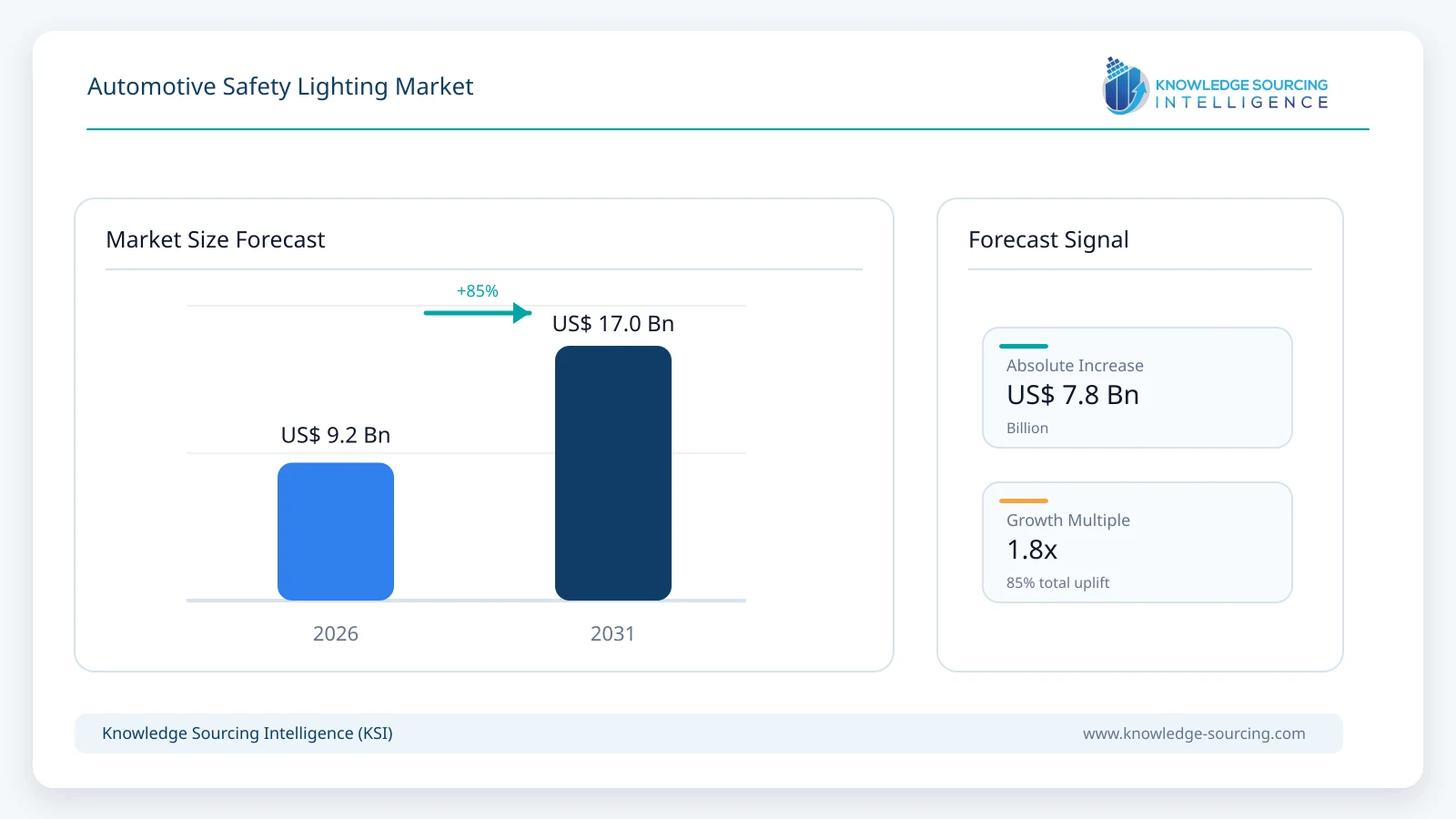
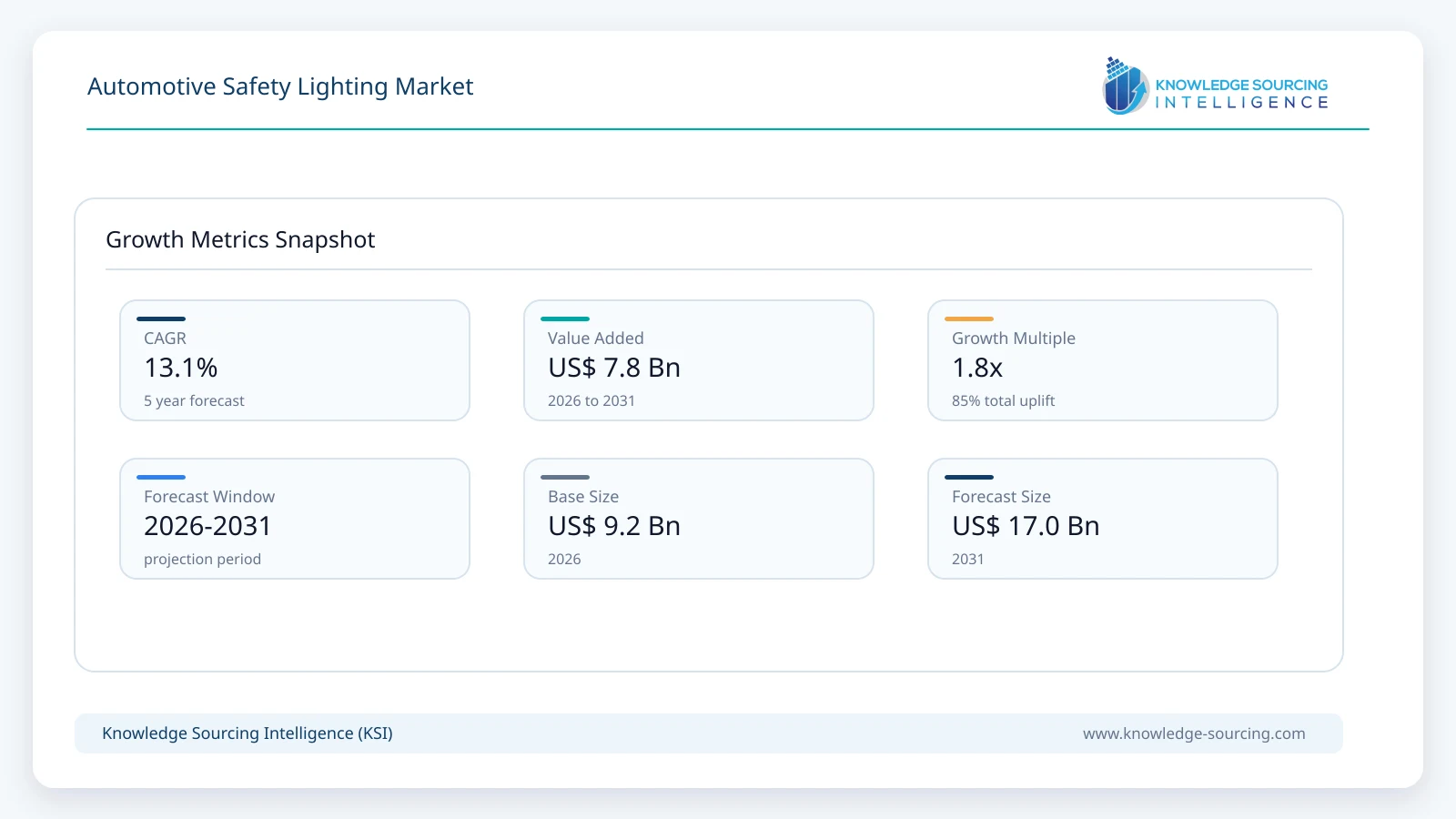
The automotive safety lighting market is anticipated to grow at a CAGR of 13.1%, from USD 9.2 billion in 2026 to USD 17.0 billion by 2031.
Highlights:
- 1Adaptive driving beam and high-resolution forward lighting account for approximately 46% of global market value in 2026 because they combine glare control, extended visibility and software-defined beam shaping within one safety-critical lighting platform.
- 2Matrix LED systems represent approximately 38% of 2026 technology value, while MicroLED and other high-resolution pixel architectures are gaining share as premium functions move into compact and upper-midrange vehicles.
- 3Front-mounted safety lighting accounts for approximately 68% of global market value in 2026 because forward visibility and glare-free high beam remain the largest safety-related lighting functions.
- 4Camera- and sensor-adaptive control represents approximately 52% of 2026 market value, reflecting the increasing use of traffic detection, steering angle, map data and ADAS inputs to manage beam distribution.
- 5Passenger vehicles account for approximately 92% of global market value in 2026, supported by wider adoption of adaptive headlamps across premium and higher-volume passenger platforms.
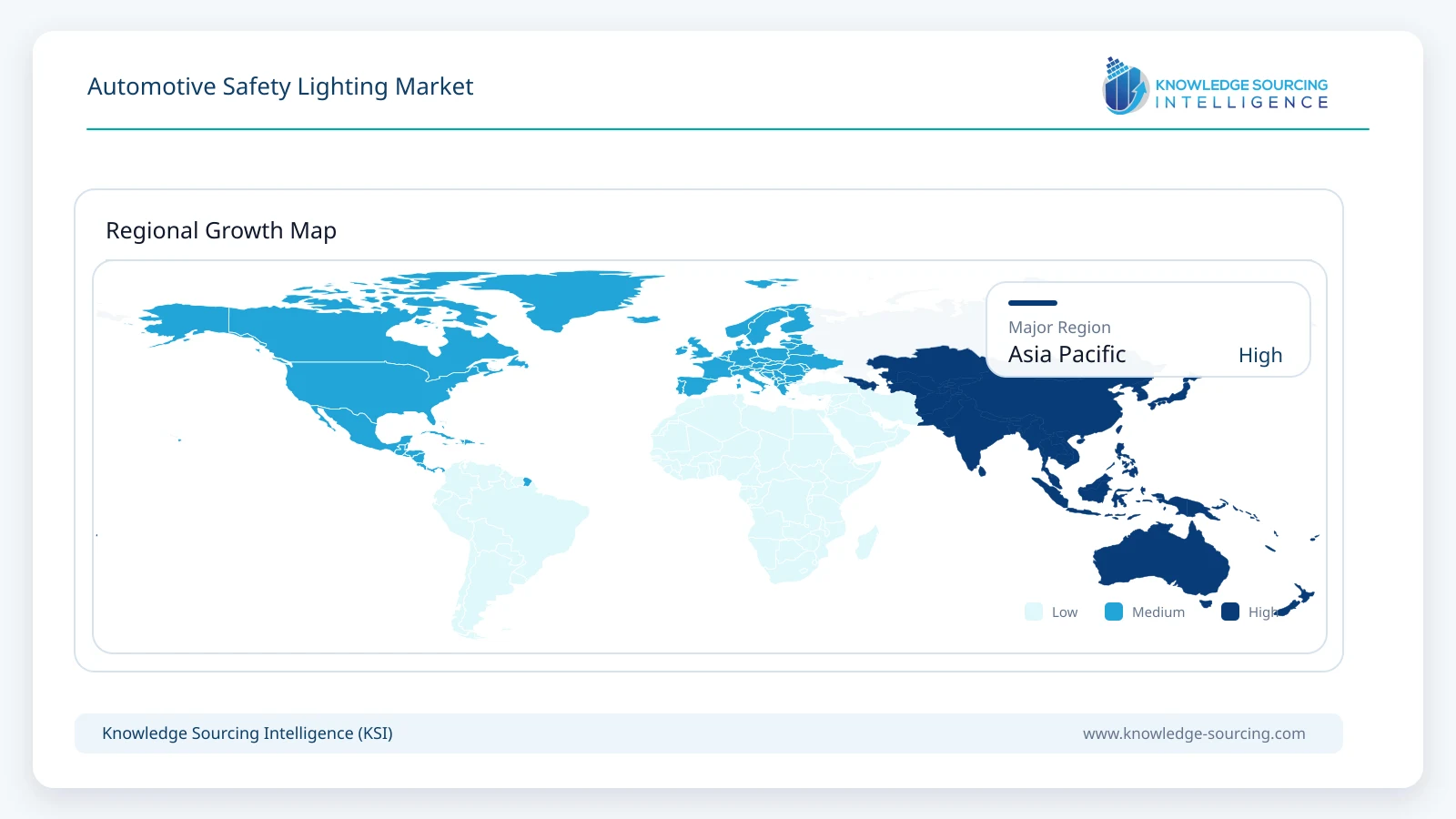
- 6Asia Pacific represents approximately 44% of global market value in 2026, supported by rapid deployment of high-resolution headlamps in China and strong regional lighting manufacturing in Japan and South Korea.
Nighttime visibility, glare control and faster recognition of hazards are pushing automotive lighting beyond fixed beam patterns toward systems that react continuously to traffic, road geometry, weather and driver-assistance inputs.
Adaptive driving beam and high-resolution forward lighting form the largest value pool because they allow the vehicle to maintain strong long-range illumination while selectively masking other road users. Pixel-controlled headlamps are also adding lane guidance, hazard highlighting and approved projection functions, increasing the safety value of the same front-lighting hardware.
The market measures the incremental value of advanced safety-oriented lighting hardware, optics, sensors, control electronics and attributable software. Conventional fixed low beam, high beam, stop, tail, turn and daytime-running lamp value is excluded unless the lamp incorporates an adaptive, predictive, high-resolution or safety-communication function.
Market Overview
Safety lighting improves the quality, timing or location of illumination rather than simply increasing lamp output. Adaptive systems can maintain high-beam visibility while creating dark zones around approaching vehicles, curve lighting can redirect illumination before the driver enters a bend, and road projections can place guidance or warning information directly within the driver's field of view.
The lighting system is increasingly connected to cameras, radar, steering data, navigation maps and centralized vehicle software. This allows the beam pattern or warning output to change according to actual road conditions, while high-resolution LED and MicroLED modules provide the pixel density required for precise masking and projection.
Safety functions are also spreading beyond the headlamp. Digital rear lamps can improve emergency or hazard signaling, side or ground lighting can warn during door opening or low-speed maneuvers, and interior light cues can direct attention toward a blind-spot or assistance-system event without forcing the driver to look at another display.
Market Trends
High-Resolution ADB Is Moving into Higher-Volume Vehicle Segments
MicroLED and dense matrix systems that were initially concentrated in flagship vehicles are entering compact and upper-midrange platforms as module size, cost and production maturity improve. The Audi Q3's 2026 series use of a 25,600-pixel MicroLED headlamp illustrates how premium-level glare-free high beam and guidance functions are moving below the traditional luxury flagship class.
Broader adoption increases the addressable market because the safety benefit is no longer dependent on low-volume premium models, while common high-resolution platforms can be scaled across several vehicle lines.
Lighting Is Becoming More Closely Linked with ADAS
Lane-change assistance, lane-departure warnings, traffic-sign recognition and navigation data are beginning to influence how advanced headlamps shape or project light. Audi's digital matrix systems can reflect blind-spot and lane-departure information in the lane light, while other high-resolution systems project lane guidance through construction zones.
Closer integration reduces the separation between perception, decision-making and lighting output, making the headlamp an active endpoint within the broader driver-assistance system.
Road Projection Is Shifting toward Safety-Relevant Guidance
Higher pixel density and brighter optical systems are allowing selected guidance and warning symbols to be projected directly onto the roadway rather than shown only on the instrument cluster. Lane markers, hazard triangles, road-risk highlighting and navigation cues can reduce the distance between the driver's visual attention and the information source.
The commercial opportunity will remain linked to regulation because permissible symbols, colors and locations differ by market, but technical readiness is advancing faster than the legal framework.
Glare Control Is Becoming as Important as Maximum Illumination
Better nighttime visibility cannot come at the expense of other road users, making selective dimming and precise beam cut-off central to advanced lighting design. IIHS reported in its 2026 headlight review that only 5% of tested model-year 2026 systems produced excessive glare, compared with 21% in model year 2017, showing measurable improvement in beam control.
The same safety requirement favors higher-resolution systems because more individually controlled pixels allow the vehicle to preserve useful high-beam illumination around traffic rather than switching the entire beam down.
Software-Defined Lighting Is Extending Safety Functions after SOP
High-resolution headlamps increasingly use software to manage beam patterns, masking logic and approved projections, allowing the same hardware platform to support several safety functions. FORVIA HELLA's SSL | HD platform can add new lighting functions through over-the-air software updates without changing the headlamp hardware.
This creates a longer functional lifecycle for advanced lighting systems and strengthens the value of common pixel-light platforms that can be adapted to regional rules and different vehicle trims.
Segment Analysis
By Safety Function: Adaptive Driving Beam and High-Resolution Forward Lighting
Selective high-beam masking and pixel-level light distribution provide the strongest direct safety case because they improve long-range visibility without exposing approaching or preceding road users to the full high beam. High-resolution systems also provide the optical foundation for lane guidance, hazard highlighting and future safety projections.
Adaptive driving beam and high-resolution forward lighting account for approximately USD 4.23 billion in 2026 and are projected to approach USD 8.67 billion by 2031. The segment gains share as MicroLED and dense matrix systems move into more vehicle classes.
By Technology: Matrix LED Systems
Matrix LED remains the largest technology class because it offers proven automotive durability, strong glare-free high-beam performance and a scalable cost structure across premium and mainstream applications. The architecture can vary from relatively low segment counts to much denser matrices depending on the required precision.
Matrix LED systems represent approximately USD 3.50 billion in 2026 and are projected to reach about USD 5.10 billion by 2031. Their share declines as MicroLED and high-resolution pixel systems grow faster, but matrix LED remains the volume foundation for advanced safety lighting.
By Vehicle Location: Front Safety Lighting
Forward lighting dominates market value because nighttime crash avoidance depends heavily on how far and how clearly the driver can see the road, pedestrians, cyclists, animals and obstacles. Adaptive high beam, curve lighting, weather functions and road projection all concentrate significant optical and electronic content in the front lamp.
Front safety lighting accounts for approximately USD 6.26 billion in 2026 and is projected to exceed USD 11.05 billion by 2031. Rear, side and interior safety-lighting functions will grow faster from smaller bases but will not displace the front system as the largest value pool.
By Control Architecture: Camera- and Sensor-Adaptive Lighting
Camera and sensor inputs allow advanced lighting systems to detect other vehicles, road geometry and selected hazards before changing the light distribution. Steering angle, yaw data, vehicle speed and navigation maps can further refine cornering and predictive beam behavior.
Sensor-adaptive control represents approximately USD 4.78 billion in 2026 and is projected to approach USD 9.18 billion by 2031 as lighting becomes more tightly integrated with ADAS domain controllers.
By Vehicle Type: Passenger Vehicles
Passenger cars, SUVs and MPVs dominate demand because adaptive front lighting and digital headlamp technologies are being introduced first on premium and high-content passenger platforms before moving into commercial vehicles. China's NEV market is accelerating the transition by adopting high-resolution headlamps at a fast model-development pace.
Passenger vehicles account for approximately USD 8.46 billion in 2026 and are projected to reach about USD 15.47 billion by 2031. Commercial vehicles remain a smaller segment but offer clear safety value in long-distance night operation and large-vehicle maneuvering.
Market Drivers
Nighttime Crash Risk Is Keeping Headlight Performance under Continuous Scrutiny
About half of traffic deaths occur in darkness or at dawn or dusk according to IIHS, keeping forward visibility and glare management central to road-safety improvement. Headlight ratings have also become more demanding, with acceptable or good headlights required across trim levels for 2026 IIHS Top Safety Pick qualification.
OEMs therefore have both safety and rating incentives to improve beam reach, consistency and glare control rather than treating lighting as a styling-only purchase feature.
Adaptive Driving Beam Regulation Is Expanding the Addressable Market
Europe and several other markets have used adaptive driving beam for years, while the United States began permitting ADB under FMVSS No. 108 in 2022. NHTSA's October 2026 announcement that it would modernize lighting standards around glare, performance and testing signals continued regulatory attention to advanced headlighting.
Greater alignment between regional requirements would reduce engineering duplication and make it easier for OEMs to deploy common high-resolution lighting platforms globally.
ADAS Integration Is Creating More Safety-Relevant Lighting Inputs
Cameras, radar, navigation data and driver-assistance software already identify lane position, traffic, road curvature and selected hazards. Using the same information to control the headlamp allows light to anticipate rather than simply react to steering or manual driver input.
The incremental cost becomes easier to justify when lighting shares perception and computing resources with ADAS rather than requiring a completely separate sensing stack.
MicroLED and Pixel Lighting Are Increasing Functional Density
Tens of thousands of individually controllable emitters can create narrow masking zones, precise guidance patterns and more accurate adaptive beams from a compact module. The technology also improves packaging because high-resolution light sources can reduce the size of conventional optical assemblies.
As production volumes increase, the same module can support safety, communication and personalization functions through software, improving platform economics across several vehicle variants.
OEM Competition in China Is Accelerating Advanced Lighting Adoption
Chinese NEV manufacturers increasingly use high-resolution headlamps and digital light functions as visible technology features, shortening the time between supplier development and series launch. FORVIA HELLA's fully localized SSL | HD system on the Zeekr 8X demonstrates how suppliers are adapting premium lighting platforms to local cost and development-speed requirements.
The scale and pace of the Chinese market are likely to push advanced safety lighting into lower price points, increasing pressure on global OEMs to match functionality.
Market Restraints
High-Resolution Safety Lighting Adds Significant Optical and Electronic Cost
Pixel LED arrays, precision optics, thermal management, cameras, control electronics and high-performance software raise system cost well above a conventional fixed LED headlamp. The additional value is easiest to justify on premium vehicles or platforms where the same hardware also supports communication and personalization.
Cost reduction will depend on common modules, higher production volumes and simplified optics rather than on LED price declines alone.
Regional Regulatory Differences Limit Global Function Reuse
ADB testing methods, permitted projections, signal behavior and photometric limits are not fully harmonized across major markets. A lighting function that is legal in Europe or China may require modification, restriction or complete deactivation elsewhere.
OEMs must therefore maintain region-specific software and validation, reducing some of the scale benefit of software-defined lighting platforms.
Glare and Misalignment Remain Safety Risks
Advanced beam control can reduce glare when correctly calibrated, but poor aim, sensor error or optical degradation can still create uncomfortable or unsafe light levels for other road users. Higher-output systems make calibration and long-term mechanical stability particularly important.
Headlamp self-leveling, diagnostics and robust mounting therefore remain necessary even when software controls the beam dynamically.
Weather and Sensor Limitations Can Reduce Adaptive Performance
Heavy rain, fog, snow, dirt or blocked cameras can limit the system's ability to detect road users and determine the correct beam pattern. Reflective road signs and wet surfaces can also create unwanted brightness that requires careful optical and software tuning.
Safety lighting must fail gracefully under these conditions, which increases validation effort and limits how aggressively some functions can operate.
Complex Lighting Software Requires Automotive-Grade Validation
Beam-shaping algorithms and safety projections affect what the driver can see and how other road users perceive the vehicle, making software errors more consequential than ordinary decorative-lighting defects. OTA updates also create a need for controlled software release processes and region-specific compliance checks.
The growing role of centralized vehicle compute increases integration efficiency but also expands the validation boundary between lighting, ADAS and cybersecurity teams.
Regional Outlook
Asia Pacific
China's rapid NEV development cycle, large passenger-vehicle production base and strong local electronics supply chain make Asia Pacific the largest automotive safety-lighting market in 2026. High-resolution headlamps are being used not only on premium models but also as visible technology differentiators on upper-midrange vehicles, increasing the addressable volume for matrix and pixel lighting.
FORVIA HELLA's localized SSL | HD production for the Zeekr 8X, ams OSRAM's EVIYOS deployments on NIO models and broader adoption by Japanese and South Korean OEMs support continued regional growth. Supplier localization should also reduce cost and shorten development cycles, helping advanced safety functions move into more vehicle segments through 2031.
Europe
Long-standing use of adaptive driving beam, strong premium-vehicle production and UNECE-based lighting regulation keep Europe a high-value market for advanced safety lighting. German OEMs continue to commercialize digital matrix and MicroLED headlamps with glare-free high beam, lane guidance and hazard-related projection functions.
European suppliers including FORVIA HELLA, Valeo, Marelli and ZKW maintain strong capabilities in advanced optics, electronics and high-resolution modules, while UNECE Regulation No. 149 provides the technical framework for road-illumination devices. Future growth will come from wider adoption below the premium segment and more software-enabled safety functions from common headlamp hardware.
Competitive Landscape
Advanced safety lighting is led by global lighting Tier 1 suppliers and semiconductor companies with the optical, electronic and software capability required for adaptive headlamps. FORVIA HELLA, Valeo, Marelli, ZKW, Koito and Stanley Electric compete through complete lighting systems, while ams OSRAM supplies high-resolution MicroLED light sources that enable pixel-level beam control.
The competitive focus is shifting from lumen output toward resolution, masking accuracy, optical efficiency, thermal management and software integration with ADAS. Suppliers that can scale one platform from conventional matrix functions to high-resolution projection have a cost advantage because OEMs can differentiate vehicle grades without redesigning the full headlamp.
Regulatory engineering is becoming another important capability as functions need to be adapted to different photometric and projection requirements. Series-production wins will increasingly depend on combining global compliance, localized manufacturing and software flexibility rather than offering the highest pixel count alone.
Recent Developments
6 October 2026: NHTSA announced a new effort to modernize U.S. vehicle-lighting standards under FMVSS No. 108, with headlight glare, performance and updated testing procedures identified as core areas for rulemaking.
28 May 2026: FORVIA HELLA launched fully localized production of its SSL | HD high-resolution headlamp system in China for the Zeekr 8X, using around 25,000 individually controlled pixels per headlamp for lane guidance, glare-free illumination and safety-related projections.
24 April 2026: Valeo presented Color Ultra High Definition Laser Projection at Auto China 2026, positioning the headlamp as a platform for projecting navigation and safety cues directly onto the road.
2 April 2026: Marelli introduced its 25K and 40K h-Digi MicroLED headlamp portfolio at Auto China 2026, supporting high-precision adaptive driving beam, road projection and dynamic front-lighting functions.
23 March 2026: ams OSRAM announced series deployment of EVIYOS HD25 in the Audi Q3 through ZKW's microZ module, bringing 25,600-pixel adaptive projection lighting into the premium compact segment.
30 January 2026: Mercedes-Benz opened orders for the updated S-Class with next-generation DIGITAL LIGHT, using new MicroLED technology, a larger high-resolution illumination field and a swiveling ULTRA RANGE high beam reaching up to 600 meters.
Market Outlook
Wider adoption of adaptive driving beam, denser pixel-light architectures and closer integration with driver-assistance systems is expected to expand the automotive safety lighting market from approximately USD 9.200 billion in 2026 to about USD 17.000 billion by 2031. Adaptive forward illumination will remain the largest value pool, while high-resolution projection and software-defined safety functions grow faster.
MicroLED will gain share from conventional matrix systems as cost and production maturity improve, but matrix LED will remain important across higher-volume platforms where precise glare-free lighting can be delivered without the highest pixel density. The strongest system architectures will combine forward visibility, masking, guidance and selected communication functions from one common optical platform.
Asia Pacific is expected to retain the largest regional position, while Europe continues to provide a strong regulatory and premium-technology base. Long-term market growth will depend on regulatory harmonization, measurable safety performance, reliable sensor integration and the ability to reduce cost without weakening glare control or optical precision.
Automotive Safety Lighting Market Scope
| Report Metric | Details |
|---|---|
| Total Market Size in 2026 | USD 9.2 billion |
| Total Market Size in 2031 | USD 17.0 billion |
| Forecast Unit | Billion |
| Growth Rate | 13.1% |
| Study Period | 2021 to 2031 |
| Historical Data | 2021 to 2024 |
| Base Year | 2025 |
| Forecast Period | 2026 – 2031 |
| Segmentation | Safety Function, Technology, Vehicle Location, Control Architecture, Vehicle Type, Geography |
| Companies |
|
| Customization Scope | 15% Free Customization included with purchase — Request Custom Breakdown → |
| Sample & Data Access | PDF Sample, Excel Databook & Analyst Briefing — Download Free Sample → |
Market Segmentation
By Safety Function
Adaptive Driving Beam and High-Resolution Forward Lighting
Curve, Cornering and Weather-Adaptive Front Lighting
Dynamic Signaling and Emergency Warning Lighting
Road and Ground Projection Safety Lighting
Interior, Door and Occupant Safety Lighting
By Technology
Matrix LED Systems
MicroLED and High-Resolution Pixel Systems
Adaptive LED Modules
OLED and Surface Signal Lighting
Laser, MEMS and DLP Projection
Other Safety Lighting Technologies
By Vehicle Location
Front Safety Lighting
Rear Safety Lighting
Side and Ground Safety Lighting
Interior Safety Lighting
By Control Architecture
Camera- and Sensor-Adaptive Lighting
Vehicle-State and Event-Triggered Lighting
ADAS- and Navigation-Linked Lighting
Driver-Controlled and Semi-Automatic Lighting
By Vehicle Type
Passenger Vehicles
Light Commercial Vehicles
Medium and Heavy Commercial Vehicles and Buses
By Geography
North America
United States
Canada
Mexico
South America
Brazil
Argentina
Others
Europe
Germany
United Kingdom
France
Italy
Spain
Others
Middle East and Africa
Saudi Arabia
UAE
South Africa
Others
Asia Pacific
China
Japan
South Korea
India
Indonesia
Thailand
Others
Table of Contents
1. INTRODUCTION
1.1. Market Overview
1.2. Market Definition
1.3. Scope of the Study
1.4. Market Segmentation
1.5. Currency
1.6. Assumptions
1.7. Base and Forecast Years
1.8. Key Benefits to Stakeholders
2. RESEARCH METHODOLOGY
2.1. Research Design
2.2. Secondary Research
2.3. Primary Research
2.4. Market Estimation
2.5. Segment Modelling
2.6. Data Triangulation and Validation
3. EXECUTIVE SUMMARY
3.1. Key Findings
3.2. Automotive Safety Lighting Market Size, 2026-2031
3.3. Safety Function Outlook
3.4. Technology Outlook
3.5. Vehicle Location Outlook
3.6. Control Architecture Outlook
3.7. Vehicle Type Outlook
3.8. Regional Opportunity Summary
4. MARKET DYNAMICS
4.1. Market Drivers
4.1.1. Nighttime Crash Risk Is Keeping Headlight Performance under Continuous Scrutiny
4.1.2. Adaptive Driving Beam Regulation Is Expanding the Addressable Market
4.1.3. ADAS Integration Is Creating More Safety-Relevant Lighting Inputs
4.1.4. MicroLED and Pixel Lighting Are Increasing Functional Density
4.1.5. OEM Competition in China Is Accelerating Advanced Lighting Adoption
4.2. Market Restraints
4.2.1. High-Resolution Safety Lighting Adds Significant Optical and Electronic Cost
4.2.2. Regional Regulatory Differences Limit Global Function Reuse
4.2.3. Glare and Misalignment Remain Safety Risks
4.2.4. Weather and Sensor Limitations Can Reduce Adaptive Performance
4.2.5. Complex Lighting Software Requires Automotive-Grade Validation
4.3. Market Opportunities
4.4. Porter's Five Forces Analysis
4.5. Industry Value Chain Analysis
4.6. Safety Lighting Hardware, Software and Integration Economics
4.7. FMVSS No. 108, UN R149 and Headlight Performance Requirements
5. TECHNOLOGY OUTLOOK
5.1. Matrix LED Adaptive Headlamps
5.2. MicroLED and High-Resolution Pixel Headlamps
5.3. Adaptive Driving Beam Control
5.4. Curve, Cornering and Predictive Front Lighting
5.5. Weather-Adaptive and Anti-Glare Lighting
5.6. Road and Ground Safety Projection
5.7. Dynamic Brake, Hazard and Rear Safety Lighting
5.8. Side and Door-Opening Warning Lighting
5.9. Interior Safety and Attention Guidance Lighting
5.10. Camera, Radar and ADAS Data Integration
5.11. Map- and Navigation-Linked Lighting Control
5.12. OTA Updates, Diagnostics and Functional Validation
6. AUTOMOTIVE SAFETY LIGHTING MARKET BY SAFETY FUNCTION
6.1. Introduction
6.2. Adaptive Driving Beam and High-Resolution Forward Lighting
6.3. Curve, Cornering and Weather-Adaptive Front Lighting
6.4. Dynamic Signaling and Emergency Warning Lighting
6.5. Road and Ground Projection Safety Lighting
6.6. Interior, Door and Occupant Safety Lighting
7. AUTOMOTIVE SAFETY LIGHTING MARKET BY TECHNOLOGY
7.1. Introduction
7.2. Matrix LED Systems
7.3. MicroLED and High-Resolution Pixel Systems
7.4. Adaptive LED Modules
7.5. OLED and Surface Signal Lighting
7.6. Laser, MEMS and DLP Projection
7.7. Other Safety Lighting Technologies
8. AUTOMOTIVE SAFETY LIGHTING MARKET BY VEHICLE LOCATION
8.1. Introduction
8.2. Front Safety Lighting
8.3. Rear Safety Lighting
8.4. Side and Ground Safety Lighting
8.5. Interior Safety Lighting
9. AUTOMOTIVE SAFETY LIGHTING MARKET BY CONTROL ARCHITECTURE
9.1. Introduction
9.2. Camera- and Sensor-Adaptive Lighting
9.3. Vehicle-State and Event-Triggered Lighting
9.4. ADAS- and Navigation-Linked Lighting
9.5. Driver-Controlled and Semi-Automatic Lighting
10. AUTOMOTIVE SAFETY LIGHTING MARKET BY VEHICLE TYPE
10.1. Introduction
10.2. Passenger Vehicles
10.3. Light Commercial Vehicles
10.4. Medium and Heavy Commercial Vehicles and Buses
11. AUTOMOTIVE SAFETY LIGHTING MARKET BY GEOGRAPHY
11.1. North America
11.1.1. United States
11.1.2. Canada
11.1.3. Mexico
11.2. South America
11.2.1. Brazil
11.2.2. Argentina
11.2.3. Others
11.3. Europe
11.3.1. Germany
11.3.2. United Kingdom
11.3.3. France
11.3.4. Italy
11.3.5. Spain
11.3.6. Others
11.4. Middle East and Africa
11.4.1. Saudi Arabia
11.4.2. UAE
11.4.3. South Africa
11.4.4. Others
11.5. Asia Pacific
11.5.1. China
11.5.2. Japan
11.5.3. South Korea
11.5.4. India
11.5.5. Indonesia
11.5.6. Thailand
11.5.7. Others
12. COMPETITIVE ENVIRONMENT AND ANALYSIS
12.1. Major Players and Strategy Analysis
12.2. Market Share Analysis
12.3. Matrix LED and ADB Performance Benchmarking
12.4. MicroLED and High-Resolution Headlamp Benchmarking
12.5. Projection and Safety Communication Benchmarking
12.6. ADAS Integration and Software Capability Benchmarking
12.7. Regulatory Readiness and Series-Production Benchmarking
12.8. Competitive Dashboard
13. COMPANY PROFILES
13.1. FORVIA HELLA
13.2. Valeo
13.3. Marelli
13.4. ZKW Group
13.5. Koito Manufacturing Co., Ltd.
13.6. Stanley Electric Co., Ltd.
13.7. ams OSRAM
13.8. Hyundai Mobis
13.9. Magna International Inc.
13.10. Varroc Engineering Ltd.
14. APPENDIX
14.1. Currency
14.2. Assumptions
14.3. Base and Forecast Years Timeline
14.4. Key Benefits for Stakeholders
14.5. Research Methodology
14.6. Abbreviations
14.7. Data Sources





Frequently asked questions
What is the projected growth for the Automotive Safety Lighting Market?
The Automotive Safety Lighting Market will grow at a 13.1% CAGR, reaching USD 17.0 billion by 2031.
Which lighting technologies hold the largest market share?
Adaptive driving beam and high-resolution forward lighting account for 46% in 2026.
Which vehicle segment drives the most market value?
Passenger vehicles account for approximately 92% of global market value in 2026.
Which region leads the Automotive Safety Lighting Market?
Asia Pacific accounts for 44% of global market value in 2026.
What control mechanism holds the largest market value share?
Camera- and sensor-adaptive control represents 52% of 2026 market value.
What are the main drivers for automotive safety lighting innovation?
Nighttime visibility, glare control, and faster hazard recognition are key drivers.
Cite this report
Knowledge Sourcing Intelligence. (Oct 2026). Automotive Safety Lighting Market Size, Share & Growth Forecast (2026-2031). https://www.knowledge-sourcing.com/report/automotive-safety-lighting-market