
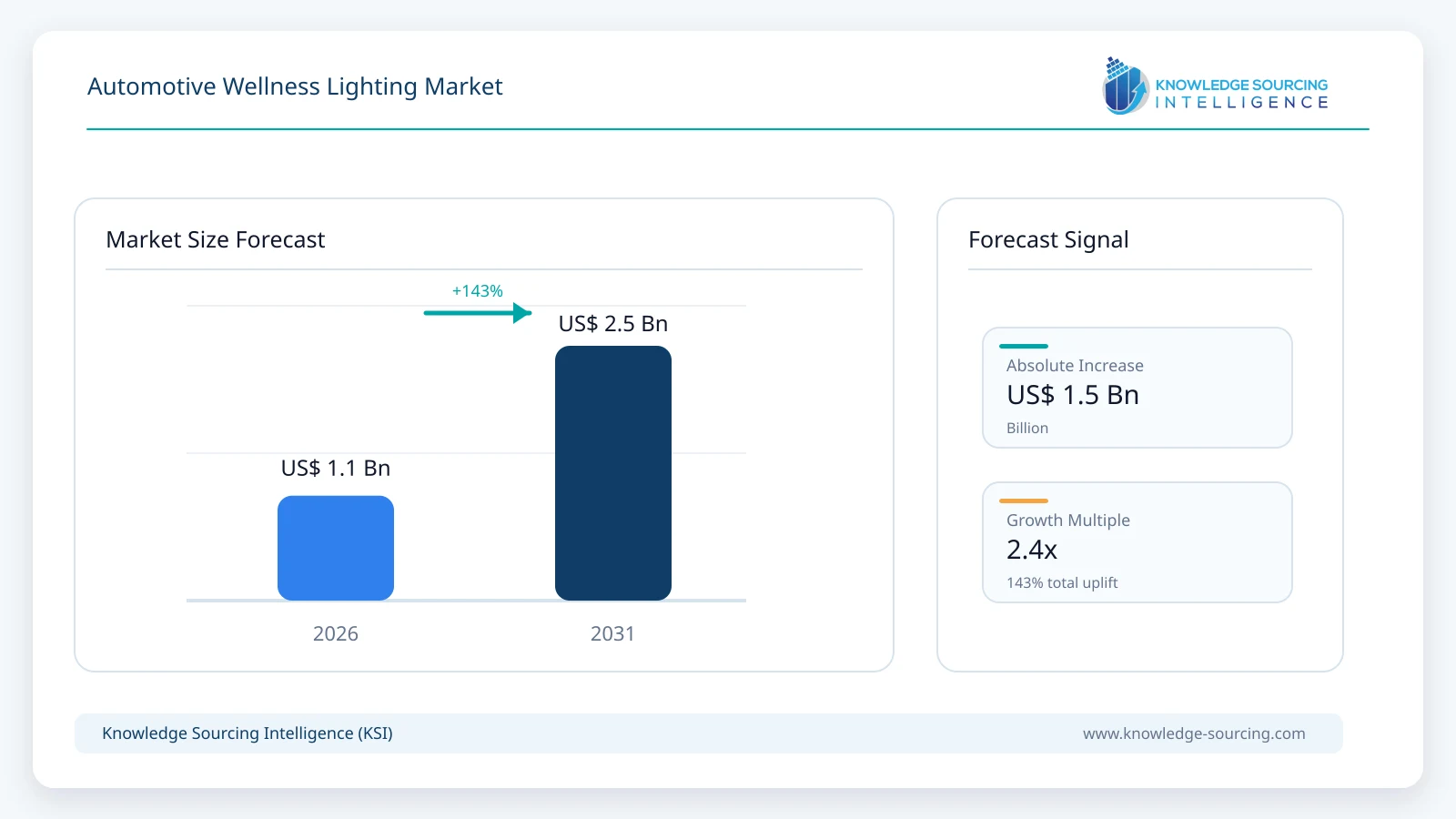
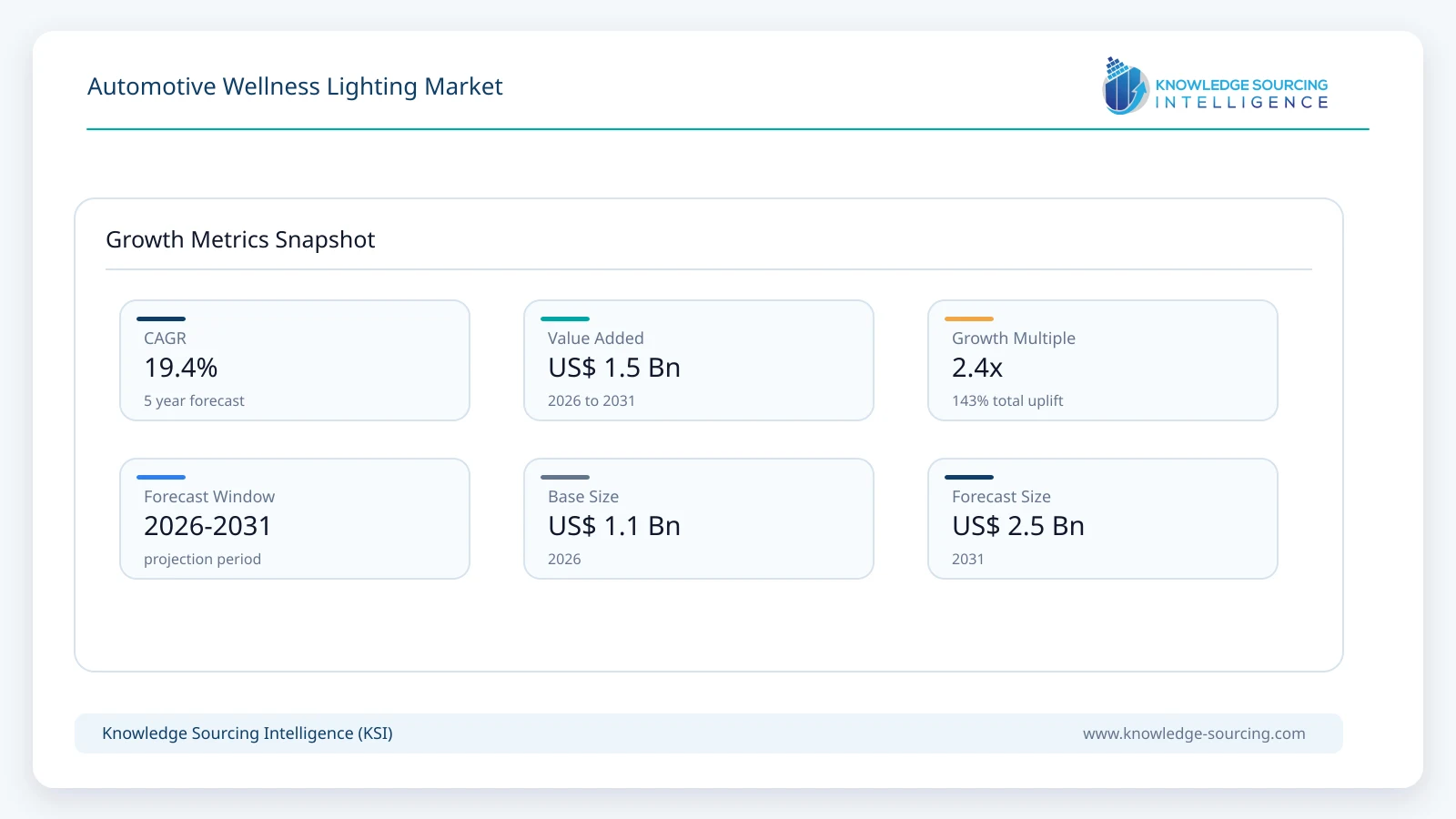
The automotive wellness lighting market is growing at a CAGR of 19.4%, from USD 1.05 billion in 2026 to USD 2.55 billion by 2031.
Highlights:
- 1Circadian and tunable-white lighting accounts for approximately 45% of global market value in 2026, reflecting the strongest technical link between light spectrum, time-of-day adaptation and occupant well-being.
- 2Pre-programmed wellness lighting scenarios represent approximately 41% of 2026 control architecture value, while sensor-adaptive and biometric-responsive systems are gaining share as occupant monitoring becomes more capable.
- 3Driver alertness, fatigue and stress-management applications account for approximately 38% of 2026 market value because the safety and comfort case is strongest where lighting supports the driver over long or late journeys.
- 4Roof, overhead and upper-cabin lighting zones represent approximately 31% of 2026 demand because they provide broad indirect illumination and allow tunable-white or calming light to influence the complete cabin environment.
- 5Passenger vehicles account for approximately 97% of global market value in 2026, led by premium cars, EVs and technology-focused SUVs with advanced comfort packages.
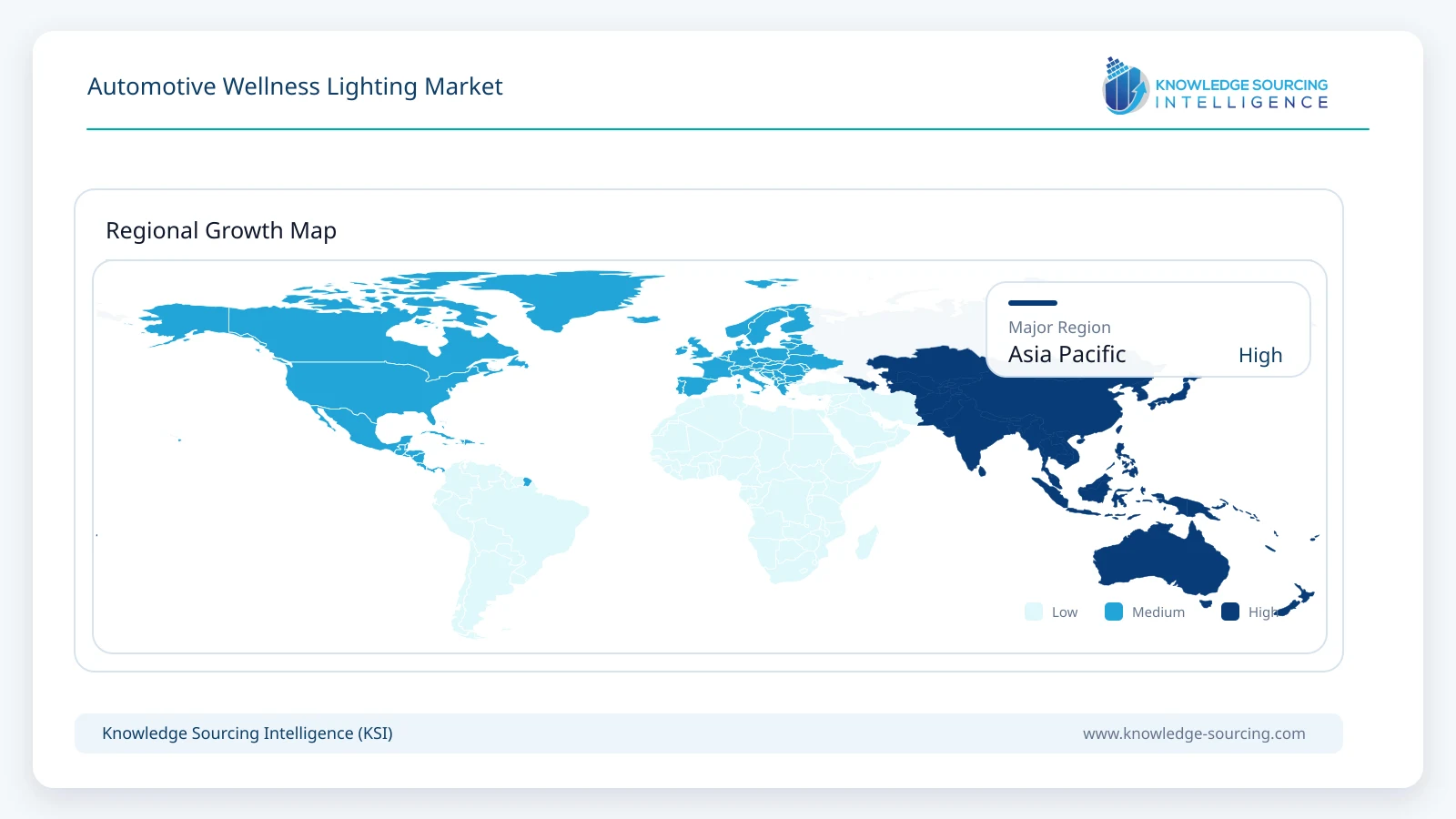
- 6Asia Pacific represents approximately 44% of global market value in 2026, supported by rapid smart-cabin adoption in China, Japan and South Korea and growing use of human-centric lighting on new EV platforms.
Growing emphasis on occupant well-being is moving automotive lighting beyond ambience toward functions that are designed around fatigue, stress, relaxation and biological response.
Circadian and tunable-white lighting forms the largest functional group because controlled color temperature and intensity can support alertness during active driving and a calmer environment during evening or rest periods. Adaptive mood and relaxation lighting adds a broader emotional layer, while sensor-responsive systems are beginning to adjust lighting according to occupant state, eye movement, time of day or selected cabin mode.
The market is limited to lighting hardware, control electronics and software specifically attributable to wellness functions. Conventional dome and reading lamps, decorative ambient lighting without a defined well-being purpose, general HMI warning lighting and the full value of seats, audio, climate or fragrance systems used in multisensory programs are excluded.
Market Overview
Wellness lighting is differentiated by the intended occupant outcome rather than by a single lamp type or color range. A system may increase color temperature and brightness to support alertness, shift toward warmer and lower-intensity light during relaxation, coordinate dynamic effects with breathing or massage programs, or use sensor data to alter the lighting response when fatigue or discomfort is detected.
Circadian lighting provides the clearest technical foundation because tunable-white LEDs can vary spectral content across the day, but the wellness category is broader. OEMs are also using calibrated RGB lighting, indirect light distribution, animated patterns and personalized scenes to support calmness, concentration, emotional comfort and reduced sensory stress.
Integration with other cabin systems is becoming more important as premium vehicles combine lighting with seat massage, soundscapes, climate settings, fragrance and display content. The lighting layer adds value when these functions are coordinated around a defined wellness scenario rather than operated independently, which is increasing demand for centralized software control and occupant-state inputs.
Market Trends
Human-Centric Lighting Is Moving Closer to Occupant-State Adaptation
Biometric sensing, eye tracking and occupant-monitoring data are creating a path from user-selected lighting scenes toward lighting that responds to the condition of the driver or passengers. Hyundai Mobis has demonstrated human-centric lighting that uses biometric signals and eye movement to support circadian rhythm, mental wellness, stress reduction and motion-sickness mitigation.
Early systems remain concentrated in premium and concept vehicles, but the direction is commercially important because it links wellness lighting to sensor platforms that OEMs are already installing for safety and personalization.
Circadian-Aligned White Light Is Becoming a Distinct Premium Function
Tunable-white lighting gives OEMs a more defensible wellness function than purely decorative color selection because color temperature and brightness can be coordinated with time of day, driving conditions and rest scenarios. FORVIA HELLA now positions tunable-white reading and overhead lighting as part of circadian-aligned cabin illumination rather than as a simple convenience feature.
Higher-quality white-light control also improves visual comfort during reading, work and night driving, allowing the same hardware to support both functional and wellness use cases.
Emotional Lighting Is Being Studied for Non-Visual Effects
Research is moving beyond whether occupants prefer a particular color toward how lighting may influence emotional state, attention and cognitive performance. Antolin's LUXIA project is specifically evaluating the non-visual effects of color, intensity and dynamic lighting patterns on well-being and user experience.
This work can help OEMs move from subjective mood themes toward evidence-based lighting scenarios, which should improve credibility and reduce the risk of wellness claims being treated as styling language.
Multisensory Wellness Programs Are Increasing Lighting Value
Premium wellness packages increasingly combine light with massage, audio, climate and display content so occupants experience one coordinated mode rather than several unrelated comfort features. Mercedes-Benz ENERGIZING COMFORT and similar concepts show how activating light, soothing sound and seat functions can be combined around recovery, relaxation or concentration.
The lighting component gains strategic value in these programs because it can change the perceived cabin atmosphere quickly and can be controlled entirely through software once suitable hardware is installed.
Rest and Lounge Modes Are Expanding beyond Conventional Passenger Cars
Long-range EVs, premium rear-seat cabins and commercial vehicles are creating more situations in which the vehicle is used for rest, work or waiting rather than continuous active driving. Lighting designed for dimmable rest phases, low-glare orientation and calming ambience is therefore becoming relevant outside traditional luxury sedans.
FORVIA HELLA's 2026 commercial-vehicle concept, which uses dynamic interior lighting to support both driving and rest phases, illustrates how wellness-oriented lighting can extend into cabins where occupants spend many hours per day.
Segment Analysis
By Wellness Function: Circadian and Tunable-White Lighting
Controlled color temperature and intensity make circadian and tunable-white lighting the largest wellness function because the same lighting network can support active-driving alertness, evening relaxation and more comfortable task lighting. The category is also easier to define technically than broad mood lighting, which helps OEMs position it as a functional comfort feature.
Circadian and tunable-white lighting accounts for approximately USD 0.47 billion in 2026 and is projected to reach about USD 1.25 billion by 2031. Its share is expected to increase as tunable-white overhead modules and sensor-based time-of-day control move into more premium and upper-midrange vehicles.
By Control Architecture: Pre-Programmed Wellness Scenarios
Pre-programmed wellness scenarios lead current adoption because they can combine calibrated lighting sequences with vehicle modes without requiring continuous biometric interpretation. Relaxation, concentration, night-driving and welcome programs can be deployed through existing cockpit software and adjusted by the occupant.
The architecture represents approximately USD 0.43 billion in 2026. Sensor-adaptive and biometric-responsive control will grow faster through 2031, but pre-programmed scenarios will remain important because they are easier to validate and can be offered across a wider range of vehicle platforms.
By Application: Driver Alertness, Fatigue and Stress Management
Driver-focused wellness functions have the strongest near-term business case because prolonged night driving, cognitive load and fatigue directly affect comfort and safety. Lighting can support alertness through brighter or cooler illumination, reduce stress through calmer visual environments and reinforce rest-mode transitions when the vehicle is stationary.
Driver wellness applications account for approximately USD 0.40 billion in 2026 and could approach USD 0.92 billion by 2031 as occupant-monitoring systems provide more reliable information about attention and fatigue.
By Lighting Location: Roof, Overhead and Upper-Cabin Zones
Overhead locations lead wellness-lighting value because broad indirect illumination can influence the complete visual environment without relying on bright point sources in the occupant's direct field of view. Roof consoles and headliner-integrated light can also combine tunable-white reading functions with low-intensity ambient and relaxation modes.
Roof and upper-cabin lighting accounts for approximately USD 0.33 billion in 2026 and is expected to remain the largest location through 2031, although door, dashboard and seat-area lighting will gain content as multisensory wellness packages become more spatially coordinated.
By Vehicle Type: Passenger Vehicles
Premium passenger cars, EVs and technology-focused SUVs account for nearly all current demand because these vehicles already carry the sensors, software architecture and high-content interior lighting needed to support wellness functions. Luxury rear-seat environments also provide a strong use case for relaxation and personalized lighting.
Passenger vehicles represent approximately USD 1.02 billion in 2026 and are projected to exceed USD 2.45 billion by 2031. Commercial vehicles remain a smaller segment, although long-haul trucks and premium buses offer meaningful opportunities for rest-phase and fatigue-management lighting.
Market Drivers
Occupant Wellness Is Becoming a Formal Cabin-Design Objective
OEM interior strategies increasingly address stress, fatigue, emotional comfort and recovery alongside traditional ergonomics and luxury. Lighting is well suited to this shift because color, brightness and spatial distribution can be changed through software without adding moving mechanical systems.
The feature also scales across several cabin zones, allowing one lighting network to support multiple wellness programs rather than a single fixed comfort function.
Occupant Monitoring Is Creating Better Inputs for Adaptive Lighting
Driver and occupant-monitoring cameras are improving the vehicle's ability to detect eye closure, gaze, head position and selected signs of fatigue or discomfort. When this information is connected to interior lighting, the system can move beyond a manual mood selection toward context-aware brightness and color changes.
The same sensing infrastructure can support safety, personalization and wellness, improving the economics of adaptive lighting because the required inputs are shared across several vehicle functions.
Premium EVs Are Using the Cabin as a Primary Differentiation Space
Electric powertrains reduce many of the traditional mechanical cues used to differentiate premium vehicles, increasing the importance of the interior experience. Lighting can create a visible sense of calm, energy or personalization while reinforcing the digital character of an EV cabin.
Chinese and global premium EV makers are therefore accelerating adoption of dense ambient lighting, lounge modes and multisensory comfort functions, creating a larger installed base for wellness-specific software and control.
Longer Journey and Rest Scenarios Are Expanding the Use Case
Long-distance EV charging stops, premium rear-seat travel, commercial-vehicle rest periods and future automated-driving scenarios increase the amount of time occupants may use the cabin for recovery rather than active driving. Lighting can help shift the environment between work, alertness and relaxation without altering the physical cabin.
This creates demand for low-glare, tunable and scene-based lighting that remains useful even when the vehicle is stationary.
Multisensory Integration Is Increasing the Value per Vehicle
Coordinating lighting with massage, audio, climate, fragrance and display content turns individual comfort features into a broader wellness experience. The lighting layer can signal the start of a program, reinforce its intended emotional effect and provide continuity across different cabin zones.
Centralized cockpit software makes these combinations easier to deploy, allowing premium wellness packages to add software value without requiring a separate hardware controller for every function.
Market Restraints
Wellness Benefits Are Difficult to Quantify across Different Occupants
Responses to color, brightness and dynamic lighting vary by age, personal preference, cultural context and time of day, which makes a universal wellness effect difficult to prove. A lighting scene that feels calming to one occupant may be distracting or uncomfortable to another.
OEMs therefore need personalization and conservative claims rather than relying on broad health language that cannot be supported consistently across users.
Driver Distraction Can Conflict with Wellness-Oriented Animation
Dynamic lighting intended to improve mood or engagement can become counterproductive if movement, color changes or brightness draw attention away from the road. The risk is highest when decorative effects and safety-related lighting share the same visual channels.
Clear priority rules, automatic dimming and driving-state restrictions are required so wellness scenarios remain supportive rather than adding visual workload.
Biometric Adaptation Raises Privacy and Validation Requirements
Lighting that responds to eye movement, fatigue indicators or other biometric signals depends on accurate sensing and responsible handling of occupant data. False interpretation can produce unwanted lighting changes, while storage or cloud use of sensitive data can create privacy concerns.
Local processing, transparent consent and careful validation will become more important as wellness lighting moves from user-selected scenes toward automated physiological response.
Premium Hardware Content Limits Near-Term Penetration
Tunable-white LEDs, additional light points, optical guides, sensors and intelligent controllers cost more than conventional static cabin lighting. Wellness functions can therefore be difficult to justify in entry-level vehicles unless the same hardware also supports ambient lighting, HMI or safety communication.
Platform reuse and multifunctional lighting architectures will be important for lowering the incremental cost of wellness features as adoption spreads beyond luxury vehicles.
Scientific Evidence and Regulatory Guidance Remain Uneven
Circadian science provides a stronger evidence base than many emotional or stress-reduction claims, but automotive use introduces short exposure times, changing daylight conditions and highly variable occupant behavior. These factors make direct transfer from building or healthcare lighting research difficult.
Suppliers and OEMs will need more automotive-specific human-factors testing to support credible claims and to distinguish genuine wellness functions from premium mood-lighting features.
Regional Outlook
Asia Pacific
Rapid smart-cabin development in China and strong lighting, sensor and electronics supply chains across Japan and South Korea make Asia Pacific the largest regional automotive wellness-lighting market in 2026. Chinese EV manufacturers are particularly active in using interior lighting to create relaxation, concentration and personalized mood scenarios, while Hyundai Mobis has advanced sensor-responsive human-centric lighting concepts.
Regional growth through 2031 will come from both higher content per vehicle and broader adoption below the luxury segment. China's fast model cycles support early commercialization, while Japanese suppliers such as Toyota Boshoku and Toyoda Gosei are integrating illumination into broader comfort-focused cabin concepts.
Europe
Europe remains a high-value market because premium OEMs have already established multisensory comfort programs and advanced interior-lighting architectures. Mercedes-Benz ENERGIZING COMFORT demonstrates the commercial link between activating light, massage, audio and display content, while FORVIA HELLA and Antolin are developing human-centric and adaptive lighting technologies.
European growth is likely to emphasize validated wellness functions, lower visual distraction and higher-quality tunable-white lighting rather than simply increasing the number of RGB light points. The region's premium-vehicle mix and strong human-factors engineering base should support above-average value per vehicle even if production growth remains moderate.
Competitive Landscape
Competition spans lighting suppliers, interior-system companies, smart-cabin technology providers and premium OEMs because wellness lighting depends on both optical hardware and the software logic that connects it to occupant state. FORVIA HELLA, Valeo and ams OSRAM contribute lighting modules and control technology, while Antolin, Hyundai Mobis and Toyota Boshoku are developing broader cabin concepts that link light with emotional comfort and adaptive interior functions.
The strongest differentiation is moving toward validated use cases rather than color range alone. Suppliers able to support tunable-white calibration, sensor integration, low-glare distribution and consistent behavior across different cabin zones are better positioned than companies offering only decorative RGB effects.
OEMs are also shaping the competitive landscape through proprietary wellness programs that combine several comfort systems. This favors suppliers that can integrate with centralized vehicle software and provide lighting components that work across multiple modes without requiring a dedicated architecture for each program.
Recent Developments
3 September 2026: FORVIA HELLA presented adaptive RGB interior lighting for commercial vehicles that combines comfort, visual communication and safety functions, with dimmable ambience designed for night driving and rest phases.
19 August 2026: Genesis unveiled the GV90 with Ambient Glow mood lighting across the dashboard, doors, headliner and console, integrating lighting into a broader multisensory luxury and comfort environment.
23 April 2026: Toyota Boshoku presented the LOUNZE+ cabin concept at Auto China 2026 with illumination synchronized to visual content as part of a coordinated relaxation-focused interior space.
During 2026: Mercedes-Benz expanded ENERGIZING COMFORT into new electric vehicle programs, combining activating light with sound, massage and display content to support mental and physical recovery during journeys.
26 January 2026: Antolin advanced the LUXIA R&D project to study adaptive emotional lighting and its non-visual effects on well-being, emotional state, attention and cognitive performance.
At the 2025 Seoul Mobility Show, Hyundai Mobis demonstrated Human-Centric Interior Lighting with 32 adaptive patterns designed around circadian rhythm, stress reduction, motion-sickness mitigation and occupant-state response.
Market Outlook
Greater use of human-centric lighting, occupant sensing and software-controlled comfort modes is expected to expand the automotive wellness lighting market from approximately USD 1.050 billion in 2026 to about USD 2.550 billion by 2031. Circadian and tunable-white lighting will remain the largest functional category, while biometric-responsive and multisensory wellness scenarios grow faster from a smaller base.
The strongest commercial opportunity will come from lighting platforms that serve several purposes at once. Hardware that already supports ambient personalization, reading light and HMI can add wellness modes through improved calibration, sensing and software, reducing the incremental cost of entering the category.
Asia Pacific is expected to retain the largest regional position, while Europe continues to generate high value through premium multisensory programs and human-centric lighting development. Long-term success will depend on clear wellness outcomes, disciplined human-factors design, privacy-aware sensor integration and simple user controls that make the feature understandable rather than technically impressive but difficult to use.
Automotive Wellness Lighting Market Scope
| Report Metric | Details |
|---|---|
| Total Market Size in 2026 | USD 1.05 billion |
| Total Market Size in 2031 | USD 2.55 billion |
| Forecast Unit | Billion |
| Growth Rate | 19.4% |
| Study Period | 2021 to 2031 |
| Historical Data | 2021 to 2024 |
| Base Year | 2025 |
| Forecast Period | 2026 – 2031 |
| Segmentation | Wellness Function, Control Architecture, Application, Lighting Location, Vehicle Type, Geography |
| Companies |
|
| Customization Scope | 15% Free Customization included with purchase — Request Custom Breakdown → |
| Sample & Data Access | PDF Sample, Excel Databook & Analyst Briefing — Download Free Sample → |
Market Segmentation
By Wellness Function
Circadian and Tunable-White Lighting
Relaxation and Mood-Regulation Lighting
Alertness and Fatigue-Management Lighting
Stress and Motion-Sickness Mitigation Lighting
Multisensory and Other Wellness Lighting
By Control Architecture
Pre-Programmed Wellness Scenarios
Sensor-Adaptive Lighting
Biometric and Occupant-State Responsive Lighting
By Application
Driver Alertness, Fatigue and Stress Management
General Occupant Relaxation and Comfort
Rear-Passenger Wellness and Lounge Modes
Rest, Sleep and Stationary-Vehicle Modes
By Lighting Location
Roof, Overhead and Upper-Cabin Zones
Door and Side-Trim Lighting
Instrument Panel and Dashboard
Center Console and Footwell
Seat and Rear-Passenger Areas
By Vehicle Type
Passenger Vehicles
Light Commercial Vehicles
Medium and Heavy Commercial Vehicles and Buses
By Geography
North America
United States
Canada
Mexico
South America
Brazil
Argentina
Others
Europe
Germany
United Kingdom
France
Italy
Spain
Others
Middle East and Africa
Saudi Arabia
UAE
South Africa
Others
Asia Pacific
China
Japan
South Korea
India
Indonesia
Thailand
Others
Table of Contents
1. INTRODUCTION
1.1. Market Overview
1.2. Market Definition
1.3. Scope of the Study
1.4. Market Segmentation
1.5. Currency
1.6. Assumptions
1.7. Base and Forecast Years
1.8. Key Benefits to Stakeholders
2. RESEARCH METHODOLOGY
2.1. Research Design
2.2. Secondary Research
2.3. Primary Research
2.4. Market Estimation
2.5. Segment Modelling
2.6. Data Triangulation and Validation
3. EXECUTIVE SUMMARY
3.1. Key Findings
3.2. Automotive Wellness Lighting Market Size, 2026-2031
3.3. Wellness Function Outlook
3.4. Control Architecture Outlook
3.5. Application Outlook
3.6. Lighting Location Outlook
3.7. Vehicle Type Outlook
3.8. Regional Opportunity Summary
4. MARKET DYNAMICS
4.1. Market Drivers
4.1.1. Occupant Wellness Is Becoming a Formal Cabin-Design Objective
4.1.2. Occupant Monitoring Is Creating Better Inputs for Adaptive Lighting
4.1.3. Premium EVs Are Using the Cabin as a Primary Differentiation Space
4.1.4. Longer Journey and Rest Scenarios Are Expanding the Use Case
4.1.5. Multisensory Integration Is Increasing the Value per Vehicle
4.2. Market Restraints
4.2.1. Wellness Benefits Are Difficult to Quantify across Different Occupants
4.2.2. Driver Distraction Can Conflict with Wellness-Oriented Animation
4.2.3. Biometric Adaptation Raises Privacy and Validation Requirements
4.2.4. Premium Hardware Content Limits Near-Term Penetration
4.2.5. Scientific Evidence and Regulatory Guidance Remain Uneven
4.3. Market Opportunities
4.4. Porter's Five Forces Analysis
4.5. Industry Value Chain Analysis
4.6. Lighting Hardware, Software and Sensor Integration Economics
4.7. Human-Factors, Driver-Distraction and Interior Lighting Requirements
5. TECHNOLOGY OUTLOOK
5.1. Tunable-White and Circadian Lighting
5.2. Adaptive RGB Wellness Lighting
5.3. Full-Spectrum and High-Quality White LEDs
5.4. Sensor-Responsive Lighting Control
5.5. Biometric and Occupant-Monitoring Integration
5.6. Fatigue and Alertness-Support Lighting
5.7. Relaxation and Stress-Reduction Lighting
5.8. Motion-Sickness Mitigation Lighting
5.9. Multisensory Wellness Integration
5.10. Personalized Zone Lighting
5.11. Wellness Lighting Software and Scenario Management
5.12. Human-Factors Validation and Optical Calibration
6. AUTOMOTIVE WELLNESS LIGHTING MARKET BY WELLNESS FUNCTION
6.1. Introduction
6.2. Circadian and Tunable-White Lighting
6.3. Relaxation and Mood-Regulation Lighting
6.4. Alertness and Fatigue-Management Lighting
6.5. Stress and Motion-Sickness Mitigation Lighting
6.6. Multisensory and Other Wellness Lighting
7. AUTOMOTIVE WELLNESS LIGHTING MARKET BY CONTROL ARCHITECTURE
7.1. Introduction
7.2. Pre-Programmed Wellness Scenarios
7.3. Sensor-Adaptive Lighting
7.4. Biometric and Occupant-State Responsive Lighting
8. AUTOMOTIVE WELLNESS LIGHTING MARKET BY APPLICATION
8.1. Introduction
8.2. Driver Alertness, Fatigue and Stress Management
8.3. General Occupant Relaxation and Comfort
8.4. Rear-Passenger Wellness and Lounge Modes
8.5. Rest, Sleep and Stationary-Vehicle Modes
9. AUTOMOTIVE WELLNESS LIGHTING MARKET BY LIGHTING LOCATION
9.1. Introduction
9.2. Roof, Overhead and Upper-Cabin Zones
9.3. Door and Side-Trim Lighting
9.4. Instrument Panel and Dashboard
9.5. Center Console and Footwell
9.6. Seat and Rear-Passenger Areas
10. AUTOMOTIVE WELLNESS LIGHTING MARKET BY VEHICLE TYPE
10.1. Introduction
10.2. Passenger Vehicles
10.3. Light Commercial Vehicles
10.4. Medium and Heavy Commercial Vehicles and Buses
11. AUTOMOTIVE WELLNESS LIGHTING MARKET BY GEOGRAPHY
11.1. North America
11.1.1. United States
11.1.2. Canada
11.1.3. Mexico
11.2. South America
11.2.1. Brazil
11.2.2. Argentina
11.2.3. Others
11.3. Europe
11.3.1. Germany
11.3.2. United Kingdom
11.3.3. France
11.3.4. Italy
11.3.5. Spain
11.3.6. Others
11.4. Middle East and Africa
11.4.1. Saudi Arabia
11.4.2. UAE
11.4.3. South Africa
11.4.4. Others
11.5. Asia Pacific
11.5.1. China
11.5.2. Japan
11.5.3. South Korea
11.5.4. India
11.5.5. Indonesia
11.5.6. Thailand
11.5.7. Others
12. COMPETITIVE ENVIRONMENT AND ANALYSIS
12.1. Major Players and Strategy Analysis
12.2. Market Share Analysis
12.3. Circadian and Tunable-White Technology Benchmarking
12.4. Sensor-Adaptive and Biometric Lighting Benchmarking
12.5. Multisensory Wellness Integration Benchmarking
12.6. Human-Factors and Wellness-Use-Case Benchmarking
12.7. OEM Programs and Series-Production Readiness
12.8. Competitive Dashboard
13. COMPANY PROFILES
13.1. FORVIA HELLA
13.2. Hyundai Mobis
13.3. Antolin
13.4. Valeo
13.5. ams OSRAM
13.6. Toyota Boshoku Corporation
13.7. Toyoda Gosei Co., Ltd.
13.8. Marelli
13.9. Yanfeng Automotive Interiors
13.10. Mercedes-Benz Group AG
14. APPENDIX
14.1. Currency
14.2. Assumptions
14.3. Base and Forecast Years Timeline
14.4. Key Benefits for Stakeholders
14.5. Research Methodology
14.6. Abbreviations
14.7. Data Sources





Frequently asked questions
What is the projected market size of automotive wellness lighting by 2031?
Market projected to reach USD 2.55 billion by 2031, growing at 19.4% CAGR.
Which lighting technology holds the largest market share in 2026?
Circadian and tunable-white lighting accounts for 45% of market value in 2026.
What applications drive the most demand for wellness lighting?
Driver alertness, fatigue, and stress-management applications account for 38%.
Which region leads the global Automotive Wellness Lighting Market?
Asia Pacific represents 44% of global market value in 2026.
What vehicle segment dominates the Automotive Wellness Lighting Market?
Passenger vehicles account for 97% of global market value in 2026.
What is the primary factor driving the wellness lighting market's growth?
Growing emphasis on occupant well-being beyond ambience is driving growth.
Cite this report
Knowledge Sourcing Intelligence. (Oct 2026). Automotive Wellness Lighting Market Size, Share & Growth Forecast (2026-2031). https://www.knowledge-sourcing.com/report/automotive-wellness-lighting-market