
The France farm equipment market is estimated at USD 7.67 billion in 2026 and is projected to reach USD 9.34 billion by 2032, representing a 3.3% CAGR during the forecast period.
Highlights:
- 1Tractors are selected for detailed numerical analysis, with KSI-estimated revenue of US$2.68 billion and a 34.9% market share in 2026, rising to US$3.27 billion by 2032 at a 3.40% CAGR.
- 2Standard agricultural tractors registered 19,561 units in 2025, with another 2,027 vineyard and orchard tractors; the 33,446-unit all-category registration total includes non-core machinery and cannot be treated as tractor sales alone.
- 3French agricultural machinery demand remains weakest in standard tractors, combines and vineyard harvesters, while livestock equipment and certain specialized applications show greater resilience.
- 4French producers and suppliers are exposed to divergent marketsAXEMA reported domestic production-related sales weakening in 2025 even as agricultural machinery exports advanced.
- 5Precision spraying, targeted application, reduced-tillage equipment, financing and dealer support increasingly influence supplier differentiation and customers’ total cost of ownership.
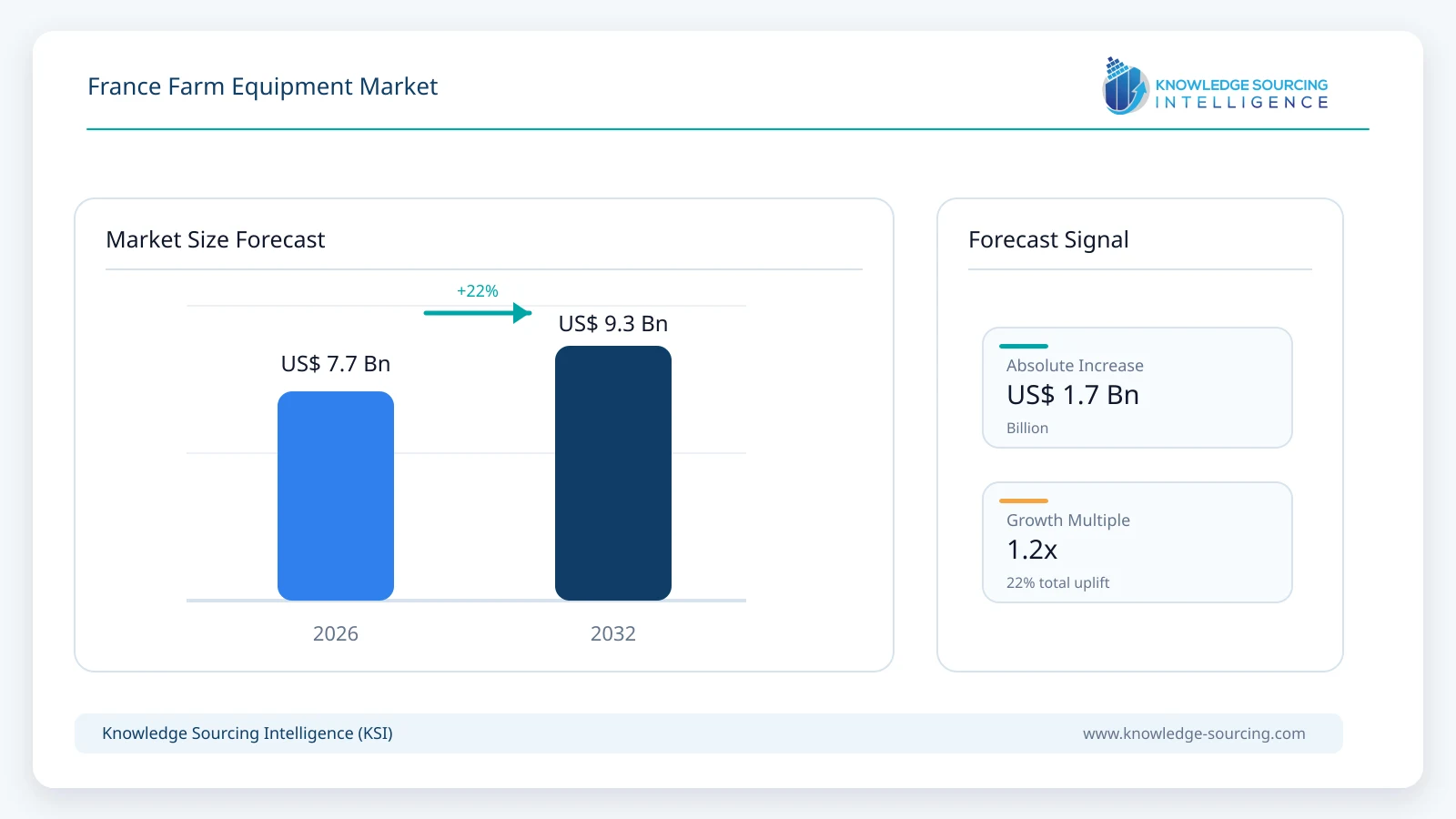
Tractors are estimated using French registration volumes, horsepower-specific selling-price benchmarks and expected 2026 purchasing trends. Harvesting machinery, tillage implements, seed drills, sprayers, fertilizer equipment, forage systems and other professional farm machinery are assessed separately through equipment volumes, replacement patterns and indicative transaction values. France enters this outlook after a sharp correction in investment: AXEMA reported a 9% fall in agro-equipment demand in 2025 and expects the market to remain weak in 2026, with recovery more likely from 2027. AXEMA's separate 2026 market forecast of €7.15 billion, equivalent to approximately US$7.96 billion, provides an external comparison rather than the KSI estimate. The moderate growth outlook reflects gradual fleet replacement, precision-equipment upgrades and selective demand from higher-utilization agricultural businesses.
The market comprises new agricultural tractors, combines and specialized harvesting machines, tillage implements, seeding and planting machinery, crop-protection equipment, fertilizer applicators, forage and livestock machinery, and other professional agricultural equipment. Standalone used-equipment transactions, aftersales repair services, unrelated landscape-maintenance machinery and software subscriptions are excluded from new-equipment revenue. These distinctions are necessary because industrial production, export turnover and domestic sales serve different accounting purposes and cannot be added together. France recorded 19,561 first registrations of standard agricultural tractors and approximately 2,027 vineyard and orchard tractors in 2025, providing an observable basis for estimating the principal equipment segment. The larger AXEMA total of 33,446 registrations also includes categories such as green-space tractors and telescopic loaders, which are not all allocated to the tractor segment in this study. Estimates are expressed in US dollars using a constant reference conversion of €1 = US$1.1133, based on the European Central Bank's October 28, 2026 reference rate. Holding that rate constant allows the forecast to reflect equipment demand and pricing rather than speculative future exchange-rate movements.
Market Dynamics
Demand Drivers: Replacement Cycles, Farm Consolidation and Precision Equipment
Mechanization demand is supported by the renewal requirements of a large agricultural installed base, not simply the creation of new farms. Agreste reported approximately 349,600 metropolitan farms in 2023 and a larger average holding size than in the preceding census. As holdings consolidate, the remaining operators often require more reliable, higher-capacity machines that can complete time-sensitive field operations across greater areas. Contractors and equipment-sharing cooperatives also concentrate purchasing decisions around operating hours, financing availability and the revenue generated from each working day. This creates a market for advanced tractors, harvesting machines and soil-management implements even when aggregate registration volumes are under pressure. Digital guidance, section control, variable-rate application and equipment telemetry can improve machine utilization and reduce wasted seed, fertilizer and crop-protection inputs. For a farm deciding between a new machine, a leased unit and a second-hand purchase, these capabilities only support a premium when they lower demonstrable operating expenditure. Dealers able to provide field demonstrations, reliable spare parts and practical operator training therefore influence conversion more than standalone technology claims.
Market Restraints: Weak Farm Income, Financing and Used-Machine Competition
The near-term restraint is the gap between the productivity advantages of new machinery and the willingness of farmers to commit capital during a period of uncertain cash flow. AXEMA estimates a further decline in the French market during 2026, after the 2025 contraction and a cumulative loss from the 2023 high. Tractors, combines and vineyard equipment face particular pressure because new models require large financing commitments, while existing machines can often remain serviceable through repair and extended maintenance. Interest rates affect both monthly payment levels and the residual value at which dealers can accept trade-ins. At the same time, second-hand equipment competes directly with manufacturers offering new machinery at a substantially higher acquisition price. OEMs must manage excess dealer inventory without undermining pricing or resale confidence. The pressure extends unevenly through the value chain: global production and exports can sustain a factory even as French domestic demand falls, whereas a dealer concentrated in a single crop basin may face a prolonged revenue downturn. These constraints justify conservative near-term sales forecasts.
Market Opportunities: Targeted Investments and Energy-Efficient Operations
Equipment that offers a measurable operational saving has greater near-term sales potential than technology positioned solely around automation. FranceAgriMer’s 2026 evaluation covered investment assistance for protein-crop production, reduced agricultural inputs and climate protection, with a combined historical program envelope of approximately US$468 million at the report’s fixed reference exchange rate. Such schemes do not guarantee continuing demand, but they show how public support has encouraged equipment categories with clearly defined agronomic benefits. For sprayers, attractive features include drift reduction, accurate section control and targeted application. For tillage and seeding, buyers compare soil disturbance, fuel consumption, residue management and the establishment of crops under increasingly variable weather conditions. Livestock producers can justify investment in feeding, handling and manure systems where equipment improves throughput or reduces labor exposure. Manufacturers also have opportunities in electrification, alternative drivetrains, fleet management and autonomous attachments, although adoption depends on serviceability and economics in real operating conditions. A recovery in 2027 would likely be uneven, led by equipment categories where cash savings and replacement necessity can be documented through dealer-led selling.
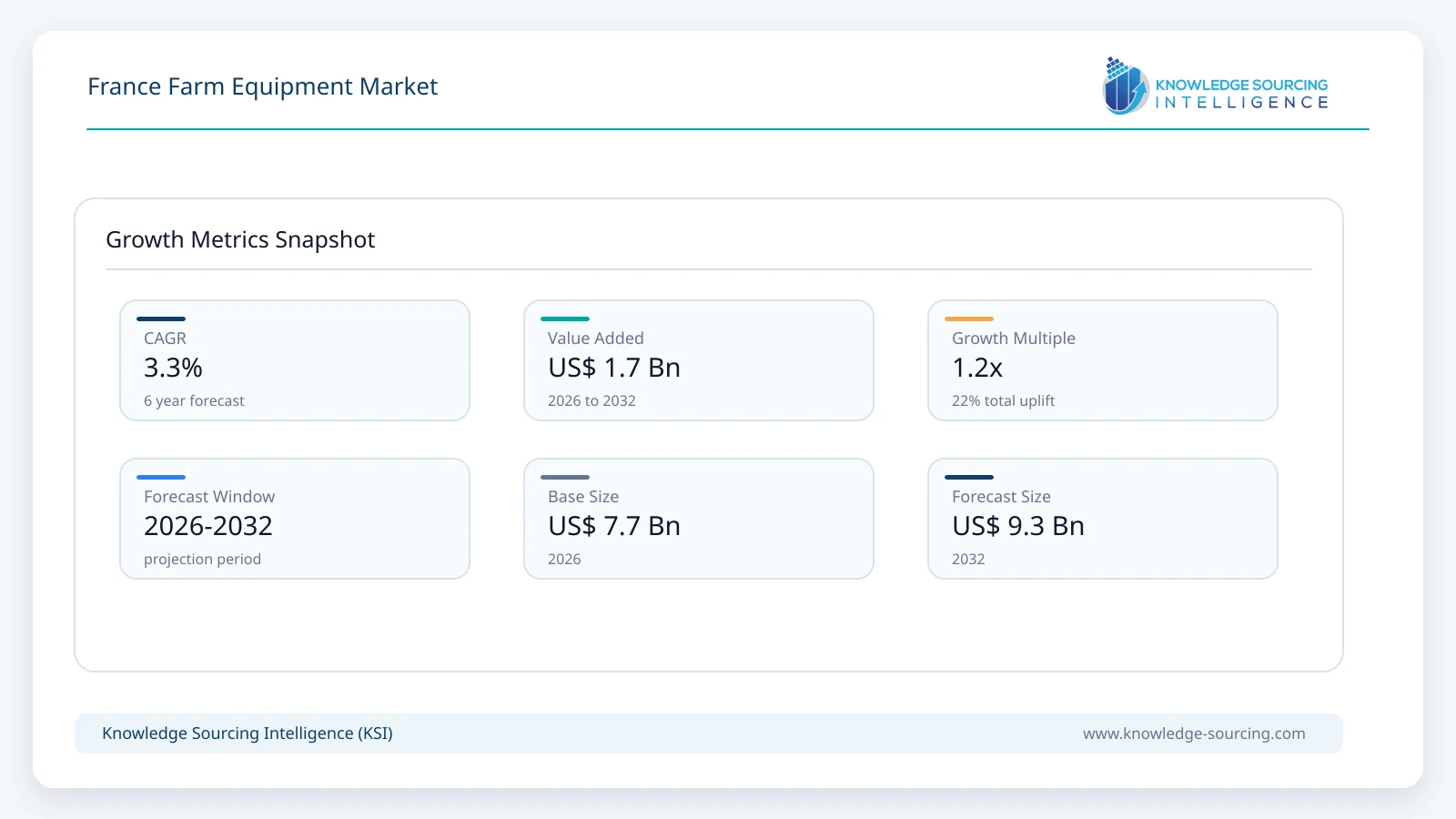
Major Segment Analysis
Tractors
Tractors form the selected numerical segment because French first-registration statistics permit a more robust equipment-volume assessment than is available for many smaller machinery classes. KSI places new tractor revenue at US$2.68 billion in 2026, accounting for approximately 34.9% of the domestic farm equipment market. Sales are projected to reach US$3.27 billion in 2032, a 3.40% CAGR, with segment share remaining close to 35.0%. The estimate distinguishes standard agricultural tractors from vineyard and orchard machines and does not include green-space tractors or telescopic loaders as tractor revenue. France registered 19,561 standard agricultural tractors in 2025, compared with 23,976 in 2024, alongside 2,027 vineyard and orchard tractors. This measured contraction establishes the volume starting point; selling prices vary with horsepower, driveline specification, automation, dealer discounts and equipment packages. The forecast assumes a gradual recovery in tractor replacement purchases after the 2026 trough, particularly where larger holdings and agricultural contractors can spread technology costs across more working hours. Dealers must nevertheless manage financing costs and used-machine inventories, both of which influence the timing of new orders.
The competitive balance in tractors is shaped by operating scale and the range of agricultural environments found across France. Large cereal farms in the Paris Basin require higher horsepower, implement compatibility and predictable field productivity; mixed-farming and livestock areas use versatile machines with loading and forage capabilities. Vineyards and orchards demand narrower or specialized configurations that cannot be evaluated solely through the horsepower benchmarks used for broad-acre agriculture. John Deere, AGCO’s Massey Ferguson, Fendt and Valtra brands, CLAAS, CNH’s New Holland and Case IH brands, and SDF’s Deutz-Fahr are all relevant to the competitive landscape. French manufacturing is also strategically important: AGCO maintains Massey Ferguson tractor operations at Beauvais, while CLAAS produces tractors at Le Mans. A purchaser’s choice frequently reflects finance terms, local maintenance infrastructure, second-hand values and implement integration more than the model’s catalogue specification. The commercial winner is therefore not necessarily the supplier with the largest tractor range, but the one that reduces operating interruptions over the machine’s full ownership period.
Other Equipment Categories
Combines and specialized harvesters are exposed to seasonal crop profitability and exceptionally high replacement costs. AXEMA’s 2025 market assessment identifies historically weak sales for combines and grape harvesters, reinforcing the influence of cereal and wine-sector conditions on capital purchases. Tillage equipment, ploughs and cultivation implements have different demand drivers because agronomic practices are shifting toward lower soil disturbance, mechanical weed control and flexible crop rotations. Seeding and planting machinery benefits from precision placement and technology that reduces seed loss, while agricultural spraying depends increasingly on regulatory expectations and the ability to cut input volumes through targeted treatment. Forage machinery, balers and livestock equipment follow animal production and contractor utilization more closely than crop-harvesting cycles. These categories should not be added together using overlapping functions such as ‘ploughing’ and ‘pre-harvesting’; each machine belongs to one primary equipment family, while agricultural function is a separate analytical dimension. This distinction allows the report to maintain internally coherent equipment totals across type, function and application period without double counting.
Regional Analysis:
Northern France and the Paris Basin
Northern France and the Paris Basin represent a major market for tractors, combines, precision planting and high-capacity crop-management machinery. Large arable operations in Hauts-de-France, Île-de-France and parts of Grand Est typically place a high value on completing operations within narrow weather windows, which raises demand for efficient drivetrains and implements with wide working widths. The region also concentrates buyers with significant exposure to cereal and oilseed profitability, so equipment orders respond strongly to crop margins and financing conditions. Larger machines and contractor-based operations encourage digital fleet management, guidance and service agreements, but these features must demonstrate a credible reduction in downtime or fuel and input costs. The operating environment differs from the specialized needs of vineyard areas, making national average machine specifications a weak guide to local purchasing decisions. Supplier competition is therefore closely linked to dealer workshops, seasonal availability of replacement machines and the ability to support equipment during critical planting and harvesting periods.
Western France: Brittany, Normandy and Pays de la Loire
Western France has a distinct equipment mix linked to livestock production, grassland management and mixed farming. Buyers in Brittany, Normandy and Pays de la Loire rely on tractors, forage harvesters, balers, feeding systems, manure-management machinery and related handling equipment. The investment decision frequently depends on the daily operating cost of labor-intensive feeding and forage operations rather than grain-harvesting capacity. AXEMA reports that livestock equipment held up better than several arable-machine categories during the 2025 downturn, illustrating the importance of diversified agricultural demand. Contractors and cooperatives can justify high-utilization machines where multiple customers share the purchase and running costs, while individual farms place greater weight on after-sales service and the availability of used units. Equipment vendors with integrated forage lines and practical operator support are therefore well positioned, even when general tractor registrations are weak. This regional profile also creates demand for machines that reduce fuel use, improve application accuracy and maintain productivity under variable soil and weather conditions.
Southwest France: Nouvelle-Aquitaine and Occitanie
Nouvelle-Aquitaine and Occitanie contain diverse demand centers spanning vineyards, orchards, field crops and mixed agricultural systems. Vineyards and orchards require narrow tractors, specialist sprayers, crop-care implements and harvesting machinery adapted to row geometry and terrain. In these segments, the economic case for replacing equipment depends on labor needs, crop prices and the ability to reduce chemical inputs without reducing treatment effectiveness. AXEMA identifies vineyard harvesters as one of the categories that experienced particularly weak market conditions in 2025, making an immediate rebound difficult to justify. Specialized manufacturers and dealerships nonetheless retain opportunities to sell advanced spraying, precision guidance and climate-protection equipment where tangible input savings or labor efficiencies are demonstrated. FranceAgriMer’s orchard-equipment support and the broader investment-policy framework have also highlighted the importance of machines addressing climate adaptation. Commercial opportunities will vary widely among crop systems, requiring suppliers to separate standard tractor sales from high-value specialized machinery.
Central and Eastern France
Centre-Val de Loire, Bourgogne-Franche-Comté and Auvergne-Rhône-Alpes encompass mixed crop systems, livestock activity, permanent crops and areas with challenging terrain. The machinery requirements consequently combine conventional field tractors and tillage implements with forage equipment, specialized vineyard tools and reliable maintenance support. Buyers may prioritize machine versatility where annual utilization is divided across several tasks rather than concentrated in one operation. The region also benefits from proximity to parts of the domestic manufacturing and equipment-supplier base, supporting dealer service networks and product demonstrations. For OEMs, the principal selling proposition is a machine’s cost per operating hour, especially when farms are extending replacement cycles and considering second-hand alternatives. Tractors equipped for a range of implements, compact machinery for specialty crops and digital precision controls may all attract demand, but the commercial mix varies by department and production system. Regional analysis must therefore reflect local farm economics rather than allocating sales mechanically by population or land area alone.
Southeastern France and Mediterranean Production Areas
Southeastern France and Mediterranean production areas present opportunities for specialist equipment used in horticulture, orchards, wine production and irrigated agriculture. Farm buyers often require compact tractors, crop-protection equipment, row-crop implements and machines designed for narrow plots or constrained access. Climate volatility has increased attention to irrigation efficiency, water conservation, protection against extreme weather and the ability to complete farm work in shorter operational windows. FranceAgriMer’s orchard-equipment programs illustrate how targeted investment assistance has supported machinery with defined environmental or productivity benefits, although eligibility and funding periods differ among schemes. Suppliers with efficient atomization, drift-reduction systems and locally available servicing can compete on economic value, particularly where chemical use is closely scrutinized. The market remains vulnerable to farm-income volatility and financing constraints; premium equipment is adopted most readily when there is a clear reduction in labor requirements, material inputs or crop-loss exposure. A standard broad-acre tractor product strategy is therefore unlikely to capture the region’s full equipment opportunity.
Competitive Environment
The French equipment market combines internationally diversified manufacturers with important domestic industrial specialists and local dealer networks. John Deere, CNH, AGCO and CLAAS compete across tractors and mechanized harvesting, while KUHN has an established French manufacturing footprint in soil preparation, seeding, forage and livestock equipment. Kubota’s agricultural offering includes the Kverneland and Vicon equipment brands, which should be considered within the same corporate group rather than counted as independent parent companies. EXEL Industries participates in spraying and sugar-beet harvesting through brands including Berthoud, Tecnoma, HARDI and Agrifac; its own financial disclosures show a difficult 2024–2025 selling environment for agricultural spraying. SDF’s Deutz-Fahr offering is also relevant in tractors, while AMAZONE and HORSCH address tillage, seeding, fertilization and crop protection. The competitive position of these manufacturers depends not only on engineering and portfolio breadth but also on finance, local stock, workshop capacity and resale values. Company-level French revenue shares cannot be inferred from group-level global revenue or brand visibility, so profiles should emphasize verifiable portfolios and presence rather than unsupported market-share rankings.
Recent Developments
May 2026: AXEMA forecast the French agro-equipment market at €7.15 billion for 2026 (approximately US$7.96 billion at the study's constant exchange rate), while warning that a recovery was unlikely before 2027. This industry forecast is a benchmark, not the KSI market estimate.
July 2026: EXEL Industries reported a 18.7% year-on-year decline in third-quarter revenue for fiscal 2025–2026, while noting tentative improvement in some trailed and self-propelled sprayer orders.
September 2026: CLAAS introduced the ARION Series 5 CMATIC tractor range at Innov-Agri, targeting four-cylinder tractors in the 145–180 hp class with variable transmission and digital machine-management features.
France Farm Equipment Market Scope
| Report Metric | Details |
|---|---|
| Total Market Size in 2026 | USD 7.67 billion |
| Total Market Size in 2032 | USD 9.34 billion |
| Forecast Unit | Billion |
| Growth Rate | 3.3% |
| Study Period | 2021 to 2032 |
| Historical Data | 2021 to 2024 |
| Base Year | 2025 |
| Forecast Period | 2026 – 2032 |
| Segmentation | Type, Function, Application Period |
| Companies |
|
| Customization Scope | 15% Free Customization included with purchase — Request Custom Breakdown → |
| Sample & Data Access | PDF Sample, Excel Databook & Analyst Briefing — Download Free Sample → |
Market Segmentation
By Type
Tractors
Combines and Other Harvesting Equipment
Tillage and Soil Preparation Equipment
Seeding and Planting Equipment
Sprayers and Crop Protection Equipment
Fertilizer Application Equipment
Forage, Balers and Livestock Equipment
Other Agricultural Equipment
By Function
Power and Field Operations
Soil Preparation and Cultivation
Sowing and Planting
Crop Protection and Fertilizing
Harvesting and Threshing
Forage and Livestock Operations
By Application Period
Pre-Harvesting
During Harvesting
Post-Harvesting and Livestock Operations
Table of Contents
1. INTRODUCTION
1.1. Market Overview
1.2. Market Definition
1.3. Scope of the Study
1.4. Currency, Historical and Forecast Period
2. RESEARCH METHODOLOGY
2.1. Research Design
2.2. Primary and Secondary Evidence
2.3. Market Sizing and Forecasting
2.4. Segment Reconciliation
3. EXECUTIVE SUMMARY
3.1. France Farm Equipment Market Snapshot
3.2. Key Findings
3.3. Strategic Implications
4. MARKET DYNAMICS
4.1. Market Segmentation
4.2. Market Drivers
4.3. Market Restraints
4.4. Market Opportunities
4.5. Porter’s Five Forces Analysis
4.5.1. Supplier Bargaining Power
4.5.2. Buyer Bargaining Power
4.5.3. Threat of New Entrants
4.5.4. Threat of Substitutes
4.5.5. Competitive Rivalry
5. FRANCE FARM EQUIPMENT MARKET BY TYPE
5.1. Tractors
5.2. Combines and Other Harvesting Equipment
5.3. Tillage and Soil Preparation Equipment
5.4. Seeding and Planting Equipment
5.5. Sprayers and Crop Protection Equipment
5.6. Fertilizer Application Equipment
5.7. Forage, Balers and Livestock Equipment
5.8. Other Agricultural Equipment
6. FRANCE FARM EQUIPMENT MARKET BY FUNCTION
6.1. Power and Field Operations
6.2. Soil Preparation and Cultivation
6.3. Sowing and Planting
6.4. Crop Protection and Fertilizing
6.5. Harvesting and Threshing
6.6. Forage and Livestock Operations
7. FRANCE FARM EQUIPMENT MARKET BY APPLICATION PERIOD
7.1. Pre-Harvesting
7.2. During Harvesting
7.3. Post-Harvesting and Livestock Operations
8. FRANCE FARM EQUIPMENT MARKET BY CUSTOMER TYPE AND REGION
8.1. Agricultural Holdings
8.2. Agricultural Contractors
8.3. Cooperatives and Machinery-Sharing Groups
8.4. Northern France and Paris Basin
8.5. Western France
8.6. Southwest France
8.7. Central and Eastern France
8.8. Southeastern France and Mediterranean Production Areas
9. COMPETITIVE INTELLIGENCE
9.1. Competitive Benchmarking
9.2. Product and Technology Positioning
9.3. Dealer and Aftermarket Strategies
9.4. Recent Investment and Commercial Developments
10. COMPANY PROFILES
10.1. Deere & Company (John Deere)
10.2. CNH Industrial N.V. (New Holland Agriculture and Case IH)
10.3. AGCO Corporation (Massey Ferguson, Fendt and Valtra)
10.4. CLAAS KGaA mbH
10.5. Bucher Industries AG (KUHN Group)
10.6. Kubota Corporation (Kubota, Kverneland and Vicon)
10.7. EXEL Industries SA
10.8. SDF S.p.A. (Deutz-Fahr and SAME)
10.9. AMAZONEN-WERKE H. DREYER SE & Co. KG
10.10. HORSCH Maschinen GmbH
11. RESEARCH METHODOLOGY AND DEFINITIONS
12. LIST OF FIGURES
13. LIST OF TABLES





Frequently asked questions
What is the projected size of the France farm equipment market by 2032?
The France Farm Equipment Market is projected to reach USD 9.34 billion by 2032.
What is the CAGR for the France farm equipment market from 2026 to 2032?
The France Farm Equipment Market is projected to grow at a 3.3% CAGR.
Which equipment segment holds the largest market share in France?
Tractors hold the largest share, estimated at 34.9% in 2026.
What is the outlook for the France farm equipment market recovery?
Recovery is more likely from 2027 after weakness in 2025-2026.
What factors influence supplier differentiation and customer costs in France?
Precision tech, financing, and dealer support increasingly influence differentiation.
Which farm equipment segments show weaker demand in France?
Standard tractors, combines, and vineyard harvesters show weakest demand.
Cite this report
Knowledge Sourcing Intelligence. (Oct 2026). France Farm Equipment Market - Strategic Insights and Forecasts (2026-2032). https://www.knowledge-sourcing.com/report/france-farm-equipment-market