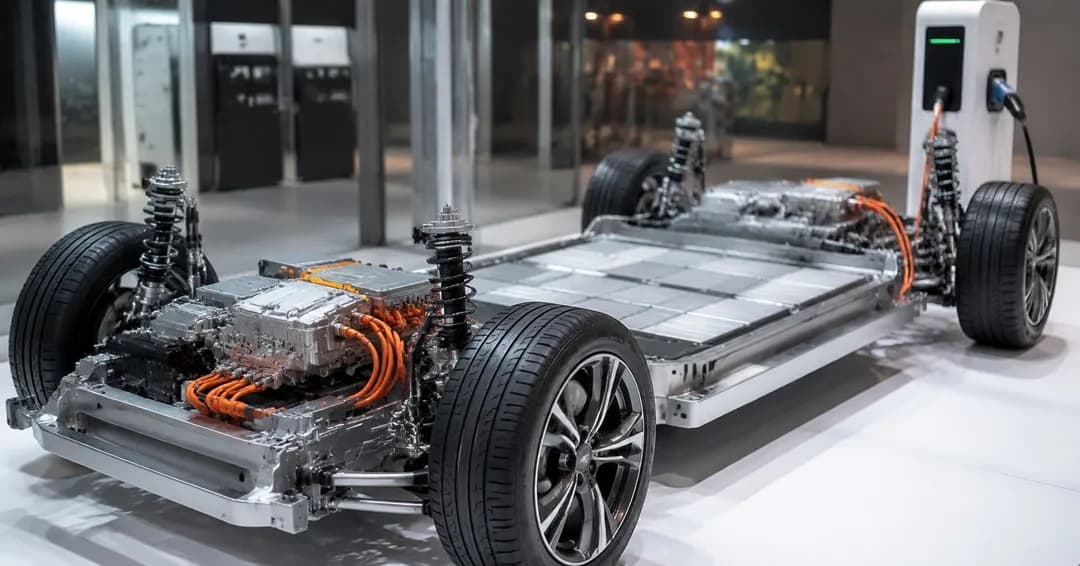
India's EV industry is shifting beyond affordability towards engineering efficiency. The article explains how 800V architecture can enable faster charging, lower energy losses, improved thermal management, and better performance. It also examines its role in commercial vehicles, silicon carbide technology, local manufacturing, charging infrastructure, and India's next-generation electric mobility ecosystem.
India's EV Industry Is Entering a New Engineering Phase
For nearly a decade, the conversation around electric vehicles (EVs) in India revolved around affordability, driving range, and charging infrastructure. Those priorities remain important, but they no longer define the entire direction of the industry. As manufacturers introduce larger battery packs, faster charging capabilities, more powerful electric drivetrains, and vehicles designed for longer-distance travel, the technical foundation of the vehicle itself has become an equally important area of innovation.
One of the most significant developments shaping this transition is the move toward 800V electrical architecture. Although initially associated with premium electric vehicles in international markets, higher-voltage platforms are gradually becoming relevant across a broader range of applications, including commercial vehicles, electric SUVs, premium passenger cars, and emerging long-range electric vehicle platforms. Rather than representing a luxury feature, 800V architecture is increasingly viewed as an engineering solution to challenges that conventional 400V systems struggle to address efficiently.
India's automotive industry is approaching this transition from a unique position. Unlike mature EV markets where adoption has been driven primarily by environmental policies or premium consumer demand, India's market is shaped by affordability, operational efficiency, extreme climate conditions, and the need to electrify public transportation alongside private mobility. These conditions make the evaluation of higher-voltage systems considerably more nuanced. The question is no longer whether 800V architecture offers technical advantages; it clearly does, but whether those advantages align with the economic and operational realities of India's rapidly evolving EV ecosystem.
The answer increasingly appears to be yes, particularly as the market moves beyond its first generation of electric vehicles and manufacturers prepare vehicle platforms for higher-power charging infrastructure and larger battery capacities.
Why the Traditional 400V Platform Is Beginning to Show Its Limits
The majority of electric passenger vehicles sold globally today continue to use battery systems operating between approximately 350V and 450V. This architecture became the industry standard because it offered a practical compromise between performance, manufacturing cost, component availability, and safety. During the initial phase of EV adoption, most vehicles carried relatively modest battery capacities, typically designed for urban commuting or short intercity travel. Under these conditions, the electrical system delivered acceptable charging performance without requiring excessively complex power electronics.
India's early EV market mirrored this pattern. The first wave of locally produced electric cars emphasized affordability and practicality rather than high-performance engineering. Battery capacities were comparatively small, daily travel distances remained limited, and charging infrastructure was still developing. For these vehicles, a conventional 400V platform met most customer expectations without introducing unnecessary complexity into the manufacturing process.
However, the market has evolved considerably over the past few years. Consumer expectations have shifted from simply owning an electric vehicle to expecting an ownership experience that closely resembles that of conventional internal combustion engine vehicles. Buyers increasingly demand longer driving ranges, faster charging times, improved highway performance, and the ability to undertake intercity travel without extensive planning.
Meeting these expectations has resulted in progressively larger battery packs and more powerful electric drivetrains. While these developments improve vehicle capability, they also expose the limitations of lower-voltage electrical systems. Delivering higher levels of power through a 400V platform requires substantially higher electrical current, which introduces several engineering challenges that become increasingly difficult to manage as vehicle performance improves.
Among the most significant issues is resistive heat generation. Higher current flowing through electrical conductors inevitably produces greater heat, requiring thicker cables, larger connectors, more sophisticated cooling systems, and additional thermal protection throughout the vehicle. These components not only increase manufacturing costs but also add weight, occupy valuable packaging space, and reduce overall system efficiency.
Consequently, manufacturers eventually reach a point where increasing current becomes less practical than increasing voltage. This transition has already occurred across numerous industrial sectors, including renewable energy systems, railway electrification, and industrial automation. Electric vehicles are now approaching a similar engineering transition, particularly in vehicle segments requiring high charging power and sustained performance.
Understanding the Engineering Logic Behind 800V Architecture
Although discussions surrounding 800V platforms often focus on charging speed, the underlying engineering rationale extends far beyond reducing charging times.
The relationship between voltage, current, and power is governed by a straightforward electrical principle:
Power = Voltage × Current
For a vehicle requiring a given amount of power, increasing system voltage allows the same power to be delivered with significantly lower current. In practical automotive applications, doubling the operating voltage from approximately 400V to 800V nearly halves the current required for equivalent power delivery.
This reduction in current creates a series of interconnected benefits that extend throughout the vehicle's electrical system.
Lower current reduces resistive losses within cables and connectors. Because electrical losses increase with the square of the current (I²R losses), even moderate reductions in current produce disproportionately large improvements in efficiency. Less energy is converted into unwanted heat, allowing components to operate at lower temperatures while reducing demands on the cooling system.
The consequences extend well beyond electrical efficiency. Smaller current requirements enable manufacturers to reduce cable thickness, lowering vehicle weight while simplifying routing throughout the chassis. Connectors experience less thermal stress, power electronics operate more efficiently, and battery cooling systems can often be optimised because less heat is generated during high-power operation.
Instead of addressing thermal issues by installing increasingly sophisticated cooling hardware, manufacturers reduce heat generation at its source. From an engineering perspective, preventing losses is generally preferable to managing them after they occur.
This philosophy has become increasingly important as EV development shifts toward maximising overall system efficiency rather than merely increasing battery capacity.
Why Charging Speed Is Only One Part of the Story
Public discussions about higher-voltage electric vehicles frequently emphasise ultra-fast charging, often presenting it as the defining advantage of 800V architecture. While charging performance certainly improves, reducing charging time represents only one outcome of a much broader set of engineering improvements.
To understand why, it is useful to consider the relationship between charging power and electrical current.
A charging station delivering 250 kW through a conventional 400V platform must supply extremely high current. Such current levels require heavy charging cables, and at higher power levels, many charging systems rely on liquid-cooled cables and advanced thermal management. As charging power increases further, these requirements become progressively more difficult and expensive to manage.
An 800V system achieves similar charging power while operating at substantially lower current. This reduces thermal stress within the charging cable, minimises connector heating, and allows charging infrastructure to operate more efficiently.
The benefits extend beyond the charging station itself. Lower charging current also reduces heat generated within the vehicle's battery pack during rapid charging, allowing battery temperature to remain within optimal operating ranges more easily. Since elevated temperatures can accelerate battery degradation over time, better thermal management may contribute to improved long-term battery performance, although battery longevity also depends on cell chemistry, charging strategy, and operating conditions.
For Indian consumers, this distinction could become increasingly significant as highway charging infrastructure expands. Urban charging patterns generally involve overnight charging at relatively low power, where charging speed is less critical. Long-distance travel presents a different scenario. Drivers increasingly expect charging stops that resemble traditional refuelling breaks rather than extended waiting periods.
As India's national highway charging network becomes denser, vehicle architecture capable of efficiently utilising higher-power chargers will become increasingly valuable. The importance of higher-voltage systems therefore extends beyond individual vehicle performance and begins influencing the overall economics of public charging infrastructure.
Technical Comparison Between 400V and 800V EV Architectures
Parameter | Conventional 400V Platform | Advanced 800V Platform |
Typical Operating Voltage | 350–450V | 700–900V |
Current Required for Similar Power Output | High | Nearly 50% Lower |
Cable Size | Larger and Heavier | Smaller and Lighter |
Heat Generated During High-Power Operation | Higher | Lower |
Cooling Requirements | More Extensive | Reduced Thermal Load |
Ultra-Fast Charging Compatibility | Limited at Very High Power | Optimised for High-Power DC Charging |
High-Speed Continuous Performance | Moderate | Improved Efficiency |
Suitability for Large Battery Packs | Good | Excellent |
The comparison highlights an important point that is sometimes overlooked in broader EV discussions. The value of an 800V platform lies not in one isolated advantage but in the cumulative effect of numerous incremental efficiency improvements. Each individual gain may appear modest, but together they create a vehicle that is lighter, cooler, more efficient, and better suited to high-power charging and future vehicle platforms.
India's Expanding EV Segments Are Changing the Engineering Equation
One of the reasons 800V architecture is becoming increasingly relevant is that the composition of India's EV market is changing. A few years ago, most electric passenger vehicles targeted urban commuters who travelled relatively short distances each day. Today, manufacturers are introducing larger electric SUVs, premium crossovers, luxury sedans, and commercial vehicles with significantly different operational requirements. The launch of higher-capacity electric SUVs and premium EV platforms by both global and domestic manufacturers reflects this broader shift toward vehicles that require greater charging capability and sustained power delivery.
These new vehicle categories demand greater power, larger batteries, and more sustained performance than earlier generations of electric cars.
Electric SUVs, for example, require larger battery packs to achieve competitive driving ranges while accommodating heavier vehicle weights. Premium buyers also expect stronger acceleration, higher cruising speeds, and consistent performance regardless of battery state of charge. Delivering these characteristics through a conventional 400V architecture becomes progressively more challenging as power requirements increase.
The commercial vehicle sector presents an even stronger case for higher-voltage systems. Electric buses, long-distance delivery vehicles, and heavy commercial trucks typically operate for extended hours with limited downtime. Charging duration directly affects fleet utilisation, making rapid energy replenishment an economic rather than merely technical consideration.
At the same time, India's logistics sector continues to expand through the growth of e-commerce, cold-chain transportation, and organised retail distribution. Fleet operators increasingly evaluate electric vehicles based on total cost of ownership rather than initial purchase price alone. Factors such as charging efficiency, vehicle uptime, battery longevity, and maintenance requirements therefore carry greater financial significance than they do for private consumers.
These market developments collectively shift the engineering priorities of manufacturers. Instead of designing vehicles solely around purchase affordability, automakers must optimise long-term operational efficiency across increasingly diverse use cases. Higher-voltage electrical systems provide one pathway towards achieving that balance without continuously increasing battery size to compensate for system inefficiencies.
Commercial Vehicles Could Become the Earliest Large-Scale Beneficiaries
Public discussions around EV technology often focus on passenger cars because they attract greater media attention and consumer interest. However, the commercial vehicle segment is likely to become one of the strongest business cases for 800V electrical architecture in India. The economics of fleet operations differ fundamentally from private vehicle ownership, and these differences amplify the advantages offered by higher-voltage systems.
A private vehicle may remain parked for most of the day, making overnight charging an acceptable routine. Fleet vehicles operate under entirely different conditions. Electric buses, logistics trucks, urban delivery vans, mining vehicles, airport transport fleets, and municipal service vehicles generate revenue only while they are in operation. Every additional minute spent at a charging station represents lost productivity.
For fleet operators, charging time translates directly into operational cost.
Consider a long-haul logistics vehicle operating between industrial corridors. If charging downtime can be reduced substantially without compromising battery life, the vehicle can complete additional trips over the course of a month. Across a fleet of hundreds or even thousands of vehicles, these seemingly small improvements accumulate into meaningful financial gains. The higher upfront investment associated with an 800V platform may therefore be justified through improved vehicle utilisation rather than lower purchase costs.
Electric buses present another compelling example. Many buses operate on tightly scheduled routes where prolonged charging breaks can disrupt service frequency. Faster charging during scheduled layovers allows operators to maximise daily fleet availability while potentially reducing the number of reserve vehicles required to maintain service continuity.
This operational advantage becomes increasingly valuable as state transport undertakings and private fleet operators continue expanding electric bus deployments across Indian cities. Government-supported programmes such as the PM e-Drive Scheme and state-led electric bus procurement initiatives are expected to accelerate the deployment of high-capacity charging infrastructure, further strengthening the business case for higher-voltage commercial EV platforms. Rather than focusing exclusively on battery size, transport authorities are increasingly evaluating technologies that improve overall fleet productivity. Higher-voltage platforms fit naturally within that objective.
Silicon Carbide Is Quietly Transforming EV Power Electronics
The growing interest in 800V architecture cannot be understood without considering advances in power semiconductor technology. While battery innovation receives considerable public attention, improvements in power electronics have been equally important in enabling higher-voltage electric vehicles.
Traditional silicon-based semiconductors have served the automotive industry well for decades. However, their efficiency declines as operating voltages and switching frequencies increase. Silicon carbide (SiC), a wide-bandgap semiconductor material, addresses many of these limitations by offering lower switching losses, higher thermal tolerance, and improved efficiency under demanding operating conditions.
For an electric vehicle manufacturer, these characteristics translate into several practical benefits. Power conversion losses decline, allowing more battery energy to reach the electric motor. Inverters operate at higher efficiency while generating less heat, reducing the burden on cooling systems. Because silicon carbide devices tolerate higher operating temperatures than conventional silicon components, thermal management systems can often be simplified without compromising reliability.
Perhaps more importantly, silicon carbide complements higher-voltage architectures exceptionally well. Many of the efficiency gains associated with 800V systems become substantially more attractive when paired with SiC-based inverters and onboard chargers. This combination allows manufacturers to improve overall drivetrain efficiency while reducing component size and weight.
Until recently, the widespread adoption of silicon carbide was constrained by production capacity and manufacturing costs. Significant investments by global semiconductor manufacturers have expanded automotive-grade SiC wafer and device production, improving supply availability while supporting gradual cost reductions. As production volumes increase and fabrication processes mature, component costs are expected to decline, making higher-voltage systems economically viable across a broader range of vehicle categories.
For India, where semiconductor manufacturing has become an area of strategic industrial policy, developments in silicon carbide supply chains could play a significant role in shaping future EV competitiveness. The country's semiconductor incentive programmes and investments in power electronics manufacturing may also strengthen the domestic supply chain supporting advanced EV architectures over the long term.
Thermal Efficiency Matters More in India Than in Many Global Markets
Engineering decisions that appear marginal in moderate climates often become critical under Indian operating conditions. Ambient temperatures exceeding 40°C are common across several regions during summer months, while urban traffic congestion further increases thermal stress on electric powertrains.
Battery performance is closely linked to temperature. High operating temperatures accelerate chemical degradation within lithium-ion cells, reducing long-term capacity retention and potentially shortening battery lifespan. Rapid charging, sustained highway driving, and repeated acceleration events all contribute additional heat to the battery pack.
Conventional approaches rely on increasingly sophisticated liquid cooling systems to manage this heat. While effective, these solutions add cost, complexity, weight, and maintenance requirements.
Higher-voltage platforms offer an alternative strategy by reducing heat generation throughout the electrical system.
Because lower current flows through cables, connectors, inverters, and battery terminals, less resistive heating occurs during both driving and charging. Battery cooling systems still remain essential, particularly in hot climates, but their workload is reduced. Lower thermal stress also benefits power electronics, charging connectors, and electric motors, contributing to improved system reliability over extended operating periods.
This advantage becomes particularly significant for commercial fleets operating continuously throughout the day. Vehicles exposed to prolonged heat cycles experience greater cumulative thermal stress than privately owned cars. Technologies that reduce operating temperatures therefore contribute not only to efficiency but also to long-term durability.
For manufacturers attempting to offer battery warranties extending eight years or more, reducing thermal degradation has become an increasingly valuable engineering objective.
Charging Infrastructure Must Progress Alongside Vehicle Technology
The benefits of higher-voltage vehicles depend partly on the capabilities of the charging infrastructure supporting them. A vehicle designed for ultra-fast charging cannot demonstrate its full potential if connected exclusively to lower-power charging stations.
India's charging ecosystem, however, is evolving steadily. While slow AC charging remains common in residential settings, public charging networks are increasingly deploying higher-capacity DC fast chargers along major highways and urban mobility corridors. Leading charging infrastructure operators have also begun deploying chargers rated at 180 kW, 240 kW and above, anticipating the growing number of higher-voltage passenger and commercial EVs entering the market.
Importantly, the transition does not require an abrupt replacement of existing infrastructure.
Modern battery management systems and charging protocols are designed to negotiate charging parameters dynamically. An 800V vehicle can typically charge using lower-voltage infrastructure, although at reduced charging speeds. Conversely, many modern high-power DC chargers support both 400V and 800V battery systems through intelligent power conversion and voltage management, allowing existing and future vehicle platforms to share the same charging network.
This compatibility allows infrastructure development to occur progressively. Charging networks need not be rebuilt from scratch each time vehicle technology advances. Instead, operators can introduce higher-power equipment gradually while maintaining service for older vehicle generations.
Such phased evolution is particularly relevant for India, where infrastructure investment must balance technological advancement with commercial viability. As utilisation of public fast-charging stations increases along national highways and freight corridors, compatibility between vehicle architecture and charging infrastructure will become an increasingly important factor in reducing charging downtime and improving network efficiency.
The Importance of Local Manufacturing Cannot Be Overlooked
Although the technical advantages of 800V architecture are becoming increasingly evident, widespread adoption in India will ultimately depend on manufacturing economics. Higher-voltage platforms require a range of specialised components that are not yet produced domestically at the same scale as conventional automotive parts.
Among the components requiring higher-voltage compatibility are battery packs, traction inverters, onboard chargers, DC-DC converters, high-voltage wiring systems, insulation materials, contactors, and various safety devices. If these components continue to rely heavily on imports, vehicle costs will remain relatively high despite improvements in production efficiency elsewhere.
Localisation therefore becomes one of the most important variables influencing adoption timelines. India has already launched several initiatives aimed at strengthening domestic manufacturing across batteries, advanced chemistry cells, automotive electronics, and semiconductor production. Programmes such as the Production Linked Incentive (PLI) Scheme for Advanced Chemistry Cell (ACC) Battery Storage and semiconductor manufacturing initiatives are expected to strengthen the domestic supply chain for next-generation EV components, including power electronics and battery systems.
Historically, automotive technologies have followed a recognisable pattern. Premium vehicles introduce new engineering solutions at relatively low production volumes. As demand grows, suppliers invest in localised manufacturing, production efficiencies improve, and component costs decline. Eventually, technologies that were once confined to luxury vehicles become standard features across mainstream market segments.
Higher-voltage EV platforms are likely to follow a similar trajectory. As domestic suppliers expand capabilities in high-voltage connectors, battery management systems, silicon carbide power modules, and thermal management components, manufacturers are expected to reduce dependence on imported subsystems while improving cost competitiveness.
Expected Adoption Potential of 800V Architecture Across Indian EV Segments
Vehicle Segment | Near-Term Adoption Potential | Key Driver |
Premium Electric Sedans | Very High | Performance and ultra-fast charging |
Electric SUVs | High | Large battery packs and highway capability |
Luxury Crossovers | High | Charging efficiency and premium performance |
Electric Buses | High | Fleet utilisation and reduced downtime |
Heavy Commercial Trucks | Very High | High energy demand and continuous operation |
Urban Delivery Vans | Moderate to High | Logistics productivity and route optimisation |
Mid-Segment Passenger Cars | Moderate | Future platform upgrades as costs decline |
Entry-Level Passenger Cars | Low (Short Term) | High cost sensitivity |
Electric Two-Wheelers | Limited | Small battery size and lower power requirements |
The table illustrates that adoption will not occur uniformly across the automotive market. Vehicle categories with higher power requirements and greater commercial utilisation are expected to justify higher-voltage platforms much earlier than cost-sensitive urban mobility solutions. This phased adoption reflects differences in battery capacity, charging requirements, operating cycles, and total cost of ownership across vehicle segments.
Software Will Become a Key Differentiator
Electrical architecture is only one part of the equation. As EVs become increasingly software-defined, manufacturers are relying on intelligent control systems to maximise the benefits of advanced hardware.
Battery management systems continuously monitor cell voltages, temperatures, charging rates, and state of health. Sophisticated software determines how aggressively a battery should charge under varying environmental conditions, when thermal preconditioning should occur, and how power should be distributed between propulsion, regenerative braking, and auxiliary systems.
Higher-voltage platforms increase both the opportunities and responsibilities of these software systems.
For example, predictive thermal management can prepare the battery before arriving at a fast-charging station, ensuring that charging begins under optimal temperature conditions. Dynamic energy management algorithms can optimise efficiency during highway cruising while protecting components from excessive thermal loads. Over-the-air software updates also allow manufacturers to refine charging strategies and energy management throughout the vehicle's operational life.
Software is also becoming central to charging optimisation, battery diagnostics, cybersecurity, functional safety, and predictive maintenance. These capabilities will become increasingly important as vehicle architectures become more sophisticated and charging infrastructure continues to evolve.
As hardware differences between competing manufacturers gradually narrow, software capability may become one of the principal competitive differentiators in the EV market.
Cost Remains the Primary Barrier, but History Suggests It Will Decline
The strongest argument against widespread deployment of 800V architecture remains its higher initial cost. Advanced power semiconductors, higher-voltage insulation systems, specialised safety components, and redesigned electrical architectures increase development and manufacturing expenses compared with established 400V platforms.
However, automotive technology rarely follows a static cost curve.
Several innovations that are now considered standard—including electronic fuel injection, anti-lock braking systems, airbags, LED lighting, lithium-ion batteries, and advanced driver assistance systems—were initially confined to premium vehicle segments because of high production costs. As manufacturing volumes increased and supply chains matured, these technologies became economically viable across increasingly affordable vehicle categories.
Higher-voltage EV architecture appears to be following a similar path.
Manufacturers are already designing modular vehicle platforms capable of supporting both 400V and 800V configurations, allowing greater production flexibility while reducing long-term engineering costs. Several global automakers have also introduced scalable EV platforms capable of accommodating multiple voltage architectures, enabling manufacturers to serve different market segments without developing entirely separate vehicle platforms.
As silicon carbide production expands, localised manufacturing improves, and charging infrastructure becomes more capable, the cost differential between the two architectures is likely to narrow further.
For original equipment manufacturers planning product portfolios extending into the next decade, these future cost trends may be more influential than today's component prices.
Looking Ahead: India Has an Opportunity to Leapfrog
India's automotive industry has demonstrated an ability to adopt new technologies rapidly once economic conditions become favourable. The expansion of digital payments, mobile communications, and renewable energy illustrates how large markets can bypass intermediate stages when newer technologies offer compelling long-term value.
Electric mobility could follow a similar trajectory.
Rather than spending years extracting incremental gains from increasingly complex 400V platforms, manufacturers developing entirely new vehicle architectures may choose to invest directly in scalable electrical systems capable of supporting future charging infrastructure, larger battery capacities, and higher-performance drivetrains.
This does not imply that every electric vehicle sold in India will soon transition to 800V. Entry-level passenger cars and two-wheelers are likely to continue using lower-voltage systems for many years because their battery capacities and operating profiles do not justify the additional investment.
Nevertheless, the next generation of premium passenger vehicles, electric buses, heavy commercial vehicles, and long-range SUVs is increasingly likely to be designed with higher-voltage compatibility from the outset. Several manufacturers have already announced global product roadmaps centred on 800V-capable platforms, indicating that the technology is moving steadily beyond niche premium applications.
The broader implication is that 800V architecture should not be viewed simply as another technical specification on a product brochure. It represents a shift in how manufacturers approach vehicle efficiency, charging capability, thermal management, power electronics, and long-term platform scalability. As India's EV market matures and moves toward higher-performance applications, these considerations will become increasingly important in future product development strategies.
Conclusion
India's electric vehicle industry is entering a phase where engineering efficiency is becoming as important as battery capacity or driving range. The transition from 400V to 800V architecture reflects this broader shift. Rather than focusing solely on faster charging, higher-voltage systems improve the efficiency of the entire electrical ecosystem by reducing current, minimising heat generation, enabling lighter components, and supporting increasingly powerful electric drivetrains.
The strongest early adoption is expected in vehicle segments where operational efficiency carries measurable economic value, including premium passenger vehicles, electric buses, heavy commercial trucks, and logistics fleets. These applications place sustained demands on charging performance, thermal stability, and power delivery that conventional architectures struggle to satisfy without increasing system complexity.
Several challenges remain. Component costs, semiconductor availability, localisation of advanced power electronics, and the expansion of high-power charging infrastructure will all influence the pace of adoption. The speed of adoption will also depend on continued investment in domestic manufacturing, charging infrastructure, semiconductor supply chains, and supportive government policies aimed at strengthening India's EV ecosystem.
Over the coming decade, India's EV landscape is unlikely to be defined by a single battery chemistry or a single charging standard. Instead, competitiveness will increasingly depend on how efficiently manufacturers integrate batteries, power electronics, software, thermal management, and electrical architecture into a cohesive system.
In that context, 800V platforms represent more than an incremental upgrade. They provide a scalable engineering foundation for faster charging, improved energy efficiency, enhanced thermal performance, and higher-power electric drivetrains, making them increasingly relevant for India's next generation of passenger and commercial electric vehicles.
Have questions?
More Thought Articles
How EV Charger Manufacturers Can Capitalize on India’s Home Charging Revolution
India’s residential EV charging opportunity is expanding as policy support, EV adoption, and private parking infrastructure develop. Manufacturers can capture value beyond AC chargers through installation, smart charging, load management, solar integration, software, and after-sales services. Housing societies, automakers, and property developers offer scalable routes to residential charging customers.
Second-Life EV Battery Market in India: What Is Driving Demand from Manufacturers?
India’s second-life EV battery market is gaining relevance as electric vehicle adoption expands and batteries retain useful capacity after automotive service. Growing stationary-storage demand, battery data, refurbishment capabilities, EPR obligations, and critical-mineral policies are encouraging manufacturers to extend battery value through reuse before eventual recycling within India’s emerging circular battery ecosystem.
The Rise of Locally Manufactured Battery Separators in India’s EV Ecosystem
India’s battery industry is progressing from pack assembly toward domestic cell and material manufacturing, creating opportunities for lithium-ion battery separators. Policy support, ACC capacity expansion and R&D initiatives are strengthening the ecosystem. However, technical complexity, manufacturing yields, qualification requirements and economics mean localisation will likely advance gradually through coatings, testing and finishing.