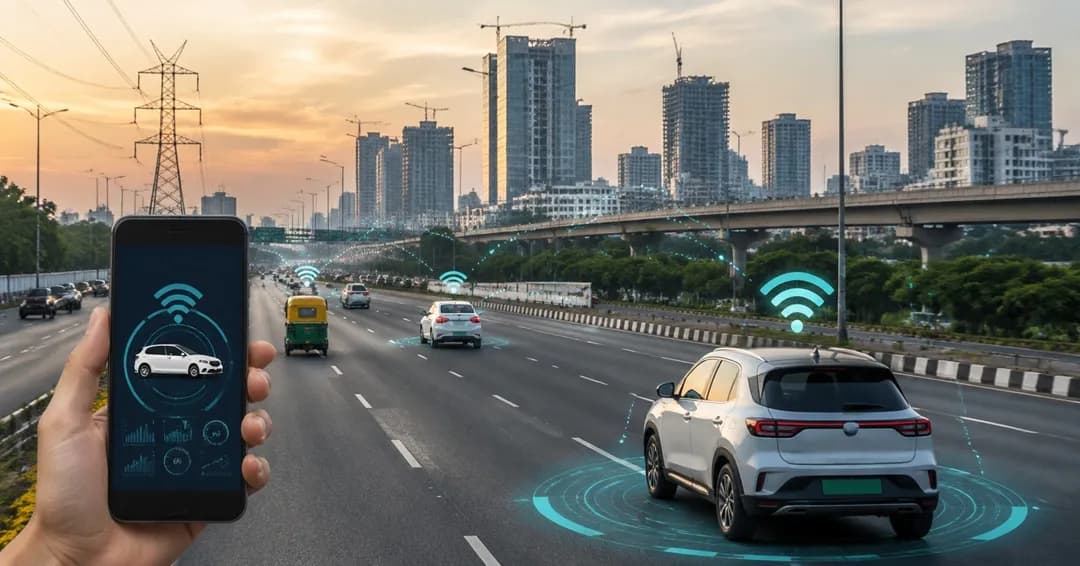
India's EV ecosystem is rapidly embracing telematics, transforming vehicles into connected, data-driven mobility platforms. By enabling battery intelligence, predictive maintenance, fleet optimisation, software updates, and smarter infrastructure planning, telematics is improving operational efficiency, reducing ownership costs, and creating new opportunities for manufacturers, fleet operators, insurers, and connected mobility services.
India's electric mobility story has moved well beyond discussions around vehicle subsidies, battery chemistry, and public charging infrastructure. As electric vehicles become increasingly visible across urban roads, highways, logistics corridors, and public transport networks, another transformation is unfolding quietly in the background. Vehicles are no longer functioning as isolated machines that simply transport people or goods from one location to another. Instead, they are becoming intelligent, connected assets capable of generating, transmitting, and interpreting enormous volumes of operational data throughout their lifecycle.
This digital transformation is being driven by telematics. Although the technology has existed in commercial fleet management for years, its role within the electric vehicle ecosystem is significantly broader. In an EV, telematics is not merely a navigation or vehicle tracking solution; it forms part of the operational backbone that connects the battery management system, onboard diagnostics, cloud computing platforms, mobile applications, charging infrastructure, and fleet management software. Every journey produces valuable information about battery health, energy consumption, driver behaviour, charging habits, environmental conditions, and vehicle performance, creating opportunities for smarter decision-making across the transportation value chain.
India presents a particularly compelling case for EV telematics because of the country's unique transportation dynamics. Urban congestion, long operating hours for commercial fleets, varied climatic conditions, and the rapid growth of app-based mobility services create an environment where operational efficiency directly influences profitability. For electric vehicles, where battery performance and energy optimisation determine the economics of ownership, connected technologies have become increasingly difficult to ignore. Fleet operators need accurate information to maximise vehicle utilisation, manufacturers require real-world performance data to improve future products, and consumers expect the same level of digital convenience that they experience with smartphones and other connected devices.
Unlike many developed automotive markets where connected services evolved gradually after vehicle ownership had already matured, India's electric mobility ecosystem is incorporating telematics almost from the outset. This gives manufacturers, software developers, charging network operators, and mobility service providers an opportunity to design integrated digital ecosystems rather than retrofit existing ones. The result is an industry where software capabilities are beginning to influence purchasing decisions nearly as much as vehicle specifications themselves.
As the Indian EV market expands across passenger cars, two-wheelers, commercial vehicles, and public transportation, telematics is emerging as one of the technologies that will shape long-term competitiveness. Its importance extends beyond convenience features, influencing operational efficiency, predictive maintenance, energy management, insurance models, infrastructure planning, and regulatory compliance. Recent advances in software-defined vehicle (SDV) architectures, over-the-air (OTA) software updates, and connected mobility platforms are further strengthening the role of telematics across India's EV ecosystem.
EV Telematics: More Than Vehicle Tracking
The term telematics is often associated with GPS-based vehicle tracking, largely because location monitoring represented its earliest commercial application. While location tracking remains an important function, modern EV telematics has evolved into a sophisticated digital ecosystem that continuously monitors the technical, operational, and environmental performance of a vehicle.
Unlike conventional internal combustion engine vehicles, electric vehicles depend heavily on electronic systems that manage battery performance, regenerative braking, thermal control, power electronics, and energy distribution. These systems generate vast quantities of operational data every second. Telematics enables this information to be securely transmitted from the vehicle to cloud-based platforms, where advanced analytics convert raw data into practical insights.
In practical terms, every connected EV functions as a moving Internet of Things (IoT) device. Embedded sensors measure battery voltage, motor efficiency, charging cycles, acceleration patterns, ambient temperature, braking intensity, and component health. Communication modules then relay this information through 4G, 5G, or other secure wireless communication networks to centralised platforms that process and analyse the data in real time.
This continuous exchange of information allows vehicle owners, fleet managers, manufacturers, and service providers to understand how a vehicle is performing under actual operating conditions rather than relying solely on scheduled inspections or driver feedback. As a result, maintenance decisions become proactive instead of reactive, while operational planning becomes increasingly data-driven.
The architecture supporting modern EV telematics typically combines hardware installed within the vehicle and cloud-based software platforms that interpret incoming information.
Core Components of an EV Telematics System
Component | Primary Role | Operational Benefit |
GPS Module | Real-time vehicle positioning and route monitoring | Fleet visibility, navigation, theft recovery |
Battery Management System (BMS) Integration | Monitors battery charge, health, temperature, and charging behaviour | Improved battery longevity and energy efficiency |
Cellular Connectivity (4G/5G) | Enables continuous communication between vehicle and cloud | Remote diagnostics and real-time monitoring |
Vehicle Sensors | Capture data on motor performance, braking, tyre pressure, temperature, and electrical systems | Predictive maintenance and operational insights |
Cloud Analytics Platform | Processes large volumes of operational data | Performance optimisation and fleet intelligence |
Mobile and Web Applications | User interface for drivers, owners, and fleet managers | Remote monitoring, alerts, and vehicle control |
What distinguishes electric vehicle telematics from earlier connected vehicle technologies is the depth of information being collected. Traditional fleet management systems focused primarily on logistics by tracking vehicle location, speed, and route deviations. EV telematics extends far beyond logistics by monitoring the health of the vehicle's most valuable component: the battery.
This distinction is commercially significant. Battery replacement remains one of the largest ownership costs associated with electric vehicles. Continuous visibility into battery degradation, charging behaviour, and thermal performance enables manufacturers and fleet operators to make informed decisions that directly influence vehicle lifespan and operating costs. Many manufacturers now also use anonymised fleet data to improve battery management software and deliver OTA updates that optimise energy efficiency and battery performance over time.
Why India Is Becoming a Natural Market for Connected EV Technologies
Several structural characteristics make India one of the most promising environments for telematics-enabled electric mobility. While many countries are introducing connected vehicle technologies alongside electric transportation, India's transportation ecosystem creates stronger economic incentives for widespread adoption.
Commercial mobility has become one of the primary drivers of electric vehicle deployment. Delivery services, ride-hailing platforms, e-commerce logistics, municipal transport authorities, and corporate fleets are rapidly incorporating electric vehicles into daily operations. These organisations measure success not only by vehicle acquisition costs but also by utilisation rates, operating efficiency, and service reliability. Every hour that an electric vehicle remains idle due to charging delays, maintenance issues, or operational uncertainty represents lost revenue.
Telematics addresses this challenge by improving visibility across the entire fleet. Instead of relying on driver updates or manual reporting, fleet managers receive continuous operational information that enables quicker decision-making. Vehicle locations, battery levels, charging schedules, maintenance alerts, and route performance can all be monitored through a single dashboard, allowing operators to optimise utilisation without increasing administrative complexity.
India's urban environment further reinforces the value of connected mobility. Congested roads, unpredictable traffic conditions, and varying driving patterns affect energy consumption more significantly than they do in many developed markets with relatively uniform traffic flow. Telematics enables route optimisation based on real-world traffic conditions, helping vehicles conserve energy while improving scheduling accuracy.
Climate diversity also plays a meaningful role. Electric vehicles operating in northern India during peak summer temperatures experience battery behaviour that differs from vehicles running in cooler hill regions or coastal climates. Continuous monitoring allows manufacturers to analyse these regional variations, improving battery management strategies and refining future vehicle designs. Such data would be difficult to obtain through conventional testing alone.
Another factor supporting telematics adoption is India's rapidly expanding digital infrastructure. Smartphone penetration has increased dramatically over the past decade, while cloud computing, digital payment systems, and mobile internet connectivity have become deeply integrated into everyday economic activity. Consumers who routinely manage banking, shopping, and entertainment through connected applications increasingly expect similar digital experiences from their vehicles.
Government initiatives have also created favourable conditions, even if telematics itself is rarely the primary focus of policy. The PM E-DRIVE Scheme, launched in 2024 to support electric mobility adoption, alongside continuing investments in public charging infrastructure and digital transport initiatives, has further strengthened the ecosystem required for connected EV deployment.
Connected Fleets Are Redefining Commercial Transportation
Commercial transportation has emerged as the segment where EV telematics is delivering its most immediate and measurable value. Passenger vehicle owners certainly benefit from connected services, but the financial impact is considerably more pronounced for fleet operators responsible for managing dozens or even thousands of vehicles simultaneously.
Historically, fleet management relied on periodic reporting, scheduled maintenance, and manual oversight. Vehicle utilisation was often estimated rather than measured precisely, while maintenance decisions followed fixed service intervals regardless of the vehicle's actual operating condition. This approach inevitably resulted in inefficiencies. Some vehicles were serviced earlier than necessary, while others experienced unexpected failures because emerging issues remained undetected between inspections.
Connected electric vehicles fundamentally change this operating model by providing continuous visibility into fleet performance. Instead of waiting for problems to become apparent through driver complaints or mechanical breakdowns, fleet managers receive a steady stream of operational information that supports proactive decision-making.
For logistics companies operating electric delivery vans, telematics enables dispatch teams to monitor battery levels across the fleet in real time, ensuring that vehicles assigned to longer delivery routes have sufficient energy reserves. Charging schedules can be coordinated to minimise downtime, while route planning software adjusts assignments according to battery availability, traffic conditions, and expected delivery windows. Many fleet operators are also integrating telematics platforms with warehouse management and transport management systems to improve dispatch efficiency and monitor vehicle productivity across multiple locations.
Electric buses operating within city transport systems benefit in similar ways. Municipal transport authorities can monitor route adherence, energy consumption, charging requirements, and vehicle health throughout the day. Rather than removing buses from service according to fixed maintenance schedules, operators can prioritise inspections based on actual vehicle condition. This improves fleet availability while reducing unnecessary maintenance expenditure. Several State Transport Undertakings (STUs) deploying electric buses under central government programmes are increasingly relying on telematics dashboards for fleet supervision, charging management, and operational reporting.
Driver behaviour has also become an important component of telematics-based fleet optimisation. Aggressive acceleration, excessive speeding, harsh braking, prolonged idling, and inefficient driving patterns all influence energy consumption and battery degradation. Connected platforms provide detailed performance reports that help organisations identify training opportunities while encouraging safer and more energy-efficient driving practices.
The implications extend beyond operational efficiency. Insurance providers increasingly recognise that driving behaviour influences risk, while financiers see value in understanding vehicle utilisation and condition throughout the financing period. Consequently, telematics data is beginning to support broader commercial decisions that extend well beyond transportation management itself. Usage-based insurance and fleet risk assessment models continue to gain attention as insurers evaluate connected vehicle data to improve underwriting accuracy.
As India's commercial EV market continues to expand, connected fleet management is gradually shifting from a competitive advantage to an operational necessity. Organisations capable of interpreting and acting upon vehicle data are likely to achieve lower operating costs, higher vehicle utilisation, and longer asset lifecycles than competitors relying on conventional fleet management practices. These advantages become even more significant as fleets scale, making telematics one of the most commercially important technologies underpinning the next phase of India's electric mobility transition.
Battery Intelligence Is Becoming the Core of EV Operations
If there is one area where telematics has transformed electric mobility more profoundly than any other, it is battery management. Unlike conventional vehicles, where the engine is expected to operate with relatively predictable maintenance schedules over many years, an electric vehicle's long-term value depends largely on the condition of its battery pack. Battery degradation directly influences driving range, charging performance, resale value, warranty costs, and ultimately the economics of vehicle ownership.
This explains why battery intelligence has moved from being a technical feature hidden inside the vehicle to becoming one of the most commercially valuable outputs of a telematics platform. Modern connected EVs continuously monitor battery parameters including State of Charge (SOC), State of Health (SOH), cell voltage balance, charging frequency, discharge cycles, operating temperature, and energy efficiency under varying driving conditions. Instead of collecting this information only during scheduled servicing, manufacturers receive continuous feedback throughout the vehicle's operational life.
The practical benefits are substantial. Consider two vehicles of the same model operating in different regions of India. One may spend most of its time navigating congested city traffic with frequent stop-start movement, while another covers long highway distances at relatively stable speeds. Although both vehicles may accumulate similar mileage, the stress placed on their batteries can differ considerably. Telematics enables manufacturers to understand these variations in real-world conditions rather than relying solely on laboratory testing. These real-world datasets are increasingly being used to refine battery management algorithms and validate future battery chemistries under Indian operating conditions.
Fleet operators derive equally important advantages from battery analytics. Daily operations can be planned around actual battery health instead of estimated driving range, reducing the likelihood of unexpected downtime. Charging schedules can also be adjusted to minimise battery stress by avoiding unnecessary fast charging or repeated deep discharge cycles where operationally feasible. Over time, these incremental improvements help preserve battery capacity and extend usable vehicle life.
For individual consumers, battery transparency reduces one of the biggest uncertainties surrounding electric vehicle ownership. Buyers increasingly want to understand not only how much charge remains but also how healthy the battery is after several years of operation. As India's used EV market expands, verified battery health records generated through telematics could become almost as important as traditional service histories, influencing resale values and buyer confidence. The growing industry focus on battery health certificates and digital battery records is expected to improve confidence in the emerging used EV market.
Predictive Maintenance Is Replacing Traditional Service Models
Maintenance strategies in the automotive industry have historically been based on fixed service intervals. Vehicles were inspected after predetermined distances or time periods regardless of their actual condition. While this approach was practical for internal combustion engine vehicles with numerous moving parts, it is less efficient for electric vehicles, which generally require less mechanical maintenance but depend heavily on electronic systems and software.
Telematics is gradually replacing calendar-based servicing with condition-based maintenance. Instead of waiting for components to fail or servicing them prematurely, connected platforms analyse operational trends to identify early warning signs before problems become serious enough to affect vehicle performance.
For example, gradual increases in motor operating temperature, irregular inverter behaviour, abnormal battery cooling performance, or changes in regenerative braking efficiency may indicate developing issues long before drivers notice any visible symptoms. By continuously analysing sensor data, telematics systems can generate maintenance alerts based on actual operating conditions rather than arbitrary mileage thresholds. Many manufacturers now combine predictive diagnostics with remote software diagnostics, enabling service teams to identify certain issues before a vehicle reaches the workshop.
This shift has important commercial implications. Unexpected breakdowns are expensive, particularly for commercial fleets where every inactive vehicle represents lost revenue. Predictive maintenance allows operators to schedule repairs during planned downtime, improving workshop efficiency while reducing disruption to daily operations.
Manufacturers also benefit because predictive diagnostics improve warranty management. Instead of investigating failures after they occur, engineering teams can analyse operational data from thousands of connected vehicles to identify recurring issues, software anomalies, or component weaknesses. These insights feed directly into future product development, enabling continuous improvement across successive vehicle generations.
Another advantage lies in spare parts planning. Workshops equipped with predictive maintenance information can order components before vehicles arrive for servicing, reducing repair times and improving inventory management. This becomes increasingly valuable as electric vehicle sales grow and service networks handle larger numbers of connected vehicles.
The broader implication is that maintenance is gradually shifting from a reactive support function to an integrated element of vehicle lifecycle management. Rather than repairing failures, the objective increasingly becomes preventing them altogether. As software-defined vehicles become more common, predictive maintenance is expected to increasingly combine vehicle diagnostics with over-the-air software updates, reducing the need for some physical service visits.
Software Is Emerging as a Competitive Differentiator
Automotive competition has traditionally centred on engineering characteristics such as engine performance, fuel efficiency, suspension quality, and vehicle design. While these attributes remain important, the electric mobility transition is introducing a new competitive dimension in which software capabilities increasingly influence customer purchasing decisions.
Telematics sits at the centre of this evolution because it enables manufacturers to maintain an active digital relationship with vehicles long after they leave the factory. Instead of treating vehicle delivery as the end of the production process, companies can continue improving product performance through over-the-air (OTA) software updates.
These updates can optimise battery management algorithms, improve energy efficiency, refine motor control systems, strengthen cybersecurity protections, enhance navigation features, and introduce entirely new connected services without requiring physical workshop visits. In effect, the vehicle becomes a continuously evolving product rather than a fixed mechanical asset.
This capability carries particular significance for electric vehicles because software plays an increasingly important role in determining real-world performance. Improvements in energy management algorithms, for instance, may increase effective driving range under certain operating conditions without requiring any hardware modifications. Likewise, software enhancements can improve charging efficiency, thermal management, or regenerative braking performance throughout the vehicle's operational life.
Consumers have become accustomed to receiving regular software updates for smartphones, laptops, and connected home devices. Similar expectations are gradually emerging within the automotive sector. Vehicle owners increasingly view digital services, mobile applications, and connected features as integral components of the ownership experience rather than optional accessories.
For manufacturers operating in India's highly competitive EV market, software capabilities may therefore become an increasingly important source of differentiation as hardware technologies gradually converge. Several Indian EV manufacturers have expanded connected vehicle platforms that combine remote diagnostics, smartphone integration, navigation, vehicle health monitoring, and OTA software updates, reinforcing the industry's shift towards software-defined vehicles.
Vehicle Data Is Creating New Business Opportunities
The growing importance of telematics extends beyond vehicle operation itself. Continuous streams of operational data are enabling entirely new business models across multiple sectors associated with transportation.
Insurance represents one of the clearest examples. Conventional motor insurance relies heavily on demographic information, vehicle specifications, and historical claims data to estimate risk. Connected vehicles provide insurers with much richer behavioural information, including acceleration patterns, braking habits, daily mileage, route characteristics, and driving consistency. This enables the gradual development of usage-based insurance products where premiums reflect actual driving behaviour rather than broad statistical assumptions.
Financial institutions are also beginning to recognise the value of connected vehicle data. Leasing companies, fleet financiers, and lenders gain greater visibility into vehicle utilisation, operating condition, and maintenance practices throughout the financing period. Better information reduces uncertainty and may eventually support more flexible financing structures for commercial fleets.
Charging network operators similarly benefit from telematics-generated insights. By analysing charging frequency, station utilisation, peak demand periods, and regional charging behaviour, operators can make more informed infrastructure investment decisions. Rather than expanding networks based solely on projected demand, providers can identify locations where charging congestion is emerging and prioritise capacity expansion accordingly.
Manufacturers arguably derive the broadest strategic benefits. Continuous operational feedback allows engineering teams to understand how products perform under diverse real-world conditions across India's varied geography. Battery performance in humid coastal environments, energy consumption during extreme summer temperatures, and vehicle behaviour under heavy commercial utilisation all provide valuable information that influences future product development. These insights are also supporting improvements in battery warranty management, software calibration, charging strategies, and future vehicle development programmes.
How Different Stakeholders Benefit from EV Telematics
Stakeholder | Primary Value Generated | Long-Term Strategic Benefit |
Vehicle Manufacturers | Real-world performance data, software updates, warranty insights | Faster product improvement and reduced warranty costs |
Fleet Operators | Route optimisation, predictive maintenance, battery monitoring | Lower operating expenses and higher vehicle utilisation |
Insurance Companies | Driving behaviour analysis and risk assessment | Usage-based insurance and improved pricing accuracy |
Charging Network Operators | Charging demand analysis and utilisation monitoring | Better infrastructure planning and reduced congestion |
Financial Institutions | Vehicle health and utilisation data | Improved lending decisions and residual value estimation |
Vehicle Owners | Remote monitoring, battery diagnostics, maintenance alerts | Greater convenience and improved ownership experience |
What makes these developments particularly interesting is that the value of telematics increases as more connected vehicles enter the ecosystem. Larger datasets improve predictive models, strengthen artificial intelligence applications, and provide increasingly accurate operational insights. In many respects, the industry's competitive advantage is beginning to depend not simply on manufacturing vehicles but on interpreting the information those vehicles generate throughout their operational lives. As connected EV adoption increases, anonymised operational data is also expected to contribute to improvements in charging infrastructure planning, battery analytics, and fleet optimisation models.
Connected Mobility Is Supporting Smarter Cities
India's urban centres face mounting transportation challenges driven by population growth, increasing vehicle ownership, and expanding commercial activity. While electric vehicles alone cannot solve congestion or infrastructure constraints, connected mobility platforms provide city authorities with better information for transportation planning and resource allocation.
Electric buses equipped with telematics illustrate this potential clearly. Transit authorities can monitor route punctuality, energy consumption, battery status, charging schedules, and vehicle health in real time. Rather than relying exclusively on periodic operational reports, planners receive continuous data that supports more responsive scheduling decisions. The deployment of connected electric buses under central and state-supported programmes is increasing the availability of operational data for fleet optimisation and service planning.
Ride-hailing operators and shared mobility providers also benefit from connected vehicle intelligence. Dynamic fleet allocation, demand forecasting, and energy-efficient route planning all become more accurate when supported by real-time operational information. Reduced idle time not only improves profitability but also contributes to lower energy consumption across the transport network.
Another emerging application involves charging infrastructure planning. As public charging networks expand, telematics data can identify areas experiencing persistent charging demand, helping both private operators and municipal authorities determine where additional charging stations are likely to deliver the greatest value. Data-driven planning is becoming increasingly important as India's public charging network continues to expand across highways, cities, and commercial corridors.
Over time, connected vehicles may also interact more directly with intelligent transportation systems, traffic management platforms, and electricity grids. Although such integration remains at an early stage in India, the foundations are gradually being established through increasing digitalisation of both transportation and energy infrastructure. Future vehicle-to-grid (V2G) and smart charging applications are also expected to rely heavily on secure telematics platforms capable of exchanging real-time operational and energy data.
Cybersecurity and Data Governance Are Becoming Strategic Priorities
The expansion of connected mobility inevitably raises important questions regarding cybersecurity and data governance. Every connected vehicle exchanges information with cloud servers, mobile applications, charging infrastructure, and software platforms, creating multiple digital entry points that require protection.
Modern EV telematics platforms therefore incorporate encrypted communication protocols, secure authentication mechanisms, intrusion detection systems, and regular software security updates. These measures are designed to minimise the risk of unauthorised access, data interception, software manipulation, or identity theft. As connected vehicle deployments expand, manufacturers are also aligning their cybersecurity practices with internationally recognised automotive cybersecurity and software update management frameworks, helping improve the security of connected vehicle ecosystems.
However, cybersecurity represents only part of the broader governance challenge. Questions surrounding data ownership continue to evolve. Vehicle-generated information may be valuable to manufacturers, fleet operators, insurers, charging providers, regulators, and consumers simultaneously. Establishing transparent frameworks governing data access, storage, consent, and commercial usage will become increasingly important as connected vehicle adoption expands. India's implementation of the Digital Personal Data Protection Act, 2023, has also increased the focus on responsible handling of user data, making data governance an increasingly important consideration for connected mobility platforms.
Interoperability also deserves greater attention. Many telematics platforms remain proprietary, limiting seamless integration across mixed fleets containing vehicles from multiple manufacturers. Greater standardisation would improve operational flexibility for fleet operators while encouraging wider innovation across software ecosystems. Growing industry interest in open APIs and interoperable fleet management platforms is expected to support greater integration across charging networks, fleet software, and vehicle manufacturers in the coming years.
These challenges should not be viewed as obstacles unique to India. Similar debates are occurring across global automotive markets as connected vehicles become increasingly sophisticated. The difference is that India's rapidly growing EV industry has an opportunity to address these governance issues relatively early in its digital transformation.
The Road Ahead
The next phase of EV telematics in India is likely to be shaped by artificial intelligence, edge computing, 5G connectivity, and closer integration between vehicles, charging infrastructure, and electricity networks. Telematics platforms are gradually evolving from systems that merely report operational information into platforms capable of recommending actions based on predictive analytics.
Artificial intelligence will likely improve battery life forecasting, charging optimisation, fleet scheduling, and maintenance planning by identifying complex operational patterns that conventional analytics may overlook. Edge computing could reduce response times by processing certain information directly within the vehicle rather than relying exclusively on cloud infrastructure. Meanwhile, expanding 5G coverage is expected to improve communication reliability for applications requiring lower latency and higher data transmission capacity.
Another development likely to influence the Indian market is the emergence of battery passports and digital lifecycle records. Verified histories documenting charging behaviour, maintenance events, software updates, and battery health could become standard features supporting vehicle resale, financing, and warranty administration. As secondary markets for electric vehicles mature, trusted digital records may significantly improve buyer confidence. Although battery passport initiatives are currently advancing more rapidly in Europe, similar digital battery record concepts are attracting growing interest among Indian EV stakeholders, particularly as battery reuse, recycling, and second-life applications gain importance.
Commercial fleets are expected to remain the leading adopters of advanced telematics because their return on investment is relatively easy to quantify. However, as connected services become increasingly standard across passenger vehicles, consumers are also likely to view remote diagnostics, intelligent charging, and software-driven enhancements as essential ownership features rather than premium offerings.
Another emerging trend is the convergence of telematics with software-defined vehicles (SDVs), advanced driver assistance systems (ADAS), fleet AI platforms, and cloud-native mobility services. As these technologies mature, telematics will increasingly serve as the data foundation supporting vehicle intelligence, predictive analytics, and lifecycle management across the EV ecosystem.
Conclusion
India's electric vehicle industry is entering a stage where connectivity is becoming as strategically important as electrification itself. While batteries, motors, and charging infrastructure remain fundamental building blocks of the transition, telematics is increasingly acting as the intelligence layer that enables these technologies to operate more efficiently. By connecting vehicles with cloud platforms, charging networks, manufacturers, and service providers, telematics transforms isolated vehicles into participants within a broader digital mobility ecosystem.
Its value extends far beyond vehicle tracking. Battery health monitoring, predictive maintenance, fleet optimisation, software updates, intelligent charging, insurance innovation, infrastructure planning, and cybersecurity all depend on reliable operational data generated through connected vehicles. Each of these applications contributes incremental improvements that collectively enhance vehicle performance, reduce operating costs, and improve user experience.
The broader significance of EV telematics lies in its ability to convert data into measurable economic value. Manufacturers gain continuous product intelligence, fleet operators achieve higher asset utilisation, insurers improve risk assessment, charging providers optimise infrastructure investment, and consumers enjoy greater transparency throughout the ownership journey. As the volume of connected vehicles continues to increase, the quality of these insights is likely to improve further, creating a self-reinforcing cycle of technological advancement.
Looking ahead, India's connected mobility ecosystem will probably evolve through gradual integration rather than dramatic disruption. Artificial intelligence, software-defined vehicles, intelligent charging networks, digital battery lifecycle management, and secure cloud connectivity will strengthen the role of telematics across the transportation sector. Organisations that view connected vehicle data as a strategic asset rather than a technical by-product are likely to be better positioned to compete in an increasingly software-driven automotive market.
Ultimately, the future of electric mobility in India will not be determined solely by how efficiently vehicles consume electricity, but also by how intelligently they communicate, learn from operational experience, and support better decisions across the entire transportation ecosystem. As India's EV adoption continues to accelerate and connected vehicle capabilities become standard across more vehicle categories, telematics is expected to remain a key enabler of operational efficiency, digital services, and long-term innovation throughout the country's mobility ecosystem.
Have questions?
More Thought Articles
How EV Charger Manufacturers Can Capitalize on India’s Home Charging Revolution
India’s residential EV charging opportunity is expanding as policy support, EV adoption, and private parking infrastructure develop. Manufacturers can capture value beyond AC chargers through installation, smart charging, load management, solar integration, software, and after-sales services. Housing societies, automakers, and property developers offer scalable routes to residential charging customers.
Second-Life EV Battery Market in India: What Is Driving Demand from Manufacturers?
India’s second-life EV battery market is gaining relevance as electric vehicle adoption expands and batteries retain useful capacity after automotive service. Growing stationary-storage demand, battery data, refurbishment capabilities, EPR obligations, and critical-mineral policies are encouraging manufacturers to extend battery value through reuse before eventual recycling within India’s emerging circular battery ecosystem.
The Rise of Locally Manufactured Battery Separators in India’s EV Ecosystem
India’s battery industry is progressing from pack assembly toward domestic cell and material manufacturing, creating opportunities for lithium-ion battery separators. Policy support, ACC capacity expansion and R&D initiatives are strengthening the ecosystem. However, technical complexity, manufacturing yields, qualification requirements and economics mean localisation will likely advance gradually through coatings, testing and finishing.