
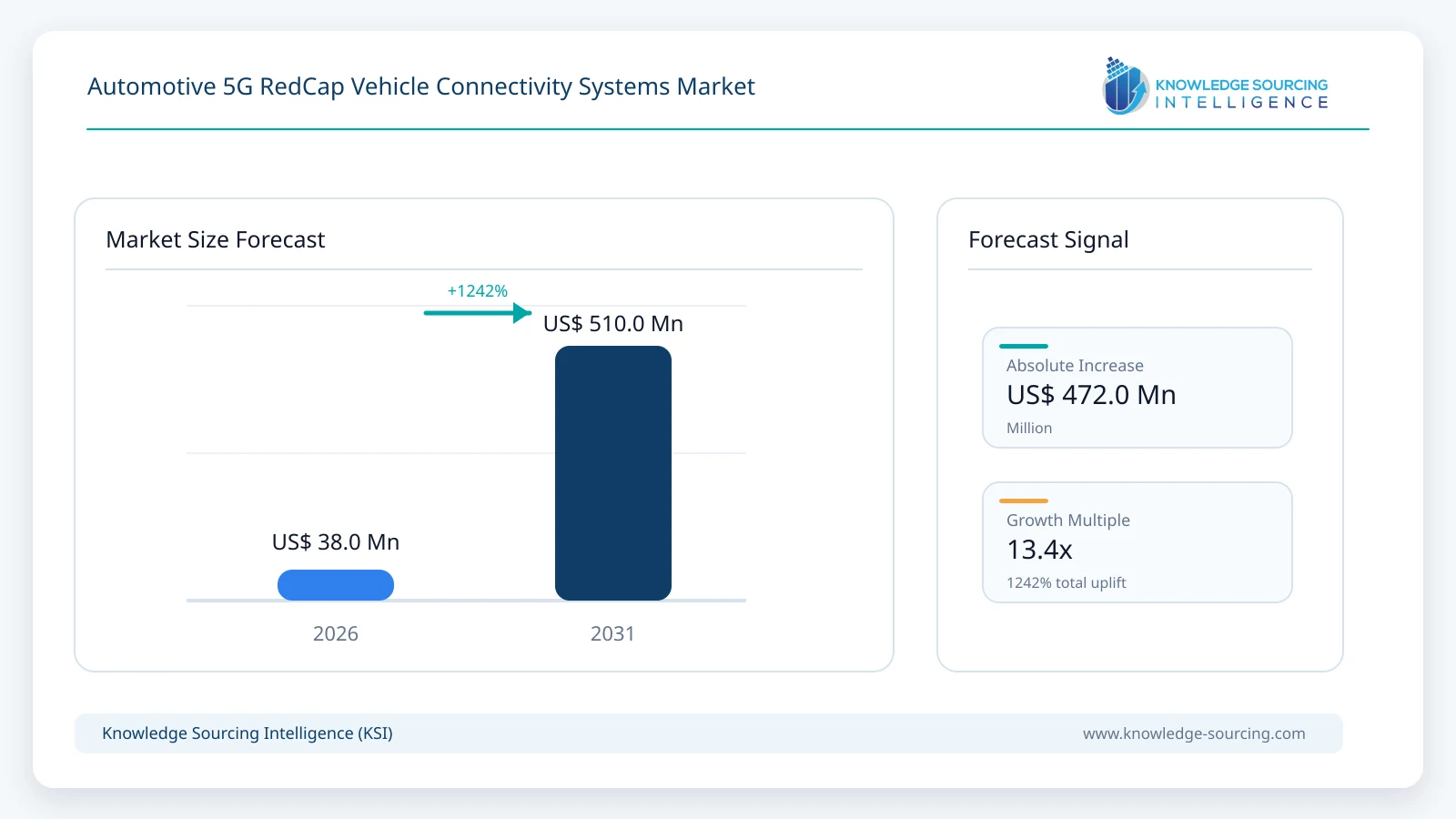
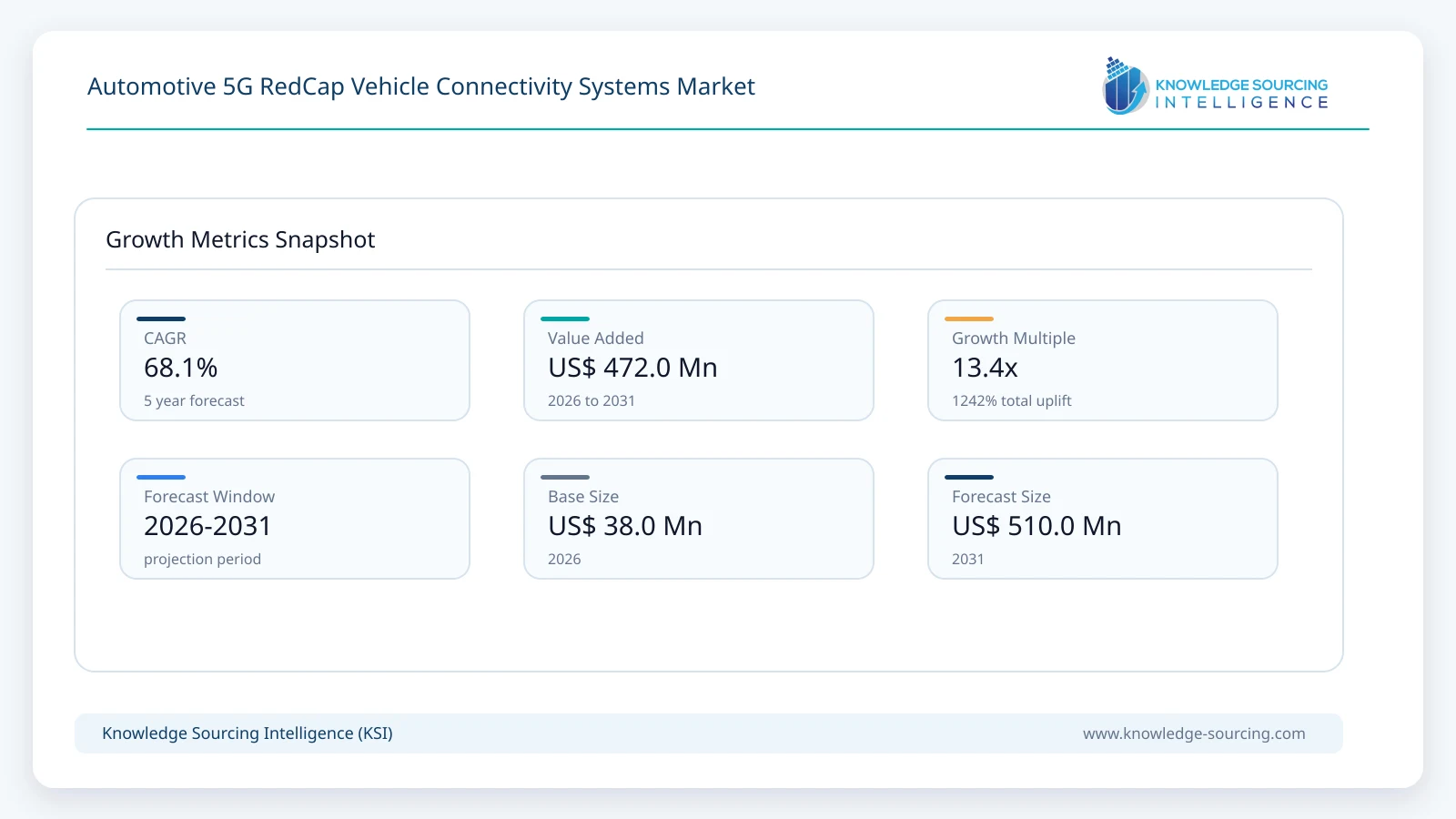
The Automotive 5G RedCap Vehicle Connectivity Systems Market is forecast to grow at a CAGR of 68.1%, reaching USD 510.0 million in 2031 from USD 38.0 million in 2026.
Highlights:
- 1The market is estimated at USD 38 million in 2026 and projected at USD 510 million in 2031.
- 2Factory-oriented integrated RedCap T-Boxes account for USD 18 million in 2026; standalone modules account for USD 9 million.
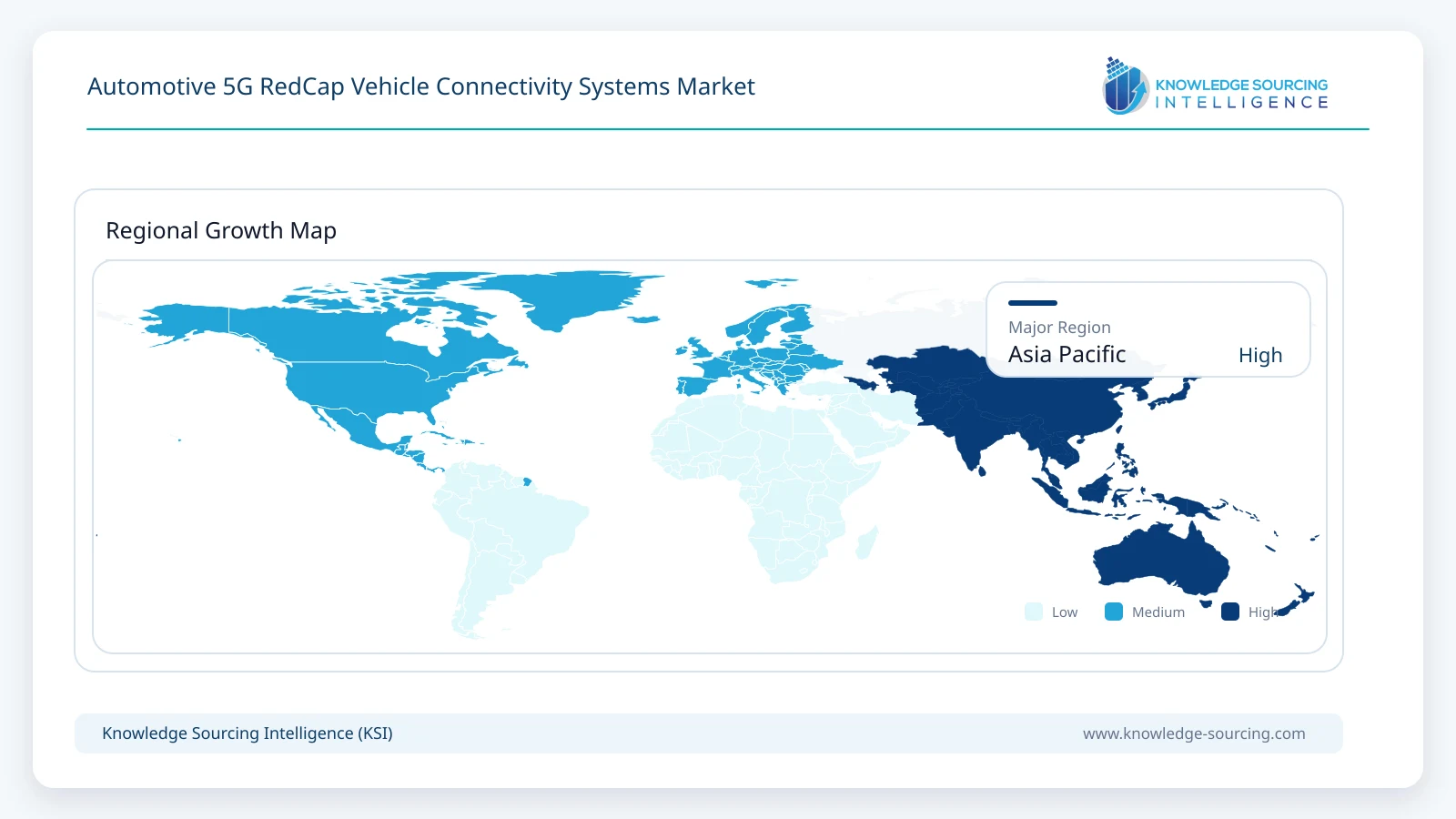
- 3Asia Pacific represents approximately 76.3% of the estimated 2026 market, led by early activity in China.
- 4Qualcomm launched its automotive A10 RedCap modem in 2026; Marelli targets RedCap telematics production in 2028.
- 5Dual RedCap/LTE connectivity is the leading technical configuration for vehicle service continuity.
- 6Automotive qualification, 5G standalone network coverage and supplier sourcing remain key commercialization factors.
Automotive-grade RedCap products occupy the middle tier between cost-sensitive LTE telematics and full-bandwidth 5G modules. Qualcomm introduced an A10 modem in January 2026, while Marelli outlined an affordable vehicle telematics design whose first global series production is targeted for 2028. In China, Jingwei Hirain and GosuncnWelink have disclosed vehicle-oriented RedCap modules and telematics units, providing a base for earlier integration activity.
The study evaluates the direct supplier revenue associated with a qualifying automotive 5G RedCap system, including embedded modules or complete T-Boxes and separately contracted vehicle software integration. The 2026 and 2031 values are developed from RedCap-specific installation assumptions, the estimated equipment value in each purchasing channel, and design and qualification work. A module already included in a complete vehicle telematics unit is not counted a second time.
Global analysis examines vehicle types, propulsion systems, use cases, radio configurations, buying channels, and delivery routes. Asia Pacific has the largest initial revenue contribution because China has moved relatively early on RedCap networks and automotive modules; Europe and North America offer considerable later-stage opportunities but face different network, certification, and sourcing timelines.
Market Overview
Vehicle connectivity hardware now needs to support emergency calling, service diagnostics, positioning, and routine over-the-air communication across platforms designed to remain on the road for more than a decade. Full 5G modems are technically capable but may be unnecessarily expensive for these moderate-data-rate functions. Reduced-capability NR simplifies the radio chain and narrows bandwidth requirements while retaining a path toward 5G standalone networks, making it attractive for selected passenger and commercial vehicle platforms.
Product maturity differs materially by region. GosuncnWelink already lists a GT802 RedCap T-Box and automotive RedCap modules; Jingwei Hirain disclosed module production-line readiness and nominated front-fit programs in late 2025. Marelli, by contrast, announced an automotive solution in December 2025 while targeting first global series production in 2028. Qualcomm and MediaTek supply semiconductor architectures that can enable additional Tier 1 designs without establishing that all announced modem platforms have entered vehicle serial production.
The greatest short-term demand comes from factories and Tier 1 connectivity suppliers replacing LTE devices with cost-conscious RedCap units rather than moving every connected vehicle to high-bandwidth 5G. Regional network coverage, LTE fallback, emergency-call compliance, radio qualification, and automotive semiconductor sourcing will determine how quickly modules move from availability to installed vehicle content.
Market Trends
RedCap as a Lower-Complexity Path to 5G Telematics
Automakers evaluating a 4G telematics refresh can now consider Release 17 RedCap for remote diagnostics, periodic vehicle data and emergency calling where multi-gigabit transfer is unnecessary. The simplified bandwidth and RF architecture reduce hardware burden relative to full 5G, while automotive specifications continue to require stable operation across vibration, temperature and extended vehicle lifecycles. Qualcomm specifically positioned its A10 automotive modem for a wider range of vehicle tiers.
Marelli has marketed an affordable RedCap solution with LTE continuity and GNSS integration, illustrating how the value proposition shifts from headline peak throughput to the effective cost of an automotive connectivity platform. The first series production target of 2028 limits assumptions about broad near-term volumes. By 2031, competition is expected to depend more heavily on platform qualification, integrated system pricing and lifecycle support than on modem speed alone.
Automotive T-Box Integration and Feature Consolidation
Automotive RedCap products increasingly combine an embedded modem with Ethernet, GNSS, security functions and vehicle-network interfaces inside a compact communications node. GosuncnWelink identifies its GT802 T-Box as a center for external vehicle communication, with inertial sensing and emergency backup power. This integration can reduce the complexity of qualifying several separate connectivity modules for lower- and middle-price vehicle programs.
The share of factory-fitted T-Boxes in the modeled market increases as more vehicle platforms purchase an integrated unit rather than just a stand-alone radio module. Engineering revenue remains important during early platform conversions, especially for antenna validation, electromagnetic compatibility, emergency-call behavior, and continuity during network handover. The model counts the complete bought-in T-Box value only when the module within it is not counted separately.
LTE Fallback and Coverage-Led Product Selection
RedCap depends on 5G standalone infrastructure, and network readiness remains much more uneven than broad LTE availability. GSMA materials show comparatively early RedCap network deployment in China and development or trial activity in many other markets. This favors multimode automotive designs that maintain existing LTE telematics services in areas lacking functioning RedCap coverage.
An LTE fallback strategy affects device pricing and qualification because suppliers still must test emergency calling, roaming, vehicle positioning and remote software services across technologies. OEMs with global vehicle platforms may stagger regional launches instead of standardizing one radio configuration immediately. Cellular operators and automotive Tier 1s consequently influence the introduction schedule as much as the availability of semiconductor samples.
Automotive Qualification and Regionalized Sourcing
Automotive connectivity purchases require long-duration software support, functional reliability, cybersecurity processes and supply continuity that go beyond the characteristics of a general industrial IoT modem. GosuncnWelink markets RedCap modules for automotive operating temperatures, while Jingwei Hirain emphasizes local engineering and qualified automotive module manufacturing. Marelli has separately highlighted regional sourcing requirements in North America as a design consideration.
Supplier selection is expected to favor firms that can move from a RedCap modem data sheet to a vehicle-ready assembly with traceable component sourcing and automotive production processes. Firms selling industrial RedCap modules can participate in development or aftermarket channels without automatically receiving the same market position as suppliers nominated for factory-installed T-Boxes.
Integration of Telematics, Security and Moderate-Bandwidth Services
Vehicle RedCap systems can carry routine remote diagnostics, positioning data, software-update coordination and safety communications while leaving high-throughput passenger entertainment or rich sensor streaming to other connectivity paths. Automotive suppliers are increasingly balancing cellular bandwidth with on-device preprocessing and domain-controller coordination to limit operating expense and unnecessary data transfer.
Commercial opportunity consequently extends beyond a single radio part to secure vehicle onboarding, protocol integration and diagnostic validation. These services are a small but distinct revenue stream in the KSI model, with the larger share of forecast spending remaining attributable to automotive modules and integrated telematics boxes. Basic carrier data subscriptions and application services unrelated to RedCap equipment are outside the scope.
Segment Analysis
Integrated Telematics Units and Standalone RedCap Modules
Integrated RedCap T-Boxes and TCUs account for an estimated USD 18 million in 2026, compared with USD 9 million for standalone vehicle-oriented modules. Complete telematics units command a higher attributable price because they include the modem, processor, GNSS and vehicle network interfaces; component supply remains important where an automaker or Tier 1 performs the unit integration internally.
By 2031, integrated units are projected to reach USD 315 million as more OEM vehicle lines qualify RedCap factory fitments, while standalone module revenue reaches USD 150 million. The distinction is based on the sold transaction: units embedded in counted TCUs are excluded from the module line. Design and qualification services are modeled separately at USD 45 million in 2031.
Passenger Vehicle and Commercial Vehicle Demand
Passenger cars represent USD 31 million, or about 81.6% of the 2026 modeled market, due to the concentration of connected-vehicle electronic platforms in high-volume consumer vehicle production. Light commercial vehicles and medium/heavy commercial vehicles contribute USD 5 million and USD 2 million, respectively, primarily from fleet telematics and network refresh activities.
Passenger cars remain the largest group in 2031 at USD 414 million, while commercial platforms expand as network-support requirements and fleet telematics replacement cycles grow. Vehicle type should not be confused with propulsion: electric, hybrid and combustion vehicles can each purchase the same RedCap communications architecture.
Applications, Radio Choices and Customer Groups
Remote diagnostics and software updates generate an estimated USD 12 million in 2026, followed by emergency-call and safety telematics at USD 10 million. Fleet operations, secure connectivity and moderate-bandwidth cabin services form additional use cases. These application allocations represent alternative slices of the same global market, not separate spend that should be added to the commercial-offering totals.
RedCap with LTE fallback represents the majority of modeled revenue because early RedCap network availability cannot guarantee cross-border service continuity. Vehicle OEMs and Tier 1 suppliers account for most purchases, while fleet integrators and service providers contribute a smaller aftermarket channel. Radio configurations with additional V2X or GNSS connectivity only contribute RedCap-specific system value, not unrelated roadside or V2X decision software.
Market Drivers
Lower Hardware Cost for Mainstream 5G Migration
Automakers renewing LTE T-Boxes are considering whether full 5G bandwidth is necessary for routine service diagnostics and emergency communications. RedCap can meet moderate communications needs with a lower-complexity modem-RF design, creating a route for mid-market and value-oriented vehicle lines to transition to 5G infrastructure without adopting the most expensive connectivity tier.
Long Vehicle Life and Connectivity Renewal Requirements
Automotive telematics systems must remain useful throughout long service lives even as operators modernize radio networks and core services. Dual RedCap and LTE configurations provide a migration option that supports older coverage today while preserving compatibility with increasingly widespread standalone 5G. This creates procurement interest in future-ready modules and supported communications firmware.
China-Based Automotive Module and Network Ecosystem
Chinese connectivity suppliers have already demonstrated automotive RedCap modules, T-Boxes, and nominated design programs, while the GSMA has documented extensive domestic network activity. This combination helps compress product testing and network interoperability cycles, establishing the highest initial regional opportunity for module integration and OEM deployment.
Consolidation of Telematics and Vehicle Service Functions
Connected vehicles increasingly combine remote diagnostics, location, remote software management, and vehicle safety services in one electronics platform. RedCap T-Boxes with Ethernet, GNSS, security and backup power reduce the need to validate multiple independent devices for these medium-throughput functions, potentially increasing the appeal of integrated supplier solutions.
Supplier Competition and Expanding Modem Availability
Qualcomm introduced an automotive A10 RedCap modem in January 2026, while Marelli, Jingwei Hirain and GosuncnWelink provide different stages of vehicle-system commercialization. Additional ecosystem suppliers can widen the choices for automakers and Tier 1s, support regional procurement strategies and gradually improve cost competitiveness as production programs mature.
Market Restraints
Uneven 5G Standalone and RedCap Network Availability
Automotive RedCap relies on suitable 5G standalone network support, which is not uniformly enabled across countries, operators or roaming partnerships. Vehicles can encounter large geographic gaps in RedCap service; manufacturers therefore must retain LTE fallback and cannot justify a global migration schedule solely because a chipset or module is available.
Automotive Qualification and Delayed Start of Production
Automotive electronics require electromagnetic compatibility testing, thermal and vibration validation, lifecycle software maintenance and production traceability. Marelli targets initial global RedCap series production in 2028 despite announcing its solution in late 2025, demonstrating how engineering readiness and commercial production can be separated by years.
Competition from Established LTE and Full 5G Architectures
LTE Cat 4 and related vehicle modems remain widely deployed and commercially understood, while premium infotainment and automated-driving platforms continue to justify full 5G bandwidth. RedCap occupies a middle segment that must show enough total lifecycle saving to merit a separate telematics SKU and qualification path rather than remaining a niche between the two established options.
Regional Cybersecurity and Component-Sourcing Rules
Vehicle communication equipment is exposed to evolving requirements on secure firmware, supply-chain origin, and protection of connected-vehicle data. Marelli highlighted North American sourcing and compliance issues in its December 2025 release, illustrating why common RedCap reference architectures may require different regional components, documentation, and qualification work.
Uncertain Unit Volumes and Early Supplier Pricing
Public RedCap supplier announcements largely report device launches, product samples, or OEM design nominations rather than audited shipment revenue. Without consistent model-level bill-of-material pricing and fleet rollouts, early forecasts carry considerable uncertainty. Suppliers also face downward module ASP pressure as volumes expand, which may offset some of the growth created by increasing installations.
Regional Outlook
Asia Pacific
Asia Pacific contributes an estimated USD 29 million in 2026, or 76.3% of the global market, largely from China. GSMA deployment evidence and product launches by Jingwei Hirain and GosuncnWelink support earlier testing, local network coverage and telematics integration. China is modeled at USD 24 million, with Japan, South Korea and India making smaller contributions while their suppliers evaluate standards, roaming requirements and platform qualification.
By 2031, the regional market is projected at USD 287 million. Growth depends on moving beyond first-stage modules into high-volume factory programs and lower hardware prices, while different Asian countries maintain their own certification and network conditions. Manufacturers able to deliver qualified T-Boxes and stable LTE fallback are positioned to benefit from the transition.
Europe
Europe represents an estimated USD 3.8 million in 2026, with Germany and the United Kingdom accounting for a substantial portion of the early opportunity. Marelli has introduced a vehicle-focused RedCap solution but targets first global series production in 2028, limiting the degree to which its announcement supports present shipments. European adoption is likely to begin with pilot programs, selected fleet connections and development contracts.
The European market is projected to reach USD 100 million by 2031 as automotive sourcing programs mature and operators expand suitable standalone 5G coverage. OEMs will place emphasis on emergency-call interoperability, cross-border LTE fallback and long-term software support. Supplier qualification and fleet business cases will determine which countries convert technical availability into paid RedCap hardware demand.
Competitive Landscape
Automotive 5G RedCap supply involves chipset makers, specialized modules, and Tier 1 telematics integrators. Qualcomm and MediaTek offer modem and vehicle-connectivity platforms; Marelli offers a targeted low-cost automotive RedCap telematics design; Jingwei Hirain and GosuncnWelink have disclosed vehicle-oriented RedCap modules and T-Boxes. Fibocom, Quectel and MeiG Smart supply RedCap modules in adjacent IoT or aftermarket applications, while UNISOC provides a RedCap chipset option. Their presence in the supply chain should not be interpreted as equivalent to automotive factory-fit shipments.
The competitive advantage in this market comes from securing series vehicle nominations, integrating modem functionality into a reliable T-Box and supporting regional mobile operators over the vehicle lifecycle. High-bandwidth 5G module sales or unrelated industrial RedCap volumes are not appropriate proxies for market share. Suppliers with evidence of automotive quality processes, fallback operation and local sourcing can compete for mainstream platform replacements as programs move into production.
Recent Developments
2 September 2026: Fibocom launched the RU311 RedCap/LTE Cat4 module family for mid-tier IoT including aftermarket vehicle applications; automotive factory-fit qualification was not disclosed.
5 January 2026: Qualcomm introduced the automotive A10 RedCap modem at CES, adding a reduced-complexity Release 17 cellular option to its vehicle connectivity portfolio.
December 2025: Jingwei Hirain presented its HM5100 automotive RedCap module and reported front-fit project nominations, indicating early vehicle-program readiness without disclosing audited volumes.
9 December 2025: Marelli announced Affordable 5G RedCap automotive telematics with targeted early-2026 samples and a 2028 production start.
22 July 2025: Jingwei Hirain displayed lightweight RedCap T-Box technology at the Hongqi automotive supply-chain event.
23 April 2025: GosuncnWelink showcased the GM870A and GM871A automotive RedCap module family at Auto Shanghai, identifying vehicle-temperature design requirements and integrated V2X options.
Market Outlook
Automotive 5G RedCap vehicle connectivity systems are gaining traction as vehicle manufacturers transition selected LTE telematics systems to cost-efficient, qualified 5G architectures. Integrated T-Boxes remain the largest revenue contributor, while standalone modem modules support Tier 1 customers that assemble their own connectivity units. Asia Pacific leads the initial market, supported by automotive manufacturing capabilities and connectivity technology adoption, while Europe and North America are gaining momentum through supplier production launches. Increasing demand for connected vehicle services, reliable data transmission, and efficient telematics architectures is strengthening adoption. RedCap technology also offers a practical pathway for automakers seeking to introduce 5G connectivity without the complexity and cost of full-featured 5G systems.
The transition will not occur simultaneously across all car segments or countries. RedCap standalone-network coverage, LTE continuity, OEM sourcing schedules, and the cost of meeting automotive security and reliability expectations are likely to determine adoption more strongly than peak radio speed. The forecast therefore reflects a staged increase in qualifying installations rather than treating all new 5G connected vehicles as RedCap systems.
Automotive 5G RedCap Vehicle Connectivity Systems Market Scope:
| Report Metric | Details |
|---|---|
| Total Market Size in 2026 | USD 38.0 million |
| Total Market Size in 2031 | USD 510.0 million |
| Forecast Unit | USD Million |
| Growth Rate | 68.1% |
| Study Period | 2021 to 2031 |
| Historical Data | 2021 to 2024 |
| Base Year | 2025 |
| Forecast Period | 2026 – 2031 |
| Segmentation | Commercial Offering, Vehicle Type, Propulsion Type, Application |
| Companies |
|
| Customization Scope | 15% Free Customization included with purchase — Request Custom Breakdown → |
| Sample & Data Access | PDF Sample, Excel Databook & Analyst Briefing — Download Free Sample → |
Market Segmentation
By Commercial Offering
Integrated 5G RedCap T-Boxes and TCUs
Standalone Vehicle-Grade RedCap Modem Modules
RedCap Design, Qualification and Integration Services
By Vehicle Type
Passenger Cars
Light Commercial Vehicles
Medium and Heavy Commercial Vehicles
By Propulsion Type
Battery Electric Vehicles
Hybrid and Plug-in Hybrid Vehicles
Internal Combustion Vehicles
Other Electrified and Specialty Vehicles
By Application
Remote Diagnostics and Software Updates
Emergency Calling and Vehicle Safety Telematics
Fleet Operations and Predictive Maintenance
Secure Connectivity and Positioning
Connected Cabin and Mobility Services
By Radio and Integration Architecture
5G RedCap with LTE Fallback
RedCap Integrated with C-V2X or Direct Radio
RedCap Multi-Radio Connectivity Unit
By Installation Pathway
New-Vehicle Factory-Fitted Systems
Fleet and Authorized Aftermarket Installation
Platform Qualification and Development Programs
By Customer Group
Vehicle Manufacturers and Automotive Tier 1s
Fleet and Specialist Telematics Integrators
Connectivity Platform and Service Providers
By Geography
North America
United States
Canada
Mexico
South America
Brazil
Argentina
Others
Europe
Germany
United Kingdom
France
Italy
Spain
Netherlands
Nordic Countries
Others
Middle East and Africa
Saudi Arabia
United Arab Emirates
Israel
South Africa
Others
Asia Pacific
China
Japan
South Korea
India
Australia
Indonesia
Thailand
Taiwan
Others
Table of Contents
1. EXECUTIVE SUMMARY
1.1. Market Opportunity and Key Findings
1.2. Automotive 5G RedCap Vehicle Connectivity Market Size, 2026–2031
1.3. Technical and Commercial Highlights
1.4. Regional Opportunity
2. MARKET SNAPSHOT
2.1. Market Overview
2.2. Market Definition
2.3. Scope of the Study
2.4. Market Segmentation
3. BUSINESS LANDSCAPE
3.1. Market Drivers
3.1.1. Lower Hardware Cost for Mainstream 5G Migration
3.1.2. Long Vehicle Life and Connectivity Renewal Requirements
3.1.3. China-Based Automotive Module and Network Ecosystem
3.1.4. Consolidation of Telematics and Vehicle Service Functions
3.1.5. Supplier Competition and Expanding Modem Availability
3.2. Market Restraints
3.2.1. Uneven 5G Standalone and RedCap Network Availability
3.2.2. Automotive Qualification and Delayed Start of Production
3.2.3. Competition from Established LTE and Full 5G Architectures
3.2.4. Regional Cybersecurity and Component-Sourcing Rules
3.2.5. Uncertain Unit Volumes and Early Supplier Pricing
3.3. Market Opportunities
3.4. Porter’s Five Forces Analysis
3.5. Industry Value Chain Analysis
3.6. Policies and Regulations
3.7. Strategic Recommendations
4. TECHNOLOGICAL OUTLOOK
4.1. 3GPP Release 17 RedCap Architecture
4.2. Automotive Modem-RF and T-Box Platforms
4.3. 5G Standalone and LTE Fallback
4.4. Telematics, GNSS and Emergency Calling
4.5. Automotive Cybersecurity and Radio Qualification
4.6. RedCap Platform Migration and Release 18 Development
5. AUTOMOTIVE 5G REDCAP VEHICLE CONNECTIVITY SYSTEMS MARKET BY COMMERCIAL OFFERING
5.1. Introduction
5.2. Integrated 5G RedCap T-Boxes and TCUs
5.3. Standalone Vehicle-Grade RedCap Modem Modules
5.4. RedCap Design, Qualification and Integration Services
6. AUTOMOTIVE 5G REDCAP VEHICLE CONNECTIVITY SYSTEMS MARKET BY VEHICLE TYPE
6.1. Introduction
6.2. Passenger Cars
6.3. Light Commercial Vehicles
6.4. Medium and Heavy Commercial Vehicles
7. AUTOMOTIVE 5G REDCAP VEHICLE CONNECTIVITY SYSTEMS MARKET BY PROPULSION TYPE
7.1. Introduction
7.2. Battery Electric Vehicles
7.3. Hybrid and Plug-in Hybrid Vehicles
7.4. Internal Combustion Vehicles
7.5. Other Electrified and Specialty Vehicles
8. AUTOMOTIVE 5G REDCAP VEHICLE CONNECTIVITY SYSTEMS MARKET BY APPLICATION
8.1. Introduction
8.2. Remote Diagnostics and Software Updates
8.3. Emergency Calling and Vehicle Safety Telematics
8.4. Fleet Operations and Predictive Maintenance
8.5. Secure Connectivity and Positioning
8.6. Connected Cabin and Mobility Services
9. AUTOMOTIVE 5G REDCAP VEHICLE CONNECTIVITY SYSTEMS MARKET BY RADIO AND INTEGRATION ARCHITECTURE
9.1. Introduction
9.2. 5G RedCap with LTE Fallback
9.3. RedCap Integrated with C-V2X or Direct Radio
9.4. RedCap Multi-Radio Connectivity Unit
10. AUTOMOTIVE 5G REDCAP VEHICLE CONNECTIVITY SYSTEMS MARKET BY INSTALLATION PATHWAY
10.1. Introduction
10.2. New-Vehicle Factory-Fitted Systems
10.3. Fleet and Authorized Aftermarket Installation
10.4. Platform Qualification and Development Programs
11. AUTOMOTIVE 5G REDCAP VEHICLE CONNECTIVITY SYSTEMS MARKET BY CUSTOMER GROUP
11.1. Introduction
11.2. Vehicle Manufacturers and Automotive Tier 1s
11.3. Fleet and Specialist Telematics Integrators
11.4. Connectivity Platform and Service Providers
12. AUTOMOTIVE 5G REDCAP VEHICLE CONNECTIVITY SYSTEMS MARKET BY GEOGRAPHY
12.1. North America
12.1.1. United States
12.1.2. Canada
12.1.3. Mexico
12.2. South America
12.2.1. Brazil
12.2.2. Argentina
12.2.3. Others
12.3. Europe
12.3.1. Germany
12.3.2. United Kingdom
12.3.3. France
12.3.4. Italy
12.3.5. Spain
12.3.6. Netherlands
12.3.7. Nordic Countries
12.3.8. Others
12.4. Middle East and Africa
12.4.1. Saudi Arabia
12.4.2. United Arab Emirates
12.4.3. Israel
12.4.4. South Africa
12.4.5. Others
12.5. Asia Pacific
12.5.1. China
12.5.2. Japan
12.5.3. South Korea
12.5.4. India
12.5.5. Australia
12.5.6. Indonesia
12.5.7. Thailand
12.5.8. Taiwan
12.5.9. Others
13. COMPETITIVE ENVIRONMENT AND ANALYSIS
13.1. Major Players and Strategies
13.2. Market Share Analysis
13.3. Supplier Nominations and Technology Agreements
13.4. Competitive Dashboard
14. COMPANY PROFILES
14.1. Marelli
14.2. Qualcomm Technologies
14.3. Jingwei Hirain Technologies
14.4. GosuncnWelink
14.5. MediaTek
14.6. Fibocom Wireless
14.7. Quectel Wireless Solutions
14.8. MeiG Smart Technology
14.9. UNISOC
15. APPENDIX
15.1. Currency
15.2. Assumptions
15.3. Base and Forecast Years
15.4. Key Benefits for Stakeholders
15.5. Research Methodology
15.6. Abbreviations





Frequently asked questions
What is the projected market size for Automotive 5G RedCap systems by 2031?
The Automotive 5G RedCap Vehicle Connectivity Systems Market is projected to reach USD 510 million by 2031.
What is the Compound Annual Growth Rate (CAGR) forecast for this market?
The Automotive 5G RedCap Vehicle Connectivity Systems Market is forecast to grow at a high 68.1% CAGR.
Which region dominates the Automotive 5G RedCap market in 2026?
Asia Pacific leads with 76.3% of the 2026 market, driven by China.
What are the leading RedCap product segments by revenue in 2026?
Factory-oriented T-Boxes ($18M) and standalone modules ($9M) lead in 2026.
What are key commercialization factors for Automotive 5G RedCap connectivity?
Automotive qualification, 5G standalone coverage, and supplier sourcing are crucial.
Why is RedCap attractive for vehicle connectivity over full 5G modems?
RedCap offers cost-effective 5G for moderate-data functions, simplifying radio chains.
Cite this report
Knowledge Sourcing Intelligence. (Oct 2026). Automotive 5G RedCap Vehicle Connectivity Systems Market Size, Share & Growth Forecast (2026-2031). https://www.knowledge-sourcing.com/report/automotive-5g-redcap-vehicle-connectivity-systems-market