
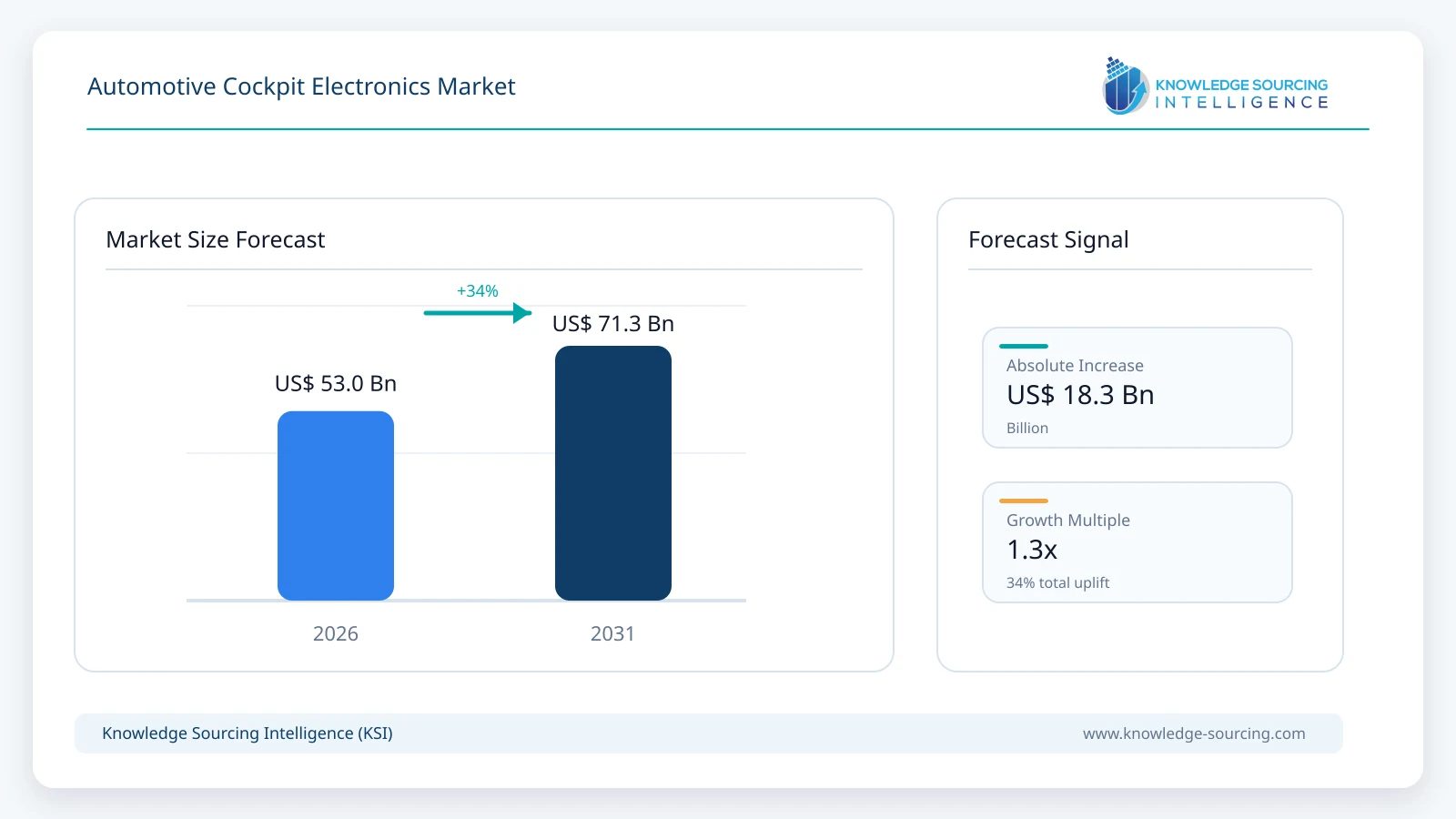
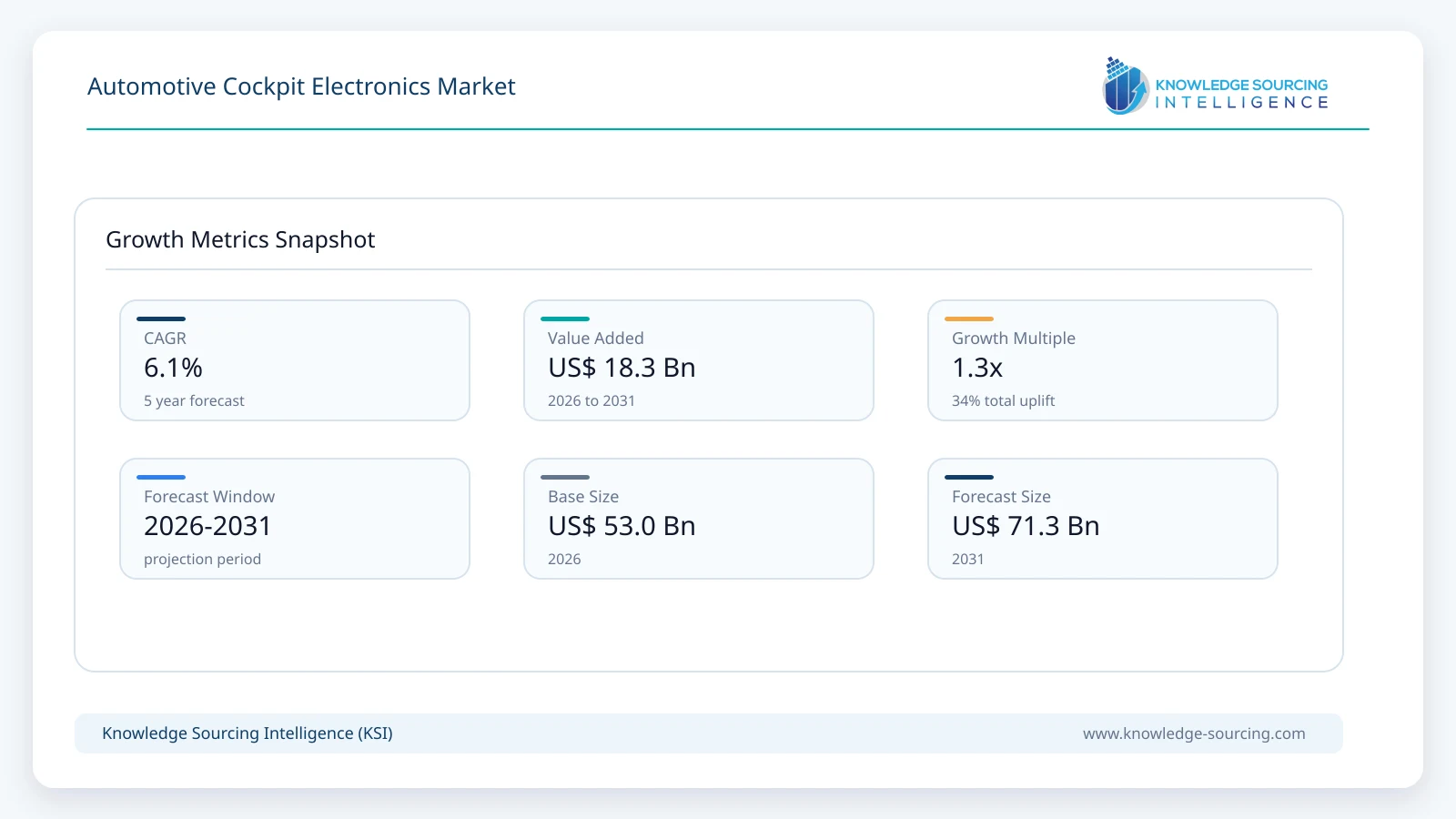
The automotive cockpit electronics market is estimated at approximately USD 53.000 billion in 2026 and is projected to reach about USD 71.261 billion by 2031, representing a CAGR of 6.1% over the forecast period.
Highlights:
- 1Digital cockpit controllers and IVI/head-unit electronics account for approximately 33% of global market value in 2026, remaining the largest product group.
- 2Display systems represent approximately 28% of 2026 market value and gain share as larger center displays, passenger screens, OLED/MiniLED systems and advanced HUDs increase content per vehicle.
- 3Cockpit domain-consolidated architecture accounts for approximately 44% of market value in 2026 and is modeled to reach 53% by 2031.
- 4Passenger vehicles account for approximately 92% of global market value in 2026 because smart-cockpit investment remains concentrated in passenger cars, SUVs and MPVs.
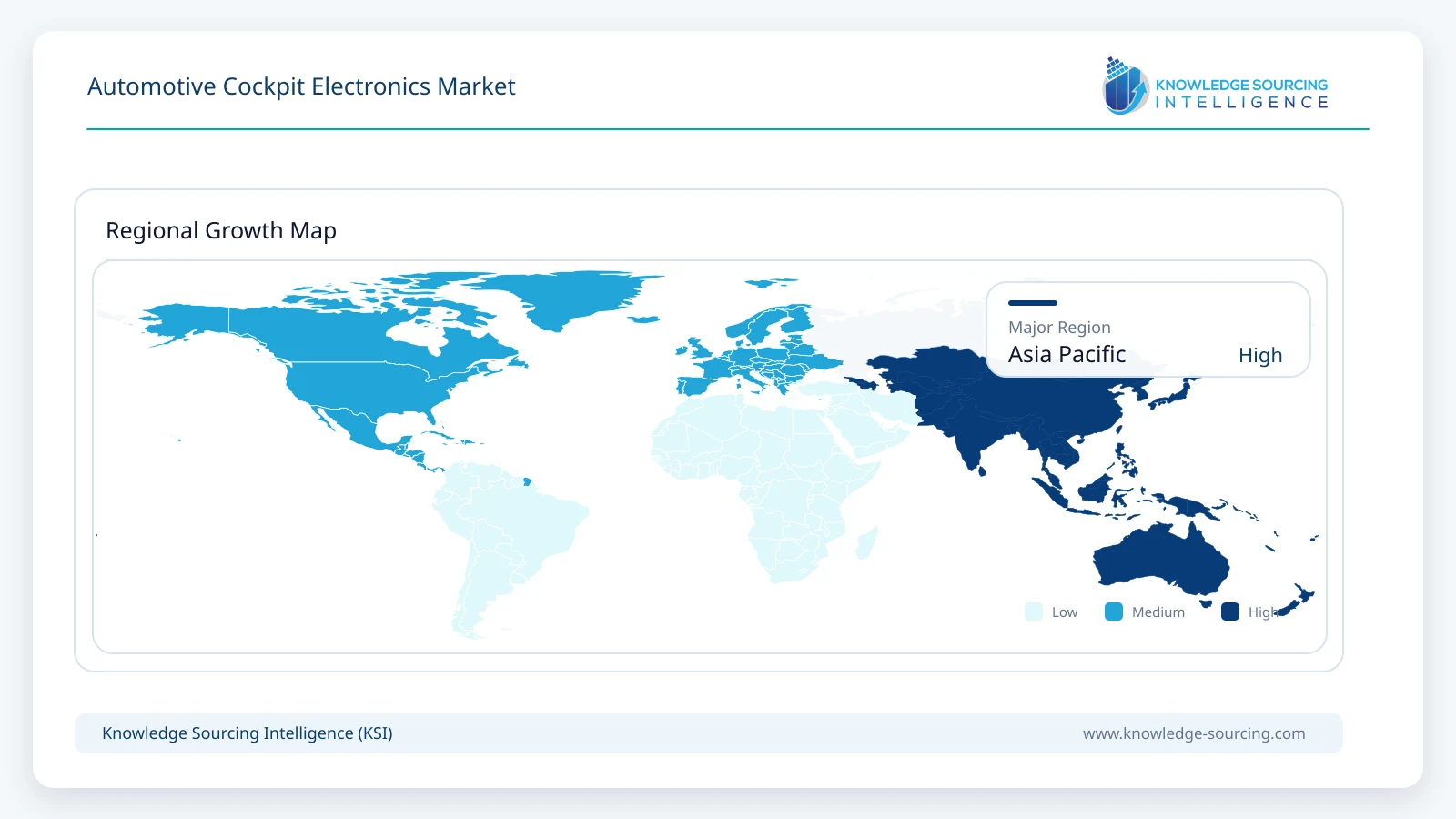
- 5Asia Pacific represents approximately 46% of global market value in 2026, supported by high production and rapid smart-cockpit adoption in China.
- 6Cabin sensing and HMI control electronics are expected to outgrow the market as DMS, OMS, voice, gesture and AI interaction penetrate a broader vehicle base.
Cockpit electronics have shifted from independent modules into an interconnected system spanning compute, displays, connectivity, audio and sensing. Earlier vehicles commonly used separate hardware for IVI, cluster, telematics and individual displays, whereas SDV programs increasingly consolidate these functions around domain controllers and high-speed networking. The result is fewer ECUs but higher compute, memory, graphics and software content within each remaining platform.
Display electronics remain one of the largest value pools because cockpit digitization is increasing both screen area and feature integration. AUMOVIO's industry study places display solutions at EUR 11.5 billion in 2024 and EUR 15.9 billion by 2029, while BOE Varitronix exceeded HKD 13 billion of 2024 revenue. OLED, MiniLED, privacy, haptics and panoramic formats continue to raise display value per vehicle.
Connectivity and audio are becoming more tightly integrated with cockpit compute rather than remaining isolated subsystems. LG reported a 23% global telematics share in 2025, and Marelli's ProConnect combines cluster, IVI, telematics, camera handling and audio DSP on one platform. This integration reduces module duplication while increasing modem, networking, cybersecurity and software content.
Cabin sensing and HMI electronics provide the strongest incremental growth as cameras, microphones, radar, touch, haptics and AI accelerators support DMS, OMS, voice, personalization and multimodal interaction. The most attractive architectures reuse the same sensing and compute hardware across several functions, improving economics while increasing the importance of software orchestration and privacy.
Market Trends
Cockpit Electronics Are Consolidating around Domain and Central Compute
Vehicle architectures are moving from function-specific ECUs toward cockpit domain controllers and cross-domain computers because IVI, cluster, displays and selected sensing workloads can share high-performance compute. Bosch's ten-million-unit cockpit-computer milestone and Panasonic's Mazda CDC program show that consolidation is already at series-production scale. Value shifts from distributed modules toward higher-content controllers, virtualization and base software rather than disappearing with ECU count.
Display Area and Feature Integration Continue to Raise Electronics Content per Vehicle
Central displays, clusters, passenger screens and HUDs are increasing in size and functionality, adding touch, local dimming, privacy and haptic features. AUMOVIO identifies multi-display adoption, larger screen sizes and feature integration as primary display-market drivers, while BOE continues to expand OLED and MiniLED automotive products. Larger display assemblies also raise graphics-controller and memory requirements, supporting both display and compute value.
Connectivity Is Moving from Standalone Telematics toward Integrated Cockpit Platforms
Telematics is becoming more tightly integrated with infotainment and cockpit compute as 5G, OTA and cloud services expand. LG's smart telematics solution integrates the TCU and antenna, while Marelli combines telematics with cluster and IVI on common hardware. OEMs increasingly source connectivity as part of a connected cockpit platform, raising cybersecurity and software value even as physical modules consolidate.
AI and In-Cabin Sensing Are Creating a New High-Growth Electronics Layer
Driver monitoring, occupant monitoring, voice AI and personalization are adding cameras, radar, microphones and NPU workloads to the cockpit stack. LG, HARMAN and Hyundai Mobis increasingly combine sensing with broader cockpit and display architectures. Growth is strongest where one sensor or processor supports several functions, allowing regulatory safety features and premium HMI capabilities to share hardware.
Software Portability Is Becoming a Purchasing Criterion alongside Hardware Performance
OEMs increasingly need cockpit software to remain reusable across processor generations and vehicle lines, raising the importance of hypervisors, VirtIO and containerized services. Panasonic, LG and HARMAN are all developing hardware-software abstraction within cockpit platforms. Portability lowers redevelopment cost and reduces dependence on one silicon generation, making base software a larger part of supplier differentiation.
Automotive Cockpit Electronics Market Segment Analysis
By Product Type
Digital Cockpit Controllers and IVI/Head Units
Digital cockpit controllers and IVI/head-unit electronics account for approximately USD 17.49 billion in 2026 and are projected to reach about USD 22.80 billion by 2031. Their 33% share reflects the silicon, memory and software required to run infotainment and increasingly several displays from one controller. Share eases slightly by 2031 as display and cabin-sensing electronics grow faster, but the category remains the largest product pool.
By Product Type
Display Systems
Display systems represent approximately USD 14.84 billion in 2026 and are projected to reach about USD 20.67 billion by 2031. Larger center displays, passenger screens, OLED/MiniLED systems and advanced HUDs support growth above the total market. The modeled share rises from 28% to 29%, consistent with supplier revenue trends showing display value growing faster than vehicle production.
By Electronics Architecture
Cockpit Domain-Consolidated Architecture
Cockpit domain-consolidated electronics account for approximately USD 23.32 billion in 2026 and are projected to reach about USD 37.77 billion by 2031, implying roughly 10.1% annual growth. Share rises from 44% to 53% as cluster, IVI, displays and selected cameras migrate onto shared high-performance controllers. Distributed electronics decline, while cross-domain central compute grows even faster from a smaller base.
By Vehicle Class
Premium and Upper-Mid-Range Vehicles
Premium and upper-mid-range vehicles account for approximately USD 25.44 billion in 2026 because they carry the highest display count, audio content, AI processing, connectivity and sensing hardware per vehicle. Their share declines from 48% to 44% by 2031 as domain controllers and connected-cockpit functions penetrate mid-range platforms. Premium vehicles nevertheless remain the main launch environment for OLED, advanced sensing and cross-domain compute.
By Vehicle Type
Passenger Vehicles
Passenger vehicles account for approximately USD 48.76 billion in 2026 and are projected to reach about USD 64.14 billion by 2031. Passenger cars, SUVs and MPVs dominate global digital-cockpit and smart-cabin deployment, and large model volumes allow common electronics platforms to span several nameplates. Share moderates from 92% to 90% as commercial vehicles add digital clusters, telematics and camera systems faster from a smaller base.
Market Drivers
Software-Defined Vehicle Architectures Are Increasing Cockpit Electronics Content per Vehicle
SDVs require scalable compute, Ethernet, virtualization and OTA-capable electronics that can support new cockpit features after launch. Consolidation reduces ECU count but raises compute headroom, storage, cybersecurity and software content in the remaining platforms. OEM reuse of one architecture across several models supports market growth even when global vehicle production is relatively flat.
Larger Displays and Multi-Screen Cockpits Are Raising Display and Compute Value
Central displays, passenger screens, clusters and HUDs are increasing screen area and feature content, raising panel, touch, optical and controller value per vehicle. AUMOVIO, BOE and Visteon all identify larger displays and multi-display adoption as major growth drivers. The same trend increases graphics and memory requirements within cockpit controllers.
Connectivity and OTA Services Are Expanding Telematics and Gateway Requirements
5G, cloud services and OTA updates require more capable telematics, antennas, cybersecurity and data-routing electronics. LG's reported 23% global telematics share in 2025 and its integrated TCU-antenna architecture demonstrate both scale and ongoing product evolution. Connectivity increasingly supports infotainment, user profiles, apps and diagnostics rather than only e-call functionality.
Regulatory and Safety Requirements Are Increasing In-Cabin Sensing Adoption
Driver and occupant monitoring are expanding as regulation and NCAP protocols place greater emphasis on attention, occupant status and child presence. These functions add cameras, infrared, radar and processing hardware to the cockpit electronics stack. Reuse of the same sensors for gesture, personalization and AI interaction strengthens the business case beyond compliance alone.
Consumer Expectations for Digital Experience Are Accelerating Cockpit Premiumization
Drivers increasingly compare vehicle interfaces with smartphones, raising expectations for display quality, graphics, voice, connectivity and personalized content. OEMs use cockpit electronics as a visible differentiation point because improvements are immediately apparent and can often be updated after sale. This pressure is spreading advanced electronics from premium into mid-range vehicles.
Market Restraints
Electronics Consolidation Can Reduce Unit Count Faster than It Raises Controller Value
Domain controllers replace several function-specific ECUs, so higher compute performance does not translate directly into market growth. A consolidated cockpit computer may substitute separate cluster, infotainment and display controllers. The market expands only when additional silicon, software, sensing and display content outweigh the value of eliminated legacy modules.
Automotive Semiconductor and Display Cycles Remain Faster than Vehicle Lifecycles
Cockpit processors, displays and connectivity standards evolve faster than vehicle programs, creating obsolescence risk before production ends. OEMs must buy enough performance headroom for future software without over-specifying costly hardware at launch. Modular compute and software abstraction reduce the mismatch but do not remove long qualification and supply requirements.
Mixed-Criticality Integration Increases Validation and Cybersecurity Complexity
Cockpit platforms increasingly host safety-relevant cluster software beside infotainment, cameras, telematics and third-party applications. Hypervisors, secure boot and fault isolation are required so failures or attacks cannot propagate across domains. Consolidation can therefore save hardware while increasing validation, cybersecurity and lifecycle-engineering cost.
High Thermal and Power Loads Constrain Premium Cockpit Architectures
Large displays, high-performance SoCs, AI accelerators, audio amplifiers and continuous connectivity increase dashboard power and heat. Premium cockpit computers may require advanced cooling, while display systems face direct solar load. Thermal constraints can force workload partitioning or more expensive efficient hardware, limiting unconstrained content growth.
Driver-Distraction Concerns Can Limit Touchscreen-Centric Feature Expansion
Moving more controls into digital displays can increase glance time when functions are difficult to locate or change position across menus. Regulatory and NCAP scrutiny favors eyes-on-road interaction, stable controls and effective voice or haptic alternatives. OEMs may therefore retain selected physical controls rather than transferring every cockpit function to a touchscreen.
Regional Outlook
Asia Pacific
Asia Pacific is estimated to account for approximately 46% of global automotive cockpit electronics market value in 2026, making it the largest region. China combines the world's largest vehicle-production base with rapid adoption of large displays, domain controllers, AI assistants and connected cockpit features, while Japan, South Korea and Taiwan contribute major electronics and display supply chains. The internal model increases the region's share to approximately 49% by 2031 as advanced cockpit content spreads into broader price segments.
Europe
Europe is the second major high-value market because premium OEMs and SDV programs support high electronics content per vehicle. AUMOVIO, Bosch, HARMAN and Marelli provide a strong regional supplier base across displays, compute, connectivity and HMI. Europe's modeled share eases from approximately 25% in 2026 to 23% in 2031 as vehicle volumes mature, although absolute market value still rises through premiumization and domain consolidation.
Competitive Landscape
Competition spans Tier 1 cockpit integrators, display specialists, infotainment and connectivity suppliers because cockpit value is distributed across compute, visualization, communications and HMI hardware rather than concentrated in one component category. Visteon, HARMAN, Panasonic Automotive Systems, AUMOVIO, Bosch, LG Vehicle Solution, DENSO, Marelli, Hyundai Mobis, BOE Varitronix, Yazaki and Alps Alpine all participate materially in one or more core cockpit-electronics layers.
Visteon is a useful pure-play benchmark with USD 3.768 billion of 2025 sales centered on digital cockpit electronics, while HARMAN combines digital cockpit, connectivity, display, audio and in-cabin sensing. LG, Panasonic, AUMOVIO and Bosch bring scale in IVI, telematics, displays and cockpit compute, while BOE and Marelli demonstrate how display and controller suppliers are moving toward integrated smart-cockpit modules.
Competition increasingly depends on platform reuse, software portability, display integration, connectivity, sensing, cybersecurity and long-term update support. Suppliers spanning several layers can capture more content per vehicle, while specialists remain competitive where they lead in displays, HUDs, audio or sensing.
Recent Developments
October 2026: LG Electronics announced an integrated cockpit solution combining instrument cluster and infotainment control for Renault Group's first mass-produced SDV commercial vehicle.
July 2026: Panasonic Automotive Systems announced that its cockpit domain controller was adopted in Mazda's all-new CX-5, centralizing IVI, HUD and instrument-cluster functions.
May 2026: LG Electronics introduced an Android Automotive solution capable of controlling multiple in-vehicle displays from a single SoC.
April 2026: Bosch and Qualcomm expanded their collaboration after Bosch surpassed ten million delivered Snapdragon-based cockpit computers.
April 2026: Marelli presented a unified software-defined cockpit architecture combining compute, AI, MiniLED display technology and HMI at Auto China 2026.
Market Outlook
The automotive cockpit electronics market is expected to increase from approximately USD 53.000 billion in 2026 to about USD 71.261 billion by 2031. The 6.1% CAGR reflects relatively slow vehicle-volume growth but continued increases in display, compute, connectivity and sensing content per vehicle. Domain-consolidated architecture should become the largest structural value pool, while cross-domain central compute grows fastest from a smaller base.
Asia Pacific should retain the largest regional market as China drives smart-cockpit scale, while Europe remains important for premium content and SDV engineering. Supplier performance will depend on integrating compute, displays, connectivity, sensing and software without allowing thermal load, validation complexity or driver-distraction risk to offset the benefits of consolidation.
Automotive Cockpit Electronics Market Scope:
| Report Metric | Details |
|---|---|
| Total Market Size in 2026 | USD 53.000 billion |
| Total Market Size in 2031 | USD 71.261 billion |
| Forecast Unit | USD Billion |
| Growth Rate | 6.1% |
| Study Period | 2021 to 2031 |
| Historical Data | 2021 to 2024 |
| Base Year | 2025 |
| Forecast Period | 2026 – 2031 |
| Segmentation | Product Type, Electronics Architecture, Vehicle Class, Vehicle Type, Geography |
| Companies |
|
Market Segmentation
By Product Type
Digital Cockpit Controllers & IVI/Head Units
Display Systems
Connectivity & Telematics Electronics
Audio & Voice Electronics
Cabin Sensing & HMI Control Electronics
By Electronics Architecture
Distributed / Function-Specific Cockpit Electronics
Cockpit Domain-Consolidated Architecture
Cross-Domain / Centralized Cockpit Architecture
By Vehicle Class
Premium & Upper-Mid-Range Vehicles
Mid-Range Vehicles
Mass-Market & Economy Vehicles
By Vehicle Type
Passenger Vehicles
Light Commercial Vehicles
Medium & Heavy Commercial Vehicles
By Geography
North America
United States
Canada
Mexico
South America
Brazil
Argentina
Others
Europe
United Kingdom
Germany
France
Italy
Spain
Others
Middle East & Africa
Saudi Arabia
UAE
Israel
South Africa
Others
Asia Pacific
China
India
Japan
South Korea
Australia
Indonesia
Thailand
Taiwan
Others
Table of Contents
1. EXECUTIVE SUMMARY
2. MARKET SNAPSHOT
2.1. Market Overview
2.2. Market Definition
2.3. Scope of the Study
2.4. Market Segmentation
3. BUSINESS LANDSCAPE
3.1. Market Drivers
3.1.1. Software-Defined Vehicle Architectures Are Increasing Cockpit Electronics Content per Vehicle
3.1.2. Larger Displays and Multi-Screen Cockpits Are Raising Display and Compute Value
3.1.3. Connectivity and OTA Services Are Expanding Telematics and Gateway Requirements
3.1.4. Regulatory and Safety Requirements Are Increasing In-Cabin Sensing Adoption
3.1.5. Consumer Expectations for Digital Experience Are Accelerating Cockpit Premiumization
3.2. Market Restraints
3.2.1. Electronics Consolidation Can Reduce Unit Count Faster than It Raises Controller Value
3.2.2. Automotive Semiconductor and Display Cycles Remain Faster than Vehicle Lifecycles
3.2.3. Mixed-Criticality Integration Increases Validation and Cybersecurity Complexity
3.2.4. High Thermal and Power Loads Constrain Premium Cockpit Architectures
3.2.5. Driver-Distraction Concerns Can Limit Touchscreen-Centric Feature Expansion
3.3. Market Opportunities
3.4. Porter's Five Forces Analysis
3.5. Industry Value Chain Analysis
3.6. Policies and Regulations
3.7. Strategic Recommendations
4. TECHNOLOGICAL OUTLOOK
4.1. Cockpit Domain Controllers and High-Performance Computers
4.2. In-Vehicle Infotainment and Head-Unit Architectures
4.3. Digital Cluster and Multi-Display Electronics
4.4. Head-Up Display and Windshield Display Electronics
4.5. Telematics, 5G and Connectivity Modules
4.6. Automotive Audio, Voice and Microphone Electronics
4.7. Driver and Occupant Monitoring Electronics
4.8. Touch, Haptic and Gesture HMI Electronics
4.9. AI Acceleration and Edge Inference
4.10. Hypervisors, VirtIO and Multi-OS Virtualization
4.11. Ethernet, High-Speed I/O and Cockpit Networking
4.12. OTA Updates, Containers and Feature-on-Demand
4.13. Thermal and Power Management for Cockpit Electronics
5. AUTOMOTIVE COCKPIT ELECTRONICS MARKET BY PRODUCT TYPE
5.1. Digital Cockpit Controllers & IVI/Head Units
5.2. Display Systems
5.3. Connectivity & Telematics Electronics
5.4. Audio & Voice Electronics
5.5. Cabin Sensing & HMI Control Electronics
6. AUTOMOTIVE COCKPIT ELECTRONICS MARKET BY ELECTRONICS ARCHITECTURE
6.1. Distributed / Function-Specific Cockpit Electronics
6.2. Cockpit Domain-Consolidated Architecture
6.3. Cross-Domain / Centralized Cockpit Architecture
7. AUTOMOTIVE COCKPIT ELECTRONICS MARKET BY VEHICLE CLASS
7.1. Premium & Upper-Mid-Range Vehicles
7.2. Mid-Range Vehicles
7.3. Mass-Market & Economy Vehicles
8. AUTOMOTIVE COCKPIT ELECTRONICS MARKET BY VEHICLE TYPE
8.1. Passenger Vehicles
8.2. Light Commercial Vehicles
8.3. Medium & Heavy Commercial Vehicles
9. AUTOMOTIVE COCKPIT ELECTRONICS MARKET BY GEOGRAPHY
9.1. North America
9.1.1. United States
9.1.2. Canada
9.1.3. Mexico
9.2. South America
9.2.1. Brazil
9.2.2. Argentina
9.2.3. Others
9.3. Europe
9.3.1. United Kingdom
9.3.2. Germany
9.3.3. France
9.3.4. Italy
9.3.5. Spain
9.3.6. Others
9.4. Middle East & Africa
9.4.1. Saudi Arabia
9.4.2. UAE
9.4.3. Israel
9.4.4. South Africa
9.4.5. Others
9.5. Asia Pacific
9.5.1. China
9.5.2. India
9.5.3. Japan
9.5.4. South Korea
9.5.5. Australia
9.5.6. Indonesia
9.5.7. Thailand
9.5.8. Taiwan
9.5.9. Others
10. COMPETITIVE ENVIRONMENT AND ANALYSIS
10.1. Major Players and Strategy Analysis
10.2. Market Share Analysis
10.3. Product and Architecture Benchmarking
10.4. Mergers, Acquisitions, Agreements and Collaborations
10.5. Competitive Dashboard
11. COMPANY PROFILES
11.1. Visteon Corporation
11.2. HARMAN International
11.3. Panasonic Automotive Systems Co., Ltd.
11.4. AUMOVIO
11.5. Robert Bosch GmbH
11.6. LG Electronics Vehicle Solution Company
11.7. DENSO Corporation
11.8. Marelli
11.9. Hyundai Mobis
11.10. BOE Varitronix Limited
11.11. Yazaki Corporation
11.12. Alps Alpine Co., Ltd.
12. APPENDIX
12.1. Currency
12.2. Assumptions
12.3. Base and Forecast Years Timeline
12.4. Key Benefits for Stakeholders
12.5. Research Methodology
12.6. Abbreviations
12.7. Data Sources
Navigate
Trusted by the world's leading organizations











