
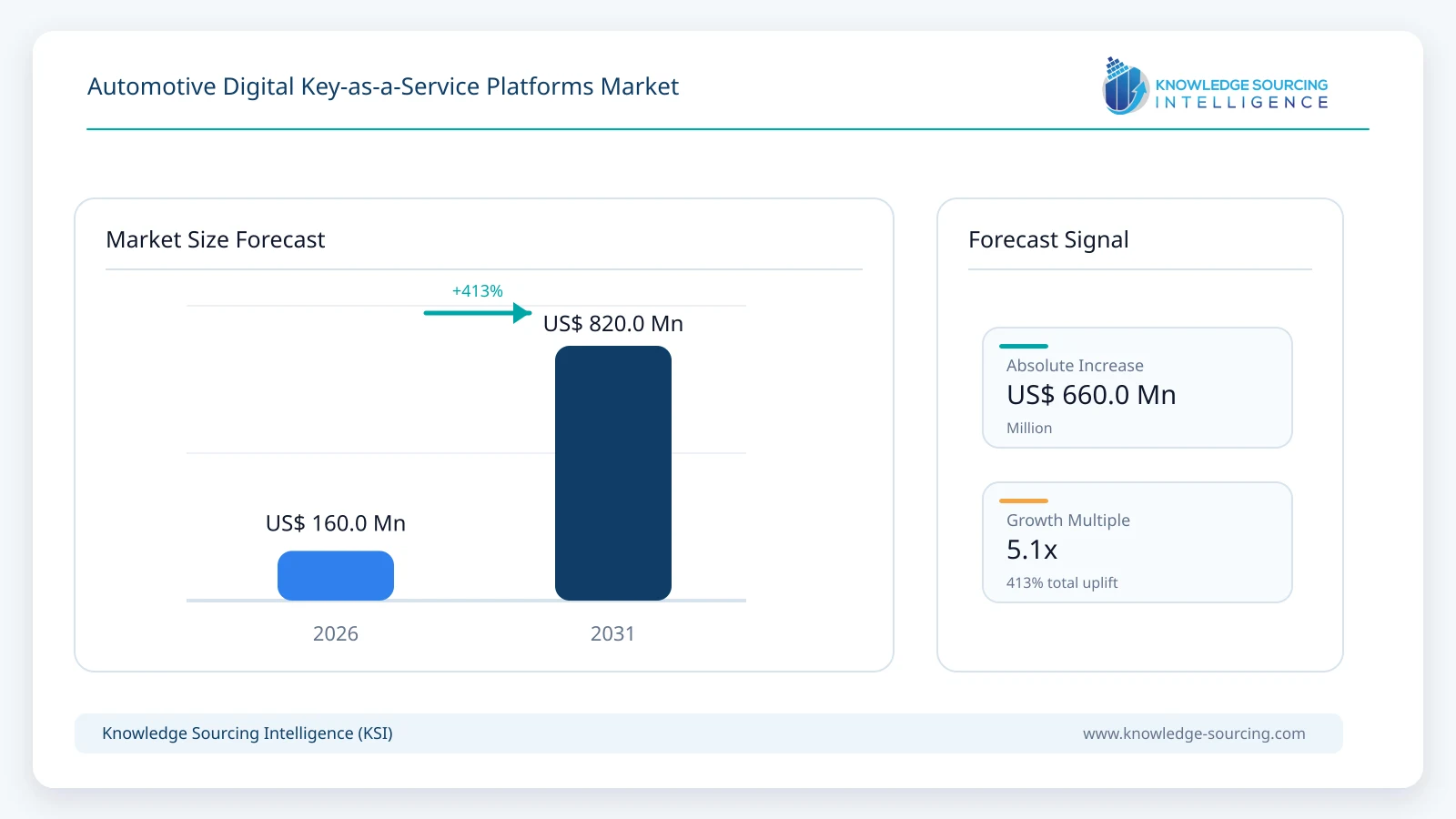
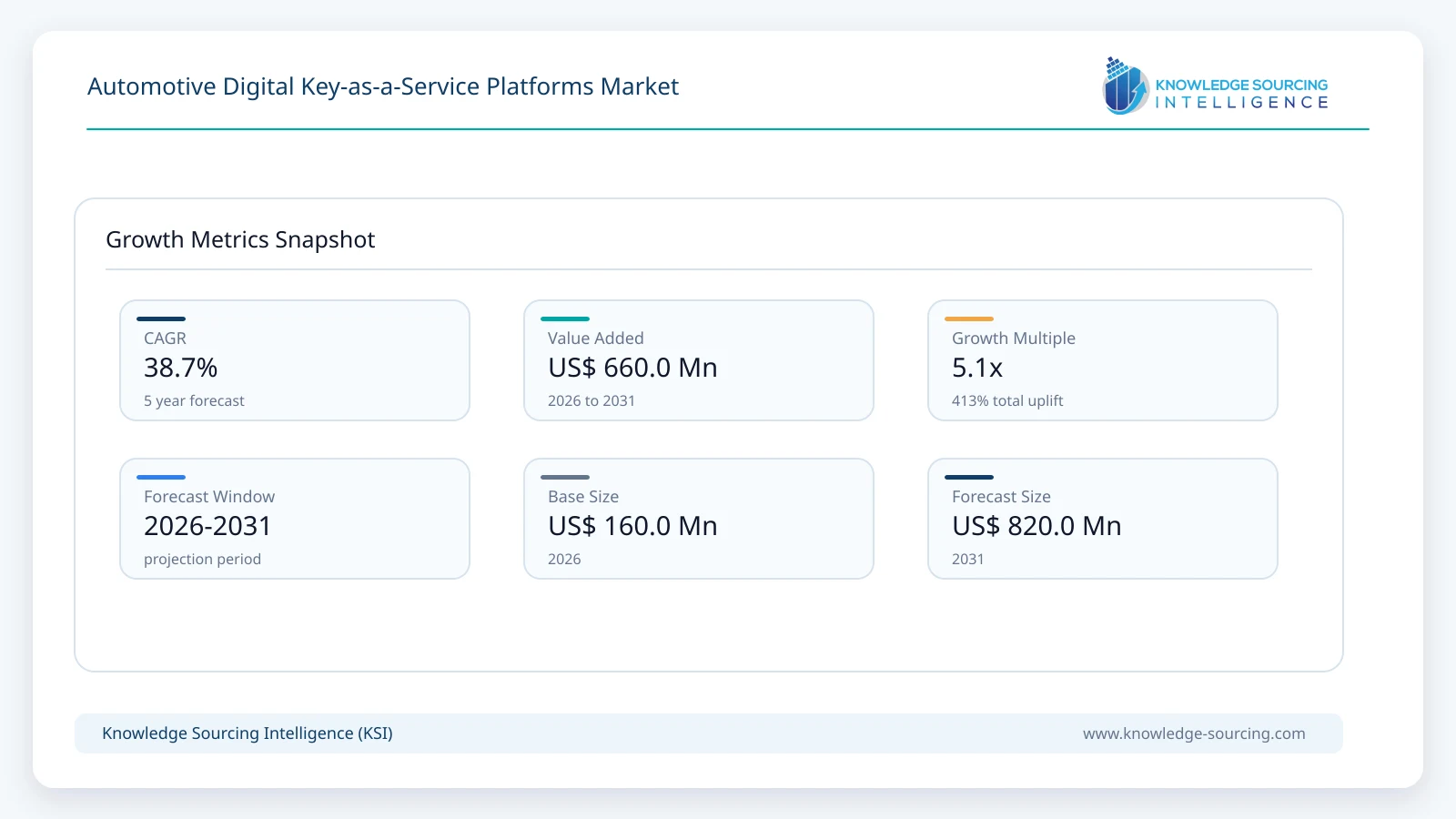
The automotive digital key-as-a-service platforms market is growing at a CAGR of 38.7%, from USD 160 million in 2026 to USD 820 million by 2031.
Highlights:
- 1Credential issuance and lifecycle management forms the largest 2026 service category, with modeled revenue of USD 58 million.
- 2Passenger vehicle OEMs account for approximately 65.6% of 2026 revenue, while rentals and shared mobility expand their contribution through 2031.
- 3CCC-certified OEM server products from doubleSlash, AUMOVIO and Shanghai Ingeek establish a clearer ecosystem for standards-based backend procurement.
- 4Fleet delegation, shared ownership and temporary access become more important as CCC Digital Key Version 4 capabilities move through interoperability testing.
- 5Cybersecurity, key recovery, device compatibility and backend uptime remain material procurement requirements.
Digital key-as-a-service platforms deliver the cloud services needed to issue, manage, share and revoke vehicle access credentials after a vehicle leaves the factory. The service layer connects automotive manufacturer servers with secure smartphone wallets or brand applications and maintains authorization records for changing users, ownership transfers, lost devices and service personnel. This creates purchasing demand for managed infrastructure as well as software integration.
OEMs may operate their own private digital-key backend, license a dedicated managed environment or purchase a cloud service delivered across multiple customers. WirelessCar markets a managed digital-key service with provisioning, sharing and termination functionality, while doubleSlash offers a CCC-certified vehicle OEM server. AUMOVIO has contracted to supply an end-to-end CoSmA architecture incorporating both in-vehicle access equipment and centralized cloud key management.
Passenger vehicle owners generally receive digital access as part of the vehicle, while fleet and rental operators procure timed permissions, remote credential revocation and connections to booking, workshop or dispatch systems. As access rights become more dynamic, the provider’s recurring security, uptime and credential administration responsibilities account for a larger portion of platform spending.
Market Overview
An automotive digital key connects a trusted personal device to vehicle entry and start functions through a combination of near-field communication, Bluetooth Low Energy, ultra-wideband ranging and secure backend authorization. Cloud-managed credentials determine which device may access a particular vehicle, which functions are permitted and when rights expire. The CCC specification supports cross-platform sharing and helps automotive suppliers design consistent interactions among vehicle systems, mobile devices and OEM servers.
AUMOVIO, doubleSlash and Shanghai Ingeek reached CCC vehicle OEM server certification milestones in 2026, indicating that the backend is becoming a separately tested part of the digital-key system. WirelessCar markets key lifecycle services as SaaS, while Bosch and Huf address the more operationally demanding requirements of fleet vehicle access. These supplier models create opportunities for technology vendors that can maintain a secure service throughout a vehicle’s useful life.
Vehicle access has a different service profile from one-time remote unlocking. Key issuance, renewal, device replacement, credential revocation and authorization audits must work across successive smartphones, software versions and changes of driver. For rental and service fleets, the platform also needs dependable integration with booking and customer management systems. Recurring fees are supported by these ongoing functions, although bundled OEM contracts keep effective prices under pressure.
Market Trends
Certified OEM Servers Are Becoming a Distinct Procurement Layer
CCC certification of doubleSlash Digital Key in January 2026, AUMOVIO CoSmA Cloud Solutions in February and Ingeek Digital Key Platform in April demonstrates the emergence of a defined backend product category. Vehicle manufacturers can evaluate interoperability at the server layer instead of treating the cloud as an undocumented extension of an in-vehicle access module.
Certified server interfaces can reduce the burden of testing every device and vehicle combination independently, but automakers still need to connect identity, customer accounts, authorization policies and aftersales systems. Vendors able to supply both standards compliance and production support are well placed to win long-term managed-service contracts.
Digital Key Version 4 Expands Delegated Access
The October 2026 CCC Plugfest hosted by Google tested Version 4 functions for server-based owner devices, fleet-management servers and service-provider servers. This expands the technical discussion from an owner sharing a spare key to an operator assigning and withdrawing access across many vehicles, users and operating locations.
Rental companies and commercial fleets can link access permissions to a reservation, shift or repair order, reducing the time needed for physical handovers. Because Version 4 functionality was still undergoing cross-company testing during 2026, commercial revenue expansion depends on certification readiness and subsequent OEM model deployment rather than the testing event alone.
Managed Cloud Services Are Replacing Bespoke Key Backends
WirelessCar offers its Digital Key Management as a managed cloud SaaS service with credential provisioning, termination and sharing. AUMOVIO also markets a production cloud environment for CoSmA, and its May 2026 agreement covers centralized key management alongside vehicle hardware. These products reduce the need for each automaker to build and maintain every security service internally.
Dedicated environments remain attractive to large vehicle manufacturers with strict identity and operating requirements, while shared cloud offerings can improve commercial viability for smaller programs. Platform suppliers compete on lifecycle support, availability guarantees, integration speed and certification maintenance rather than cloud processing alone.
Fleet and Rental Integrations Move Beyond Owner Convenience
Bosch describes cloud key sharing, fleet web interfaces and third-party transport-management integrations in its xtended access offering, while Huf reports long-standing digital key management activity for rental and car-sharing operators. These applications require many short-duration authorizations, location-specific vehicle assignment and reliable access when drivers change.
Managed services become more valuable as fleets distribute vehicles across multiple depots or cities and replace manual key cabinets with authenticated mobile credentials. The commercial benefit is strongest when access workflows connect with existing reservation, identity-verification and dispatch systems, reducing labor while preserving an auditable history of key issuance and withdrawal.
Credential Security and Recovery Become Core Service Features
CCC Digital Key relies on secure authentication across vehicle, handset and server, with BLE and UWB proximity verification supporting hands-free access and NFC providing an important fallback path. Vendors must support revocation when a phone is lost, restore access after device replacement and keep multiple active credentials aligned with owner permissions.
Security services create ongoing technical work for backend operators as mobile operating systems, cryptographic methods and threat scenarios evolve. Suppliers that integrate key lifecycle controls with vehicle cybersecurity processes can sustain recurring customer relationships, although stronger controls also increase testing, documentation and support obligations.
Segment Analysis
By Service Type: Credential Issuance and Lifecycle Management
Credential issuance and lifecycle management represents an estimated USD 58 million in 2026 because virtually every managed key deployment needs secure creation, assignment, updating and withdrawal of vehicle authorization. CCC-certified OEM server platforms from doubleSlash, AUMOVIO and Ingeek demonstrate the critical role of backend credentials even where the vehicle’s physical access hardware comes from another supplier.
Fleet and rental access orchestration gains importance as the customer base broadens beyond privately owned vehicles. Timed rentals, delegated service access and centralized key recovery require more frequent transactions and deeper operational integration than the initial owner credential. These higher-activity use cases account for a rising share of platform demand through 2031.
By Customer Type: Passenger Vehicle OEMs
Passenger vehicle OEMs account for an estimated USD 105 million, or 65.6%, in 2026 because the vehicle manufacturer typically owns the relationship between user accounts, onboard access security and smartphone-wallet integration. AUMOVIO’s 2026 contract for a European automaker, with planned vehicle introduction from 2028, illustrates the long vehicle-platform programs involved in this purchasing category.
Rental companies and shared-mobility providers are expected to increase their contribution over the forecast period. Their use of many short-lived credentials per vehicle makes central access control and rapid revocation particularly valuable. The ability to connect the digital key with bookings and vehicle utilization may support higher service intensity than simple private owner access.
By Deployment Model: Dedicated Managed Cloud
Dedicated managed cloud environments account for an estimated USD 68 million in 2026 as larger OEMs require controlled security operations, integration with proprietary identity directories and managed platform availability. Backend suppliers must accommodate different model-year hardware, smartphone ecosystems and vehicle ownership procedures while maintaining a consistent access experience.
Multi-tenant cloud SaaS is projected to expand from USD 62 million in 2026 to USD 350 million in 2031, benefiting from repeatable integration, shared platform maintenance and the ability to bring smaller vehicle and fleet programs online. Private deployments remain relevant where automakers retain direct custody of identity data or mandate tightly specified security infrastructure.
By Digital-Key Ecosystem: Interoperable Wallet-Based Digital Key
Interoperable wallet-based keys account for USD 72 million in modeled 2026 revenue as CCC-aligned vehicle programs adopt standardized ways to store and share credentials on smartphones. The CCC certified product register includes vehicles from BMW, Mercedes-Benz, Hyundai, Volvo, Polestar and other manufacturers, supporting wider demand for compatible vehicle and cloud services.
Proprietary app-based platforms continue to serve existing fleets and vehicle lines, particularly when an operator wants a tightly controlled branded process. Hybrid wallet-and-app offerings become more attractive for fleets that need both secure vehicle-level credentials and administrative workflow functions, including rental reservations, driver handovers and service-provider access.
Market Drivers
Expansion of Interoperable Mobile Wallet Keys
The CCC certified 115 vehicle and component products during 2025, bringing a wider range of automotive manufacturers and device suppliers into a common digital-key ecosystem. Interoperable wallet credentials make it easier for OEMs to support key sharing across operating systems and device models without designing every access flow exclusively for one brand.
Each additional certified vehicle family can create demand for key provisioning, device replacement and lifecycle services. Managed backend providers benefit because interoperability reduces one source of integration complexity while the continuing responsibility for authorization records and secure key revocation remains with the operating platform.
New Fleet and Rental Access Workflows
CCC Digital Key Version 4 testing in October 2026 included server-based fleet and service-provider scenarios, reflecting commercial requirements that extend well beyond private vehicle entry. Car rental businesses require access permissions for a booked vehicle, return deadlines, vehicle cleaning and service access, often without a physical key counter.
Fleet customers can justify recurring fees when a managed access platform reduces key logistics and lets operations teams assign vehicles at short notice. Cloud authorization services also support account-level audit trails and changes of driver, making a subscription model commercially suitable where vehicles are shared frequently.
More Connected Vehicle Models and Backend Certification
Certifications of AUMOVIO, doubleSlash and Ingeek vehicle OEM servers in 2026 establish visible commercial implementations of the cloud component of digital access. AUMOVIO’s planned multi-platform OEM rollout from 2028 demonstrates how one awarded backend architecture can support several vehicle generations rather than a single model.
Automakers purchasing production digital keys must maintain compatibility for many years after a vehicle sale. A managed backend provider can spread security maintenance and wallet integration work across connected model lines, increasing lifetime service revenue as the installed vehicle base expands.
Growing Demand for Credential Lifecycle Security
Owner devices are routinely replaced, shared and sometimes lost, making credential cancellation and recovery essential to reliable smartphone-based vehicle access. CCC digital key features include time-limited sharing and user permissions, while NFC fallback helps preserve access when the smartphone’s battery is depleted.
Businesses handling multiple vehicle users require auditable records of issuance, renewal and revocation, especially when access rights change frequently. Ongoing security operations create reasons to retain a specialist managed-service provider after the initial vehicle software has been delivered.
Shift Toward Managed Automotive Cloud Services
WirelessCar markets Digital Key Management as cloud-based SaaS with defined support and lifecycle management responsibilities, demonstrating the business model available to automakers that do not want to operate their own credential infrastructure. AUMOVIO similarly positions CoSmA Cloud Solution around CCC integration and global interoperability.
Managed services can shorten the launch cycle for new vehicle programs and make costs more predictable by placing operation, updates and service monitoring under a continuing contract. This becomes especially valuable for companies with multiple vehicle brands, markets or business partners that must use consistent access rules.
Market Restraints
Complex Wallet, Vehicle and Server Interoperability
Digital-key functions depend on several independently updated components, including handset operating systems, secure wallets, vehicle controllers and the OEM server. The CCC continues interoperability testing of Version 4 because credentials and delegated access must work across device generations and different automotive implementations.
Platform suppliers face additional regression testing when a wallet, vehicle firmware version or backend protocol changes. Commercial launches may be delayed if a user can create a credential but cannot reliably share, transfer or revoke it across the full supported device population.
Cybersecurity and Credential Recovery Obligations
A cloud digital-key operator handles access permissions that can unlock and start valuable physical assets, making account takeover, device theft and unauthorized key delegation important security risks. Vehicle and mobile device authentication must work alongside secure issuance, revocation and recovery procedures.
Strong identity verification and incident response raise the cost of running the platform, while service interruptions can affect the customer’s ability to use a vehicle. OEMs therefore apply demanding security and uptime reviews before approving third-party cloud services, extending qualification and procurement cycles.
Bundled OEM Access Systems and Pricing Pressure
Automakers often purchase digital access as a package including UWB or BLE hardware, application software and cloud functions. AUMOVIO’s May 2026 contract is an integrated supply arrangement that includes centralized key management as one part of the deliverable, illustrating how the service may be embedded in a broader commercial agreement.
Large OEMs have bargaining leverage when they commit high vehicle volumes across several model families. Backend specialists must show value through reduced implementation time, long-term support and interoperability rather than relying on high fees for ordinary key issuance.
Vehicle Connectivity Gaps and Offline Access Requirements
Mobile networks and cloud services may be unavailable in underground parking, rural operating areas or temporary network outages. Digital keys still need reliable local authentication using vehicle and smartphone credentials, while the cloud updates the record of valid authorization when connectivity is restored.
Fleet operators may hesitate to depend on a managed access service when a failed handover could leave a vehicle unavailable for rental or dispatch. Suppliers need carefully engineered offline permissions, fallback methods and synchronization controls, adding development and validation work to each new vehicle integration.
Slow Commercial Fleet Integration and Legacy Vehicles
Existing commercial fleets contain multiple vehicle vintages with different immobilizer, locking and telematics architectures. Bosch and Huf provide fleet-oriented access solutions, but integrating cloud credentials with booking applications and varied vehicle equipment can require additional modules and operator process changes.
Older vehicles may not justify the cost of upgrading digital access, particularly in small fleets with infrequent driver changes. Platform adoption therefore depends on turnover of compatible vehicles and the operator’s ability to remove enough manual key handling to offset subscriptions and system integration costs.
Regional Outlook
Asia Pacific
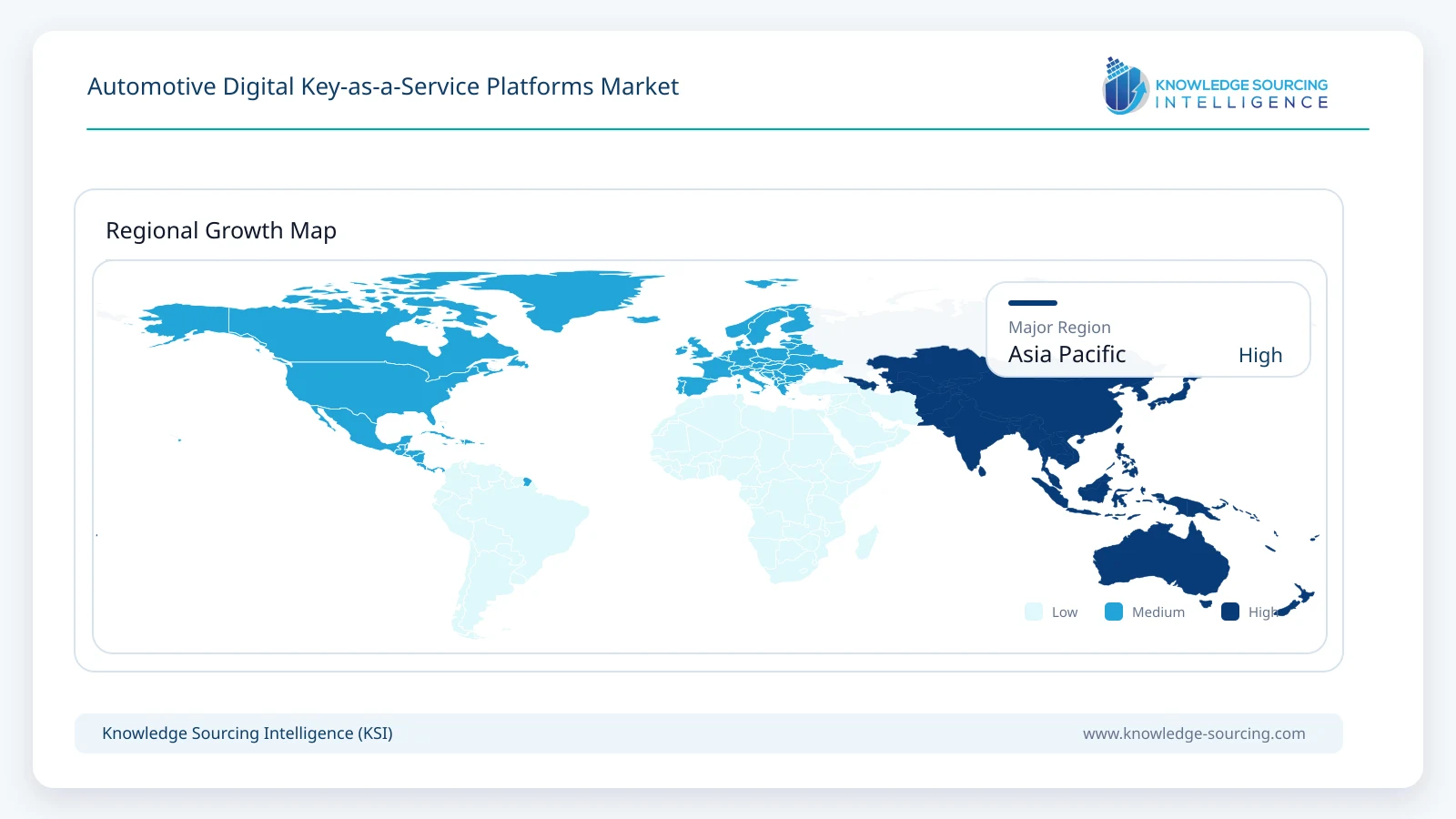
Asia Pacific leads the 2026 digital-key-as-a-service platforms market as Chinese, South Korean and Japanese automakers adopt connected vehicle access and local smartphone ecosystems support a large base of wallet-capable users. China contributes the largest modeled regional revenue pool, with CCC-certified vehicles and Ingeek’s certified server illustrating domestic participation in both vehicle products and backend infrastructure.
The region is expected to remain largest through 2031 as digital access extends across more vehicle price bands and multi-user mobility services expand in large metropolitan markets. India and Southeast Asia add longer-term opportunity through vehicle connectivity and fleet digitization, but adoption will depend on device compatibility, service localization and integration costs.
Europe
European automakers and software suppliers occupy a significant share of the digital-key cloud value chain. AUMOVIO secured an end-to-end CoSmA contract in May 2026 with planned series deployment from 2028, while Germany-based doubleSlash achieved CCC OEM server certification in January 2026. These developments show the role of European suppliers in interoperability testing and production backend design.
Rental, leasing and commercial fleet demand encourages European platform providers to support time-limited access and delegated credentials within established customer systems. Supplier opportunities remain conditioned by stringent cybersecurity reviews, long vehicle-platform qualification cycles and the cost of operating trusted services across different national markets.
Competitive Landscape
Digital key cloud services are supplied by automotive Tier 1 companies, dedicated backend specialists and connected-car platform operators. AUMOVIO and Bosch can combine vehicle-level access equipment with managed service software, while WirelessCar offers a cloud-managed digital key product and doubleSlash concentrates on CCC-compliant OEM server technology. Shanghai Ingeek adds competition from China, where vehicle manufacturers increasingly deploy smartphone access across multiple brands and models.
Fleet-oriented providers address a different purchasing process from private passenger vehicle OEM programs. Huf Secure Mobile, Ridecell and Vulog connect mobile vehicle access with rental, car-sharing or fleet management workflows. Their value proposition depends on rapid authorization changes, dispatch integration and reduced manual handovers; revenue attributable to key services must be separated from full mobility-platform subscriptions.
Competition is moving toward deeper interoperability and long-term service contracts rather than a simple comparison of NFC, BLE or UWB implementations. AUMOVIO’s OEM contract indicates the advantage of an end-to-end supplier, while a certified backend specialist can remain competitive when automakers assemble solutions from more than one hardware and software vendor. No reliable public evidence supports assigning precise market shares to the named companies.
Recent Developments
October 12, 2026 - Car Connectivity Consortium: Google hosted CCC Plugfest #20, testing Version 4 fleet-management, server-based owner and service-provider functions. The event advanced interoperability validation for future rental and fleet use cases, rather than constituting a production launch.
September 8, 2026 - Car Connectivity Consortium and Geely Holding Group: Plugfest #19 opened in Ningbo to test Version 3/Version 4 implementations and cross-platform sharing scenarios. The event broadened regional interoperability validation.
May 5, 2026 - AUMOVIO: The company announced an end-to-end CoSmA contract with a European OEM covering centralized cloud key management and access hardware, with series rollout planned from 2028.
April 14, 2026 - Shanghai Ingeek Technology: CCC recorded certification of the Ingeek Digital Key Platform in the Vehicle OEM Server category, strengthening the certified backend supplier base.
February 25, 2026 - AUMOVIO: CoSmA Cloud Solutions received CCC certification as a Vehicle OEM Server, validating a defined standards-compliant cloud access product.
January 22, 2026 - doubleSlash: The company reported CCC certification of its Digital Key backend, following the January 6 certificate date, supporting procurement of interoperable OEM server services.
Market Outlook
Digital-key cloud services should capture a larger share of automotive access spending as more vehicles support smartphone wallets, multiple active credentials and remotely managed rights. Supplier growth will depend on turning certifications and OEM nominations into production platforms, while maintaining security support over vehicle lifetimes that exceed typical phone replacement cycles.
Fleet and rental applications are likely to move from proprietary access workflows toward more interoperable server-managed arrangements as CCC Version 4 use cases reach commercial maturity. Providers that combine reliable credential management with booking integration, delegated permissions and fast recovery from device loss can earn recurring revenue from repeated access events rather than solely from first-time vehicle activation.
The market is projected to reach USD 820 million by 2031 as cloud-managed access spreads beyond premium passenger cars and into shared mobility and commercial use. Pricing pressure will remain important as large manufacturers negotiate bundled contracts, but trusted backend operation, certification maintenance and platform integration create recurring work for specialist suppliers.
Automotive Digital Key-as-a-Service Platforms Market Scope
| Report Metric | Details |
|---|---|
| Total Market Size in 2026 | USD 160 million |
| Total Market Size in 2031 | USD 820 million |
| Forecast Unit | Million |
| Growth Rate | 38.7% |
| Study Period | 2021 to 2031 |
| Historical Data | 2021 to 2024 |
| Base Year | 2025 |
| Forecast Period | 2026 – 2031 |
| Segmentation | Service Type, Customer Type, Deployment Model, Digital-Key Ecosystem, Vehicle Type, Commercial Model, Use Case, Geography |
| Companies |
|
| Customization Scope | 15% Free Customization included with purchase — Request Custom Breakdown → |
| Sample & Data Access | PDF Sample, Excel Databook & Analyst Briefing — Download Free Sample → |
Market Segmentation
By Service Type
Credential Issuance and Lifecycle Management
Secure Key Sharing and Delegation
Fleet and Rental Access Orchestration
Identity and Security Services
Implementation and Managed Integration
By Customer Type
Passenger Vehicle OEMs
Rental and Shared-Mobility Operators
Commercial Fleet Operators
Aftersales and Mobility Service Providers
By Deployment Model
Multi-Tenant Cloud SaaS
Dedicated Managed Cloud
OEM-Hosted and Private Cloud
By Digital-Key Ecosystem
Interoperable Wallet-Based Digital Key
Proprietary Application-Based Key
Hybrid Wallet and Application Access
By Vehicle Type
Passenger Cars
Light Commercial Vehicles
Medium and Heavy Commercial Vehicles
By Commercial Model
Per-Active-Vehicle Subscriptions
Enterprise Platform Licenses
Credential and Access Transaction Fees
Implementation and Integration Contracts
By Use Case
Private Owner Access
Household and Delegated Access
Fleet and Rental Access
Service and Valet Access
By Geography
North America
United States
Canada
Mexico
South America
Brazil
Argentina
Chile
Others
Europe
Germany
United Kingdom
France
Italy
Spain
Others
Middle East and Africa
Saudi Arabia
United Arab Emirates
South Africa
Turkey
Israel
Others
Asia Pacific
China
India
Japan
South Korea
Indonesia
Australia
Thailand
Taiwan
Others
Table of Contents
1. EXECUTIVE SUMMARY
2. MARKET SNAPSHOT
2.1. Market Overview
2.2. Market Definition
2.3. Scope of the Study
2.4. Market Segmentation
3. BUSINESS LANDSCAPE
3.1. Market Drivers
3.1.1. Expansion of Interoperable Mobile Wallet Keys
3.1.2. New Fleet and Rental Access Workflows
3.1.3. More Connected Vehicle Models and Backend Certification
3.1.4. Growing Demand for Credential Lifecycle Security
3.1.5. Shift Toward Managed Automotive Cloud Services
3.2. Market Restraints
3.2.1. Complex Wallet, Vehicle and Server Interoperability
3.2.2. Cybersecurity and Credential Recovery Obligations
3.2.3. Bundled OEM Access Systems and Pricing Pressure
3.2.4. Vehicle Connectivity Gaps and Offline Access Requirements
3.2.5. Slow Commercial Fleet Integration and Legacy Vehicles
3.3. Market Opportunities
3.4. Porter’s Five Forces Analysis
3.5. Industry Value Chain Analysis
3.6. Policies and Regulations
3.7. Strategic Recommendations
4. TECHNOLOGICAL OUTLOOK
4.1. Cloud Key Provisioning and Lifecycle Services
4.2. CCC Wallet Interoperability and Secure Elements
4.3. Server-Based Fleet Credentials and Delegation
4.4. Identity, Security and Key Recovery
5. AUTOMOTIVE DIGITAL KEY-AS-A-SERVICE PLATFORMS MARKET BY SERVICE TYPE
5.1. Overview
5.2. Credential Issuance and Lifecycle Management
5.3. Secure Key Sharing and Delegation
5.4. Fleet and Rental Access Orchestration
5.5. Identity and Security Services
5.6. Implementation and Managed Integration
6. AUTOMOTIVE DIGITAL KEY-AS-A-SERVICE PLATFORMS MARKET BY CUSTOMER TYPE
6.1. Overview
6.2. Passenger Vehicle OEMs
6.3. Rental and Shared-Mobility Operators
6.4. Commercial Fleet Operators
6.5. Aftersales and Mobility Service Providers
7. AUTOMOTIVE DIGITAL KEY-AS-A-SERVICE PLATFORMS MARKET BY DEPLOYMENT MODEL
7.1. Overview
7.2. Multi-Tenant Cloud SaaS
7.3. Dedicated Managed Cloud
7.4. OEM-Hosted and Private Cloud
8. AUTOMOTIVE DIGITAL KEY-AS-A-SERVICE PLATFORMS MARKET BY DIGITAL-KEY ECOSYSTEM
8.1. Overview
8.2. Interoperable Wallet-Based Digital Key
8.3. Proprietary Application-Based Key
8.4. Hybrid Wallet and Application Access
9. AUTOMOTIVE DIGITAL KEY-AS-A-SERVICE PLATFORMS MARKET BY VEHICLE TYPE
9.1. Overview
9.2. Passenger Cars
9.3. Light Commercial Vehicles
9.4. Medium and Heavy Commercial Vehicles
10. AUTOMOTIVE DIGITAL KEY-AS-A-SERVICE PLATFORMS MARKET BY COMMERCIAL MODEL
10.1. Overview
10.2. Per-Active-Vehicle Subscriptions
10.3. Enterprise Platform Licenses
10.4. Credential and Access Transaction Fees
10.5. Implementation and Integration Contracts
11. AUTOMOTIVE DIGITAL KEY-AS-A-SERVICE PLATFORMS MARKET BY USE CASE
11.1. Overview
11.2. Private Owner Access
11.3. Household and Delegated Access
11.4. Fleet and Rental Access
11.5. Service and Valet Access
12. AUTOMOTIVE DIGITAL KEY-AS-A-SERVICE PLATFORMS MARKET BY GEOGRAPHY
12.1. North America
12.1.1. United States
12.1.2. Canada
12.1.3. Mexico
12.2. South America
12.2.1. Brazil
12.2.2. Argentina
12.2.3. Chile
12.2.4. Others
12.3. Europe
12.3.1. Germany
12.3.2. United Kingdom
12.3.3. France
12.3.4. Italy
12.3.5. Spain
12.3.6. Others
12.4. Middle East and Africa
12.4.1. Saudi Arabia
12.4.2. United Arab Emirates
12.4.3. South Africa
12.4.4. Turkey
12.4.5. Israel
12.4.6. Others
12.5. Asia Pacific
12.5.1. China
12.5.2. India
12.5.3. Japan
12.5.4. South Korea
12.5.5. Indonesia
12.5.6. Australia
12.5.7. Thailand
12.5.8. Taiwan
12.5.9. Others
13. COMPETITIVE ENVIRONMENT AND ANALYSIS
13.1. Major Players and Strategy Analysis
13.2. Market Share Analysis
13.3. Mergers, Acquisitions, Agreements and Collaborations
13.4. Competitive Dashboard
14. COMPANY PROFILES
14.1. AUMOVIO Germany GmbH
14.2. WirelessCar
14.3. doubleSlash Net-Business GmbH
14.4. Shanghai Ingeek Technology Co., Ltd.
14.5. Robert Bosch GmbH
14.6. Huf Hülsbeck & Fürst GmbH & Co. KG
14.7. Valeo
14.8. Ridecell Inc.
14.9. HCLTech
14.10. Vulog
15. APPENDIX
15.1. Currency
15.2. Assumptions
15.3. Base and Forecast Years Timeline
15.4. Key Benefits for Stakeholders
15.5. Research Methodology
15.6. Abbreviations





Frequently asked questions
What is the projected market size by 2031?
The Automotive Digital Key-as-a-Service Platforms Market is projected to reach USD 820 million by 2031.
What is the market's projected compound annual growth rate?
The Automotive Digital Key-as-a-Service Platforms Market is projected to grow at a 38.7% CAGR.
Which segment is the largest revenue contributor in 2026?
Passenger vehicle OEMs account for 65.6% of 2026 revenue.
What is the largest 2026 service category by revenue?
Credential issuance and lifecycle management is the largest 2026 service.
What are key procurement requirements for digital key platforms?
Cybersecurity, key recovery, device compatibility, and backend uptime are key requirements.
Which companies offer CCC-certified OEM server products?
doubleSlash, AUMOVIO, and Shanghai Ingeek offer CCC-certified OEM servers.
Cite this report
Knowledge Sourcing Intelligence. (Oct 2026). Automotive Digital Key-as-a-Service Platforms Market Size, Share & Growth Forecast (2026-2031). https://www.knowledge-sourcing.com/report/automotive-digital-key-as-a-service-platforms-market