
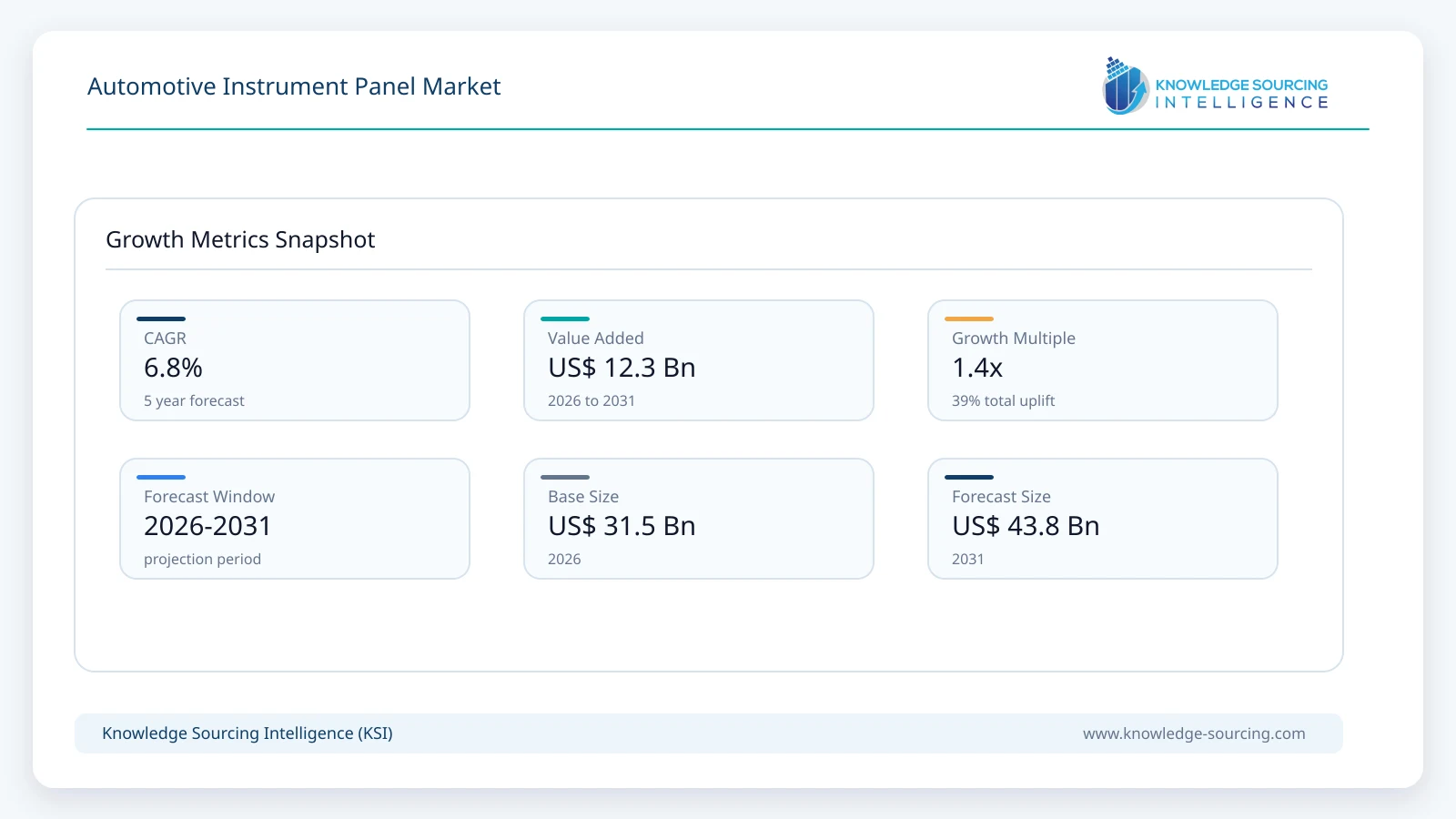
The automotive instrument panel market is estimated at approximately USD 31.5 billion in 2026 and is projected to reach about USD 43.8 billion by 2031, representing a CAGR of 6.8% during the forecast period.
Highlights:
- 1Electronics-ready and smart-surface instrument panels account for approximately 56% of global market value in 2026 as display integration, ambient lighting and solid-state controls become increasingly embedded in the panel architecture.
- 2Substrates, carriers and structural interfaces represent approximately 34% of 2026 market value because every instrument panel requires a rigid architecture to support displays, HVAC, glove box, passenger airbag and visible trim.
- 3Soft-touch, wrapped and premium surfaced instrument panels account for approximately 37% of market value in 2026, supported by foam-backed skins, textile coverings, decorative films, leather alternatives and stitched zones.
- 4Polymer and polymer-composite instrument-panel assemblies represent approximately 72% of global market value in 2026, while natural-fiber and recycled-polymer carriers are gaining share through lower mass and lower lifecycle emissions.
- 5Passenger vehicles represent approximately 94% of market value in 2026 because passenger cars, SUVs and MPVs carry the highest display, surface, airbag and HMI content per instrument panel.
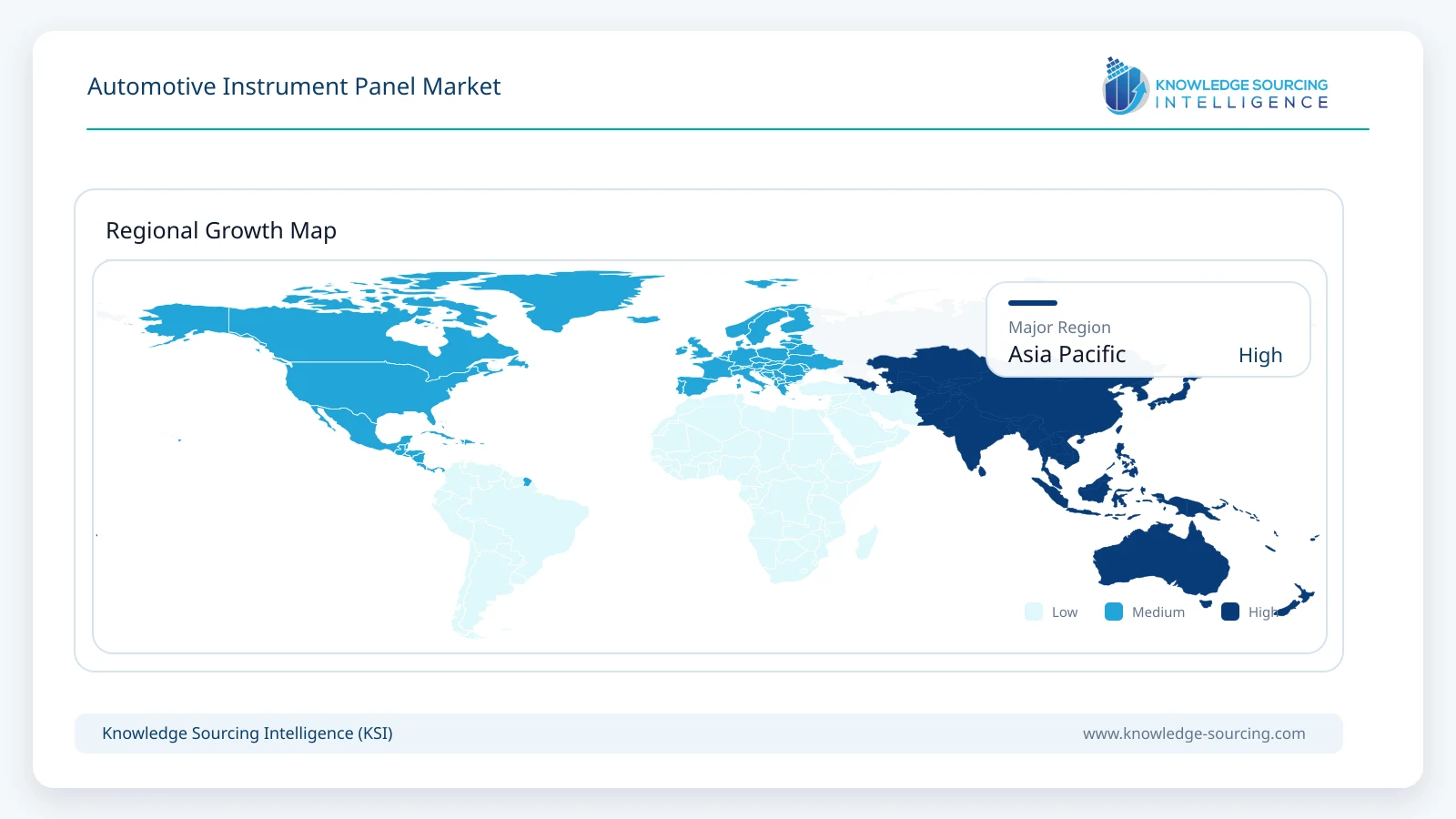
- 6Asia Pacific represents approximately 45% of global market value in 2026, supported by vehicle-production scale and rapid adoption of display-rich, technology-led front cabins in China, Japan and South Korea.
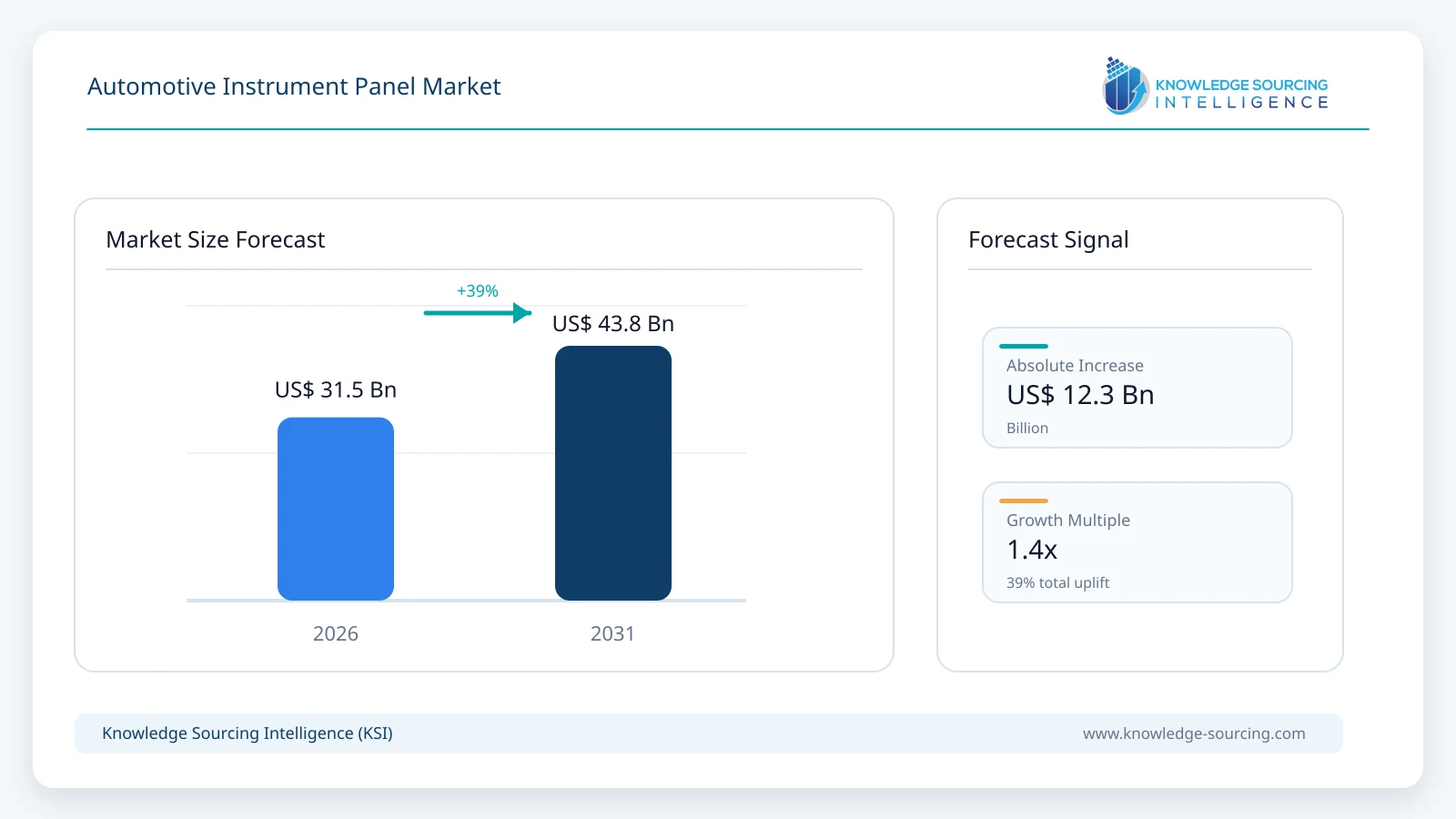
Instrument panels are evolving from predominantly molded substrates with discrete openings for gauges, vents and controls into electronics-ready front-cabin assemblies designed around large displays, hidden controls, ambient lighting, advanced decorative surfaces and increasingly sophisticated passenger-airbag integration. The component remains one of the most engineering-intensive interior systems because it must combine visible craftsmanship with crash, thermal, acoustic, dimensional and ergonomic performance while supporting the cluster, center display, HVAC outlets, glove box and structural interfaces.
Value growth is increasingly driven by integrated functionality rather than larger physical structures. Antolin develops instrument-panel systems combining trims, foams, composites and metals with safety-critical airbag functionality; FORVIA is advancing modular architectures that combine sustainable materials with surface activation; and Motherson SMRC supplies instrument panels within broader interior-system programs. Yanfeng's 2026 XiM27, Marelli's lighting and active-interior demonstrators and Antolin's smart-surface HMI work further illustrate how the instrument panel is becoming an electronics-ready and software-linked interface while remaining a highly platform-specific molded assembly.
Market Overview
The instrument panel forms the main transverse assembly across the front cabin, with a structural carrier supporting the cluster, center-display mounts, air vents, glove box and decorative parts while local reinforcement interfaces connect to the cross-car structure and steering area. The passenger side must also provide a controlled airbag deployment path across widely varying temperatures and years of material aging. Surface construction varies by vehicle segment: value-oriented and commercial vehicles frequently use hard molded thermoplastics, while mid-range and premium programs add foam, skins, textiles, wrapped materials and decorative inserts; Antolin combines hard and soft surfaces with seamless passenger-airbag integration, while FORVIA integrates advanced surface finishing, textiles, light guides and recycled materials within production panels.
Electronics packaging and material sustainability are now reshaping instrument-panel engineering in parallel. Larger displays require rigid mounting, low vibration, thermal clearance and controlled sight lines, while hidden or projected displays, cameras, ambient lighting and capacitive controls require substrates that support optics, wiring and sensor performance without visible seams or excessive depth. At the same time, natural-fiber composites, recycled polypropylene, lighter foams and lower-impact adhesives are being adopted where they can meet crash, VOC and dimensional-stability requirements; FORVIA's use of NAFILean-R in the structural part of the Renault 5 E-Tech instrument panel demonstrates the potential for large molded structures to reduce both mass and lifecycle carbon without compromising safety-critical performance.
Market Trends
Large Displays Are Becoming a Primary Instrument-Panel Design Input
Wide driver displays, center displays and passenger screens increasingly determine the geometry of the instrument panel before the final surface architecture is frozen. Yanfeng's XiM27 integrates a 35.4-inch panoramic visual interface into the instrument panel, while Marelli continues to develop pillar-to-pillar and ultra-thin display technologies intended to blend more closely with the physical interior.
Larger and wider displays require stronger local structures, improved vibration control, careful glare management and more sophisticated cable and thermal routing behind the panel. As display integration becomes inseparable from substrate and surface design, instrument-panel suppliers gain additional engineering value beyond conventional molding and finishing.
Smart Surfaces Are Replacing Discrete Mechanical Controls
Touch, force, proximity sensing and haptic feedback are moving into decorative surfaces. Antolin and UltraSense announced a 2026 Smart Surface HMI initiative that specifically targets instrument panels among other interior applications, allowing conventional switches to be replaced by thinner configurable controls embedded within the trim.
Embedding touch, force, proximity sensing and haptic feedback beneath decorative surfaces can reduce bezels and part count while giving OEMs greater styling freedom. The same shift increases validation requirements around false activation, haptic quality, illumination, EMC and software behavior, moving the instrument panel closer to an electromechanical system.
Sustainable Structural Carriers Are Moving into Series Production
Instrument-panel carriers are large molded parts and therefore offer meaningful opportunities for lower-carbon materials. FORVIA's NAFILean-R combines recycled polypropylene with natural hemp fibers and has already been used for the complete structural part of a production instrument panel, demonstrating that sustainable materials can meet crash, cabin-air and durability requirements.
Natural-fiber compression molding, recycled polypropylene and lighter multi-layer structures are expected to expand further as OEMs pursue Scope 3 reductions. The strongest solutions reduce both material mass and processing energy without introducing visible surface compromise or passenger-airbag risk.
Surface Activation Is Turning Trim into an Information Layer
Instrument panels increasingly use lighting, projection and hidden displays to deliver information through surfaces that remain visually clean when inactive. FORVIA's AirVision projects a virtual image using a flat translucent surface integrated into the instrument panel, while hidden-display technologies can reveal information through fabric-like or decorative finishes only when required.
Surface activation gives the instrument panel a direct information-delivery role and may reduce reliance on freestanding screens over time as lighting, projection and hidden displays migrate into decorative areas. Optical performance, ambient-light readability and material consistency therefore become as important as grain and tactility.
Thinner Instrument Panels Are Supporting More Open EV Cabins
Battery-electric vehicles allow different front-cabin proportions and encourage visually lighter, more horizontal instrument panels. OEMs are seeking thinner carriers, concealed vents and reduced physical switchgear to create greater perceived space without sacrificing display area or airbag packaging.
Thinner EV-oriented instrument panels must maintain stiffness and crash performance while reducing both depth and mass, creating a more demanding structural optimization problem. Hybrid cross-car structures, optimized thermoplastic carriers and more integrated HVAC interfaces are therefore becoming important enabling technologies.
Segment Analysis
By Panel Architecture: Electronics-Ready and Smart-Surface Instrument Panels
Electronics-ready and smart-surface instrument panels are the largest architecture by value because new platforms increasingly design the panel around digital displays, integrated controls, ambient lighting and sensor interfaces from the beginning of the program. The physical assembly must provide precise mounting, wiring access and thermal space for these functions while preserving safety and craftsmanship.
Electronics-ready and smart-surface instrument panels represent approximately USD 17.64 billion in 2026 and could approach USD 26.0 billion by 2031 as digital interfaces become core front-cabin content. Growth will be strongest in EVs and premium vehicles, but display-ready and smart-surface designs are also moving steadily into high-volume mid-market platforms as electronic content becomes standard.
By Integrated Content: Substrate, Carrier and Structural Interfaces
Substrates and structural interfaces remain the largest integrated-content category because every instrument panel requires a stable carrier for the cluster, displays, vents, glove box, center stack and passenger-airbag system. Molded polypropylene and engineered thermoplastics dominate, often supported by local metal or composite reinforcement where stiffness and crash loads require it.
Substrates, carriers and structural interfaces represent approximately USD 10.71 billion in 2026 and should increase in absolute value through 2031 as larger display apertures and thinner panel designs raise structural complexity. Sustainable composites also add material-engineering value to a category that was historically treated as a commodity molded carrier.
By Surface Type: Soft-Touch and Premium Surfaced Instrument Panels
Soft-touch and premium instrument panels use foam-backed skins, textiles, wrapped materials, slush-molded surfaces, decorative films or stitched inserts to improve perceived quality. The upper panel receives the greatest attention because it is continuously visible to front occupants and exposed to high solar loading.
Soft-touch and premium surfaced instrument panels account for approximately USD 11.66 billion in 2026 and could exceed USD 16.5 billion by 2031 as OEMs add more textile-covered surfaces, sustainable synthetic materials and integrated lighting. Hard molded panels will nevertheless remain significant in value-focused vehicles where cost, durability and ease of manufacturing remain decisive.
By Material Platform: Polymer and Polymer-Composite Assemblies
Thermoplastics remain the dominant instrument-panel material because they support complex geometry, molded attachment features, low mass and high-volume production. Polypropylene, ABS, TPO and related compounds are used across carriers and trim, while natural-fiber reinforcement and recycled resins are increasingly introduced to reduce lifecycle impact.
Polymer and polymer-composite assemblies represent approximately USD 22.68 billion of market value in 2026 and should remain the dominant material platform through 2031 because of their processing flexibility, low mass and high-volume economics. The mix will increasingly shift toward recycled-content compounds, natural-fiber composites and thinner structures supported by improved simulation and process control.
By Vehicle Type: Passenger Vehicles
Passenger cars, SUVs, crossovers and MPVs dominate because they combine the highest production volumes with the greatest display, HMI, premium-surface and passenger-airbag content. SUVs are particularly important because their higher price points and wider dashboards support more decorative and electronic features.
Passenger vehicles account for approximately USD 29.61 billion in 2026 and could approach USD 41 billion by 2031 because they combine high production volumes with the greatest concentration of display, HMI, premium-surface and passenger-airbag content. Commercial vehicles remain relevant for durable instrument panels with storage and driver-interface functions but typically carry lower surface and electronic content per vehicle.
Market Drivers
Rapid Expansion of Display and HMI Content
Instrument panels increasingly need to support multiple displays, digital clusters, hidden graphics and touch-sensitive interfaces. Each function requires dedicated structural, optical and wiring integration, raising engineering content even when the electronic hardware is purchased from another supplier.
Expansion of display size and digital HMI is most pronounced in China and on premium global platforms, but the same architecture is increasingly appearing in mainstream vehicles. Electronics-ready panel design is therefore becoming a baseline engineering requirement rather than a premium exception.
Premiumization of the Front Cabin
As one of the largest continuously visible cabin surfaces, the instrument panel plays a central role in communicating vehicle quality and differentiating trim levels. OEMs increasingly use soft materials, textiles, stitched trim, decorative films, lighting and precision fit to strengthen perceived craftsmanship across the front cabin.
Stronger perceived-quality requirements increase average panel value and create additional opportunities for suppliers with automated wrapping, slush molding, laser graining, decorative-film and smart-surface technologies, particularly as premium treatments spread into higher-volume vehicle segments.
Lightweighting and Lower-Carbon Material Requirements
Large instrument-panel carriers offer a meaningful opportunity for both weight and lifecycle-carbon reduction because material changes affect a substantial molded structure. Natural-fiber composites and recycled polypropylene can replace conventional virgin-polymer systems where they meet stiffness, crash and cabin-air requirements.
The scale of the instrument-panel carrier means that lower-mass and lower-carbon materials can deliver meaningful vehicle-level savings, making sustainability commercially relevant beyond isolated trim details. OEM Scope 3 targets are therefore turning sustainable carrier technology into a sourcing criterion rather than a concept-only feature.
EV Interior Architecture and Packaging Freedom
EV platforms encourage thinner and more horizontal front-cabin structures, fewer mechanical controls and greater integration of screens and concealed vents. The instrument panel becomes central to creating a spacious, technology-led cabin identity.
Suppliers able to maintain crash performance and mounting stiffness within a shallower front-cabin package gain a direct design advantage as EV interiors move toward thinner horizontal architectures. This requirement supports investment in hybrid carriers, optimized rib structures and more integrated HVAC and display mounting.
Smart Surface and Lighting Integration
Hidden-until-lit controls, ambient light and projected information allow automakers to reduce visible hardware while increasing personalization. These technologies are increasingly integrated directly into the instrument-panel surface instead of separate switch or display modules.
Integrating hidden controls, lighting and projected information shifts more instrument-panel value toward suppliers that can combine decorative materials with optics, sensing and electronics. Instrument-panel programs therefore provide a growing route for interior suppliers to participate directly in HMI content.
Market Restraints
High Tooling Cost and Vehicle-Specific Development
Instrument panels require large injection molds, skin tools, foaming equipment and assembly fixtures tied closely to each vehicle architecture. Geometry is linked to the windshield, steering position, center stack, HVAC, passenger airbag and body structure, limiting reuse across unrelated platforms.
Late changes to display geometry, styling or passenger-airbag packaging can force expensive tooling revisions because the instrument panel is tightly coupled to the surrounding vehicle architecture. Suppliers therefore carry significant launch and volume risk, particularly on lower-volume premium programs with complex surfaces.
Passenger-Airbag Integration and Safety Validation
The passenger side of the instrument panel must provide a controlled deployment path at very low and very high temperatures and after years of material aging. Seamless airbag systems add design freedom but require precise weakening, material control and validation.
New surface materials, lighting features or structural compounds near the passenger-airbag deployment zone cannot be substituted quickly because each change can affect tear behavior, deployment timing and long-term reliability. Safety validation therefore slows sustainable-material and smart-surface innovation compared with non-critical trim components.
Thermal, Glare and Dimensional Challenges from Large Displays
Displays and electronics generate heat behind an instrument panel that is already exposed to strong solar loading. Materials must resist warpage, shrinkage and discoloration while maintaining tight display alignment over the vehicle life.
Glare and windshield reflections further constrain surface gloss, display angle and material selection in highly digital instrument panels, especially under strong sunlight. These optical requirements increase the design burden and can limit decorative finishes that would otherwise be acceptable on non-display surfaces.
Cost Pressure on High-Volume Molded Structures
Instrument-panel carriers remain cost-sensitive despite increasing complexity. OEMs expect continuous productivity improvement, while polymer, energy and labor costs can fluctuate during long supply contracts.
Higher-value surfaces and electronics integration can improve revenue per instrument panel but also increase warranty exposure, validation effort and manufacturing complexity. Suppliers must therefore automate molding, trimming and assembly while controlling variant proliferation across vehicle programs.
Recycling Complexity in Multi-Layer and Electronics-Integrated Panels
Modern instrument panels can combine rigid polymers, foams, skins, textiles, metal reinforcement, adhesives, lighting and electronic interfaces. These layers are difficult to separate economically at end of life.
Mono-material concepts and removable functional modules can improve instrument-panel circularity by simplifying separation at end of life, but they must remain compatible with airbag performance, surface quality and high-volume manufacturing. Adoption is therefore likely to progress gradually rather than through an immediate redesign of existing architectures.
Regional Outlook
Asia Pacific
Asia Pacific is the largest automotive instrument panel market, supported by vehicle-production scale in China, Japan, South Korea and India. China is the strongest content-growth market because domestic EV manufacturers increasingly use wide displays, hidden controls, smart surfaces and minimalist front-cabin designs as visible differentiation features.
Yanfeng is a major regional integrator across interiors and cockpit electronics, while Antolin, FORVIA, Marelli, Motherson, Toyota Boshoku and Hyundai Mobis maintain substantial regional engineering and production footprints. Yanfeng's XiM27 demonstrates how the instrument panel is becoming a platform for panoramic visual interfaces, integrated steering functions and ambient lighting rather than a static molded structure.
Asia Pacific growth through 2031 will be supported by both vehicle output and rising content per instrument panel as wide displays, hidden controls and smart surfaces move deeper into the market. China should lead advanced smart-panel adoption, while India and Southeast Asia provide additional growth for localized molded and partially trimmed programs.
Europe
Europe is a major high-value instrument panel market due to premium vehicle production, strong surface-engineering capability and aggressive sustainability targets. European OEMs frequently specify soft-touch surfaces, textiles, decorative materials, smart lighting and low-carbon carriers while maintaining stringent passenger-airbag and VOC requirements.
Europe's supplier base includes particularly strong positions for FORVIA and Antolin, both of which combine instrument-panel engineering with advanced surface and sustainability capabilities. FORVIA won 2026 business for tailored instrument panels with a major European automaker and supplies production panels using recycled materials and integrated lighting, while Antolin combines seamless passenger-airbag systems with smart-surface technology.
Regional vehicle-volume growth is expected to remain modest, but average panel value should rise through larger displays, sustainable materials and embedded HMI. Europe will remain an important development base for natural-fiber, recycled-polymer and premium-surface technologies.
Competitive Landscape
The automotive instrument panel market is led by large interior-system suppliers with capabilities in substrate molding, soft-surface processing, passenger-airbag integration, electronics-ready packaging and local assembly. Yanfeng, FORVIA, Antolin, Motherson SMRC, Marelli, International Automotive Components, Toyota Boshoku and Hyundai Mobis compete across global OEM platforms.
Antolin differentiates through instrument-panel safety and surface technologies, including seamless passenger-airbag integration, Print Mold Design and specialized soft-surface processes. FORVIA combines modular instrument-panel architecture with sustainable materials, smart surfaces, projection and integrated lighting. Motherson SMRC offers instrument panels within broader cockpit and interior-system programs, while Yanfeng combines interiors with cockpit electronics and smart-cabin integration.
Competitive advantage increasingly depends on industrializing electronics-ready and sustainable instrument panels without compromising cost, safety or craftsmanship. Large displays, lighting and solid-state controls require much tighter coordination between structure, surface, electronics and software than conventional molded instrument panels.
A localized manufacturing footprint remains critical because instrument panels are bulky, highly platform specific and difficult to transport economically over long distances. Suppliers with tooling, molding, surface finishing and assembly capacity close to OEM plants retain an advantage in logistics, launch responsiveness and variant management.
Recent Developments
8 September 2026: Antolin and UltraSense Systems announced a next-generation Smart Surface HMI initiative for a future global vehicle platform, with instrument panels identified among the target applications for touch, force, proximity and haptic controls.
29 June 2026: Yanfeng unveiled the production-ready XiM27 smart cabin, featuring a 35.4-inch panoramic visual interface integrated into the instrument panel, adaptive ambient lighting and a fold-away steering architecture.
9 April 2026: Marelli announced its Auto China 2026 in-cabin showcase, including dedicated instrument-panel demonstrators with ambient-lighting functions, advanced displays and software-defined interior technologies.
29 January 2026: FORVIA announced significant new business with a major European automaker covering tailored instrument panels as part of a broader multi-business award, reinforcing its production pipeline for integrated interiors.
13 November 2025: FORVIA announced that it supplies the instrument panel for the Renault Clio 6 using recycled plastics, automated textile covering, laser-grained finishes and integrated light guides produced near the vehicle assembly plant.
April 2025: FORVIA presented AirVision at Auto Shanghai, using a flat translucent surface integrated into the instrument panel to create a stable virtual image and enable new display layouts without a conventional freestanding screen.
Market Outlook
The automotive instrument panel market is expected to expand from approximately USD 31.500 billion in 2026 to about USD 43.769 billion by 2031. Electronics-ready and smart-surface panels will gain share as displays, lighting and integrated HMI become standard elements of the front cabin, while conventional molded architectures remain important in value-oriented vehicles.
Material evolution will be as important as electronics integration through 2031 because OEMs are simultaneously targeting lower Scope 3 emissions and reduced vehicle mass. Recycled polypropylene, natural-fiber composites, lighter foams and thinner structural architectures should gain adoption where they can preserve airbag, VOC and dimensional performance.
Asia Pacific will remain the largest regional market, while Europe continues to generate high value per vehicle through premium surfaces and sustainable carrier technologies. Supplier success will depend on combining large-part manufacturing, safety engineering, advanced surface processing and electronics-ready integration within a cost-competitive platform architecture.
Automotive Instrument Panel Market Scope
| Report Metric | Details |
|---|---|
| Total Market Size in 2026 | USD 31.5 billion |
| Total Market Size in 2031 | USD 43.8 billion |
| Forecast Unit | Billion |
| Growth Rate | 6.8% |
| Study Period | 2021 to 2031 |
| Historical Data | 2021 to 2024 |
| Base Year | 2025 |
| Forecast Period | 2026 – 2031 |
| Segmentation | Panel Architecture, Integrated Content, Surface Type, Material Platform, Vehicle Type, Geography |
| Companies |
|
Market Segmentation
By Panel Architecture
Conventional Molded Instrument Panels
Electronics-Ready and Smart-Surface Instrument Panels
Display-Dominant and Software-Linked Instrument Panels
By Integrated Content
Substrate, Carrier and Structural Interfaces
Surface, Skin and Decorative Trim
Display, Cluster and HMI Integration
HVAC and Air-Vent Interfaces
Passenger-Airbag and Safety Interfaces
Glove Box and Center-Stack Integration
By Surface Type
Hard-Molded Instrument Panels
Soft-Touch and Premium Surfaced Instrument Panels
Smart, Illuminated and Functional Surfaces
By Material Platform
Polymer and Polymer-Composite Assemblies
Natural-Fiber and Sustainable Composite Assemblies
Premium Multi-Material Assemblies
Hybrid Metal-Polymer Structural Systems
By Vehicle Type
Passenger Vehicles
Light Commercial Vehicles
Medium and Heavy Commercial Vehicles
Buses and Specialty Vehicles
By Geography
North America
United States
Canada
Mexico
South America
Brazil
Argentina
Others
Europe
Germany
United Kingdom
France
Italy
Spain
Others
Middle East and Africa
Saudi Arabia
UAE
South Africa
Others
Asia Pacific
China
Japan
South Korea
India
Indonesia
Thailand
Others
Table of Contents
1. INTRODUCTION
1.1. Market Overview
1.2. Market Definition
1.3. Scope of the Study
1.4. Market Segmentation
1.5. Currency
1.6. Assumptions
1.7. Base and Forecast Years
1.8. Key Benefits to Stakeholders
2. RESEARCH METHODOLOGY
2.1. Research Design
2.2. Secondary Research
2.3. Primary Research
2.4. Market Estimation
2.5. Segment Modelling
2.6. Data Triangulation and Validation
3. EXECUTIVE SUMMARY
3.1. Key Findings
3.2. Automotive Instrument Panel Market Size, 2026-2031
3.3. Panel Architecture Outlook
3.4. Integrated Content Outlook
3.5. Surface Type Outlook
3.6. Material Platform Outlook
3.7. Vehicle Type Outlook
3.8. Regional Opportunity Summary
4. MARKET DYNAMICS
4.1. Market Drivers
4.1.1. Rapid Expansion of Display and HMI Content
4.1.2. Premiumization of the Front Cabin
4.1.3. Lightweighting and Lower-Carbon Material Requirements
4.1.4. EV Interior Architecture and Packaging Freedom
4.1.5. Smart Surface and Lighting Integration
4.2. Market Restraints
4.2.1. High Tooling Cost and Vehicle-Specific Development
4.2.2. Passenger-Airbag Integration and Safety Validation
4.2.3. Thermal, Glare and Dimensional Challenges from Large Displays
4.2.4. Cost Pressure on High-Volume Molded Structures
4.2.5. Recycling Complexity in Multi-Layer and Electronics-Integrated Panels
4.3. Market Opportunities
4.4. Porter's Five Forces Analysis
4.5. Industry Value Chain Analysis
4.6. Instrument Panel Content, Tooling and Manufacturing Economics
4.7. Airbag, Flammability, VOC and Sustainability Requirements
5. TECHNOLOGY OUTLOOK
5.1. Injection-Molded Instrument Panel Carriers
5.2. Cross-Car and Structural Reinforcement Interfaces
5.3. Hard, Foamed and Soft-Touch Surface Technologies
5.4. Textile, Wrapped and Decorative Surface Integration
5.5. Passenger-Airbag Seam and Seamless PAB Technologies
5.6. Large Display and Instrument Cluster Integration
5.7. Smart Surface Touch, Force and Haptic HMI
5.8. Ambient, Hidden and Informative Lighting
5.9. Integrated and Concealed Air Vent Technologies
5.10. Natural-Fiber and Recycled-Polymer Structural Carriers
5.11. Image Projection and Hidden Display Technologies
5.12. Design-for-Circularity and Material Separation
6. AUTOMOTIVE INSTRUMENT PANEL MARKET BY PANEL ARCHITECTURE
6.1. Introduction
6.2. Conventional Molded Instrument Panels
6.3. Electronics-Ready and Smart-Surface Instrument Panels
6.4. Display-Dominant and Software-Linked Instrument Panels
7. AUTOMOTIVE INSTRUMENT PANEL MARKET BY INTEGRATED CONTENT
7.1. Introduction
7.2. Substrate, Carrier and Structural Interfaces
7.3. Surface, Skin and Decorative Trim
7.4. Display, Cluster and HMI Integration
7.5. HVAC and Air-Vent Interfaces
7.6. Passenger-Airbag and Safety Interfaces
7.7. Glove Box and Center-Stack Integration
8. AUTOMOTIVE INSTRUMENT PANEL MARKET BY SURFACE TYPE
8.1. Introduction
8.2. Hard-Molded Instrument Panels
8.3. Soft-Touch and Premium Surfaced Instrument Panels
8.4. Smart, Illuminated and Functional Surfaces
9. AUTOMOTIVE INSTRUMENT PANEL MARKET BY MATERIAL PLATFORM
9.1. Introduction
9.2. Polymer and Polymer-Composite Assemblies
9.3. Natural-Fiber and Sustainable Composite Assemblies
9.4. Premium Multi-Material Assemblies
9.5. Hybrid Metal-Polymer Structural Systems
10. AUTOMOTIVE INSTRUMENT PANEL MARKET BY VEHICLE TYPE
10.1. Introduction
10.2. Passenger Vehicles
10.3. Light Commercial Vehicles
10.4. Medium and Heavy Commercial Vehicles
10.5. Buses and Specialty Vehicles
11. AUTOMOTIVE INSTRUMENT PANEL MARKET BY GEOGRAPHY
11.1. North America
11.1.1. United States
11.1.2. Canada
11.1.3. Mexico
11.2. South America
11.2.1. Brazil
11.2.2. Argentina
11.2.3. Others
11.3. Europe
11.3.1. Germany
11.3.2. United Kingdom
11.3.3. France
11.3.4. Italy
11.3.5. Spain
11.3.6. Others
11.4. Middle East and Africa
11.4.1. Saudi Arabia
11.4.2. UAE
11.4.3. South Africa
11.4.4. Others
11.5. Asia Pacific
11.5.1. China
11.5.2. Japan
11.5.3. South Korea
11.5.4. India
11.5.5. Indonesia
11.5.6. Thailand
11.5.7. Others
12. COMPETITIVE ENVIRONMENT AND ANALYSIS
12.1. Major Players and Strategy Analysis
12.2. Market Share Analysis
12.3. Substrate and Carrier Technology Benchmarking
12.4. Surface, Soft-Trim and Decorative Technology Benchmarking
12.5. Display, HMI and Smart-Surface Integration Benchmarking
12.6. Sustainable Material and Lightweighting Benchmarking
12.7. OEM Programs, Manufacturing Footprint and Production Readiness
12.8. Competitive Dashboard
13. COMPANY PROFILES
13.1. Yanfeng Automotive Interiors
13.2. FORVIA
13.3. Antolin
13.4. Motherson Group
13.5. Marelli
13.6. International Automotive Components (IAC) Group
13.7. Toyota Boshoku Corporation
13.8. Hyundai Mobis
13.9. Magna International Inc.
13.10. NBHX
13.11. Dräxlmaier Group
13.12. Toyoda Gosei Co., Ltd.
14. APPENDIX
14.1. Currency
14.2. Assumptions
14.3. Base and Forecast Years Timeline
14.4. Key Benefits for Stakeholders
14.5. Research Methodology
14.6. Abbreviations
14.7. Data Sources
Navigate
Trusted by the world's leading organizations











