
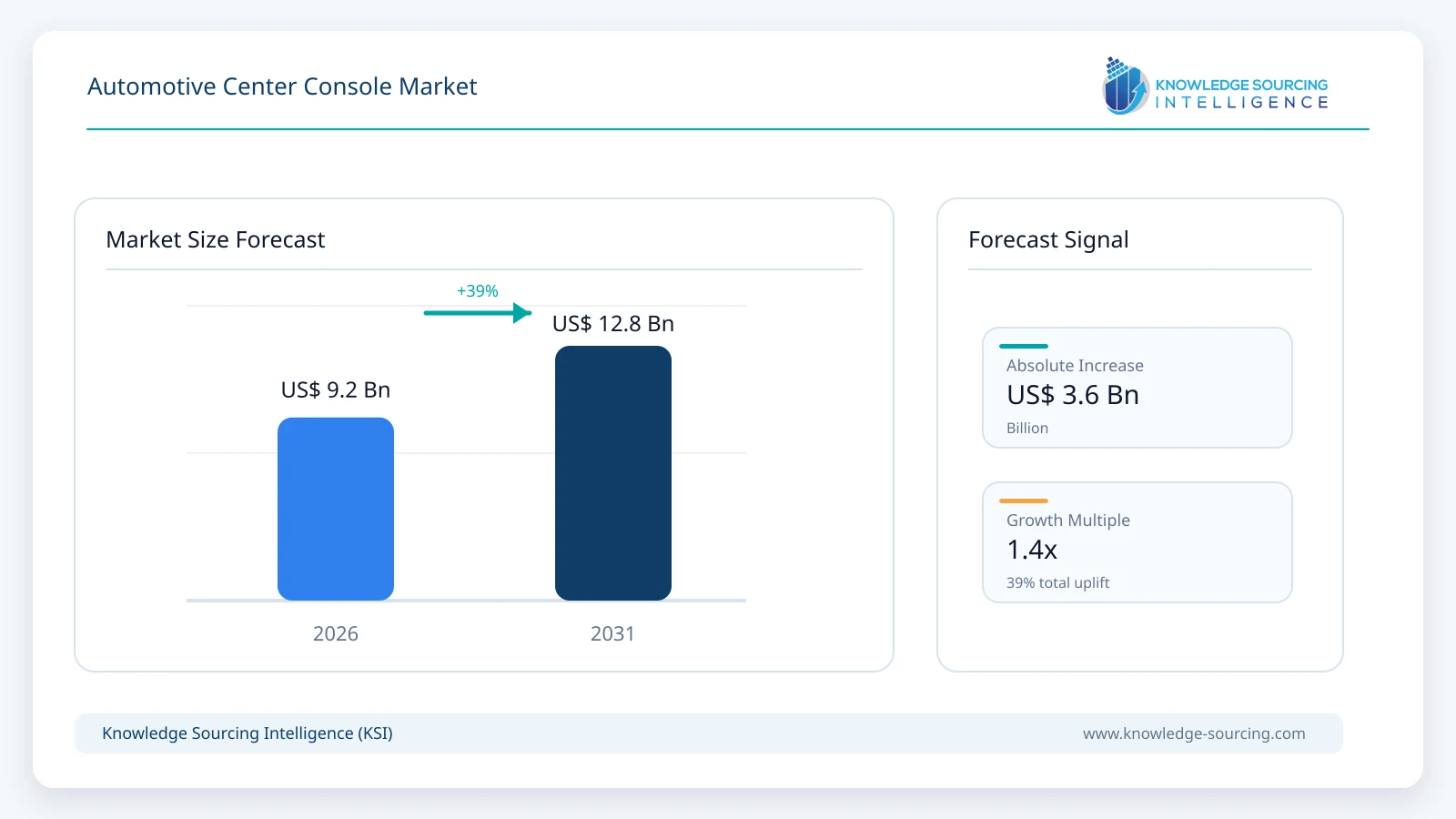
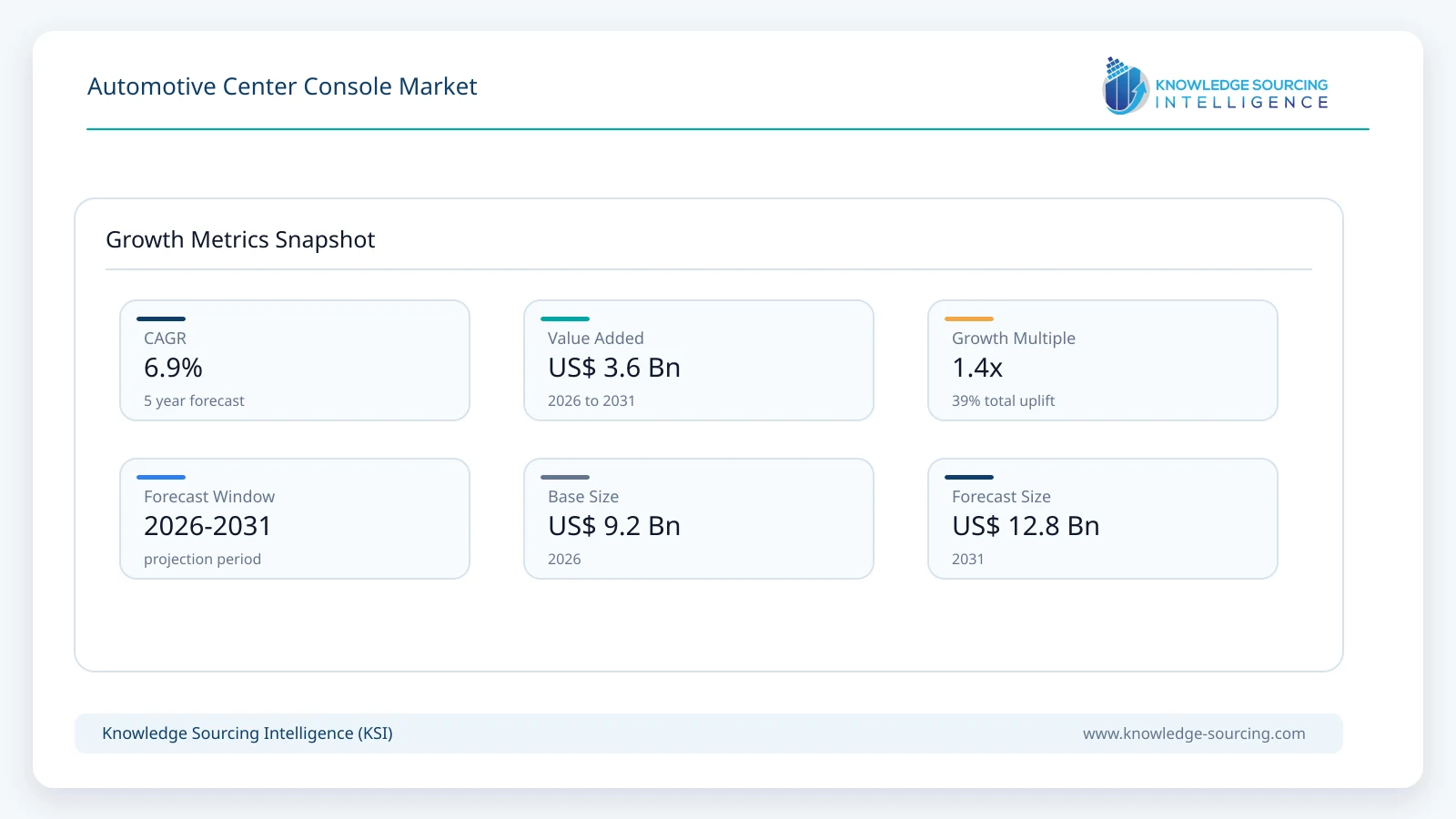
The automotive center console market is forecast to grow at a CAGR of 6.9%, reaching approximately USD 12.8 billion by 2031 from USD 9.20 billion in 2026.
Key Highlights
• Fixed integrated center consoles account for approximately 63% of global market value in 2026 because most passenger vehicles still use platform-specific floor or bridge consoles engineered around a fixed cockpit and seat layout.
• Electronics-integrated smart consoles represent approximately 48% of 2026 market value as wireless charging, touch controls, ambient lighting, USB-C power, displays and connected comfort functions become common across higher-volume vehicle segments.
• Storage and utility functions account for approximately 36% of market value in 2026, supported by the continuing importance of cupholders, enclosed bins, trays, armrests and device storage even as digital interfaces expand.
• Polymer-dominant console assemblies represent approximately 72% of 2026 market value because injection-molded thermoplastics remain the primary structural and decorative platform for high-volume console production.
• Passenger vehicles represent approximately 94% of global market value in 2026, reflecting high center-console penetration across passenger cars, SUVs, crossovers and MPVs.
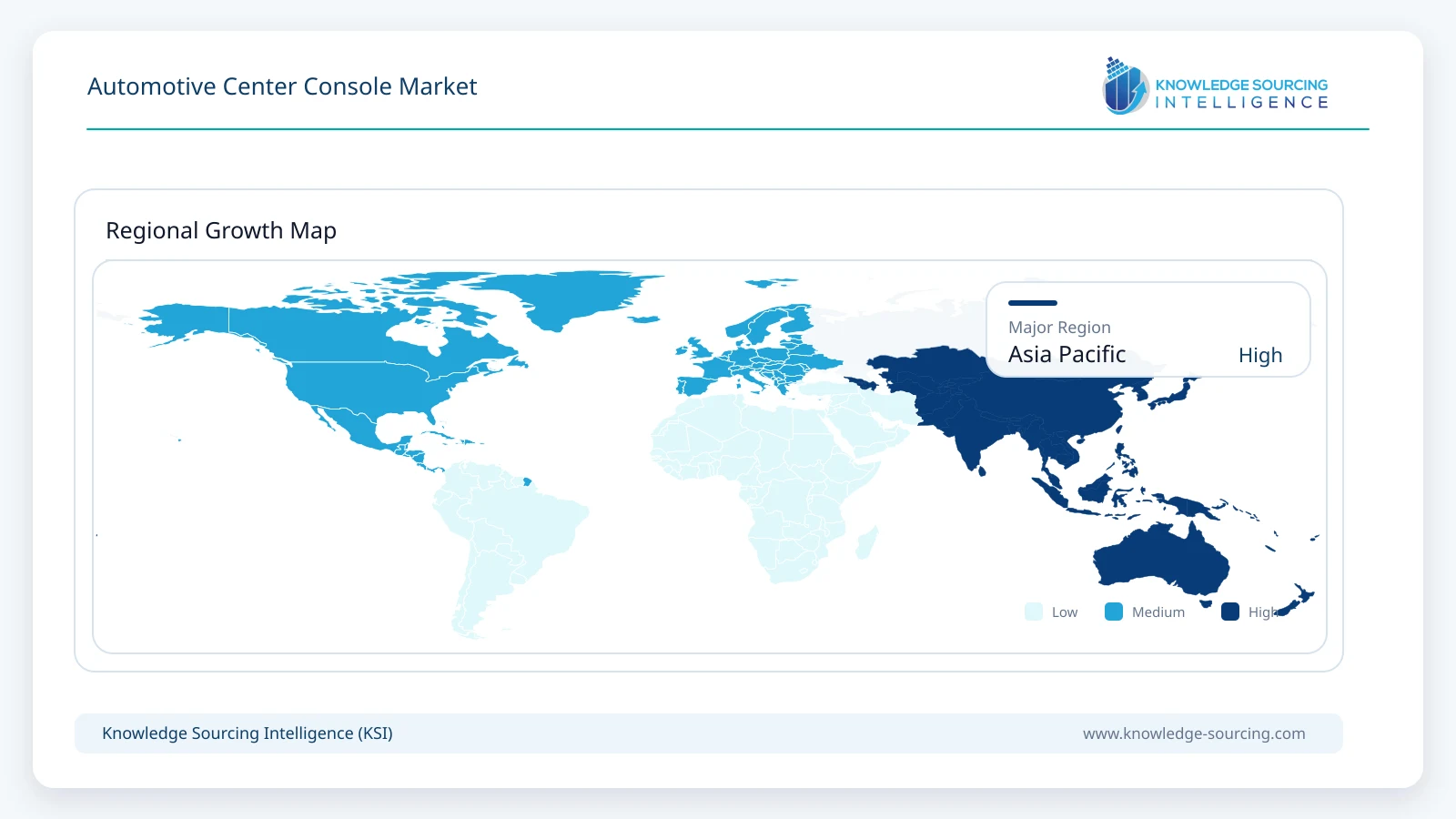
• Asia Pacific represents approximately 45% of global market value in 2026, supported by large vehicle-production volumes and fast adoption of electronics-rich, movable and premium center-console functions in China, Japan and South Korea.
Center consoles are shifting from fixed storage-and-control structures toward higher-value systems that combine smart surfaces, wireless charging, ambient lighting, HVAC interfaces, cooled storage, power distribution and movable mechanisms. Fixed integrated consoles remain the largest architecture, although EV platforms are creating more freedom for bridge consoles, open lower-storage areas and floor-mounted sliding systems.
The strongest value growth is expected in consoles that combine mechanical packaging with digital HMI, charging, powered movement and configurable storage. FORVIA, Yanfeng, Antolin, GRAMMER, Motherson, IAC and Toyota Boshoku are developing electronics-rich, sustainable and modular systems, while flat-floor EV architectures expand the addressable space for movable designs. Mechanism durability, electronics integration, surface quality and platform-specific packaging are therefore becoming more important alongside the molded structure.
Market Overview
The center console is one of the most function-dense areas of the vehicle interior, combining a molded carrier, storage, armrest, cupholders, controls and decorative surfaces with a growing electronics layer. Higher-content systems add wireless charging, power outlets, touch and force controls, ambient lighting, cooled storage, ventilation and powered mechanisms. Electrification expands this design space because the absence of a traditional transmission tunnel allows floating bridge consoles, larger lower-storage areas and movable architectures serving front and rear occupants.
Electronics integration and material strategy are becoming central to console engineering as smart surfaces replace mechanical switches and charging functions increase local electrical load. Motorized mechanisms add controllers, position sensing and anti-pinch requirements, while sustainability targets are pushing recycled polypropylene, lighter carriers and modular designs that support repair or replacement of selected features. The resulting product must balance electronics, mechanism durability, storage utility, surface craftsmanship and circularity within a tightly constrained cabin package.
Market Trends
Movable and Sliding Consoles Are Expanding with Flat-Floor EV Architectures
EV packaging is reducing dependence on a fixed transmission-tunnel console. Yanfeng's 2026 XiM27 uses a sliding and rotating center console that integrates a dual-zone refrigerator, wireless charging and an extendable worktable, while FORVIA offers manual and motorized sliding mechanisms designed to extend console functionality to rear passengers.
Movable-console economics are strongest in SUVs, MPVs and premium EVs where long cabin floors and flexible seating justify the additional mechanism cost. These systems can improve storage access and passenger interaction, but production designs also require durable rails, controlled cable management, position sensing and crash-safe locking.
The Console Is Becoming a Smart HMI Surface
Mechanical switches are increasingly being replaced by integrated touch, force and haptic controls. Antolin and UltraSense announced a 2026 Smart Surface HMI initiative for applications including center consoles, combining solid-state touch and force sensing with visual and haptic feedback.
Embedding touch, force and haptic controls converts the center console from a passive carrier into an electronic interface that must satisfy both HMI and trim requirements. Suppliers therefore need to manage sensor accuracy, illumination, haptic response, EMC and software integration while preserving scratch resistance, surface quality and the tactile feel expected from a highly visible interior component.
Modular and Interchangeable Console Functions Are Moving toward Production
FORVIA's On-demand center console uses a standardized tool-free mechanical and electrical interface that can support storage, refrigeration, tray tables or retractable display modules. The concept reflects a broader industry push to separate the console base architecture from optional functional inserts.
Modular console platforms can reduce OEM variant complexity while also creating opportunities for post-sale upgrades and easier repair through replaceable functional inserts. Wider adoption will depend on whether standardized mechanical and electrical interfaces remain durable and safe over the vehicle lifecycle without adding excessive cost or package volume.
Charging, Connectivity and Device Management Are Raising Electronic Content
Wireless charging pads, USB-C ports and high-power accessory connections are becoming standard console features. These functions require thermal management, foreign-object detection, power electronics and increasingly higher charging power, especially as occupants carry multiple phones, tablets and portable devices.
Higher charging power and connectivity content require center-console electronics to be coordinated with centralized vehicle power distribution, thermal management and cybersecurity requirements. The console consequently becomes a higher-value assembly that combines trim, mechanical packaging and electronics rather than a purely molded storage component.
Sustainable Materials and Design-for-Circularity Are Gaining Importance
FORVIA's Renault Clio 6 center console incorporates recycled plastics, while GRAMMER has developed a center console optimized for CO2 footprint, low weight and end-of-life recyclability. These programs show that console sustainability is moving from concept vehicles into production-oriented engineering.
Higher recycled content creates a materials-engineering challenge because center consoles must retain dimensional stability, grain quality, color consistency and long-term durability despite changes in resin composition. Future designs are also likely to reduce material combinations and make electronics or decorative inserts easier to separate at end of life.
Segment Analysis
By Console Architecture: Fixed Integrated Center Consoles
Fixed integrated consoles remain the largest architecture because they provide the most efficient way to package armrests, storage, cupholders, controls, charging and decorative surfaces between the front seats. They are deeply tied to cockpit geometry, seat position and platform styling and therefore remain the default on sedans, crossovers, SUVs and light commercial vehicles.
Fixed integrated consoles represent approximately USD 5.80 billion in 2026 and could approach USD 7.65 billion by 2031. Their share is expected to decline gradually as sliding and modular architectures gain adoption, but absolute value will continue to rise as lighting, wireless charging, smart controls and premium surface content increase the value per console.
By Feature Integration: Electronics-Integrated Smart Consoles
Smart consoles combine conventional storage and structural functions with electronic content such as wireless charging, USB-C power, touch controls, displays, ambient lighting, powered lids, HVAC interfaces and local sensing. The architecture is expanding because OEMs increasingly use the console as a primary touchpoint for comfort, infotainment and device management.
Electronics-integrated smart consoles account for approximately USD 4.42 billion of market value in 2026 and are expected to grow faster than conventional trim-led consoles through 2031. Growth will be strongest where shared electronics, hidden controls and software-defined HMI can replace separate switches and accessory modules.
By Primary Function: Storage and Utility
Storage and utility remains the largest functional value pool because cupholders, enclosed bins, armrest storage, trays and device compartments are required across nearly all center-console designs. Even vehicles that shift most controls to digital displays still need secure and accessible physical storage for daily-use items.
Storage and utility functions represent approximately USD 3.31 billion of 2026 market value and will increasingly gain value from flexible and enclosed storage, cooled compartments, foldable covers and modular organization rather than simply larger bins. SUVs and family vehicles will remain particularly important because their occupants place higher demands on everyday cabin utility.
By Material Platform: Polymer-Dominant Assemblies
Injection-molded thermoplastics dominate center-console structures because they allow complex geometry, integrated fastening features, low mass and cost-effective high-volume production. Decorative skins, foams, fabrics, metal inserts and electronics are layered onto these carriers to create the final visible assembly.
Polymer-dominant assemblies represent approximately USD 6.62 billion in 2026. Their share should remain high through 2031, but the material mix will change toward recycled polypropylene, lower-mass carriers and designs that reduce adhesive or mixed-material complexity.
By Vehicle Type: Passenger Vehicles
Passenger vehicles dominate demand because center consoles are nearly universal in SUVs, crossovers, sedans and many hatchbacks, and because these segments carry the highest content in storage, charging, HMI and comfort. Premium and electric vehicles add further value through powered movement, smart surfaces and rear-passenger functionality.
Passenger vehicles account for approximately USD 8.65 billion in 2026 and could exceed USD 12 billion by 2031. Commercial vehicles will continue to use consoles for storage and driver-work functions, but passenger platforms will capture most incremental value from electronics and premiumization.
Market Drivers
EV Flat-Floor Architecture and Cabin Reconfiguration
Battery-electric vehicles remove many traditional driveline constraints from the center tunnel. This creates freedom to open the lower console, move storage forward or rearward and introduce sliding or removable modules that would be difficult to package around a transmission tunnel.
Premium EVs and MPVs create the strongest opportunity for flat-floor console reconfiguration because the console can become part of a flexible living-space concept rather than remain fixed between the front seats. Higher mechanism and electronics content increases supplier value, although these designs also face stricter requirements for crash locking, cable routing and durability.
Rising Charging, Connectivity and Electronic Content
Consumers increasingly expect wireless charging, multiple high-power USB ports and convenient device storage in the center console. OEMs are also placing more climate and infotainment controls in the console, increasing the number of electronic interfaces per vehicle.
Rising charging, connectivity and electronic content directly increases console value and favors suppliers able to integrate power electronics, thermal management and HMI within the molded assembly. Higher charging power and connected functions also raise engineering requirements, creating more differentiation than conventional storage alone.
Premiumization and Interior Experience Differentiation
The center console is highly visible and frequently touched, making it an important perceived-quality element. Soft-touch materials, sliding covers, ambient lighting, decorative inserts and precision mechanisms allow automakers to differentiate higher trims without redesigning the complete cockpit.
Chinese EV manufacturers and premium global brands are increasingly using center consoles as lifestyle features rather than simple storage structures. Refrigerated compartments, work surfaces and movable modules increase content per vehicle and support higher-value sourcing programs.
Growth of Smart Surfaces and Simplified Physical Controls
Automakers are reducing the number of discrete buttons while seeking to preserve intuitive control. Center consoles are well suited to capacitive, force-sensitive and haptic surfaces because they remain within easy reach of the driver and passenger.
Integrated smart surfaces can reduce mechanical part count and enable software-configurable control layouts, but they also increase requirements for illumination, haptics, false-touch rejection and functional-safety validation. This combination expands the role of technology-focused interior suppliers within the center-console value chain.
Modularity, Upgradeability and Variant Reduction
A common console base with interchangeable functional modules can support several vehicle trims or regional configurations without changing the structural architecture. This can reduce tooling duplication and allow OEMs to add premium features late in the configuration process.
Console modularity can create additional supplier lifecycle revenue through upgrades and replacement modules while allowing OEMs to reuse a common structural base across several trims. FORVIA's MoodPlug concept demonstrates how mechanical and electrical standardization can turn the console into a reusable platform, although the model remains at an early stage of industry adoption.
Market Restraints
High Vehicle-Specific Tooling and Integration Cost
Center consoles are closely tied to the instrument panel, floor, seats, HVAC ducts, wiring and occupant reach zones. Large injection molds, decorative tooling and dedicated assembly fixtures are often unique to one platform, creating significant upfront investment.
Late changes in cockpit styling, shifter architecture or electronics can force expensive tooling revisions. This limits the economics of highly customized low-volume console programs and increases the importance of early supplier involvement.
Packaging Competition from Displays, HVAC and Storage Requirements
The center tunnel area must accommodate wiring, air ducts, electronic modules, charging hardware, storage and sometimes structural or battery-related constraints. As more functions are added, packaging conflicts become more difficult to resolve.
A console that maximizes storage can reduce space for ducts or electronics, while large charging surfaces may create heat-management challenges. Suppliers must therefore optimize the complete package rather than simply increasing feature count.
Durability and Safety Requirements for Movable Mechanisms
Sliding, rotating and powered consoles introduce rails, motors, latches, sensors and cable-management systems that must remain quiet and reliable over years of operation. They also need to lock securely during crash events and avoid pinch hazards during powered movement.
Movable-console safety and durability requirements increase cost and validation burden compared with a fixed molded assembly because rails, motors, latches and cable-management systems add additional failure modes. Mechanical play, rattles or misalignment can quickly affect perceived quality, making production tolerances especially important.
Cost Pressure on High-Volume Molded Assemblies
Basic consoles remain cost-sensitive components despite their visible role in the cabin. OEMs continue to demand annual productivity improvements, and conventional molded structures can be heavily exposed to resin prices, labor cost and tooling amortization.
Higher electronics content can improve center-console revenue per vehicle but also increases warranty exposure through charging hardware, controls, sensors and powered mechanisms. Suppliers therefore need greater assembly automation and lower part count so premium features do not erode program margins.
Recycling Complexity in Multi-Material Smart Consoles
Modern consoles combine polymers, foams, fabrics, decorative films, metal inserts, electronics, adhesives and wiring. This mixture can make end-of-life separation difficult even when individual materials are recyclable.
Modular electronics and mono-material carriers can improve center-console circularity by making mixed materials easier to separate, but they can also require new fastening strategies and additional design work. Sustainability goals therefore need to be balanced against surface quality, structural stiffness and production speed.
Regional Outlook
Asia Pacific
Asia Pacific is the largest automotive center console market, supported by high vehicle production in China, Japan, South Korea and India. China is the strongest technology driver because domestic EV manufacturers increasingly use movable consoles, refrigerators, wireless charging, large storage and smart-surface controls as visible cabin differentiators.
Yanfeng's XiM27 demonstrates the region's direction toward sliding and rotating consoles integrated with charging, cooling and work functions, while global suppliers including FORVIA and Antolin maintain significant Asian engineering and production footprints. Local sourcing is important because consoles are bulky, highly customized and closely linked to each vehicle platform.
Asia Pacific growth through 2031 will be supported by both production scale and rising console content per vehicle, with China leading premium and smart-console adoption while India and Southeast Asia add higher-volume demand for conventional and electronics-integrated systems.
Europe
Europe is a major high-value market for center consoles due to premium vehicle production, strong interior-design capability and increasing emphasis on recycled materials and smart surfaces. European OEMs frequently use the console to integrate charging, climate controls, storage and decorative features within a coordinated cockpit design.
FORVIA, Antolin and GRAMMER are important regional suppliers. FORVIA's Clio 6 program uses recycled plastics and a magnetic foldable cupholder cover, Antolin is advancing solid-state Smart Surface HMI, and GRAMMER has developed a lower-carbon, largely recyclable center console with a focus on design for circularity.
European center-console growth will be driven more by content per vehicle than by unit production, as smart HMI, sustainable materials, premium mechanisms and EV-specific packaging increase module value in a relatively mature vehicle market.
Competitive Landscape
The automotive center console market includes large global interior-system suppliers and regional specialists with capabilities in plastic injection, surface finishing, electronics integration, mechanisms and just-in-sequence assembly. FORVIA and Yanfeng compete through complete interior architectures and advanced modular concepts, while Antolin combines console structures with smart-surface electronics and decorative technologies.
GRAMMER emphasizes sustainable and circular interior development, while Motherson, IAC, Toyota Boshoku, Hyundai Mobis and Magna provide console and interior-module capabilities across major OEM platforms. NBHX, Dräxlmaier and other specialists compete in premium surfaces, decorative parts and integrated trim systems.
Competitive advantage increasingly depends on the breadth of center-console integration, particularly the ability to combine structural carriers, premium surfaces, charging, smart controls, lighting and movable mechanisms within one validated assembly. Suppliers with this capability can capture more content per vehicle while simplifying OEM sourcing.
Manufacturing footprint remains a structural advantage because center consoles are bulky, platform-specific and often delivered close to vehicle assembly plants. Cost competitiveness therefore depends on local production, high tooling utilization, automated assembly and reliable launch execution.
Recent Developments
• 8 September 2026: Antolin and UltraSense Systems announced a next-generation Smart Surface HMI development initiative for a future global vehicle platform, with center consoles identified as one of the target applications for solid-state touch, force, visual and haptic interfaces.
• 10 July 2026: Yanfeng's XiM27 smart cabin received the Red Dot Design Concept Award 2026; the concept includes a multifunctional mobile floor console integrating storage, charging and controls.
• 29 June 2026: Yanfeng unveiled the production-ready XiM27 smart cabin with a sliding and rotating center console combining a dual-zone refrigerator, wireless charging, an extendable worktable and other wellness functions.
• 27 March 2026: GRAMMER's 2025 annual report highlighted a newly developed center console optimized through sustainable materials, lower weight and design-for-circularity principles intended to improve end-of-life recyclability.
• 13 November 2025: FORVIA announced production of the center console for the Renault Clio 6 using recycled plastics and a magnetic foldable cover for the cupholder area, combining sustainability with enclosed modular storage.
• 30 October 2025: FORVIA unveiled its On-demand center console, using the MoodPlug standardized tool-free mechanical and electrical interface to support interchangeable storage, refrigeration, tray-table and display modules.
Market Outlook
The automotive center console market is expected to expand from approximately USD 9.20 billion in 2026 to about USD 12.8 billion by 2031. Fixed integrated consoles will remain the largest architecture, while movable, modular and electronics-rich designs grow faster with more flexible EV floor packaging.
Center-console value growth will increasingly come from wireless charging, smart HMI, lighting, powered mechanisms, cooled storage and multifunctional modules. This favors suppliers that integrate electronics and mechanisms while maintaining surface quality, durability and cost discipline.
Asia Pacific will remain the largest regional market, while Europe continues to generate high value per vehicle through smart surfaces, sustainable materials and premium mechanisms. Center-console content per vehicle is expected to rise steadily through 2031 despite continued dependence on platform launch cycles.
Automotive Center Console Market Scope:
| Report Metric | Details |
|---|---|
| Total Market Size in 2026 | USD 9.20 billion |
| Total Market Size in 2031 | USD 12.8 billion |
| Forecast Unit | USD Billion |
| Growth Rate | 6.9% |
| Study Period | 2021 to 2031 |
| Historical Data | 2021 to 2024 |
| Base Year | 2025 |
| Forecast Period | 2026 – 2031 |
| Segmentation | Console Architecture, Feature Integration, Primary Function, Material Platform, Vehicle Type, Geography |
| Companies |
|
Market Segmentation
By Console Architecture
Fixed Integrated Center Consoles
Bridge and Floating Center Consoles
Sliding and Movable Center Consoles
Modular and Removable Console Systems
By Feature Integration
Conventional Storage and Trim-Led Consoles
Electronics-Integrated Smart Consoles
Multi-Function Comfort and Lifestyle Consoles
By Primary Function
Storage and Utility
HMI and Vehicle Controls
Charging and Connectivity
Comfort, Thermal and Lifestyle Functions
By Material Platform
Polymer-Dominant Assemblies
Premium Multi-Material Assemblies
Sustainable and Recycled-Material Assemblies
By Vehicle Type
Passenger Vehicles
Light Commercial Vehicles
Medium and Heavy Commercial Vehicles
Buses and Specialty Vehicles
By Geography
North America
United States
Canada
Mexico
South America
Brazil
Argentina
Others
Europe
Germany
United Kingdom
France
Italy
Spain
Others
Middle East and Africa
Saudi Arabia
UAE
South Africa
Others
Asia Pacific
China
Japan
South Korea
India
Indonesia
Thailand
Others
Table of Contents
1. INTRODUCTION
1.1. Market Overview
1.2. Market Definition
1.3. Scope of the Study
1.4. Market Segmentation
1.5. Currency
1.6. Assumptions
1.7. Base and Forecast Years
1.8. Key Benefits to Stakeholders
2. RESEARCH METHODOLOGY
2.1. Research Design
2.2. Secondary Research
2.3. Primary Research
2.4. Market Estimation
2.5. Segment Modelling
2.6. Data Triangulation and Validation
3. EXECUTIVE SUMMARY
3.1. Key Findings
3.2. Automotive Center Console Market Size, 2026-2031
3.3. Console Architecture Outlook
3.4. Feature Integration Outlook
3.5. Primary Function Outlook
3.6. Material Platform Outlook
3.7. Vehicle Type Outlook
3.8. Regional Opportunity Summary
4. MARKET DYNAMICS
4.1. Market Drivers
4.1.1. EV Flat-Floor Architecture and Cabin Reconfiguration
4.1.2. Rising Charging, Connectivity and Electronic Content
4.1.3. Premiumization and Interior Experience Differentiation
4.1.4. Growth of Smart Surfaces and Simplified Physical Controls
4.1.5. Modularity, Upgradeability and Variant Reduction
4.2. Market Restraints
4.2.1. High Vehicle-Specific Tooling and Integration Cost
4.2.2. Packaging Competition from Displays, HVAC and Storage Requirements
4.2.3. Durability and Safety Requirements for Movable Mechanisms
4.2.4. Cost Pressure on High-Volume Molded Assemblies
4.2.5. Recycling Complexity in Multi-Material Smart Consoles
4.3. Market Opportunities
4.4. Porter's Five Forces Analysis
4.5. Industry Value Chain Analysis
4.6. Center Console Content and Integration Economics
4.7. Material, Flammability, Electronics and Sustainability Requirements
5. TECHNOLOGY OUTLOOK
5.1. Fixed Floor and Bridge Console Architectures
5.2. Sliding and Powered Center Consoles
5.3. Modular and Interchangeable Console Platforms
5.4. Wireless Charging and High-Power USB Integration
5.5. Smart Surface Touch, Force and Haptic Controls
5.6. Ambient and Functional Lighting Integration
5.7. Refrigerated and Temperature-Controlled Storage
5.8. Powered Lids, Covers and Compartment Mechanisms
5.9. Console HVAC and Rear-Passenger Airflow Integration
5.10. Recycled Polymer and Lightweight Console Structures
5.11. Local Controllers, Sensors and Zonal Electronics
5.12. Design-for-Circularity and Module Replacement
6. AUTOMOTIVE CENTER CONSOLE MARKET BY CONSOLE ARCHITECTURE
6.1. Introduction
6.2. Fixed Integrated Center Consoles
6.3. Bridge and Floating Center Consoles
6.4. Sliding and Movable Center Consoles
6.5. Modular and Removable Console Systems
7. AUTOMOTIVE CENTER CONSOLE MARKET BY FEATURE INTEGRATION
7.1. Introduction
7.2. Conventional Storage and Trim-Led Consoles
7.3. Electronics-Integrated Smart Consoles
7.4. Multi-Function Comfort and Lifestyle Consoles
8. AUTOMOTIVE CENTER CONSOLE MARKET BY PRIMARY FUNCTION
8.1. Introduction
8.2. Storage and Utility
8.3. HMI and Vehicle Controls
8.4. Charging and Connectivity
8.5. Comfort, Thermal and Lifestyle Functions
9. AUTOMOTIVE CENTER CONSOLE MARKET BY MATERIAL PLATFORM
9.1. Introduction
9.2. Polymer-Dominant Assemblies
9.3. Premium Multi-Material Assemblies
9.4. Sustainable and Recycled-Material Assemblies
10. AUTOMOTIVE CENTER CONSOLE MARKET BY VEHICLE TYPE
10.1. Introduction
10.2. Passenger Vehicles
10.3. Light Commercial Vehicles
10.4. Medium and Heavy Commercial Vehicles
10.5. Buses and Specialty Vehicles
11. AUTOMOTIVE CENTER CONSOLE MARKET BY GEOGRAPHY
11.1. North America
11.1.1. United States
11.1.2. Canada
11.1.3. Mexico
11.2. South America
11.2.1. Brazil
11.2.2. Argentina
11.2.3. Others
11.3. Europe
11.3.1. Germany
11.3.2. United Kingdom
11.3.3. France
11.3.4. Italy
11.3.5. Spain
11.3.6. Others
11.4. Middle East and Africa
11.4.1. Saudi Arabia
11.4.2. UAE
11.4.3. South Africa
11.4.4. Others
11.5. Asia Pacific
11.5.1. China
11.5.2. Japan
11.5.3. South Korea
11.5.4. India
11.5.5. Indonesia
11.5.6. Thailand
11.5.7. Others
12. COMPETITIVE ENVIRONMENT AND ANALYSIS
12.1. Major Players and Strategy Analysis
12.2. Market Share Analysis
12.3. Fixed versus Movable Console Architecture Benchmarking
12.4. Smart HMI, Charging and Electronics Integration Benchmarking
12.5. Storage, Comfort and Lifestyle Feature Benchmarking
12.6. Sustainable Material and Circularity Benchmarking
12.7. OEM Programs, Manufacturing Footprint and Production Readiness
12.8. Competitive Dashboard
13. COMPANY PROFILES
13.1. FORVIA
13.2. Yanfeng Automotive Interiors
13.3. Antolin
13.4. GRAMMER AG
13.5. Motherson Group
13.6. International Automotive Components (IAC) Group
13.7. Toyota Boshoku Corporation
13.8. Hyundai Mobis
13.9. Magna International Inc.
13.10. NBHX
13.11. Dräxlmaier Group
13.12. Marelli
14. APPENDIX
14.1. Currency
14.2. Assumptions
14.3. Base and Forecast Years Timeline
14.4. Key Benefits for Stakeholders
14.5. Research Methodology
14.6. Abbreviations
14.7. Data Sources
Navigate
Trusted by the world's leading organizations











