
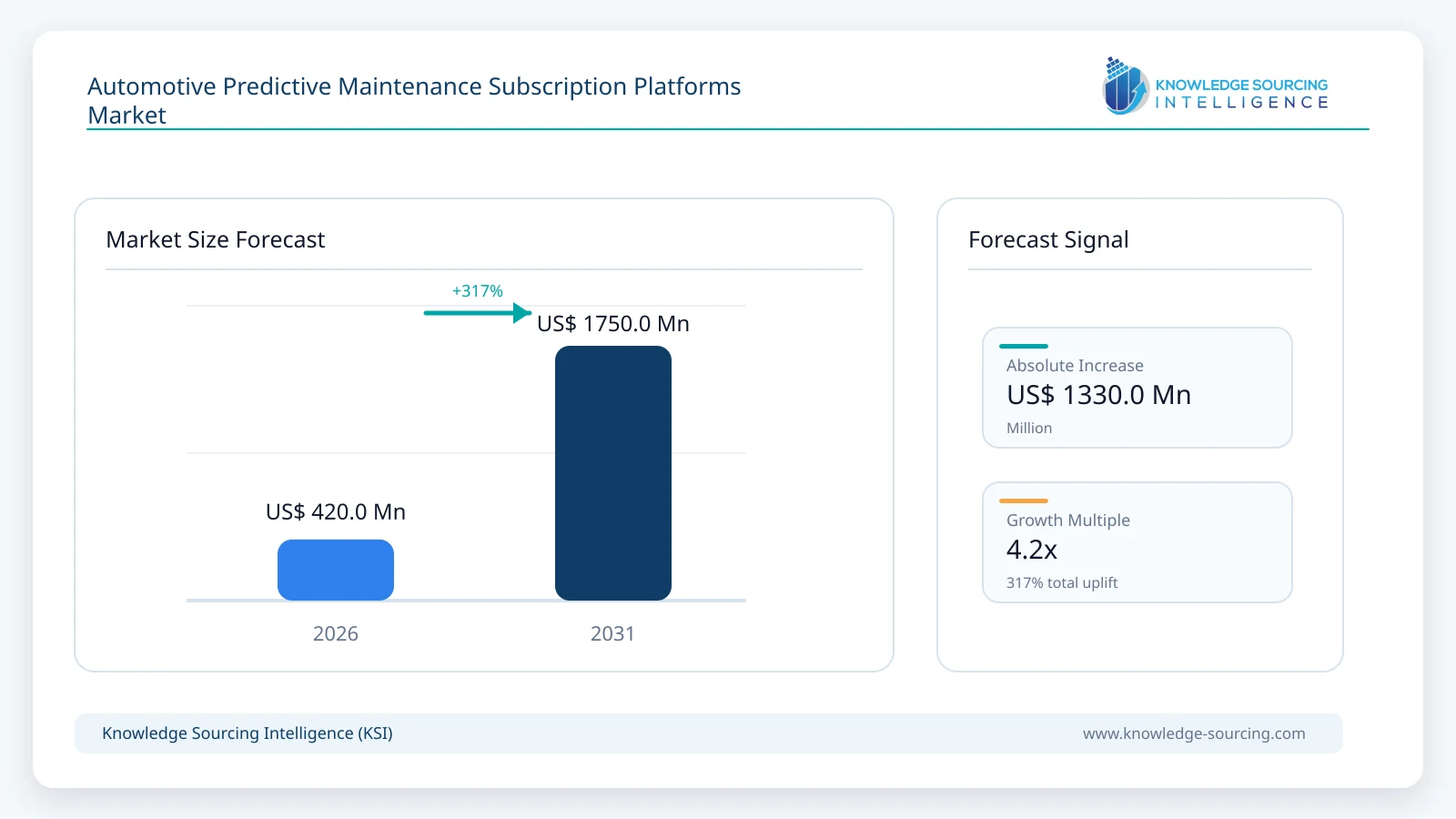
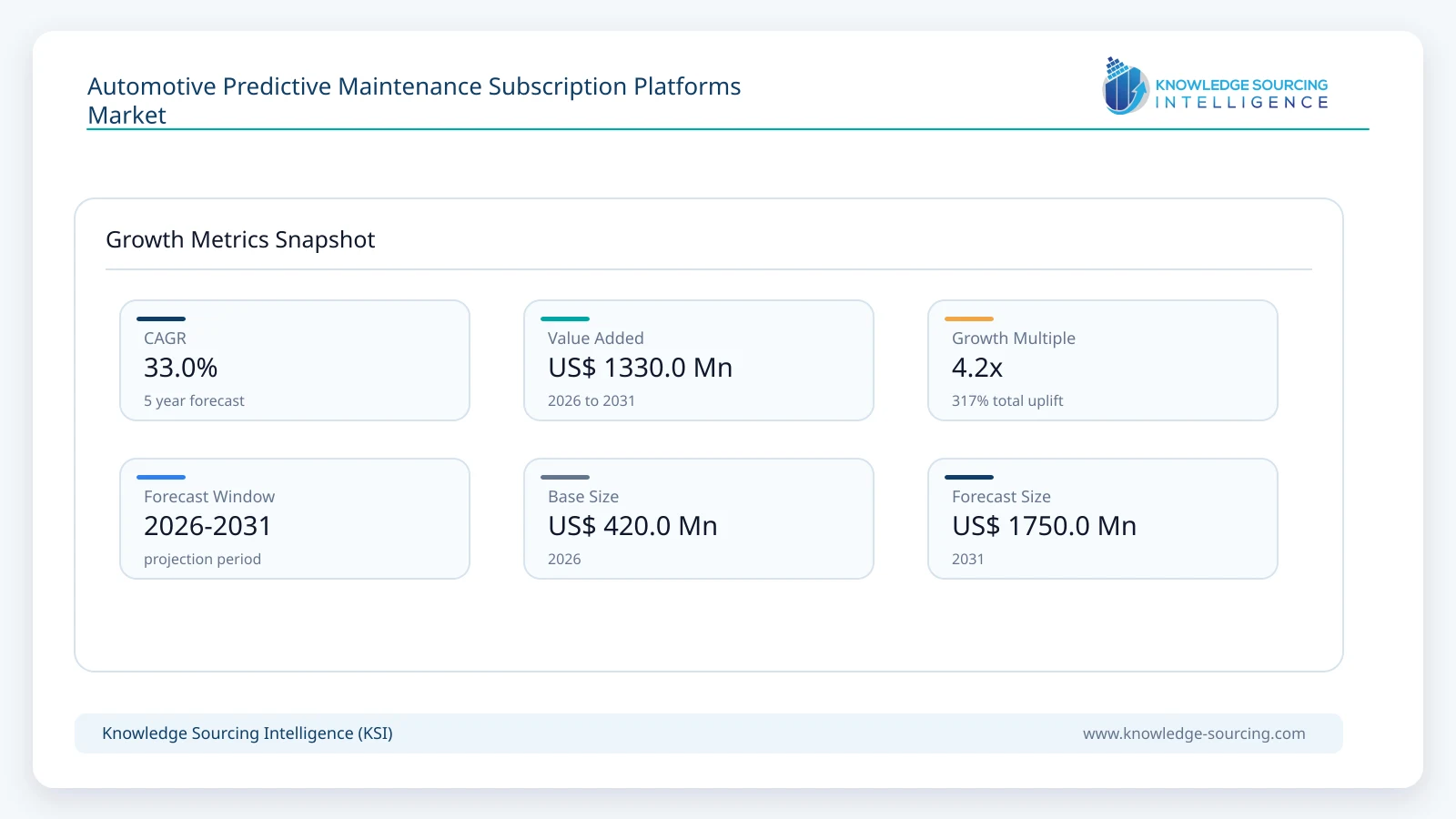
The automotive predictive maintenance subscription platforms market is projected to expand at a CAGR of 33.0%, increasing from USD 420 million in 2026 to USD 1,750 million by 2031.
Highlights:
- 1Embedded telematics add-ons represent approximately 52.4% of 2026 market value, reflecting established distribution through connected-fleet software.
- 2Medium and heavy commercial vehicles lead by vehicle type in 2026 because costly roadside failures create a strong maintenance-service business case.
- 3Battery and electric powertrain health expands faster than the legacy mechanical powertrain category as fleet electrification broadens diagnostic requirements.
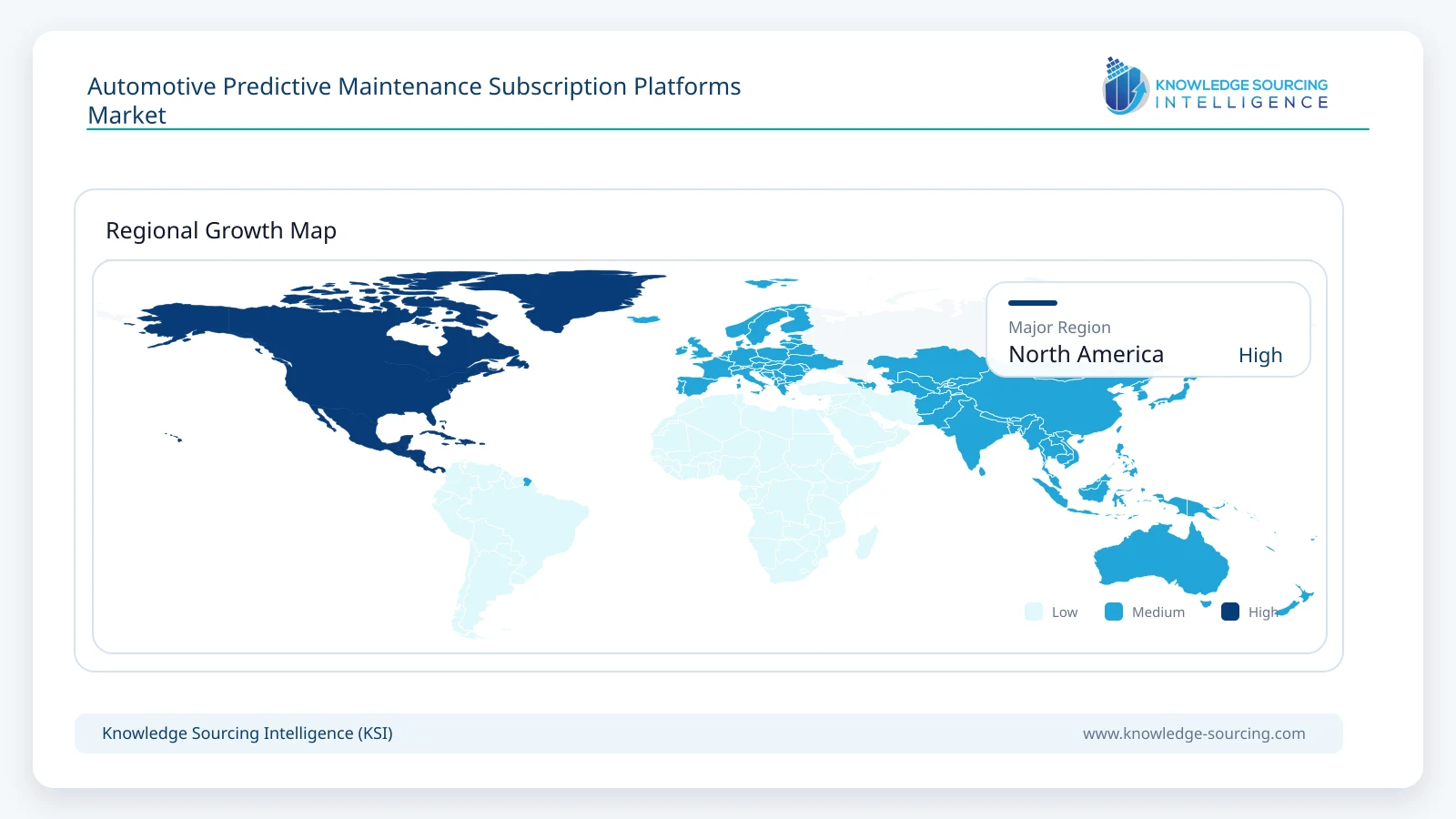
- 4North America contributes approximately 43.1% of 2026 value, while Asia Pacific is the fastest-growing regional market over the forecast period.
- 5OEM-native data access and integration with service records determine whether predictive recommendations can be converted into repairs.
Fleet predictive maintenance services turn vehicle diagnostic information into practical decisions about when equipment should be examined, repaired or taken out of service. The core commercial product is an ongoing software service that estimates component health or failure risk, communicates an understandable priority to a fleet manager, and connects the finding to maintenance execution. Bosch offers predictive diagnostics through OEM-hosted and supplier-hosted deployments, while independent analytics providers can work through existing telematics feeds.
Revenue is supported by per-vehicle subscriptions, analytics modules embedded in paid telematics plans, and OEM or dealer services that retain customers through more dependable aftersales care. Fleet operators often favor a predictable recurring charge over repeated emergency repairs, but purchasing decisions depend on alert quality, the value of prevented downtime and the availability of workshop capacity. Large truck fleets generally support higher service value per vehicle because a single failed asset can interrupt an entire delivery assignment.
Cloud analysis remains central because models benefit from repeated component observations and completed repair records across large vehicle populations. Modern integrations can also use native OEM telemetry rather than requiring an additional in-vehicle gateway, reducing installation effort for compatible models. Subscription operators are consequently moving toward common vehicle-health scores, ranked repair actions and integrations that turn an alert into an approved service task.
Market Overview
Vehicle health analytics depends on a continuous chain from fault-code acquisition and operating history to condition scoring and a recommended workshop action. A conventional dashboard can display a fault after it occurs; predictive software compares patterns across time and operating conditions to identify deterioration earlier. Geotab reports a large connected fleet data footprint, and its maintenance capabilities use indicators such as electrical-system health to generate service work requests. The value to the buyer comes from reliable prioritization rather than the volume of telemetry collected.
Commercial subscriptions can be sold directly by an analytics provider, added to a wider fleet-management plan or incorporated into the vehicle manufacturer’s digital service contract. Scania ProCare uses connected truck data to support predictive replacement of critical parts, while Volvo Trucks offers condition monitoring and planned maintenance through Volvo Connect and related service agreements. These business models can be particularly attractive when the supplier can arrange the replacement part and workshop slot alongside the alert.
Subscription economics vary with the available sensor signals and repair history for each vehicle family. Mixed-brand fleets typically need consistent alert priorities across manufacturers, whereas an OEM can use deeper component knowledge and its dealer network to support vehicle-specific failure models. The market therefore supports both independent fleet-software specialists and integrated automotive suppliers, with competition increasingly centered on repair accuracy, workflow adoption and effective use of customer data.
Market Trends
Predictive Health Is Moving Into Existing Telematics Subscriptions
Fleet telematics providers are bringing failure prediction into products that customers already use for location, safety and compliance. Geotab’s August 2026 Signals update introduced a broader predictive intelligence layer that draws on connected-vehicle information to identify emerging vehicle faults. Marketplaces also allow specialist providers such as Uptake and Questar to serve installed telematics customers without repeating the hardware deployment.
Distribution through established fleet software reduces the expense of reaching customers and makes a paid analytics module easier to compare with maintenance savings. Fleet buyers increasingly ask providers to demonstrate how improved fault prediction benefits operations beyond the alerts already available in their existing software.
Maintenance Recommendations Are Becoming More Actionable
Questar’s April 2026 Total Fleet Health release introduced a vehicle-health score, prioritized deterioration risks and an assessment of the economic consequences of delaying repairs. These features address a common operational problem: fleet managers receive more alerts than they can investigate, particularly where vehicle models and duty cycles differ substantially.
Subscription retention improves when a health prediction arrives with repair urgency, component context and a credible intervention plan. Providers are connecting diagnostic outputs to work orders, parts availability and repair histories, creating a recurring workflow product rather than a standalone fault-notification screen.
OEM Service Networks Are Incorporating Vehicle Health Into Aftersales Plans
Ford Pro updated the diagnostic information pipeline in its telematics service in February 2026 and expanded Ford Pro AI access to Europe and Canada during August. Scania and Volvo Trucks use their connected vehicle fleets and service networks to support proactive planning and reduce unexpected workshop visits.
Automaker-backed plans benefit from validated component engineering data and dealer relationships. Their main commercial constraint is the separation between software subscription value and repair or warranty coverage, particularly when predictive features are included inside multi-service contracts.
Hybrid Data Integrations Are Increasing Mixed-Fleet Coverage
Many commercial fleets include older vehicles that require plug-in telematics alongside newer vehicles with factory-installed connectivity. Bosch’s FleetME connects maintenance and telematics services, while Samsara and Fleetio list analytics integrations that reuse existing vehicle feeds. A unified health view therefore does not require every fleet asset to share a single manufacturer or hardware architecture.
Vehicle identity matching, diagnostic-code translation and consistent workshop histories remain demanding integration tasks. Vendors that can connect these records reliably are positioned to serve larger accounts and increase the share of vehicles on an active predictive-health subscription.
Electric Powertrains Are Creating Different Failure Models
Battery-electric trucks, buses and delivery vehicles need monitoring beyond engine-related wear, including traction-battery condition, thermal system behavior, high-voltage auxiliaries and charging-related faults. Volvo’s digital uptime services include monitoring of electric truck batteries, while fleet analytics platforms increasingly combine electric and combustion vehicles in one operational view.
Predictive coverage has to distinguish usable condition signals from ordinary charging and energy metrics. As more fleets electrify, maintenance subscription vendors can extend the diagnostic content sold per vehicle, but model quality depends on access to high-voltage system information and validated failure histories.
Segment Analysis
By Delivery Model: Embedded Telematics Add-ons
Embedded telematics add-ons represent about 52.4% of estimated market revenue in 2026 because fleet operators can activate analytics on connected vehicles they already manage through a recurring software account. Geotab Marketplace presents specialist predictive services to existing fleet subscribers, while Ford Pro incorporates diagnostic visibility into its telematics environment. This route reduces installation friction and concentrates purchasing around a fleet manager’s existing workflow.
Standalone predictive SaaS remains important for larger mixed fleets that want deep failure modeling independent of a telematics supplier. Its commercial momentum depends on achieving clear savings over the incremental monthly fee and offering a simple method for transferring a predicted fault into a maintenance order.
By Vehicle Type: Medium and Heavy Commercial Vehicles
Medium and heavy trucks represent the largest 2026 vehicle-type segment, with modeled revenue of USD 166 million. Long operating hours, high replacement-part costs and tight delivery schedules increase the value of monitoring driveline and engine-related deterioration before a vehicle becomes unavailable. Scania ProCare and Volvo’s condition-monitoring services illustrate the connection between onboard diagnostics, dealer capability and operator uptime.
Light commercial vehicles account for a meaningful second growth pool as parcel delivery, service fleets and commercial vans connect to fleet platforms. Passenger vehicles are expanding through rental, leasing and OEM aftersales contracts, although individual owners generally show less willingness to pay for an additional standalone predictive health subscription.
By Prediction Focus: Battery and Electric Powertrain Health
Battery and electric powertrain health is expected to gain revenue share as the commercial electric vehicle base expands and operators seek more dependable warning signals for expensive high-voltage components. A useful service combines state indicators with operating temperatures, charging patterns and historic maintenance outcomes, rather than treating a low battery state of charge as a service fault.
Conventional mechanical powertrain monitoring remains the larger 2026 category because combustion vehicles dominate existing commercial fleets. Over time, suppliers offering a common maintenance workflow across different propulsion systems are better placed to retain large customers during gradual fleet electrification.
By Vehicle Data Integration: Native OEM Embedded Telemetry
Factory-connected vehicle data is becoming an increasingly important input for predictive subscriptions, especially where an automaker can expose validated component-level information without additional gateways. Ford Pro Data Services and OEM-connected maintenance systems can make vehicle health assessments more timely and reduce separate installation costs on supported models.
Aftermarket gateways remain valuable for legacy assets and mixed-brand commercial fleets. Providers that integrate both sources can offer a consistent view across older and newer vehicles, while the commercial benefit depends on the completeness, permission terms and refresh frequency of the underlying vehicle signals.
Market Drivers
High Cost of Unexpected Commercial Vehicle Downtime
Roadside failures interrupt delivery schedules, leave drivers waiting and can create costs beyond the repair itself. Heavy commercial operators therefore evaluate prognostic alerts against avoided towing, substitute vehicles, late-delivery penalties and workshop overtime. A subscription that identifies a credible fault early enough for a planned service visit can justify recurring spend even when only a small portion of alerts result in a major avoided breakdown.
Operators with high asset utilization benefit most because taking one vehicle out of service has a visible operational cost. Vendors increasingly present repair urgency and likely consequences rather than raw diagnostic codes, helping managers decide which vehicle to schedule first.
Large Installed Base of Connected Fleet Vehicles
Geotab reported nearly six million connected-vehicle subscriptions in its February 2026 transport study, demonstrating the scale of telemetry infrastructure already deployed across commercial operations. Ford Pro, Samsara and OEM telematics services extend the accessible base through both factory and aftermarket connectivity. Predictive maintenance providers can reach customers through these established channels instead of financing a separate data-capture network.
Many telematics customers initially use vehicle tracking or compliance functions, so providers must show additional value before they can sell predictive health. Easier feature activation, dependable vehicle data and integrated billing make trial adoption more practical for fleets facing high maintenance costs.
Improvement in Failure Models and Service Recommendations
Vehicle-health providers can now combine historical faults, component operating conditions and completed repair outcomes rather than acting on isolated diagnostic trouble codes. Bosch’s predictive diagnostics and Questar’s updated Total Fleet Health use condition and risk information to support more targeted maintenance decisions. Better ranking of likely failure modes reduces the burden of checking every low-priority warning.
Model improvement becomes commercially valuable when it cuts unnecessary workshop visits while still detecting failures early enough for intervention. Subscription renewal therefore depends on measured workflow outcomes and transparent explanation of the recommended maintenance action.
OEM and Workshop Integration Expands Uptime Services
Truck manufacturers increasingly offer condition-based maintenance through connected service contracts and repair networks. Scania ProCare and Volvo Connect demonstrate how cloud-monitored component deterioration can be combined with scheduled dealer visits. Digital service providers can also link fleet managers with approved parts and workshop capacity without requiring them to coordinate several unconnected systems.
Integrating the prediction with aftersales execution creates stronger incentives to keep a subscription active. Buyers are more likely to retain vehicle-health services when warnings lead directly to a planned, completed maintenance task and reduced vehicle disruption.
Electrified Fleets Require New Maintenance Coverage
Commercial EV fleets need failure indicators for battery thermal management, electric drives, charging components and other systems that differ from traditional engine maintenance. Volvo’s connected uptime offering includes electric-truck battery monitoring and planned maintenance support, indicating how condition-based services can expand beyond diesel powertrains.
A subscription platform capable of supporting several propulsion systems reduces the need for fleet managers to manage separate diagnostic tools for each vehicle type. Revenue per monitored electric vehicle can rise with diagnostic depth, while accurate prediction still requires enough field history for the relevant components.
Market Restraints
Limited Data Depth Across Older and Mixed Fleets
Many older vehicles expose only standardized fault codes and basic operating parameters, while manufacturers differ in how much component-level data they share. A single predictive subscription can therefore have strong coverage for certain vehicle families and much weaker confidence for others. Lack of comparable sensor histories makes it harder to create a consistent vehicle-health score across mixed commercial fleets.
Providers must invest in data normalization, gateway integrations and model validation before they can scale beyond well-supported vehicle types. Limited coverage can also reduce customers’ willingness to pay a uniform price for every vehicle in the fleet.
False Alerts and Missed Failures Affect Trust
A warning that repeatedly triggers unnecessary service can erode the cost benefit of predictive software, whereas an unanticipated breakdown damages confidence in the model. Both outcomes matter because maintenance decisions commit scarce workshop capacity, parts inventory and vehicle operating time. Reliability must be demonstrated across changing weather, load, route and driver conditions.
Early programs often need human review, conservative alert thresholds and a mechanism to incorporate actual repair findings. These measures improve trust but increase service-delivery costs and can slow feature rollout to additional components.
Bundled Telematics and Repair Contracts Obscure Analytics Pricing
Vehicle health features are frequently included within larger fleet telematics, service contracts or maintenance management packages. Scania’s Pro package combines predictive capability with repair coverage, and Ford Pro offers multiple telematics subscription levels. Buyers may value the total service but resist a separate invoice for predictions that seem to be part of an existing contract.
Suppliers must make the incremental analytical benefit visible through earlier warnings, improved repair timing and avoided downtime. Difficult attribution also limits the transparency of reported market revenue for a narrowly defined predictive-subscription category.
Privacy, Cybersecurity and Data-Access Requirements
Predictive subscriptions rely on persistent access to vehicle operating information, maintenance histories and sometimes driver or location signals. Fleet operators and automakers must manage permissions, retention periods, cross-border processing and security of cloud-to-vehicle integrations. A disruption in data access can invalidate a forecast of component condition even when the underlying prediction model is technically sound.
Large multinational buyers increasingly evaluate governance and cybersecurity alongside model performance. Compliance reviews and manufacturer-specific contracts can extend sales cycles, particularly for platforms integrating several data providers or dealer networks.
Workshop Capacity Can Limit the Benefit of Early Detection
A component warning has limited operational value when spare parts are unavailable or repair appointments cannot be arranged before failure. Distributed fleet operators may have inconsistent service infrastructure across routes, and older vehicles can face longer lead times for certain components. Predictive alerts therefore compete with workshop scheduling constraints and existing maintenance backlogs.
Providers are responding with service-routing integrations, repair cost estimates and prioritization tools. Those capabilities improve commercial usefulness but require additional integrations and may increase the monthly service cost for smaller fleets.
Regional Outlook
North America
North America leads the global predictive-maintenance subscription market in 2026, supported by large truck and light-commercial fleets, established telematics subscriptions, and a broad network of software integrators. Ford Pro, Geotab, Questar and independent predictive providers serve operators that already use digital monitoring for routing, safety and utilization. Commercial users are comparatively well placed to test a paid vehicle-health module against downtime records and planned maintenance spend.
Supplier consolidation and expanded service distribution are reshaping the North American market. Bosch announced plans in March 2026 to acquire Uptake, intending to combine predictive analytics with connected fleet data and maintenance workflows. Over the forecast period, North American growth will depend on converting a mature telematics base into paid health subscriptions and increasing adoption of deeper battery and multi-system prediction.
Asia Pacific
Asia Pacific is projected to grow fastest among the five regions as commercial vehicle connectivity extends across China, India, Japan and other fleet markets. Demand is linked to high-mileage logistics vehicles, bus operations and the increasing complexity of battery-electric commercial fleets. Suppliers that can work with different vehicle-data sources and provide condition warnings at a suitable price are positioned to address a widening range of operator sizes.
China contributes the largest estimated regional revenue pool because its connected vehicle and electric commercial-vehicle base supports multiple vehicle-health use cases. Japan and South Korea offer opportunities linked to structured OEM aftersales programs, while India presents a longer-term market for cost-conscious truck and light-commercial operators. Growth remains dependent on reliable field data and practical workshop coverage, not simply the number of vehicles with a modem.
Competitive Landscape
Predictive maintenance subscriptions are supplied through three competing structures: fleet platforms with embedded analytics, specialist prognostics companies and vehicle manufacturers with connected-service ecosystems. Geotab offers an extensive telematics and application distribution environment, while Questar and Uptake focus more directly on predictive diagnostics and repair prioritization. Bosch combines automotive engineering with diagnostics infrastructure and a fleet maintenance orchestration platform.
OEM-backed competitors, including Ford Pro, Scania and Volvo Trucks, can combine detailed component data with dealer and workshop capabilities. Independent providers counter with mixed-brand support, the ability to run on existing telematics feeds and dedicated predictive models. Subscription pricing is shaped by eligible vehicle count, diagnostic coverage, integration complexity and the measurable service outcome rather than a universal per-vehicle feature list.
Partnerships and consolidation are likely to remain important because no single provider owns all the necessary vehicle signals and service networks. Bosch’s planned purchase of Uptake illustrates the attraction of combining analytics specialists with larger automotive platforms, while marketplace partnerships allow specialist models to reach customers without operating a complete telematics stack. Competitive advantage will favor accurate, explainable warnings that reliably lead to maintenance action.
Recent Developments
August 2026: Geotab: Geotab Signals 2026 Volume 2 introduced First Light and a predictive intelligence layer covering emerging vehicle faults and maintenance-related information. The release strengthens predictive functions within an established fleet-software environment.
August 2026: Ford Pro: Ford Pro AI expanded to eligible telematics customers in Europe and Canada and enabled broader interaction with vehicle-health data. The release extends the addressable subscription distribution footprint.
April 2026: Questar Auto Technologies: Questar released Total Fleet Health worldwide with updated risk ranking, dynamic health scores and cost-of-inaction analysis. The additions support maintenance prioritization rather than simple post-fault reporting.
March 2026: Robert Bosch GmbH: Bosch announced a planned acquisition of Uptake Technologies to expand its AI-driven fleet maintenance offering. The announcement described an intended transaction, not a completed acquisition.
February 2026: Ford Pro: Ford Pro Telematics updated the processing and display of vehicle diagnostic information, improving fleet visibility and the handling of resolved issues. The enhancement serves customers using eligible telematics subscriptions.
February 2026: Questar Auto Technologies: Questar made Total Fleet Health available through the Geotab Marketplace. The integration gives fleets with an established Geotab feed access to a specialist predictive-health service.
Market Outlook
Predictive maintenance subscriptions are likely to move from simple fault-message alerts toward ranked vehicle-health recommendations linked to workshop scheduling and repair cost. Providers with a broad connected fleet population can improve service delivery by learning from component histories and completed maintenance outcomes, while specialist developers can differentiate on particular failure modes. A larger recurring revenue base will depend on demonstrable operator savings, not feature availability alone.
Battery-electric fleets will increase demand for condition insights across high-voltage powertrains, thermal systems and charging hardware. Meanwhile, the replacement of older commercial vehicles will expand access to OEM-native operating signals, reducing the need for some aftermarket gateway installations. Independent applications should remain valuable where mixed fleets require consistent health measures across several brands.
Fleet maintenance procurement is expected to favor subscriptions that combine credible diagnostics with practical repairs and clear cost accountability. Vendors able to document avoided unscheduled stops, reasonable alert precision and effective integration with existing work orders will be in a stronger position to renew accounts and deepen enterprise relationships through 2031.
Automotive Predictive Maintenance Subscription Platforms Market Scope
| Report Metric | Details |
|---|---|
| Total Market Size in 2026 | USD 420 million |
| Total Market Size in 2031 | USD 1,750 million |
| Forecast Unit | Million |
| Growth Rate | 33.0% |
| Study Period | 2021 to 2031 |
| Historical Data | 2021 to 2024 |
| Base Year | 2025 |
| Forecast Period | 2026 – 2031 |
| Segmentation | Delivery Model, Primary Prediction Focus, Vehicle Type, Powertrain, Cloud Deployment Architecture, Customer Type, Vehicle Data Integration, Geography |
| Companies |
|
| Customization Scope | 15% Free Customization included with purchase — Request Custom Breakdown → |
| Sample & Data Access | PDF Sample, Excel Databook & Analyst Briefing — Download Free Sample → |
Market Segmentation
By Delivery Model
Embedded Telematics Add-ons
Standalone Predictive SaaS
OEM and Dealer Connected Services
By Primary Prediction Focus
Powertrain and Engine Health
Multi-System Vehicle Health
Tire, Brake and Chassis Health
Battery and Electric Powertrain Health
By Vehicle Type
Medium and Heavy Commercial Vehicles
Light Commercial Vehicles
Passenger Vehicles
Buses and Coaches
By Powertrain
Internal Combustion Engine
Hybrid Electric
Battery and Fuel-Cell Electric
By Cloud Deployment Architecture
Multi-Tenant Cloud SaaS
OEM or Private Cloud
Hybrid Edge and Cloud
By Customer Type
Commercial Fleet Operators
OEM and Dealer Aftersales
Leasing, Rental and Shared Mobility
Transit and Public-Sector Operators
By Vehicle Data Integration
Aftermarket Telematics Feed
Native OEM Embedded Telemetry
Mixed OEM and Aftermarket Feeds
By Geography
North America
United States
Canada
Mexico
South America
Brazil
Argentina
Chile
Others
Europe
Germany
United Kingdom
France
Italy
Spain
Sweden
Others
Middle East and Africa
Saudi Arabia
United Arab Emirates
South Africa
Turkey
Others
Asia Pacific
China
Japan
India
South Korea
Australia
Indonesia
Thailand
Taiwan
Others
Table of Contents
1. EXECUTIVE SUMMARY
1.1. Market Opportunity and Key Findings
1.2. Global Market Forecast
2. MARKET SNAPSHOT
2.1. Market Overview
2.2. Market Definition
2.3. Scope of the Study
2.4. Market Segmentation
3. BUSINESS LANDSCAPE
3.1. Market Drivers
3.1.1. High Cost of Unexpected Commercial Vehicle Downtime
3.1.2. Large Installed Base of Connected Fleet Vehicles
3.1.3. Improvement in Failure Models and Service Recommendations
3.1.4. OEM and Workshop Integration Expands Uptime Services
3.1.5. Electrified Fleets Require New Maintenance Coverage
3.2. Market Restraints
3.2.1. Limited Data Depth Across Older and Mixed Fleets
3.2.2. False Alerts and Missed Failures Affect Trust
3.2.3. Bundled Telematics and Repair Contracts Obscure Analytics Pricing
3.2.4. Privacy, Cybersecurity and Data-Access Requirements
3.2.5. Workshop Capacity Can Limit the Benefit of Early Detection
3.3. Market Opportunities
3.4. Porter’s Five Forces Analysis
3.5. Industry Value Chain Analysis
3.6. Policies and Regulations
3.7. Strategic Recommendations
4. TECHNOLOGICAL OUTLOOK
4.1. Diagnostic Data Acquisition and Validation
4.2. Anomaly Detection and Prognostic Models
4.3. Vehicle Health Scoring and Failure Prioritization
4.4. Work Order and Dealer System Integration
4.5. Predictive Analytics for Electrified Powertrains
5. AUTOMOTIVE PREDICTIVE MAINTENANCE SUBSCRIPTION PLATFORMS MARKET BY DELIVERY MODEL
5.1. Overview
5.2. Embedded Telematics Add-ons
5.3. Standalone Predictive SaaS
5.4. OEM and Dealer Connected Services
6. AUTOMOTIVE PREDICTIVE MAINTENANCE SUBSCRIPTION PLATFORMS MARKET BY PRIMARY PREDICTION FOCUS
6.1. Overview
6.2. Powertrain and Engine Health
6.3. Multi-System Vehicle Health
6.4. Tire, Brake and Chassis Health
6.5. Battery and Electric Powertrain Health
7. AUTOMOTIVE PREDICTIVE MAINTENANCE SUBSCRIPTION PLATFORMS MARKET BY VEHICLE TYPE
7.1. Overview
7.2. Medium and Heavy Commercial Vehicles
7.3. Light Commercial Vehicles
7.4. Passenger Vehicles
7.5. Buses and Coaches
8. AUTOMOTIVE PREDICTIVE MAINTENANCE SUBSCRIPTION PLATFORMS MARKET BY POWERTRAIN
8.1. Overview
8.2. Internal Combustion Engine
8.3. Hybrid Electric
8.4. Battery and Fuel-Cell Electric
9. AUTOMOTIVE PREDICTIVE MAINTENANCE SUBSCRIPTION PLATFORMS MARKET BY CLOUD DEPLOYMENT ARCHITECTURE
9.1. Overview
9.2. Multi-Tenant Cloud SaaS
9.3. OEM or Private Cloud
9.4. Hybrid Edge and Cloud
10. AUTOMOTIVE PREDICTIVE MAINTENANCE SUBSCRIPTION PLATFORMS MARKET BY CUSTOMER TYPE
10.1. Overview
10.2. Commercial Fleet Operators
10.3. OEM and Dealer Aftersales
10.4. Leasing, Rental and Shared Mobility
10.5. Transit and Public-Sector Operators
11. AUTOMOTIVE PREDICTIVE MAINTENANCE SUBSCRIPTION PLATFORMS MARKET BY VEHICLE DATA INTEGRATION
11.1. Overview
11.2. Aftermarket Telematics Feed
11.3. Native OEM Embedded Telemetry
11.4. Mixed OEM and Aftermarket Feeds
12. AUTOMOTIVE PREDICTIVE MAINTENANCE SUBSCRIPTION PLATFORMS MARKET BY GEOGRAPHY
12.1. North America
12.1.1. United States
12.1.2. Canada
12.1.3. Mexico
12.2. South America
12.2.1. Brazil
12.2.2. Argentina
12.2.3. Chile
12.2.4. Others
12.3. Europe
12.3.1. Germany
12.3.2. United Kingdom
12.3.3. France
12.3.4. Italy
12.3.5. Spain
12.3.6. Sweden
12.3.7. Others
12.4. Middle East and Africa
12.4.1. Saudi Arabia
12.4.2. United Arab Emirates
12.4.3. South Africa
12.4.4. Turkey
12.4.5. Others
12.5. Asia Pacific
12.5.1. China
12.5.2. Japan
12.5.3. India
12.5.4. South Korea
12.5.5. Australia
12.5.6. Indonesia
12.5.7. Thailand
12.5.8. Taiwan
12.5.9. Others
13. COMPETITIVE ENVIRONMENT AND ANALYSIS
13.1. Major Players and Strategy Analysis
13.2. Market Share Analysis
13.3. Mergers, Acquisitions, Agreements and Collaborations
13.4. Competitive Dashboard
14. COMPANY PROFILES
14.1. Robert Bosch GmbH
14.2. Geotab Inc.
14.3. Ford Motor Company (Ford Pro)
14.4. Questar Auto Technologies
14.5. Scania AB
14.6. Volvo Trucks
14.7. Samsara Inc.
14.8. Uptake Technologies, Inc.
14.9. Pitstop
14.10. ZF Friedrichshafen AG
14.11. Fleetio
15. APPENDIX
15.1. Currency
15.2. Assumptions
15.3. Base and Forecast Years Timeline
15.4. Key Benefits for Stakeholders
15.5. Research Methodology
15.6. Abbreviations





Frequently asked questions
What is the projected market value for Automotive Predictive Maintenance Subscription Platforms by 2031?
Market to reach $1,750 million by 2031, growing at 33.0% CAGR.
Which region holds the largest market share in 2026?
North America contributes approximately 43.1% of 2026 market value.
What is the fastest-growing regional market in the forecast period?
Asia Pacific is the fastest-growing regional market.
Which vehicle type leads the market by value in 2026?
Medium and heavy commercial vehicles lead by vehicle type.
What technology segment holds the largest market share in 2026?
Embedded telematics add-ons represent 52.4% of 2026 market value.
Which powertrain health category expands fastest?
Battery and electric powertrain health expands faster.
Cite this report
Knowledge Sourcing Intelligence. (Oct 2026). Automotive Predictive Maintenance Subscription Platforms Market Size, Share & Growth Forecast (2026-2031). https://www.knowledge-sourcing.com/report/automotive-predictive-maintenance-subscription-platforms-market