
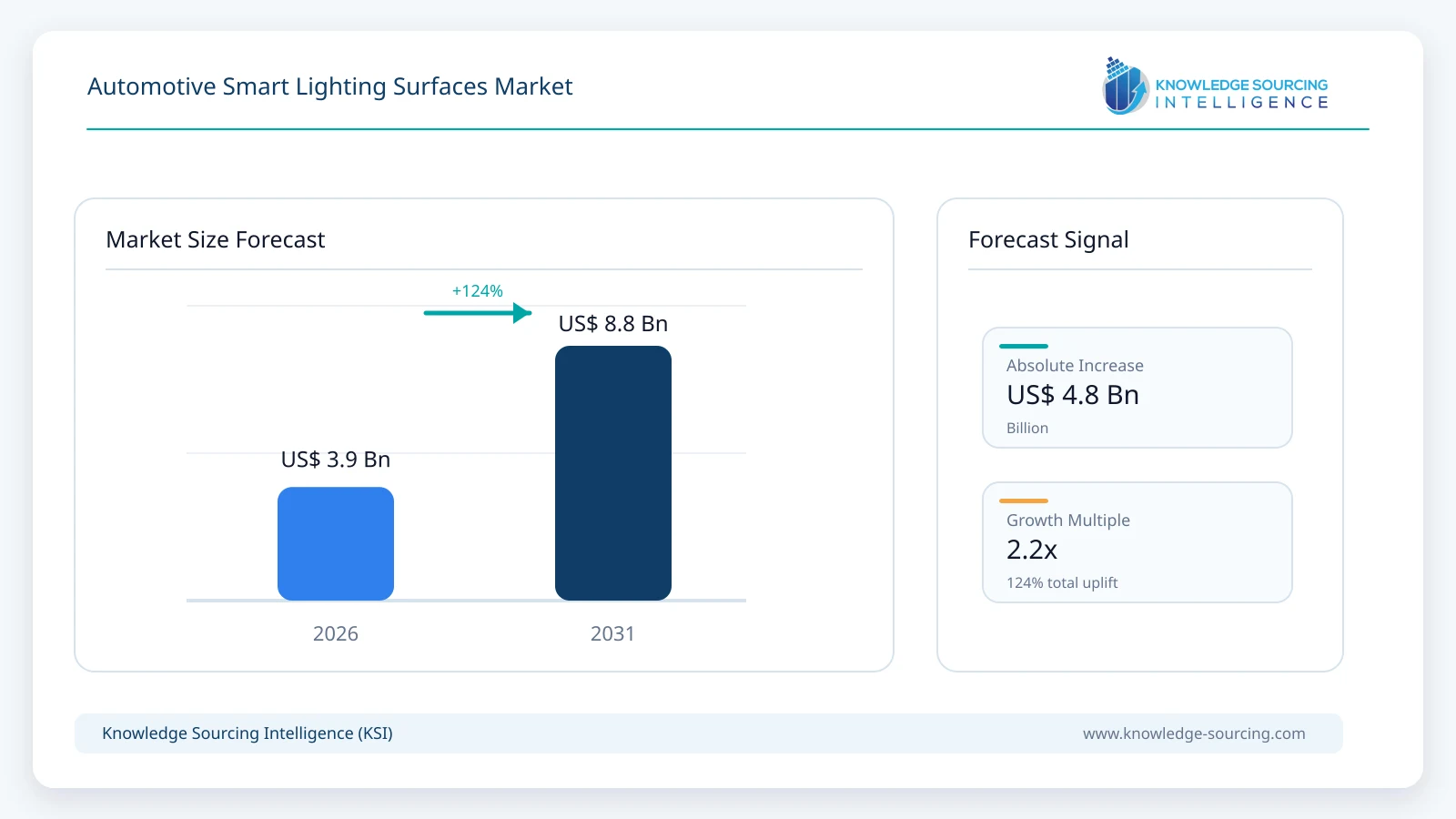
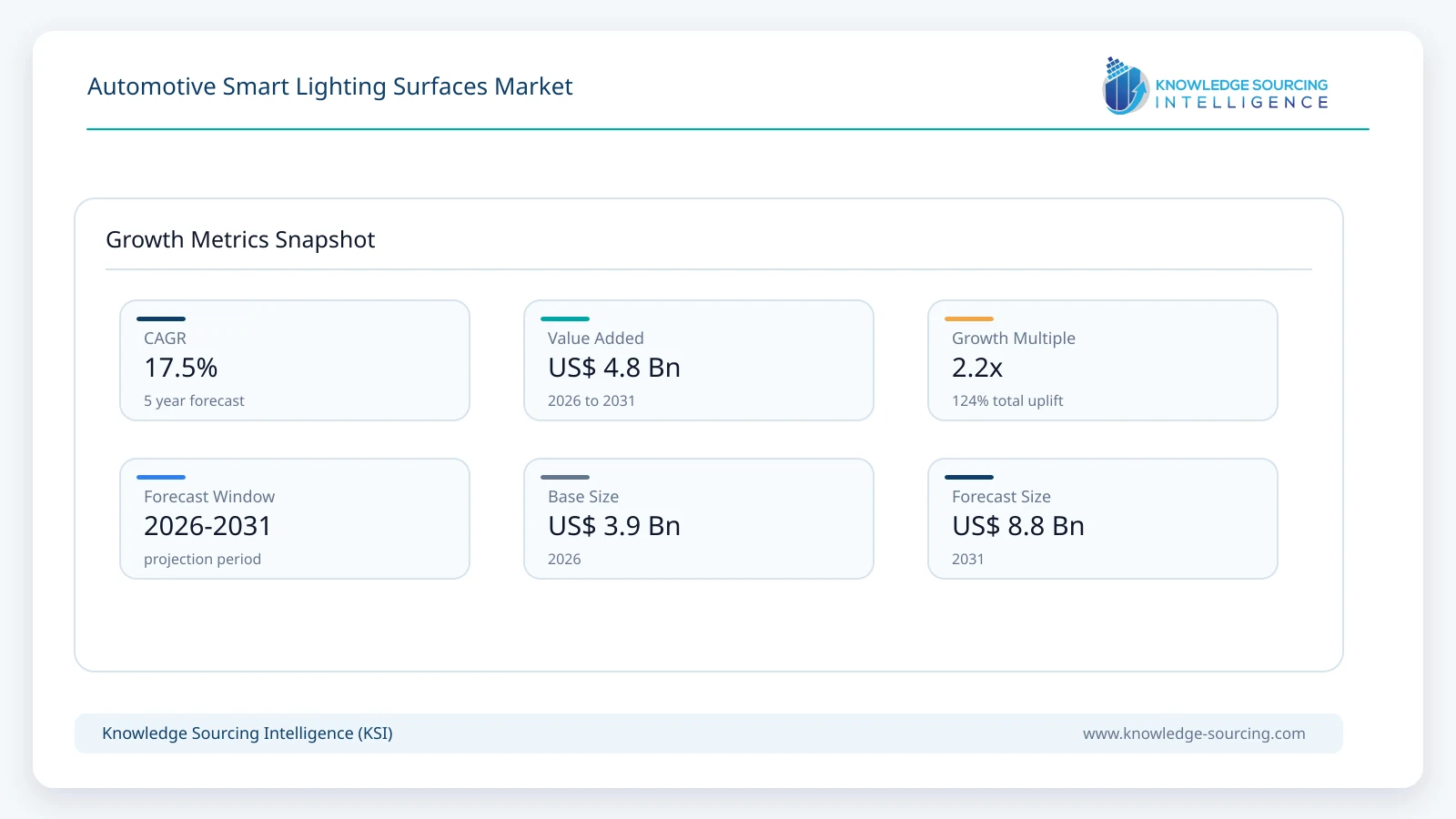
The automotive smart lighting surfaces market is growing at a CAGR of 17.5%, from USD 3.90 billion in 2026 to USD 8.75 billion by 2031.
Highlights:
- 1Interior smart lighting surfaces account for approximately 71% of global market value in 2026, supported by broad adoption across doors, instrument panels, consoles and roof structures.
- 2Integrated LED and light-guide surface architectures represent approximately 37% of 2026 market value, while in-mold structural electronics and ultra-thin embedded-lighting solutions are the fastest-growing technology class.
- 3Ambient, personalization and decorative functions account for approximately 39% of 2026 demand, although HMI, warning and communication functions are gaining share as light becomes part of the digital interface.
- 4Door and side-trim surfaces represent approximately 27% of market value in 2026 because they combine large visual area with strong demand for ambient lighting, hidden controls and animated effects.
- 5Passenger vehicles account for approximately 95% of global market value in 2026, with premium vehicles and technology-focused EVs leading adoption.
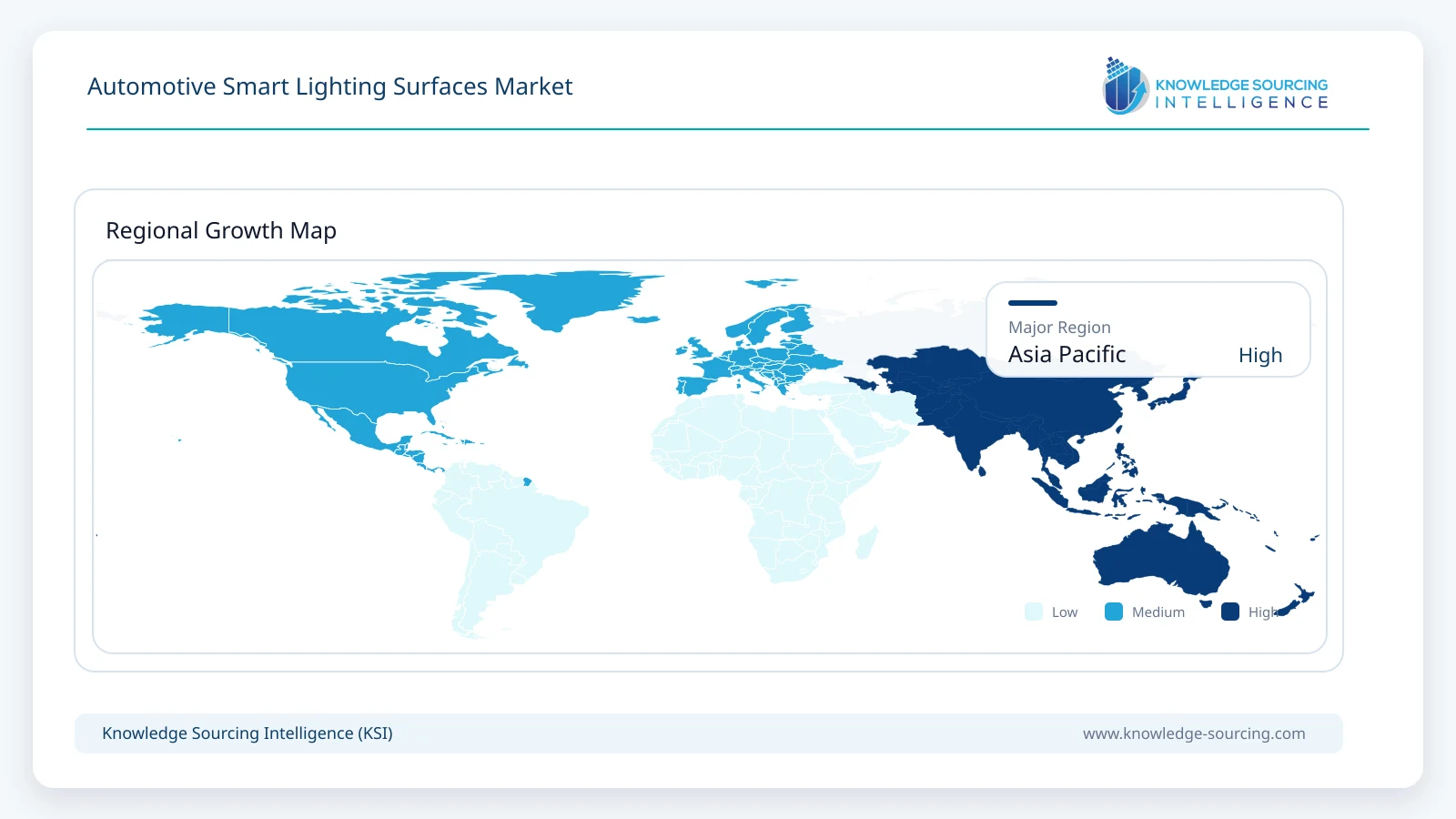
- 6Asia Pacific represents approximately 46% of global market value in 2026, supported by rapid smart-cabin development in China and strong regional production of lighting, electronics and interior components.
Surface-integrated lighting is moving from premium design concepts into series-production vehicle programs as suppliers combine LEDs, conductive structures, optical films, decorative skins and molded carriers within thinner assemblies.
Interior door panels, instrument panels and center consoles currently generate the largest value because these areas offer broad visible surfaces where lighting can support ambience, warnings, hidden controls and brand differentiation without adding separate lamp housings. Exterior adoption is expanding through illuminated grilles, front panels, emblems and body trim, particularly on electric vehicles where closed front-end designs create new space for lighting-based identity and communication.
The market measures the attributable value of the illuminated surface assembly, including the surface layer, optical and diffusion elements, embedded or closely integrated light sources, conductive structures and local electronics required for the surface function. Standalone ambient-light modules, conventional headlamps and rear lamps, projection systems, ordinary displays and smart surfaces without an integrated lighting function are outside the core scope.
Market Overview
Embedding lighting directly into a trim or body surface changes both the visual design and the component architecture. Instead of packaging a lamp behind a separate decorative part, manufacturers can place conductive traces, LEDs, diffusers, graphics and sensing elements within or immediately behind the surface, allowing the part to remain visually clean when inactive and become functional when illuminated.
Interior implementations range from thin light lines and translucent skins to complete smart panels that combine touch input, haptic feedback and light-based status information. Exterior implementations use illuminated grilles, emblems and front or rear decorative panels to create brand signatures, charging indications and selected communication functions without relying on conventional lamp geometry.
Manufacturing capability is becoming as important as concept design because surface lighting requires tight control of optical uniformity, material transmission, electronics placement, thermal behavior, surface quality and long-term durability. The strongest suppliers are therefore linking lighting expertise with interior or exterior trim engineering, in-mold electronics, surface materials and high-volume molding rather than approaching the product as an isolated LED module.
Market Trends
In-Mold Electronics Is Moving Smart Lighting Surfaces toward High-Volume Production
High-volume automotive programs are beginning to use in-mold structural electronics to place lighting and circuitry directly inside molded surfaces, reducing separate housings, wiring and assembly steps. Valeo's 2026 premium-vehicle program using TactoTek IMSE technology and NBHX's exterior smart-surface nomination in China indicate that the technology is progressing beyond demonstrators.
Broader licensing to Tier 1 suppliers such as Motherson is also widening manufacturing capacity, giving OEMs more options for sourcing thin illuminated structures across different regions.
Hidden-Until-Lit Surfaces Are Expanding beyond Individual Controls
Translucent skins, decorative films and backlit molded surfaces allow icons, patterns and light effects to remain invisible until required, helping designers reduce visual clutter while retaining access to controls and alerts. Continental's Xpreshn Hylite and similar surface materials illustrate how decorative quality and functional lighting are increasingly designed as one stack.
Larger illuminated areas are shifting value away from a single lamp or switch toward the complete surface architecture, including optical control, graphics and integration with touch or sensing.
Interactive Lighting Is Turning Interior Trim into an HMI Layer
Combining illumination with touch, force sensing, haptics and contextual software allows a door panel or console surface to act as both decoration and control interface. Marelli's interactive smart-surface approach and Antolin's work on thin solid-state HMI surfaces show how lighting can provide visual feedback without requiring conventional mechanical buttons.
This integration is especially relevant to software-defined cabins because the same physical surface can change function according to vehicle state, user profile or feature configuration.
Exterior Smart Surfaces Are Expanding with EV Front-End Redesign
Closed EV front ends and reduced cooling openings create more usable area for illuminated grilles, front panels and emblems, allowing brand identity and selected status communication to be integrated directly into exterior trim. Ultra-thin lighting structures also reduce the need for deep optical modules behind decorative panels.
Exterior adoption remains smaller than interior use but is growing faster because new EV platforms are being designed around illuminated surfaces from the start rather than adapting them to legacy grille architectures.
Thin, Conformal Lighting Is Increasing the Usable Surface Area
Flexible light guides, thin optical films, embedded LED structures and surface-light concepts are extending illumination into curved doors, pillars, consoles, roof structures and complex exterior geometries where conventional rigid modules are difficult to package. FORVIA HELLA's surface-integrated RGB concepts and Cora Light architecture reflect this move toward lighting that follows the geometry of the surface.
Greater geometric freedom allows designers to create longer continuous lighting features without increasing packaging depth, which supports broader adoption in vehicles where interior space and mass remain tightly controlled.
Segment Analysis
By Surface Area: Interior Smart Lighting Surfaces
Door panels, dashboards, consoles, pillars and roof structures make interior surfaces the largest application group because lighting can improve perceived quality while also supporting warnings, hidden controls, personalization and occupant interaction. Interior systems benefit from lower environmental exposure than exterior components and therefore provide a more mature route for integrating thin electronics and translucent surface materials.
Interior smart lighting surfaces account for approximately USD 2.77 billion in 2026 and are projected to approach USD 6.04 billion by 2031. Exterior surfaces will grow faster, but the interior will remain the larger value pool because each vehicle offers several illuminated cabin zones.
By Technology: Integrated LED and Light-Guide Surfaces
Integrated LED and light-guide architectures lead the technology mix because they combine mature automotive LEDs with proven optical guides, diffusers and decorative surfaces. The format can be adapted across narrow contour lighting, broad backlit panels and localized hidden-until-lit features without requiring a fully molded electronic circuit.
The technology represents approximately USD 1.44 billion in 2026 and could reach about USD 2.92 billion by 2031. In-mold structural electronics will expand faster as production capacity grows and OEMs seek thinner assemblies with fewer separate components.
By Function: Ambient, Personalization and Decorative Lighting
Personalization remains the largest function because illuminated surfaces provide a highly visible way to change cabin character through color, animation, welcome sequences and drive-mode effects. The same surface can also support brand-specific graphics or patterns without adding a separate display.
Ambient and decorative functions account for approximately USD 1.52 billion in 2026. Their absolute value will continue to rise, although interactive HMI, safety-warning and communication functions are expected to gain share through 2031.
By Application Location: Door and Side-Trim Surfaces
Long visible contours, broad trim areas and close proximity to handles, switches and speakers make doors the most practical location for combining lighting with decoration and interaction. The surface can support conventional ambient effects, blind-spot or warning cues, hidden control graphics and animated welcome functions within one assembly.
Door and side-trim applications are estimated at approximately USD 1.05 billion in 2026 and could exceed USD 2.25 billion by 2031 as surface-integrated lighting reaches more mid-range vehicle programs.
By Vehicle Type: Passenger Vehicles
Passenger cars, SUVs and MPVs dominate adoption because interior experience and exterior lighting signatures are important differentiation tools in premium and electric-vehicle segments. Chinese EV manufacturers have also accelerated the spread of illuminated panels and animated cabin surfaces into vehicles below traditional luxury price points.
Passenger vehicles account for approximately USD 3.71 billion in 2026 and are expected to represent about USD 8.14 billion by 2031. Commercial-vehicle adoption remains smaller but is increasing where lighting surfaces support driver communication, cabin comfort or brand identity.
Market Drivers
Software-Defined Cabin Development Is Raising the Value of Programmable Surfaces
Centralized cockpit software and zonal electronics allow lighting surfaces to respond to the same vehicle-state, occupant and ADAS data used by displays and audio systems. A surface can therefore change color, brightness or graphic behavior according to context rather than operating as a fixed decorative element.
Software control improves the utilization of installed hardware because the same illuminated area can support personalization, alerts and different feature packages across a vehicle platform.
OEM Demand for Cleaner Interiors Is Accelerating Hidden Functionality
Removing visible mechanical switches and separate lamp bezels helps OEMs create simpler interior themes while still providing controls and feedback when needed. Backlit translucent surfaces and embedded lighting support this design direction by keeping graphics hidden until the associated function becomes active.
The approach can also reduce part count when decoration, illumination and HMI are engineered together rather than as separate components.
Electric-Vehicle Styling Is Expanding Illuminated Exterior Surface Area
Closed front panels, new grille proportions and stronger emphasis on digital brand identity give EV designers more freedom to use illuminated surfaces across the vehicle exterior. Light can define the vehicle signature, show charging or access status and support communication without relying only on conventional headlamp and tail-lamp shapes.
Purpose-designed EV platforms therefore create a larger addressable area for exterior smart surfaces than many combustion-engine vehicles with cooling-driven front-end constraints.
Industrialization of IMSE and Thin Electronic Structures Is Improving Scalability
Tier 1 licensing, automated manufacturing lines and new series-production awards are reducing the industrial risk associated with molded electronic surfaces. The 2026 expansion of TactoTek's ecosystem through Valeo, Motherson, NBHX and engineering partners shows that supply capability is broadening beyond specialist prototyping.
Higher manufacturing maturity should lower integration cost, shorten development cycles and make illuminated smart surfaces more accessible to high-volume platforms.
Growth of Lighting-Based HMI and Safety Communication Is Adding Functional Value
Surface lighting can direct attention, confirm a touch input, reinforce an ADAS warning or indicate vehicle status without requiring another standalone display. These functions provide a stronger business case than decorative lighting alone because the illuminated surface contributes to the vehicle's information architecture.
Functional use also supports higher electronics and software content per surface, increasing market value even when LED component prices decline.
Market Restraints
Optical Uniformity Becomes Harder across Large and Complex Surfaces
Large illuminated panels can reveal hotspots, color variation and brightness discontinuities that are less visible in short light strips. Surface grain, material thickness, curvature and printed graphics all influence transmission, making optical simulation and production consistency critical.
Premium appearance requirements increase rejection risk because small variations that are acceptable in hidden electronics can become visible immediately when the surface is illuminated.
Multi-Material Integration Increases Validation and Recycling Complexity
Smart lighting surfaces often combine decorative films, molded polymers, conductive traces, LEDs, adhesives, optical layers and electronic components within one assembly. Each layer must survive heat, humidity, vibration, abrasion and chemical exposure without delamination or visible degradation.
The same integration that reduces component count during assembly can make end-of-life separation more difficult, increasing pressure for compatible material stacks and design-for-recycling approaches.
Repairability Remains More Difficult than for Conventional Trim
A conventional decorative panel can often be replaced or refinished without affecting electronics, whereas an illuminated smart surface may combine both functions in one part. Damage to the surface can therefore require replacement of embedded lighting or sensing content that remains technically functional.
OEMs and suppliers will need modular connection strategies and service procedures that prevent repair cost from rising disproportionately as adoption expands.
Cost Sensitivity Limits Adoption in Entry-Level Vehicle Segments
Integrated lighting adds optical components, electronics, process controls and validation cost to a surface that would otherwise be conventional trim. The economics are strongest when the design replaces separate lamps, switches or decorative parts rather than simply adding illumination.
Mainstream adoption will therefore depend on common platforms, standardized electronics and manufacturing scale that allow several trim levels to use the same basic surface architecture.
Exterior Applications Face Stricter Environmental and Regulatory Requirements
Illuminated exterior surfaces must tolerate stone impact, water, UV exposure, temperature cycling and car-wash chemicals while maintaining color and optical consistency. Communication-related exterior lighting can also fall within regulated signaling requirements depending on color, location and behavior.
These constraints slow exterior deployment relative to interior applications even though EV styling creates strong design demand.
Regional Outlook
Asia Pacific
China's rapid smart-cabin development cycle, large EV production base and strong local lighting and electronics supply chain make Asia Pacific the largest market for automotive smart lighting surfaces in 2026. Regional OEMs use illuminated interior panels, front-end light signatures and interactive surfaces as visible technology features, encouraging suppliers to industrialize new concepts faster than in more mature vehicle markets.
NBHX's 2026 exterior IMSE production nomination in China and the growing regional presence of global interior suppliers illustrate how local manufacturing capability is catching up with design demand. Japan and South Korea add established optical, electronics and polymer expertise, while India and Southeast Asia provide longer-term expansion opportunities as higher-content interiors spread into locally produced vehicles.
Europe
Premium interior programs, strong lighting engineering and early adoption of hidden-until-lit surfaces keep Europe a high-value market even with slower vehicle-production growth. Valeo, FORVIA HELLA, Continental, Antolin and other European suppliers are combining lighting, surface materials, electronics and HMI development within production-ready systems rather than treating them as separate technology domains.
European sustainability requirements will increasingly influence material selection and component architecture, particularly where multi-layer illuminated surfaces are difficult to recycle. Suppliers that can deliver thin, low-mass and recyclable illuminated structures while maintaining premium optical quality should retain an advantage through 2031.
Competitive Landscape
Competition increasingly spans lighting Tier 1 suppliers, interior-system companies, surface-material specialists and embedded-electronics technology providers because no single capability is sufficient for large smart lighting surfaces. Valeo and FORVIA HELLA bring lighting and vehicle-program scale, while Antolin, Motherson and NBHX add broad interior and exterior surface integration capabilities.
TactoTek's IMSE platform is becoming an important industrial enabler by allowing electronics and lighting to be molded into thin 3D structures, with 2026 licensing and program awards expanding the production ecosystem. Continental competes from the material side through translucent Hylite surfaces, while Marelli combines lighting with interactive smart-surface HMI concepts.
Supplier advantage will increasingly depend on the ability to manage the full surface stack from optical and material design through electronics, software, tooling and automated mass production. OEMs are likely to favor architectures that can support several trim levels and functions from a common surface platform because program economics improve when decoration, lighting and HMI share the same component.
Recent Developments
15 September 2026: TactoTek and EDAG expanded their IMSE collaboration, enabling EDAG to support development and industrialization of interior and exterior smart-surface lighting from concept through validation and series production.
3 September 2026: FORVIA HELLA presented adaptive RGB interior lighting for commercial vehicles with lighting functions seamlessly integrated into interior surfaces for ambience, visual communication and safety-related cues.
29 June 2026: NBHX secured a mass-production program in China for an exterior illuminated smart-surface application based on TactoTek IMSE technology, marking a major step toward high-volume exterior deployment.
21 May 2026: Motherson licensed TactoTek IMSE technology to expand scalable production of smart-surface parts across global automotive interior and exterior applications.
16 April 2026: Continental Surface Solutions showcased its Xpreshn Hylite concept in North America, using a translucent renewable-sourced surface for aesthetic and functional lighting, HMI panels and illuminated branding.
20 January 2026: Valeo won a major premium-automaker program for an interior lighting solution using TactoTek IMSE technology, bringing lighting and electronics together in a single high-volume smart structure.
Market Outlook
Increasing use of illuminated trim, hidden functionality and thin embedded electronics is expected to expand the automotive smart lighting surfaces market from approximately USD 3.900 billion in 2026 to about USD 8.750 billion by 2031. Interior surfaces will remain the largest value pool, while exterior smart surfaces grow faster as EV front-end architecture creates more space for illuminated panels and brand signatures.
In-mold electronics, translucent surface materials and conformal light-guide technologies will gradually reduce the distinction between trim, lighting and HMI components. The strongest growth will come from applications where a single surface performs several functions, because integrated architectures provide a clearer cost and packaging benefit than adding illumination to an otherwise conventional panel.
Asia Pacific is expected to retain the largest regional position, while Europe remains important for premium design, lighting engineering and sustainable surface development. Long-term supplier success will depend on optical consistency, mass-production yield, repairability, recyclable material stacks and the ability to scale one smart-surface platform across multiple vehicle programs and trim levels.
Automotive Smart Lighting Surfaces Market Scope
| Report Metric | Details |
|---|---|
| Total Market Size in 2026 | USD 3.90 billion |
| Total Market Size in 2031 | USD 8.75 billion |
| Forecast Unit | Billion |
| Growth Rate | 17.5% |
| Study Period | 2021 to 2031 |
| Historical Data | 2021 to 2024 |
| Base Year | 2025 |
| Forecast Period | 2026 – 2031 |
| Segmentation | Surface Area, Technology, Function, Application Location, Vehicle Type, Geography |
| Companies |
|
| Customization Scope | 15% Free Customization included with purchase — Request Custom Breakdown → |
| Sample & Data Access | PDF Sample, Excel Databook & Analyst Briefing — Download Free Sample → |
Market Segmentation
By Surface Area
Interior Smart Lighting Surfaces
Exterior Smart Lighting Surfaces
By Technology
Integrated LED and Light-Guide Surfaces
In-Mold Structural Electronics
Backlit Translucent Skins and Films
Flexible and Thin Surface-Lighting Technologies
Other Smart Lighting Surface Technologies
By Function
Ambient, Personalization and Decorative Lighting
HMI and Interactive Feedback
Safety, Warning and Status Communication
Branding and Exterior Identity
By Application Location
Door and Side Trim
Instrument Panel and Dashboard
Center Console and Storage Areas
Roof, Headliner and Pillar Surfaces
Front Grille and Exterior Panels
Emblems, Rear Trim and Other Surfaces
By Vehicle Type
Passenger Vehicles
Light Commercial Vehicles
Medium and Heavy Commercial Vehicles and Buses
By Geography
North America
United States
Canada
Mexico
South America
Brazil
Argentina
Others
Europe
Germany
United Kingdom
France
Italy
Spain
Others
Middle East and Africa
Saudi Arabia
UAE
South Africa
Others
Asia Pacific
China
Japan
South Korea
India
Indonesia
Thailand
Others
Table of Contents
1. INTRODUCTION
1.1. Market Overview
1.2. Market Definition
1.3. Scope of the Study
1.4. Market Segmentation
1.5. Currency
1.6. Assumptions
1.7. Base and Forecast Years
1.8. Key Benefits to Stakeholders
2. RESEARCH METHODOLOGY
2.1. Research Design
2.2. Secondary Research
2.3. Primary Research
2.4. Market Estimation
2.5. Segment Modelling
2.6. Data Triangulation and Validation
3. EXECUTIVE SUMMARY
3.1. Key Findings
3.2. Automotive Smart Lighting Surfaces Market Size, 2026-2031
3.3. Surface Area Outlook
3.4. Technology Outlook
3.5. Function Outlook
3.6. Application Location Outlook
3.7. Vehicle Type Outlook
3.8. Regional Opportunity Summary
4. MARKET DYNAMICS
4.1. Market Drivers
4.1.1. Software-Defined Cabin Development Is Raising the Value of Programmable Surfaces
4.1.2. OEM Demand for Cleaner Interiors Is Accelerating Hidden Functionality
4.1.3. Electric-Vehicle Styling Is Expanding Illuminated Exterior Surface Area
4.1.4. Industrialization of IMSE and Thin Electronic Structures Is Improving Scalability
4.1.5. Growth of Lighting-Based HMI and Safety Communication Is Adding Functional Value
4.2. Market Restraints
4.2.1. Optical Uniformity Becomes Harder across Large and Complex Surfaces
4.2.2. Multi-Material Integration Increases Validation and Recycling Complexity
4.2.3. Repairability Remains More Difficult than for Conventional Trim
4.2.4. Cost Sensitivity Limits Adoption in Entry-Level Vehicle Segments
4.2.5. Exterior Applications Face Stricter Environmental and Regulatory Requirements
4.3. Market Opportunities
4.4. Porter's Five Forces Analysis
4.5. Industry Value Chain Analysis
4.6. Smart Lighting Surface Cost and Integration Economics
4.7. Interior Material, Functional Safety and Exterior Lighting Requirements
5. TECHNOLOGY OUTLOOK
5.1. Integrated LED and Light-Guide Surfaces
5.2. In-Mold Structural Electronics (IMSE)
5.3. Translucent and Hidden-Until-Lit Surface Materials
5.4. Flexible and Conformal Light Guides
5.5. SurfaceLight and Thin Diffused Lighting Structures
5.6. OLED and Other Area-Light Technologies
5.7. Embedded Conductors and Printed Electronics
5.8. Touch, Force and Haptic Integration
5.9. Smart Emblems and Illuminated Exterior Trim
5.10. Surface Lighting Controllers and Serial Networks
5.11. Optical Simulation, Calibration and Thermal Compensation
5.12. Design-for-Recycling and Mono-Material Surface Architectures
6. AUTOMOTIVE SMART LIGHTING SURFACES MARKET BY SURFACE AREA
6.1. Introduction
6.2. Interior Smart Lighting Surfaces
6.3. Exterior Smart Lighting Surfaces
7. AUTOMOTIVE SMART LIGHTING SURFACES MARKET BY TECHNOLOGY
7.1. Introduction
7.2. Integrated LED and Light-Guide Surfaces
7.3. In-Mold Structural Electronics
7.4. Backlit Translucent Skins and Films
7.5. Flexible and Thin Surface-Lighting Technologies
7.6. Other Smart Lighting Surface Technologies
8. AUTOMOTIVE SMART LIGHTING SURFACES MARKET BY FUNCTION
8.1. Introduction
8.2. Ambient, Personalization and Decorative Lighting
8.3. HMI and Interactive Feedback
8.4. Safety, Warning and Status Communication
8.5. Branding and Exterior Identity
9. AUTOMOTIVE SMART LIGHTING SURFACES MARKET BY APPLICATION LOCATION
9.1. Introduction
9.2. Door and Side Trim
9.3. Instrument Panel and Dashboard
9.4. Center Console and Storage Areas
9.5. Roof, Headliner and Pillar Surfaces
9.6. Front Grille and Exterior Panels
9.7. Emblems, Rear Trim and Other Surfaces
10. AUTOMOTIVE SMART LIGHTING SURFACES MARKET BY VEHICLE TYPE
10.1. Introduction
10.2. Passenger Vehicles
10.3. Light Commercial Vehicles
10.4. Medium and Heavy Commercial Vehicles and Buses
11. AUTOMOTIVE SMART LIGHTING SURFACES MARKET BY GEOGRAPHY
11.1. North America
11.1.1. United States
11.1.2. Canada
11.1.3. Mexico
11.2. South America
11.2.1. Brazil
11.2.2. Argentina
11.2.3. Others
11.3. Europe
11.3.1. Germany
11.3.2. United Kingdom
11.3.3. France
11.3.4. Italy
11.3.5. Spain
11.3.6. Others
11.4. Middle East and Africa
11.4.1. Saudi Arabia
11.4.2. UAE
11.4.3. South Africa
11.4.4. Others
11.5. Asia Pacific
11.5.1. China
11.5.2. Japan
11.5.3. South Korea
11.5.4. India
11.5.5. Indonesia
11.5.6. Thailand
11.5.7. Others
12. COMPETITIVE ENVIRONMENT AND ANALYSIS
12.1. Major Players and Strategy Analysis
12.2. Market Share Analysis
12.3. Interior Smart Lighting Surface Benchmarking
12.4. Exterior Smart Lighting Surface Benchmarking
12.5. IMSE and Embedded Electronics Capability Benchmarking
12.6. Optical Material and Hidden-Until-Lit Benchmarking
12.7. Series-Production and Global Manufacturing Readiness
12.8. Competitive Dashboard
13. COMPANY PROFILES
13.1. Valeo
13.2. FORVIA HELLA
13.3. Antolin
13.4. Motherson Group
13.5. NBHX
13.6. TactoTek Oy
13.7. Continental Surface Solutions
13.8. Marelli
13.9. Yanfeng Automotive Interiors
13.10. Toyoda Gosei Co., Ltd.
14. APPENDIX
14.1. Currency
14.2. Assumptions
14.3. Base and Forecast Years Timeline
14.4. Key Benefits for Stakeholders
14.5. Research Methodology
14.6. Abbreviations
14.7. Data Sources





Frequently asked questions
What is the projected market size of automotive smart lighting surfaces by 2031?
The Automotive Smart Lighting Surfaces Market is projected to reach USD 8.75 billion by 2031.
What is the compound annual growth rate (CAGR) for this market?
The Automotive Smart Lighting Surfaces Market is growing at a 17.5% CAGR from 2026 to 2031.
Which segment currently accounts for the largest market value in 2026?
Interior smart lighting surfaces account for approximately 71% value.
Which region dominates the Automotive Smart Lighting Surfaces Market in 2026?
Asia Pacific represents approximately 46% of global market value.
What are the fastest-growing technologies in this market?
In-mold structural electronics and ultra-thin embedded-lighting are fastest-growing.
What vehicle types primarily drive adoption in this market?
Passenger vehicles, especially premium and EVs, lead adoption.
Cite this report
Knowledge Sourcing Intelligence. (Oct 2026). Automotive Smart Lighting Surfaces Market Size, Share & Growth Forecast (2026-2031). https://www.knowledge-sourcing.com/report/automotive-smart-lighting-surfaces-market