
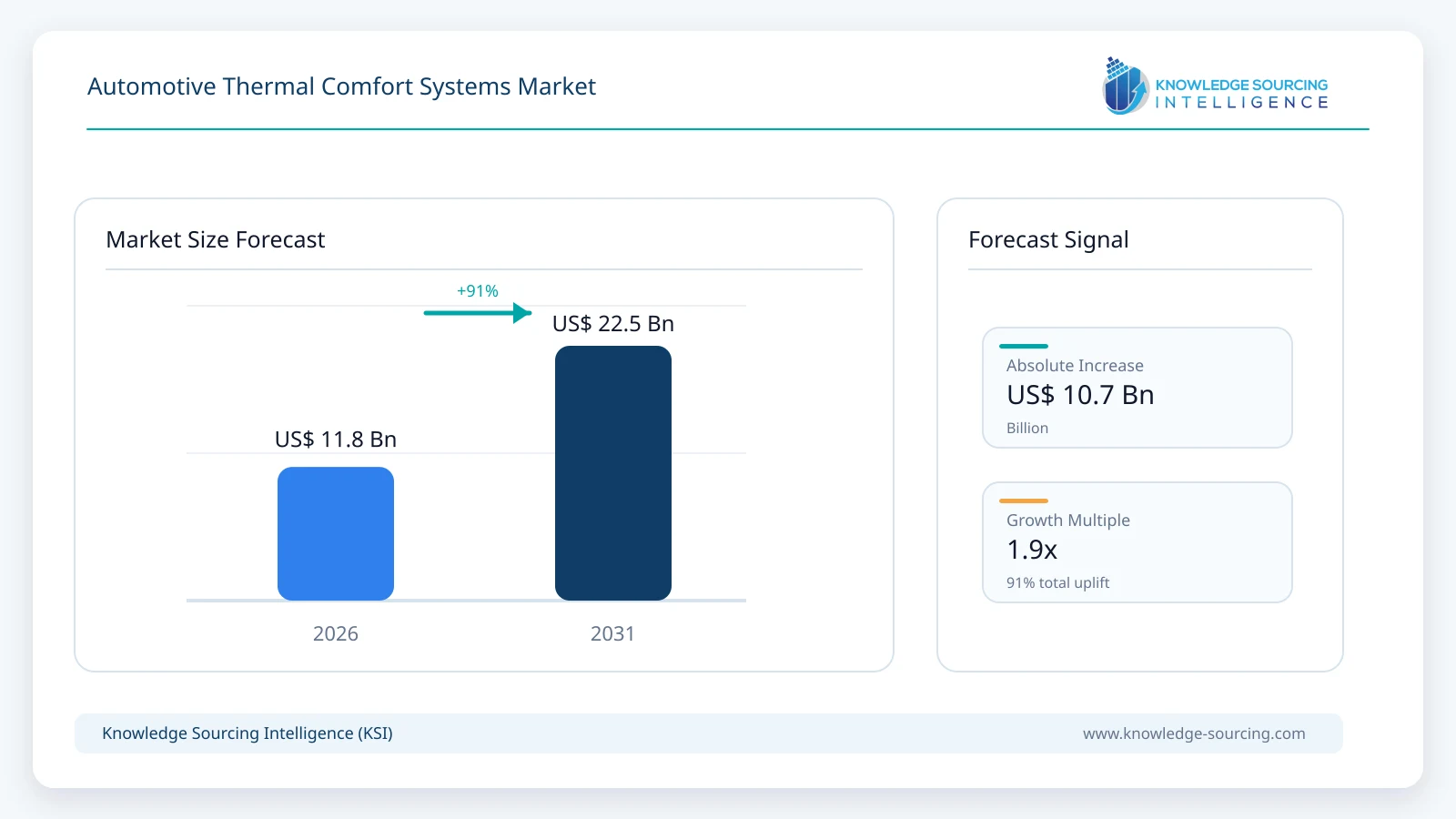
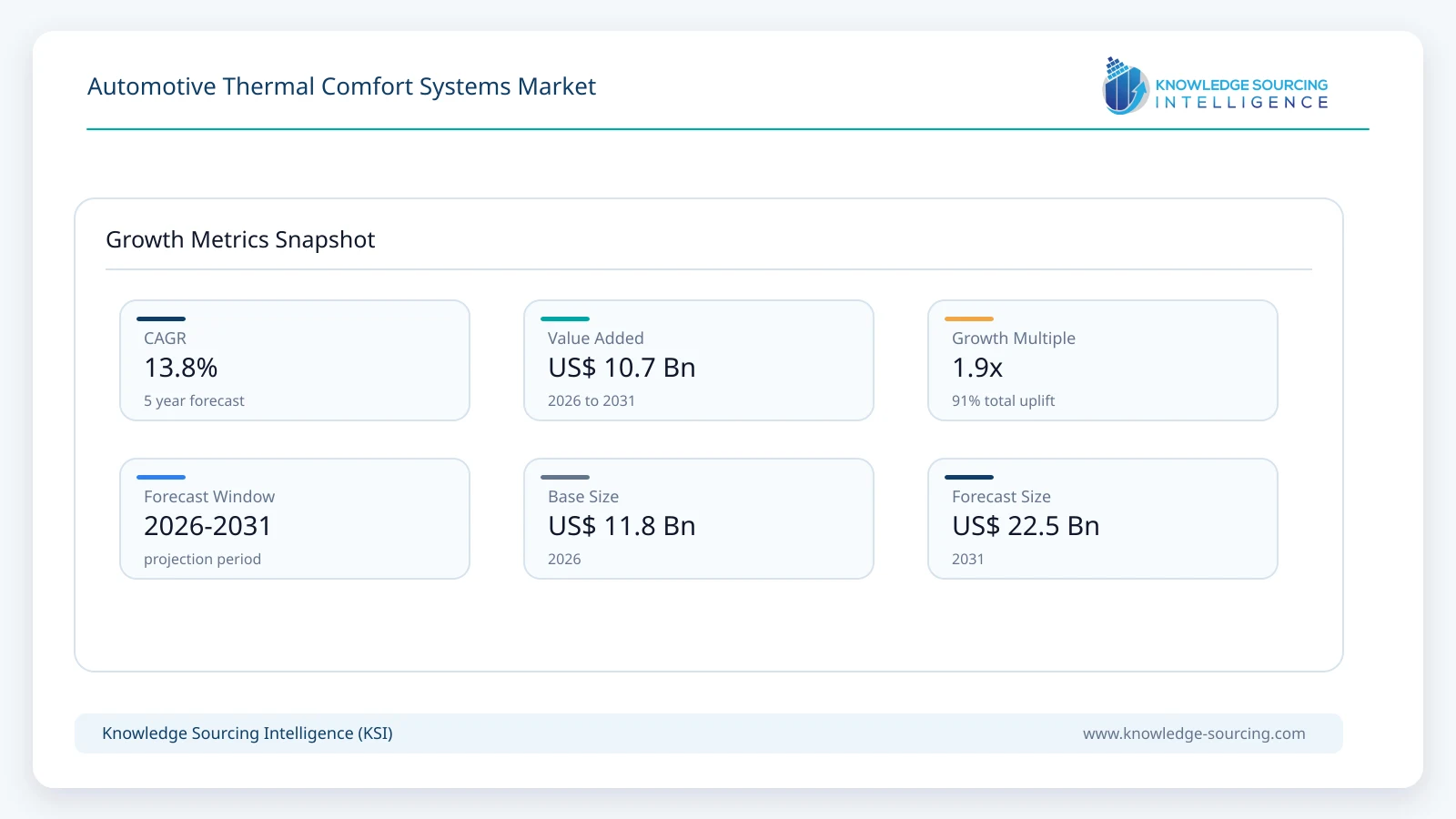
The automotive thermal comfort systems market is projected to expand at a CAGR of 13.8%, increasing from USD 11.8 billion in 2026 to USD 22.5 billion by 2031.
Highlights:
- 1Climate-controlled seating and localized thermal surfaces account for approximately 41% of global market value in 2026 because seat heating, ventilation, active cooling, steering-wheel heating, radiant surfaces and neck conditioning provide direct occupant-level comfort with high content per seating position.
- 2Heating and cold-weather comfort functions represent approximately 46% of market value in 2026, supported by seat and steering-wheel heating, radiant surfaces, heat pumps, cabin preconditioning and growing demand for efficient winter comfort in electric vehicles.
- 3Integrated HVAC-plus-local-effectors architectures account for approximately 54% of 2026 market value as automakers increasingly combine central air conditioning with seat and surface technologies instead of relying on one thermal subsystem.
- 4Premium and luxury vehicles represent approximately 37% of global market value in 2026 because advanced multi-zone HVAC, active seat climate, radiant heating, and thermal personalization remain most concentrated in high-content models.
- 5Battery electric vehicles account for approximately 39% of market value in 2026 because thermal-comfort efficiency directly affects usable driving range and because EV platforms frequently adopt heat pumps, preconditioning and localized thermal technologies.
- 6Asia Pacific represents approximately 43% of global market value in 2026, supported by high vehicle production, rapid EV growth in China and established thermal-management capabilities in Japan and South Korea.
The market includes the systems that directly heat, cool, or thermally condition occupants, ranging from conventional automatic HVAC and heat pumps to climate-controlled seats, radiant surfaces, neck conditioning, targeted airflow, and software that coordinates these functions around real-time thermal demand.
Commercial activity is accelerating across both cabin and seat-based thermal technologies. Gentherm continues to expand Climate Control Seats, Climate Control Interiors and climate-and-comfort electronics; Lear is scaling ComfortFlex, ComfortMax and FlexAir across a growing number of vehicle programs; Valeo is commercializing its AI-enabled Dual Layer HVAC; Hanon Systems is advancing software-defined thermal management; MAHLE has introduced HeatX Range+ for energy-efficient cabin heating; and DENSO combines heat-pump HVAC with personal heating and cooling devices such as seat ventilation and radiant heaters.
The strongest value shift is from uniform cabin conditioning toward hybrid architectures that combine central HVAC with localized thermal effectors. These systems can shorten time-to-comfort, provide different thermal conditions for different occupants, and reduce the energy required to heat or cool unoccupied cabin volume. The opportunity is especially strong in battery electric vehicles, where thermal-comfort energy use can materially affect driving range.
Market Overview
Thermal comfort is determined by more than cabin air temperature. Occupant sensation is affected by air temperature, radiant temperature, airflow, humidity, seat-surface temperature, clothing, and contact with heated or cooled interior surfaces. Automotive thermal comfort systems increasingly manage several of these variables together rather than using HVAC air temperature as the only control target.
Seat-based thermal technologies form the largest dedicated comfort layer. Climate-controlled seats can heat, ventilate or actively cool the occupant at the body interface, while heated steering wheels, armrests, panels, and neck-conditioning systems extend thermal control to other contact or near-body surfaces. Gentherm's product portfolio demonstrates how these functions are moving from isolated seat heaters toward a broader climate-control interior architecture.
Cabin HVAC is also becoming more intelligent. Valeo's Dual Layer HVAC combines a four-zone architecture with AI-based temperature and airflow algorithms, while Hanon Systems is shifting thermal control toward software-coordinated systems that can manage compressors, valves, pumps, blowers, and sensors through a centralized thermal-management driver.
Electrification is accelerating the role of heat pumps and heat recovery. Conventional combustion vehicles can use waste engine heat for cabin warming, whereas electric vehicles must actively generate or recover thermal energy. MAHLE HeatX Range+ recovers heat from cabin exhaust air, illustrating how cabin-comfort design is increasingly linked to whole-vehicle energy efficiency.
The long-term market direction is toward predictive thermal comfort. Occupancy, solar load, ambient conditions, user preference, and vehicle energy state can be combined to decide whether the most efficient response is central HVAC, seat heating, ventilation, radiant heating, or targeted airflow. This increases the software and control value associated with traditional thermal hardware.
Market Trends
Seat and Surface Thermal Systems Are Taking a Larger Share of the Comfort Load
Localized thermal effectors deliver heating or cooling close to the body, allowing occupants to feel comfortable before the entire cabin reaches a uniform temperature. Seat heating, ventilation, radiant surfaces and steering-wheel conditioning are therefore becoming more important elements of overall thermal strategy.
The approach is particularly valuable during vehicle start-up and short trips, when whole-cabin HVAC may consume significant energy before achieving comfort. Suppliers are increasingly designing seat and surface systems to operate as coordinated extensions of central climate control.
Heat Pumps and Heat Recovery Are Becoming Core EV Comfort Technologies
Electric vehicles cannot rely on abundant waste engine heat, making cabin heating a material energy consumer in cold weather. Heat pumps, waste-heat utilization and exhaust-air heat recovery are therefore becoming essential technologies for preserving range while maintaining occupant comfort.
MAHLE's HeatX Range+ illustrates the trend by recovering thermal energy from cabin exhaust air, while DENSO and Hanon Systems offer integrated heat-pump systems that connect cabin comfort with broader vehicle thermal management.
Software-Defined Thermal Management Is Increasing Control Precision
Thermal systems are moving from mechanically dominated subsystems toward software-coordinated networks. Hanon Systems' modular software approach allows compressors, pumps, valves, blowers, and sensors to be controlled through reusable software blocks and centralized logic.
This improves energy optimization and creates a foundation for over-the-air calibration, predictive control, and closer coordination between cabin comfort and battery or powertrain thermal demands.
Multi-Zone and Occupant-Aware Control Are Expanding Beyond Premium Flagships
Dual-zone and four-zone HVAC have become established premium features, but newer systems increasingly adjust airflow and temperature according to actual occupant position and zone demand. Valeo's Dual Layer HVAC is one example of a system that uses AI-driven control to improve comfort while reducing energy use.
As sensing and zonal electronics become less expensive, occupant-aware thermal control is expected to expand into upper-mid and mass-market vehicles, particularly on electrified platforms.
Thermal Comfort Is Being Evaluated as a System-Level Energy Function
Automakers increasingly assess cabin thermal technologies not only by heating or cooling capacity but by how much energy is required to reach and maintain occupant comfort. This favours combinations of central HVAC, seat climate, radiant surfaces and targeted airflow over oversized air-based systems.
The result is a growing need for system-level thermal models and control strategies that select the most efficient actuator for each operating condition rather than running every comfort device independently.
Segment Analysis
By Thermal Comfort Technology: Climate-Controlled Seating and Localized Thermal Surfaces
Climate-controlled seating and localized thermal surfaces are projected to generate approximately USD 9.30 billion of market value by 2031. Growth will be driven by wider adoption of seat heating, ventilation, active cooling, radiant interior surfaces, steering-wheel heating and neck-conditioning systems across premium and upper-mid vehicle classes.
The segment will remain the largest because local effectors influence thermal sensation directly and can reduce the need for aggressive cabin-wide conditioning. Integration with occupant sensing and central HVAC software will further increase content per vehicle.
By Thermal Function: Heating and Cold-Weather Comfort
Heating and cold-weather comfort technologies are projected to generate approximately USD 9.70 billion by 2031. The category includes cabin heating, heat pumps, seat and steering-wheel heating, radiant surfaces, preconditioning, and localized warming technologies designed to reduce cold-start discomfort.
Growth is particularly strong in electric vehicles, where efficient cabin heating has a direct relationship with winter driving range. Heat recovery and localized surface heating are expected to gain share alongside conventional air-based heating.
By System Architecture: Integrated HVAC and Local Thermal Effectors
Integrated HVAC-plus-local-effectors architectures are projected to generate approximately USD 13.0 billion of market value by 2031. These systems combine central air conditioning with seat heating and ventilation, radiant surfaces, targeted airflow, and software-based coordination.
The integrated architecture is gaining share because it can deliver comfort faster and more efficiently than relying solely on central HVAC. It also provides a scalable pathway to occupant-specific thermal zones without duplicating complete HVAC units.
By Vehicle Class: Premium and Luxury Vehicles
Premium and luxury vehicles are projected to generate approximately USD 7.70 billion of thermal-comfort market value by 2031. These vehicles will remain the principal launch platform for active seat cooling, heat pumps, radiant interior heating, dense thermal sensing and multi-zone control.
Cost reduction and modular thermal hardware are expected to move selected technologies, particularly seat ventilation, steering-wheel heating and smarter HVAC control, into broader vehicle classes over the forecast period.
By Propulsion: Battery Electric Vehicles
Battery electric vehicles are projected to generate approximately USD 10.40 billion of market value by 2031. EVs provide the strongest economic case for energy-efficient thermal comfort because cabin heating and cooling directly reduce usable battery energy.
Heat pumps, preconditioning, waste-heat recovery, seat-based thermal comfort and software-controlled zoning will therefore become increasingly integrated into EV thermal architectures through 2031.
Market Drivers
Electrification and the Need to Reduce Cabin-Comfort Energy Consumption
Cabin heating and cooling can represent a significant energy load in electric vehicles, particularly in extreme temperatures. Thermal-comfort systems that use heat pumps, localized heating and cooling, preconditioning, and smart zoning can reduce the amount of energy required to maintain occupant comfort.
This gives thermal-comfort technology a direct role in vehicle efficiency and range optimization rather than treating it only as a convenience feature.
Growth of Climate-Controlled Seats and Localized Thermal Surfaces
Seat heating, ventilation, and active cooling are expanding beyond traditional luxury applications. Radiant panels, steering-wheel heating, and other contact surfaces further improve time-to-comfort without requiring the entire cabin to reach the same temperature.
The increasing availability of modular seat thermal systems is lowering integration complexity and creating additional content per seating position.
Vehicle Premiumization and Rising Expectations for All-Season Comfort
Consumers increasingly expect rapid heating in winter, effective seat ventilation in summer and stable comfort across different seating positions. Premium EVs and SUVs are intensifying competition around these features and accelerating their migration into lower segments.
Thermal comfort is experienced on every journey, giving automakers a strong incentive to use it as a repeatable quality and brand-differentiation attribute.
Software-Defined Vehicle and Centralized Thermal Control Architectures
Centralized controllers can coordinate compressors, blowers, pumps, valves, HVAC zones, seat climate and sensors through common software. This enables predictive energy management, adaptive comfort and over-the-air optimization.
The shift toward software-defined vehicles therefore increases the value of thermal control algorithms and reduces dependence on fixed mechanical calibration.
Advances in Heat Pumps, Sensors and Thermal-Comfort Modelling
Improved heat-pump efficiency, compact valves, better temperature and humidity sensing and more sophisticated human thermal models allow systems to achieve comfort with lower energy use. Suppliers can increasingly control thermal sensation rather than simply maintaining a fixed air-temperature set point.
These technologies make it practical to optimize comfort dynamically across seasons, occupant loads, and vehicle operating conditions.
Market Restraints
High Hardware Cost and Integration Complexity
Advanced thermal comfort can require heat pumps, additional valves, seat blowers, heating elements, radiant panels, sensors and electronic controllers. The resulting cost can limit adoption in value-oriented vehicle segments.
Broader deployment depends on modular systems and shared control electronics that reduce component count and allow multiple comfort functions to use the same architecture.
Energy Savings Depend on Accurate System Coordination
Localized thermal systems can reduce central HVAC demand, but seat blowers, pumps and additional heating elements also consume power. Poorly coordinated systems may therefore lose part of the expected efficiency benefit.
Effective thermal control requires software to decide when local or central conditioning is the more efficient option and to deactivate unnecessary zones automatically.
Thermal Comfort Is Highly Subjective
Occupants differ in body size, clothing, age, metabolism and thermal preference. Solar load and seating position can also create substantial variation inside the same vehicle.
Automakers therefore need broad human-subject testing and adaptive calibration, increasing development complexity and making one global comfort target difficult to define.
Packaging Constraints for Distributed Thermal Hardware
Seat ventilation ducts, blowers, radiant heaters, heat exchangers and additional valves compete for limited space in seats, instrument panels and consoles. Packaging becomes more challenging as seats become thinner, lighter and more reconfigurable.
Suppliers must reduce component size and integrate multiple thermal functions into common modules to preserve interior space and seating flexibility.
Refrigerant, Reliability and Serviceability Requirements
Heat pumps and advanced HVAC architectures add refrigerant circuits, valves and controls that must operate reliably across wide temperature ranges. Natural refrigerants and lower-GWP alternatives can also require new component designs and service procedures.
Long-term adoption depends on balancing efficiency gains with durability, cost, leakage control and serviceability over the vehicle lifecycle.
Regional Outlook
Asia Pacific
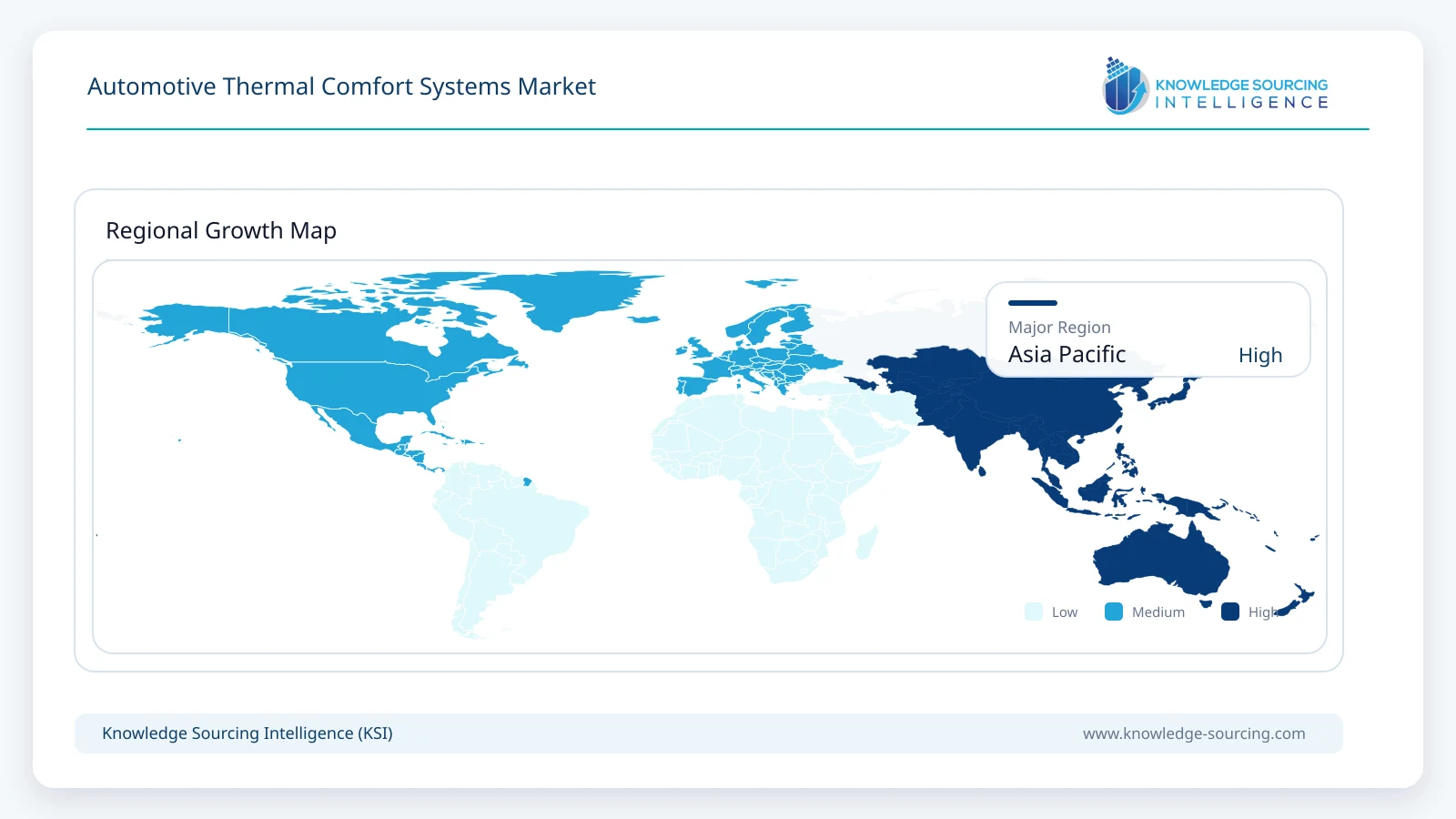
Asia Pacific is the largest regional market and is expected to remain the strongest growth centre through 2031. China is rapidly increasing thermal-comfort content in premium and upper-mid EVs, while Japan and South Korea provide deep expertise in HVAC, heat pumps, seating and integrated thermal-management systems.
Valeo has secured multiple Dual Layer HVAC contracts with Chinese automakers, while Hanon Systems and DENSO provide broad thermal-management portfolios spanning cabin HVAC, heat pumps and localized comfort technologies. Strong regional EV growth is accelerating demand for systems that improve comfort without sacrificing driving range.
Growth will be supported by high vehicle production, rapid electrification and strong consumer expectations for feature-rich smart cabins. Suppliers that combine competitive cost with energy-efficient comfort and software scalability are positioned to capture the largest regional opportunity.
Europe
Europe is a major high-value market because premium automakers and thermal-management suppliers continue to emphasize energy-efficient comfort, heat-pump integration and lower-emission refrigerants. Gentherm, Lear, Valeo and MAHLE all maintain significant European development and customer activity.
Lear is expanding ComfortFlex and related modular thermal technologies across European programs, while MAHLE's HeatX Range+ targets lower EV cabin-heating energy demand through exhaust-air heat recovery. European electrification and stringent efficiency targets create a strong commercialization pathway for advanced thermal comfort.
Growth through 2031 will depend on proving measurable efficiency gains, maintaining rapid time-to-comfort and integrating advanced thermal hardware into increasingly centralized vehicle architectures.
Competitive Landscape
The automotive thermal comfort systems market includes cabin HVAC, seating, thermal-management and control-system suppliers that directly influence occupant temperature and thermal sensation. Gentherm, Lear, Valeo, Hanon Systems, MAHLE and DENSO are directly active across climate-controlled seating, heat pumps, intelligent HVAC, localized heating and cooling, heat recovery and thermal-control software.
Gentherm is differentiated by Climate Control Seats, Climate Control Interiors and related electronics, while Lear is scaling modular thermal systems including ComfortFlex and ComfortMax. Valeo combines high-efficiency HVAC with AI-based multi-zone control, and Hanon Systems is developing software-defined thermal-management architectures for future vehicles.
MAHLE contributes cabin heating and heat-recovery innovation, while DENSO combines HVAC, heat pumps, radiant heaters and seat ventilation. Competition is increasingly shifting toward suppliers that can coordinate central and localized thermal technologies while demonstrating measurable comfort and energy benefits.
Recent Developments
12 August 2026: Hanon Systems was named a finalist for the 2026 Automotive News PACE Awards for its Highly Integrated Cooling Entity, reinforcing the company's next-generation integrated thermal-management and energy-efficiency strategy.
31 July 2026: Lear reported significant new and conquest awards with Audi for complete seats, ComfortFlex and FlexAir in Europe and North America and noted that its modular thermal comfort systems were finalists for the 2026 Automotive News PACE Awards.
23 July 2026: Gentherm reported USD 690 million of automotive new-business awards in the second quarter and 14.1% year-over-year growth in Automotive Climate and Comfort Solutions revenue.
26 May 2026: Hanon Systems outlined its 2030 growth strategy, including stronger software capabilities for software-defined vehicles alongside next-generation automotive thermal-management development.
1 May 2026: Lear reported new ComfortFlex awards with Audi and BMW and a ComfortMax Seat award with Geely, expanding global adoption of modular thermal-comfort technologies.
30 April 2026: Hanon Systems reported that it was expanding AI-integrated thermal-management solutions and software capabilities across future vehicle platforms.
19 February 2026: Gentherm reported 2025 Automotive Climate and Comfort Solutions revenue of more than USD 1.2 billion, including Climate Control Seats, Climate Control Interiors and related comfort electronics.
9 February 2026: MAHLE introduced HeatX Range+, a cabin heat-recovery system designed to reduce EV air-conditioning energy demand by approximately 20% while maintaining thermal comfort and interior air quality.
Market Outlook
The automotive thermal comfort systems market is expected to expand steadily through 2031 as cabin heating and cooling become more localized, software-controlled, and closely linked with vehicle energy management. Climate-controlled seating and local thermal surfaces will remain the largest dedicated value pool, while heat pumps, heat recovery and integrated architectures gain share.
The market will increasingly move from air-temperature control toward direct management of occupant thermal sensation. Vehicles will use occupancy, solar load, ambient conditions, user preference and energy availability to select the most efficient mix of HVAC airflow, seat climate and radiant heating.
Asia Pacific is expected to retain the largest regional share, while Europe remains a major premium engineering market. Competitive advantage will depend on rapid time-to-comfort, measurable efficiency, scalable localized hardware, and strong thermal-control software.
Automotive Thermal Comfort Systems Market Scope:
| Report Metric | Details |
|---|---|
| Total Market Size in 2026 | USD 11.8 billion |
| Total Market Size in 2031 | USD 22.5 billion |
| Forecast Unit | USD Billion |
| Growth Rate | 13.8% |
| Study Period | 2021 to 2031 |
| Historical Data | 2021 to 2024 |
| Base Year | 2025 |
| Forecast Period | 2026 – 2031 |
| Segmentation | Thermal Comfort Technology, Thermal Function, System Architecture, Vehicle Class |
| Companies |
|
Market Segmentation
By Thermal Comfort Technology
Climate-Controlled Seating and Localized Thermal Surfaces
Cabin HVAC and Multi-Zone Air Conditioning
Radiant and Infrared Heating Systems
Heat Pumps and Cabin Heat-Recovery Systems
Thermal Sensors, Controllers and Software
By Thermal Function
Heating and Cold-Weather Comfort
Cooling and Hot-Weather Comfort
Ventilation and Moisture Management
Adaptive All-Season Thermal Comfort
By System Architecture
Integrated HVAC and Local Thermal Effectors
Central HVAC-Led Comfort Systems
Seat and Surface-Led Thermal Comfort Systems
By Vehicle Class
Premium and Luxury Vehicles
Mid-Range Vehicles
Mass-Market and Economy Vehicles
By Propulsion
Battery Electric Vehicles
Hybrid and Plug-in Hybrid Electric Vehicles
Internal Combustion Engine Vehicles
Fuel Cell Electric Vehicles
By Geography
North America
United States
Canada
Mexico
South America
Brazil
Argentina
Others
Europe
Germany
United Kingdom
France
Italy
Spain
Others
Middle East and Africa
Saudi Arabia
UAE
South Africa
Others
Asia Pacific
China
Japan
South Korea
India
Singapore
Others
Table of Contents
1. INTRODUCTION
1.1. Market Overview
1.2. Market Definition
1.3. Scope of the Study
1.4. Market Segmentation
1.5. Currency
1.6. Assumptions
1.7. Base and Forecast Years
1.8. Key Benefits to Stakeholders
2. RESEARCH METHODOLOGY
2.1. Research Design
2.2. Secondary Research
2.3. Primary Research
2.4. Market Estimation
2.5. Segment Modelling
2.6. Data Triangulation and Validation
3. EXECUTIVE SUMMARY
3.1. Key Findings
3.2. Automotive Thermal Comfort Systems Market Size, 2026-2031
3.3. Thermal Comfort Technology Outlook
3.4. Thermal Function Outlook
3.5. System Architecture Outlook
3.6. Vehicle Class Outlook
3.7. Propulsion Outlook
3.8. Regional Opportunity Summary
4. MARKET DYNAMICS
4.1. Market Drivers
4.1.1. Electrification and the Need to Reduce Cabin-Comfort Energy Consumption
4.1.2. Growth of Climate-Controlled Seats and Localized Thermal Surfaces
4.1.3. Vehicle Premiumization and Rising Expectations for All-Season Comfort
4.1.4. Software-Defined Vehicle and Centralized Thermal Control Architectures
4.1.5. Advances in Heat Pumps, Sensors and Thermal-Comfort Modelling
4.2. Market Restraints
4.2.1. High Hardware Cost and Integration Complexity
4.2.2. Energy Savings Depend on Accurate System Coordination
4.2.3. Thermal Comfort Is Highly Subjective
4.2.4. Packaging Constraints for Distributed Thermal Hardware
4.2.5. Refrigerant, Reliability and Serviceability Requirements
4.3. Market Opportunities
4.4. Porter's Five Forces Analysis
4.5. Industry Value Chain Analysis
4.6. Thermal Comfort System Economics
4.7. Energy-Efficiency, Refrigerant and Human-Factors Environment
5. TECHNOLOGY OUTLOOK
5.1. Automatic and Multi-Zone HVAC
5.2. Climate-Controlled Seating and Active Seat Cooling
5.3. Steering-Wheel, Armrest and Contact-Surface Heating
5.4. Radiant and Infrared Interior Heating
5.5. Localized Airflow and Neck Conditioning
5.6. Heat-Pump Cabin Heating
5.7. Cabin Heat Recovery and Waste-Heat Utilization
5.8. Temperature, Humidity and Solar-Load Sensing
5.9. Thermophysiology-Based Comfort Modelling
5.10. Predictive Thermal Control and Energy Optimization
5.11. Thermal Controllers, Zonal ECUs and Software Integration
6. AUTOMOTIVE THERMAL COMFORT SYSTEMS MARKET BY THERMAL COMFORT TECHNOLOGY
6.1. Introduction
6.2. Climate-Controlled Seating and Localized Thermal Surfaces
6.3. Cabin HVAC and Multi-Zone Air Conditioning
6.4. Radiant and Infrared Heating Systems
6.5. Heat Pumps and Cabin Heat-Recovery Systems
6.6. Thermal Sensors, Controllers and Software
7. AUTOMOTIVE THERMAL COMFORT SYSTEMS MARKET BY THERMAL FUNCTION
7.1. Introduction
7.2. Heating and Cold-Weather Comfort
7.3. Cooling and Hot-Weather Comfort
7.4. Ventilation and Moisture Management
7.5. Adaptive All-Season Thermal Comfort
8. AUTOMOTIVE THERMAL COMFORT SYSTEMS MARKET BY SYSTEM ARCHITECTURE
8.1. Introduction
8.2. Integrated HVAC and Local Thermal Effectors
8.3. Central HVAC-Led Comfort Systems
8.4. Seat and Surface-Led Thermal Comfort Systems
9. AUTOMOTIVE THERMAL COMFORT SYSTEMS MARKET BY VEHICLE CLASS
9.1. Introduction
9.2. Premium and Luxury Vehicles
9.3. Mid-Range Vehicles
9.4. Mass-Market and Economy Vehicles
10. AUTOMOTIVE THERMAL COMFORT SYSTEMS MARKET BY PROPULSION
10.1. Introduction
10.2. Battery Electric Vehicles
10.3. Hybrid and Plug-in Hybrid Electric Vehicles
10.4. Internal Combustion Engine Vehicles
10.5. Fuel Cell Electric Vehicles
11. AUTOMOTIVE THERMAL COMFORT SYSTEMS MARKET BY GEOGRAPHY
11.1. North America
11.1.1. United States
11.1.2. Canada
11.1.3. Mexico
11.2. South America
11.2.1. Brazil
11.2.2. Argentina
11.2.3. Others
11.3. Europe
11.3.1. Germany
11.3.2. United Kingdom
11.3.3. France
11.3.4. Italy
11.3.5. Spain
11.3.6. Others
11.4. Middle East and Africa
11.4.1. Saudi Arabia
11.4.2. UAE
11.4.3. South Africa
11.4.4. Others
11.5. Asia Pacific
11.5.1. China
11.5.2. Japan
11.5.3. South Korea
11.5.4. India
11.5.5. Singapore
11.5.6. Others
12. COMPETITIVE ENVIRONMENT AND ANALYSIS
12.1. Major Players and Strategy Analysis
12.2. Market Share Analysis
12.3. Thermal Comfort Technology Benchmarking
12.4. Product Launches and Development Activity
12.5. Competitive Dashboard
13. COMPANY PROFILES
13.1. Gentherm Incorporated
13.2. Lear Corporation
13.3. Valeo
13.4. Hanon Systems
13.5. MAHLE GmbH
13.6. DENSO Corporation
14. APPENDIX
14.1. Currency
14.2. Assumptions
14.3. Base and Forecast Years Timeline
14.4. Key Benefits for Stakeholders
14.5. Research Methodology
14.6. Abbreviations
14.7. Data Sources
Navigate
Trusted by the world's leading organizations











