
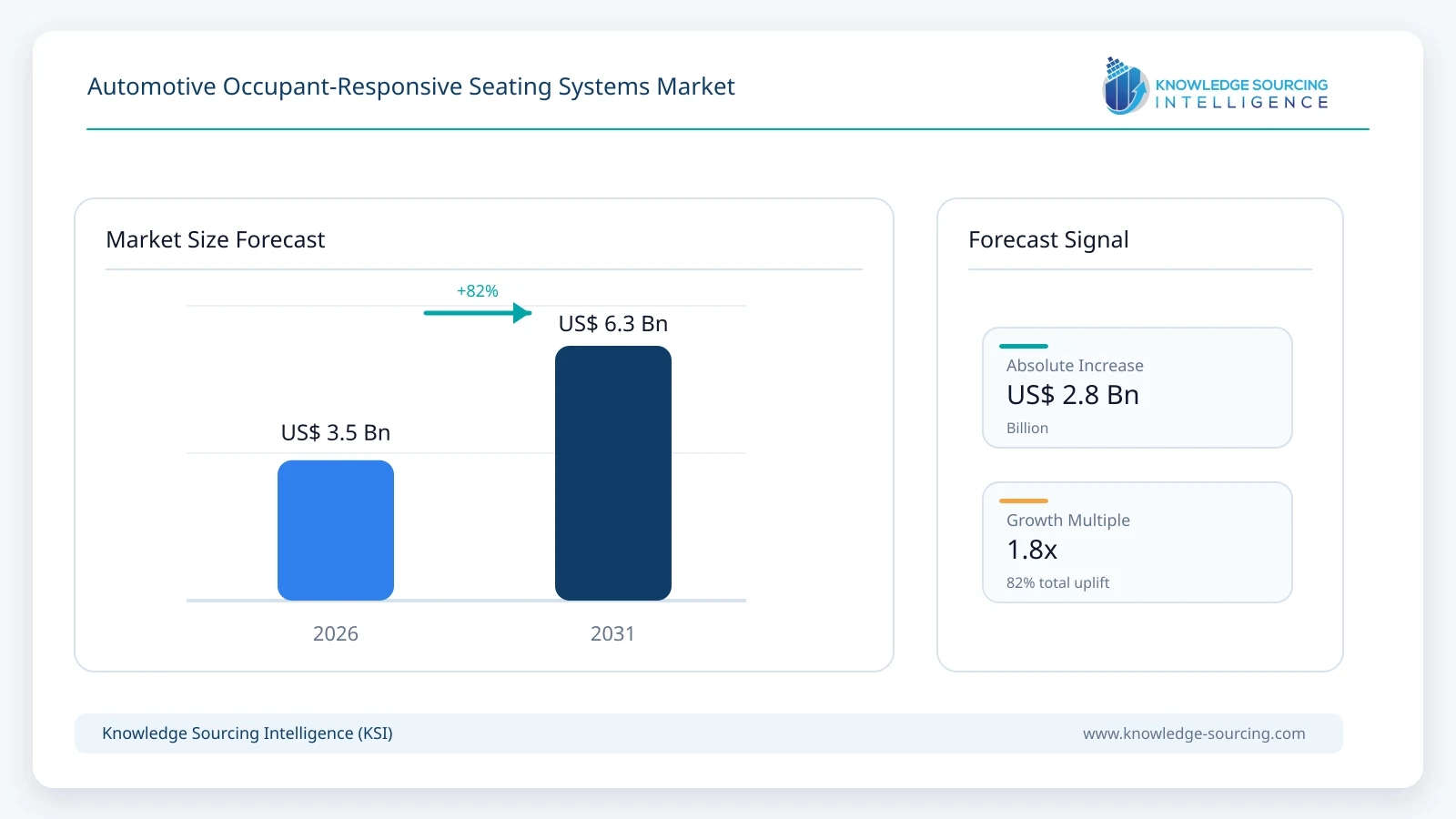
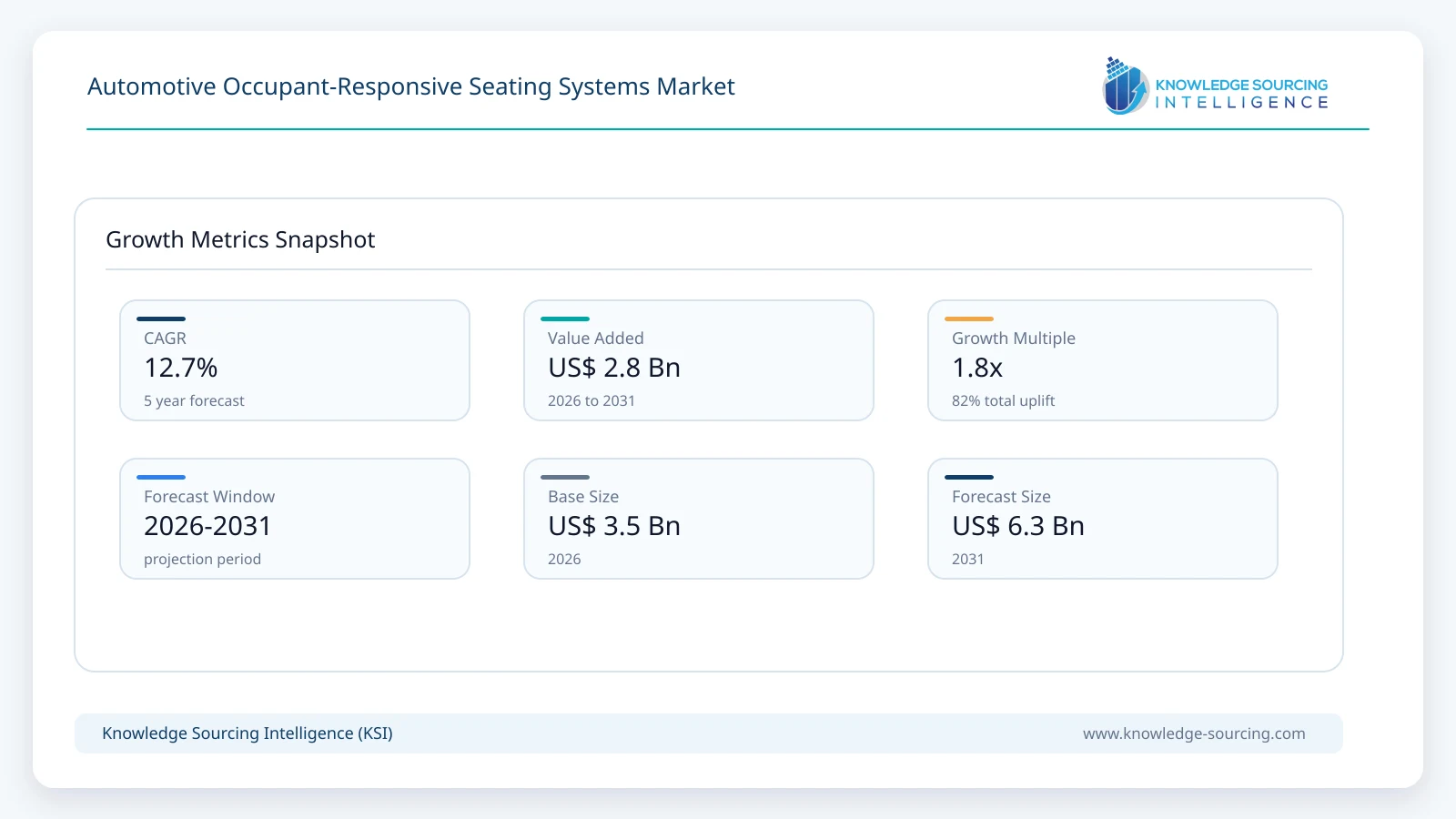
The automotive occupant-responsive seating systems market is forecast to grow at a CAGR of 12.7%, reaching approximately USD 6.28 billion in 2031 from USD 3.46 billion in 2026.
Highlights:
- 1Adaptive positioning and support accounts for approximately 37.5% of global market value in 2026, supported by established power-seat, lumbar, bolster and pneumatic actuation platforms that can be upgraded with sensing and automatic control.
- 2Pressure and force sensing represents approximately 37.0% of market value in 2026 because direct measurement of occupant loading provides a practical basis for posture, body-position and support adjustment.
- 3Passenger cars account for approximately 92.5% of market value in 2026 as premium cars, SUVs, crossovers and higher-content electric vehicles lead adoption of responsive comfort and safety features.
- 4Battery electric vehicles represent approximately 28.0% of market value in 2026, reflecting their relatively high electronic content and the engineering value of localized occupant thermal management.
- 5OEM installations account for approximately 96.5% of market value in 2026 because responsive seating normally requires platform-specific integration with seat structures, ECUs, vehicle networks and restraint systems.
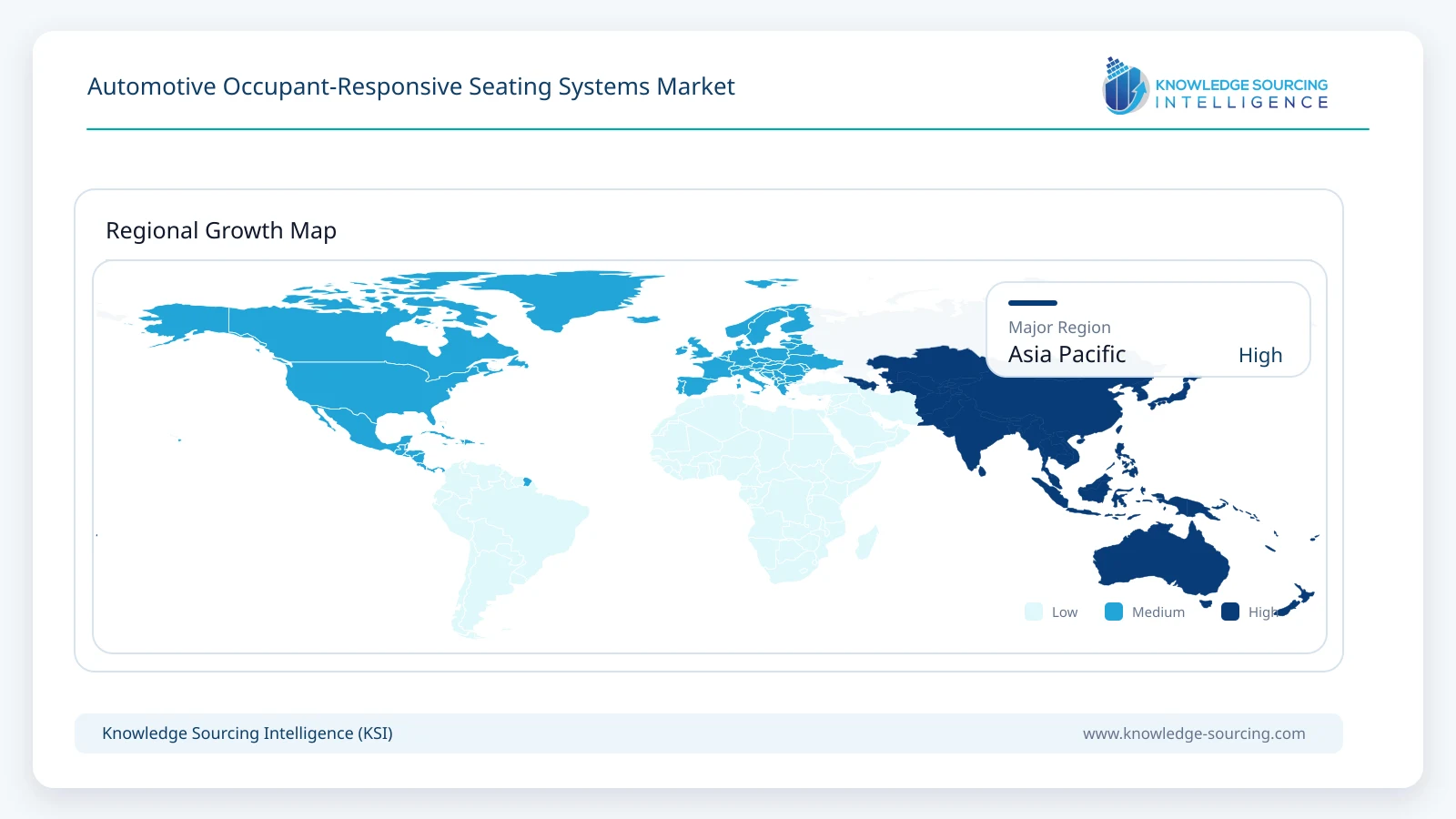
- 6Asia Pacific represents approximately 45.5% of global market value in 2026, supported by the region’s large automotive production base, rapid EV adoption and strong competition around intelligent cabin features.
Adoption is being driven by seating systems that use occupant and vehicle information to automatically modify support, position, thermal comfort, wellness functions or safety posture.
Responsive seating is progressing toward coordinated systems that combine sensing, control software and seat actuation. Current applications include automatic bolster and lumbar adjustment, posture support, software-regulated seat microclimate, fatigue-management functions and predictive repositioning linked to occupant safety.
Market growth is being supported by increasing integration of sensing, control electronics, pneumatic and electromechanical actuation, localized thermal management and software within automotive seating systems. OICA reported global motor-vehicle production of 96.4 million units in 2025, up from 92.7 million in 2024, while seat suppliers are expanding adaptive comfort and occupant-response functionality across a growing range of OEM programs.
Automotive occupant-responsive seating systems convert the seat from a passive or manually controlled interior component into an active vehicle subsystem. The defining feature is automatic response. Sensors or vehicle-state inputs identify an occupant condition or driving situation, control software interprets the information, and one or more seat functions respond without requiring the occupant to manually select every adjustment.
Magna provides a clear example through its Real Time Pressure Sensing and Auto Adjust technology. The company states that the system obtains real-time occupant pressure data and automatically adjusts seating features toward an optimized comfort position. Its technical material also identifies applications including automatic seat-comfort adjustment, anti-fatigue and discomfort mitigation, driving-mode adaptation and posture detection using machine-learning algorithms.
FORVIA has moved in a similar direction with its Transformer Seat and intelligent-seat architecture. The company describes an advanced sensor-based system capable of automatically adjusting up to ten parameters according to occupant morphology and driving conditions. The concept combines postural monitoring, pneumatics, massage, lumbar adjustment, software and AI, illustrating how future seat value is likely to be concentrated in integrated systems rather than isolated hardware features.
Hyundai Transys and TS TECH also demonstrate the widening competitive field. Hyundai Transys describes intelligent seats that automatically search for appropriate seating positions and includes smart posture support and driving-condition-linked bolster functions in its product portfolio. TS TECH is developing a Health Care Seat that recognizes posture, uses air cells to encourage improved seating alignment and combines sensing with automated seat-based intervention.
Thermal response forms another important part of the market. Gentherm manufactures climate-control seats, climate-control interior systems, lumbar and massage comfort solutions and associated electronics. Its ClimateSense architecture is designed around localized heating and cooling, software and occupant-centric control, providing a direct commercialization pathway for thermal-response seating as OEMs increase focus on individualized comfort and energy efficiency.
Market Trends
Closed-Loop Personalization Is Replacing Simple Memory Functions
Conventional memory seats reproduce a stored configuration. Occupant-responsive systems move beyond this model by continuously interpreting pressure, posture, body dimensions, driving conditions or learned user preferences and modifying the seat as conditions change. This shift is important because an occupant’s optimal support requirement is not fixed throughout a journey.
Yanfeng’s XiM27 illustrates the direction of travel. Its AI-adaptive seating automatically adjusts seat position, firmness and temperature based on learned user preferences, while a centralized domain controller links seating with climate, infotainment and other interior systems. This architecture moves seat personalization away from independent feature switches toward coordinated cabin-level intelligence.
Localized Thermal Management Is Becoming More Strategic in EVs
Electric vehicles increase the value of delivering comfort directly to the occupant. Heating or cooling the entire cabin can create a material energy load, particularly in extreme ambient conditions, whereas seat-level thermal systems act closer to the body. The commercial opportunity therefore extends beyond premium comfort and into energy-management strategy.
The International Energy Agency’s Global EV Outlook 2026 expects electric-car sales to reach approximately 23 million units in 2026. Subsequent IEA tracking raised the expected global electric-car sales share for 2026 to approximately 29%. As electric powertrains increase their share of the vehicle mix, seat-integrated thermal control and software-coordinated microclimate systems gain a broader addressable platform base.
Pressure Sensing Is Evolving Toward Multi-Sensor Fusion
Pressure and force sensing remain a practical foundation because they directly measure how an occupant loads the seat. The next stage is the combination of pressure data with position sensing, thermal signals, biometric information, cameras, cabin radar and vehicle-state inputs. Sensor fusion allows the seat controller to distinguish between posture, fatigue, body size, driving mode and safety conditions rather than responding to a single signal.
This transition supports higher-value software content. The same physical seat can apply different control strategies depending on the occupant profile and operating context. It also makes centralized seat ECUs and integrated domain controllers more important, because control decisions increasingly require information from outside the seat itself.
Wellness Functions Are Expanding Beyond Conventional Massage
Automotive wellness is shifting from manually selected massage toward posture management, fatigue reduction and automated support. TS TECH’s Health Care Seat measures posture through seat-integrated sensing and uses multiple air cells to encourage improved alignment. Hyundai Transys offers smart posture support and functions that automatically activate pneumatic support after extended driving.
These systems broaden the commercial role of pneumatics. Air cells can support lumbar adjustment, bolster control, massage, posture correction and body-pressure management from a common underlying technology platform. This enables suppliers to offer multiple functions while controlling packaging complexity.
Safety Is Becoming Integrated with Highly Adjustable Seating
Deep-recline, zero-gravity and autonomous-driving seating concepts create new occupant-protection requirements because conventional restraint systems are generally optimized around more traditional seat positions. Future responsive seats may therefore need to alter occupant position or restraint geometry based on predicted vehicle events.
Adient and Autoliv’s Z-Guard development demonstrates this convergence. The system combines active seat architecture with restraint technologies intended for deeply reclined occupants and includes predictive seat repositioning. The direction is strategically important because advanced comfort features cannot be commercialized at scale if safety performance deteriorates outside conventional seating postures.
Market Drivers
Increasing Electronic and Software Content per Vehicle
The underlying vehicle market is mature, so growth increasingly depends on broader adoption of advanced responsive-seat functions. Seat ECUs, pressure sensors, pneumatic modules, additional actuators, localized climate hardware and software are enabling more sophisticated responsive seating architectures across a growing range of vehicle programs.
OICA reported 96.4 million vehicles produced globally in 2025. Occupant-responsive seating is expected to expand faster than total vehicle production as advanced seat functions are adopted across a broader range of premium, electrified and high-content vehicle programs.
Premiumization of Cabin Comfort
Automakers increasingly use cabin technology to differentiate premium vehicles and high-content trims. Advanced seats provide a highly visible user benefit because passengers directly experience posture, support, massage, temperature and recline functions throughout a journey.
Competitive pressure is particularly strong in premium EVs and large SUVs, where multiple seating modes and rear-passenger comfort packages have become important selling points. Automated response allows OEMs to position these features as intelligent systems rather than as collections of independent switches.
EV Energy-Efficiency Requirements
Localized heating and cooling can reduce dependence on whole-cabin HVAC and improve perceived comfort more quickly. This makes seat-level thermal management strategically relevant to EVs, especially where range and energy consumption remain major purchase considerations.
The IEA expects electric vehicles to continue gaining share across China, Europe and other Asian markets through the forecast period. This provides a growing platform base for integrated seat microclimate systems and occupant-centric thermal-control algorithms.
Software-Defined Vehicle Architectures
Centralized controllers and higher-bandwidth vehicle networks allow seating systems to access cabin, ADAS and user-profile data that historically remained isolated. This supports more complex automatic responses and enables software updates to change seat behaviour without redesigning the complete mechanical system.
Yanfeng’s XiM27 uses a centralized domain controller to connect seating, climate, infotainment and other interior systems. FORVIA likewise highlights software and AI as part of its intelligent-seat architecture. These developments reinforce software capability as a competitive requirement rather than a peripheral feature.
Safety Requirements for Flexible Seating Positions
As seat travel, recline and rotation increase, safety systems must account for a wider range of occupant positions. Responsive seating can contribute by moving occupants toward safer positions or coordinating seat geometry with restraint deployment.
The opportunity is most relevant to high-end vehicles, autonomous-driving concepts and zero-gravity seating configurations. Suppliers that combine seat structures, electronics and restraint knowledge are better positioned to commercialize these features at production scale.
Market Restraints
High Incremental System Cost
Responsive seating requires sensors, control electronics, software, actuators, wiring or network connectivity and platform-specific calibration. The combined bill of materials can be difficult to justify in entry-level vehicles where consumers remain highly price sensitive.
Cost pressure is likely to keep early adoption concentrated in premium and higher-trim vehicles. Suppliers must therefore reuse hardware and software across platforms to reduce the incremental cost of adding responsive functionality.
Calibration and Occupant Variability
Pressure distribution, preferred posture and thermal comfort differ materially between occupants. Seat foam, trim construction and geometry can also influence sensor readings. Automatic adjustment must therefore work across a wide range of body sizes and seating behaviours without creating discomfort.
This raises the importance of validation datasets, robust algorithms and fail-safe limits. A system that performs well for a narrow set of test occupants may not deliver consistent real-world value across a global vehicle program.
Long OEM Development and Qualification Cycles
Automotive seats are developed around individual vehicle programs and must satisfy durability, crashworthiness, packaging, noise and quality requirements. New responsive functions therefore face multi-year engineering and validation cycles before reaching mass production.
The gap between a concept demonstration and a production award can be significant, slowing commercialization of technologies that have not yet secured a credible route to serial production.
Functional-Safety and Restraint Integration Complexity
Seat movement becomes more difficult to validate when it is linked with active or passive safety. UN seat and restraint regulations, OEM crash requirements and ISO 26262 functional-safety processes increase engineering complexity for systems that automatically change occupant position.
The challenge is particularly important for deep-recline and zero-gravity configurations, where restraint geometry can differ substantially from the conventional upright seating position.
Substitution by Centralized Cabin Sensing
Not every responsive function requires a dedicated sensor inside the seat. Camera and radar systems can increasingly identify occupant presence, posture and body characteristics from elsewhere in the cabin. This may reduce the value captured by standalone in-seat sensing suppliers.
The effect does not eliminate the responsive-seat opportunity, because actuation and control remain necessary, but it can shift value toward domain controllers and shared cabin-sensing systems. Seat suppliers therefore need architectures that can consume external sensor data as well as seat-integrated inputs.
Segment Analysis
By Response Function: Adaptive Positioning & Support
Adaptive positioning and support is the principal response-function category because powered seat mechanisms, lumbar systems, bolsters and pneumatic support already provide an established actuation base. Adding pressure sensing, posture recognition and software control allows suppliers to convert these mature components into automated comfort systems.
The segment is projected to reach approximately USD 2.135 billion by 2031. Growth is supported by automatic posture optimization, driving-mode-linked support, adaptive bolsters and software-controlled lumbar functions. Magna, FORVIA, Hyundai Transys and TS TECH all demonstrate direct product-development activity in this area.
By Sensing Technology: Pressure/Force Sensing
Pressure and force sensing is the most established sensing approach for occupant-responsive seating because it provides direct information about loading, body position and pressure distribution at the seat surface. Thin sensor arrays can be integrated within the cushion or backrest with relatively limited impact on package dimensions.
The segment is projected to reach approximately USD 2.010 billion by 2031. Its commercial role increasingly shifts from standalone pressure measurement toward use as one input within broader software and sensor-fusion architectures, particularly for posture recognition, fatigue mitigation and automatic support control.
By Vehicle Type: Passenger Cars
Passenger cars form the principal vehicle-type market because advanced seating functions are concentrated in premium cars, SUVs, crossovers, executive rear-seat packages and higher-content electric vehicles. These platforms provide the strongest willingness to pay for adaptive comfort, wellness, microclimate and deeply reclining seating systems.
The passenger-car segment is projected to reach approximately USD 5.652 billion by 2031. Commercial-vehicle adoption is increasing, particularly in driver seats with automatic weight adjustment and active comfort functions, but passenger vehicles remain the central platform for multi-function occupant-responsive architectures.
By Propulsion: Battery Electric Vehicles
Battery electric vehicles provide a favorable platform for responsive seating because they typically contain advanced electronic architectures and place greater emphasis on software-defined cabin experiences. Localized thermal management also has a stronger engineering rationale where heating and cooling loads affect available battery energy.
The battery-electric-vehicle segment is projected to reach approximately USD 2.575 billion by 2031. Growth is reinforced by expanding EV production, premium interior competition among electric-vehicle manufacturers and increasing use of centralized electronics to coordinate seating, climate and other cabin functions.
By Sales Channel: OEM
OEM installation is structurally dominant because responsive seating requires close integration with seat structures, vehicle electrical architecture, software, restraint systems and validation processes. Automatic movement and safety-related functions are difficult to retrofit without access to vehicle-level data and engineering controls.
The OEM segment is projected to reach approximately USD 6.104 billion by 2031. The market therefore depends heavily on program awards secured several years before production, making OEM relationships, platform reuse and validation capability central competitive advantages for seat suppliers.
By Geography: Asia Pacific
Asia Pacific is the most important regional market because it combines the world's largest automotive manufacturing base with rapid EV adoption and intense competition around digital and comfort features. China provides the largest production and commercialization base, while Japan and South Korea retain major seating and automotive-electronics capabilities.
The regional market is projected to reach approximately USD 3.140 billion by 2031. China is the main growth engine, while Japan and South Korea retain major seating and component capabilities. India and Southeast Asia add longer-term opportunity as local vehicle production and higher-content passenger-vehicle penetration expand.
Regional Outlook
Asia Pacific
Asia Pacific is the dominant regional market and the principal growth centre for occupant-responsive seating. The region combines the world's largest automotive production base with rapid electric-vehicle adoption and intense competition around intelligent cabin functionality. China is the main growth engine, while Japan and South Korea contribute established seat manufacturers and advanced automotive electronics capabilities.
Regional adoption is being supported by automatic posture and bolster functions, seat-integrated thermal management, smart-cabin control and increasingly sophisticated rear-seat comfort systems. India and Southeast Asia add longer-term opportunity as local production scales and higher-content passenger vehicles gain share.
Competitive Landscape
The competitive landscape is concentrated around companies that directly manufacture complete automotive seats, responsive seat systems or directly integrated automotive seat-comfort modules. These suppliers compete through complete-seat integration, adaptive comfort, responsive actuation, thermal management, software control and safety-related seating capabilities.
FORVIA, Magna, Lear and Adient combine large-scale automotive seating operations with advanced comfort, actuation or safety capabilities. FORVIA is developing intelligent seats with multi-parameter automatic adjustment; Magna offers real-time pressure-sensing-based Auto Adjust technology; Lear combines complete seating with modular thermal comfort and INTU advanced seating technologies; and Adient is integrating dynamic safety response into highly reclined seating architectures.
Asian seating manufacturers add substantial technology depth. Yanfeng is developing AI-adaptive seating and centralized smart-cabin control; Toyota Boshoku combines next-generation seating with cabin sensing and health-monitoring research; Hyundai Transys offers smart posture support, driving-condition-linked bolster functions and intelligent-seat concepts; TS TECH is developing automatic posture recognition and seat-based intervention; and TACHI-S continues work on immersive and haptic seating systems for future mobility.
Gentherm competes through directly manufactured thermal-management and pneumatic comfort systems used in automotive seats, while GRAMMER provides driver seats with automatic weight adjustment, active climate functions and digital connectivity for commercial and off-road vehicles. These specialists broaden the competitive landscape beyond complete-seat assemblers while remaining directly involved in automotive seat-system architecture.
Competitive differentiation increasingly depends on software capability, sensor integration, actuator packaging, power consumption, noise, mass, functional safety and the ability to reuse validated architectures across multiple OEM platforms. Scale remains important, but suppliers that can combine hardware and software into a closed-loop system are better positioned than companies offering isolated comfort components.
Recent Developments
July 2026: Lear reported significant new and conquest seating awards with Audi covering complete seats, ComfortFlex and FlexAir in Europe and North America, reinforcing the commercialization of modular thermal-comfort technologies within OEM seating programs.
July 2026: Gentherm reported USD 690 million of automotive new-business awards secured during the second quarter of 2026 and stated that Automotive Climate and Comfort Solutions revenue increased 14.1% year on year.
June 2026: Yanfeng unveiled the production-ready XiM27 smart-cabin platform. Its AI-adaptive seating automatically adjusts seat position, firmness and temperature based on learned user preferences and is coordinated through a centralized domain controller.
May 2026: TACHI-S announced its Automotive Engineering Exposition 2026 YOKOHAMA showcase, including the Smart Shell seat and a Stereohaptic Vibration Seat using multiple embedded vibrators to communicate directional and spatial information through the seat.
February 2026: FORVIA presented its 2026 Capital Markets Day strategy and detailed an intelligent seat using advanced sensors to automatically adjust up to ten parameters based on occupant morphology and driving conditions.
February 2026: Lear reported a thermal-comfort program award with BYD alongside multiple complete-seat awards, strengthening its position in high-content seating programs with Chinese automakers.
October 2025: Adient and Autoliv announced that the Z-Guard dynamic seat-safety solution was ready for mass production. The concept combines active seat architecture with restraint technologies designed for deeply reclined seating positions.
April 2025: FORVIA showcased its Transformer Seat at Auto Shanghai 2025. The seat uses advanced sensors and safety technology to automatically adjust up to ten parameters according to occupant morphology and driving conditions.
Market Outlook
The automotive occupant-responsive seating systems market is expected to expand materially faster than global vehicle production through 2031. Growth is supported by wider integration of sensing, pneumatic, thermal, electronic-control and software functions across advanced seat systems, particularly in premium and electrified vehicle programs.
Adaptive positioning remains the largest near-term response category because it builds on mature power-seat and support mechanisms. Over the forecast period, thermal-response, biometric and multi-sensor systems gain importance as seat controllers become better connected with cabin-domain architectures and OEMs seek more differentiated user experiences.
Electric vehicles are likely to become an increasingly important platform because they combine high electronic content with stronger incentives for localized thermal management. Asia Pacific gains additional weight as China and other regional manufacturers accelerate smart-cabin development, while North America and Europe remain important for premium seating, thermal comfort and safety integration.
Competition will increasingly centre on the ability to provide a complete closed-loop architecture. Suppliers that can sense occupant condition, interpret the information through validated software and execute a safe physical response through the seat are positioned to capture more value than suppliers limited to isolated mechanical or electronic features.
Automotive Occupant-Responsive Seating Systems Market Scope
| Report Metric | Details |
|---|---|
| Total Market Size in 2026 | USD 3.46 billion |
| Total Market Size in 2031 | USD 6.28 billion |
| Forecast Unit | Billion |
| Growth Rate | 12.7% |
| Study Period | 2021 to 2031 |
| Historical Data | 2021 to 2024 |
| Base Year | 2025 |
| Forecast Period | 2026 – 2031 |
| Segmentation | Response Function, Sensing Technology, Vehicle Type, Propulsion, Sales Channel, Geography |
| Companies |
|
Market Segmentation
By Response Function
Adaptive Positioning & Support
Thermal & Microclimate Response
Pressure & Wellness Response
Safety-Integrated Seat Response
By Sensing Technology
Pressure/Force Sensing
Capacitive Sensing
Position & Motion Sensing
Biometric/Physiological Sensing
Camera/Radar-Assisted Intelligence
Multi-Sensor/Fusion Systems
By Vehicle Type
Passenger Cars
Light Commercial Vehicles
Medium & Heavy Commercial Vehicles
By Propulsion
Internal Combustion Engine Vehicles
Hybrid Electric Vehicles
Battery Electric Vehicles
By Sales Channel
OEM
Aftermarket
By Geography
North America
United States
Canada
Mexico
South America
Brazil
Argentina
Others
Europe
Germany
United Kingdom
France
Italy
Spain
Others
Middle East and Africa
Saudi Arabia
UAE
South Africa
Others
Asia Pacific
China
Japan
South Korea
India
Indonesia
Thailand
Others
Table of Contents
1. INTRODUCTION
1.1. Market Overview
1.2. Market Definition
1.3. Scope of the Study
1.4. Market Segmentation
1.5. Currency
1.6. Assumptions
1.7. Base and Forecast Years
1.8. Key Benefits to Stakeholders
2. RESEARCH METHODOLOGY
2.1. Research Design
2.2. Secondary Research
2.3. Primary Research
2.4. Market Estimation
2.5. Segment Modelling
2.6. Data Triangulation and Validation
3. EXECUTIVE SUMMARY
3.1. Key Findings
3.2. Automotive Occupant-Responsive Seating Systems Market Size, 2026-2031
3.3. Response Function Outlook
3.4. Sensing Technology Outlook
3.5. Vehicle and Propulsion Outlook
3.6. Regional Opportunity Summary
4. MARKET DYNAMICS
4.1. Market Drivers
4.1.1. Increasing Electronic and Software Content per Vehicle
4.1.2. Premiumization of Cabin Comfort
4.1.3. EV Energy-Efficiency Requirements
4.1.4. Software-Defined Vehicle Architectures
4.1.5. Safety Requirements for Flexible Seating Positions
4.2. Market Restraints
4.2.1. High Incremental System Cost
4.2.2. Calibration and Occupant Variability
4.2.3. Long OEM Development and Qualification Cycles
4.2.4. Functional-Safety and Restraint Integration Complexity
4.2.5. Substitution by Centralized Cabin Sensing
4.3. Market Opportunities
4.4. Porter’s Five Forces Analysis
4.5. Industry Value Chain Analysis
4.6. Seat System Content and Economics
4.7. Regulatory and Functional-Safety Environment
5. TECHNOLOGY OUTLOOK
5.1. Seat-Integrated Pressure and Force Sensing
5.2. Capacitive, Position and Motion Sensing
5.3. Biometric and Physiological Sensing
5.4. Camera and Radar-Assisted Seat Intelligence
5.5. Multi-Sensor Fusion
5.6. Seat Electronic Control Units
5.7. AI-Based Occupant Personalization
5.8. Pneumatic and Electromechanical Actuation
5.9. Intelligent Thermal and Microclimate Management
5.10. Predictive Safety Repositioning
5.11. Closed-Loop Occupant-Responsive Seat Architecture
6. AUTOMOTIVE OCCUPANT-RESPONSIVE SEATING SYSTEMS MARKET BY RESPONSE FUNCTION
6.1. Introduction
6.2. Adaptive Positioning & Support
6.3. Thermal & Microclimate Response
6.4. Pressure & Wellness Response
6.5. Safety-Integrated Seat Response
7. AUTOMOTIVE OCCUPANT-RESPONSIVE SEATING SYSTEMS MARKET BY SENSING TECHNOLOGY
7.1. Introduction
7.2. Pressure/Force Sensing
7.3. Capacitive Sensing
7.4. Position & Motion Sensing
7.5. Biometric/Physiological Sensing
7.6. Camera/Radar-Assisted Intelligence
7.7. Multi-Sensor/Fusion Systems
8. AUTOMOTIVE OCCUPANT-RESPONSIVE SEATING SYSTEMS MARKET BY VEHICLE TYPE
8.1. Introduction
8.2. Passenger Cars
8.3. Light Commercial Vehicles
8.4. Medium & Heavy Commercial Vehicles
9. AUTOMOTIVE OCCUPANT-RESPONSIVE SEATING SYSTEMS MARKET BY PROPULSION
9.1. Introduction
9.2. Internal Combustion Engine Vehicles
9.3. Hybrid Electric Vehicles
9.4. Battery Electric Vehicles
10. AUTOMOTIVE OCCUPANT-RESPONSIVE SEATING SYSTEMS MARKET BY SALES CHANNEL
10.1. Introduction
10.2. OEM
10.3. Aftermarket
11. AUTOMOTIVE OCCUPANT-RESPONSIVE SEATING SYSTEMS MARKET BY GEOGRAPHY
11.1. North America
11.1.1. United States
11.1.2. Canada
11.1.3. Mexico
11.2. South America
11.2.1. Brazil
11.2.2. Argentina
11.2.3. Others
11.3. Europe
11.3.1. Germany
11.3.2. United Kingdom
11.3.3. France
11.3.4. Italy
11.3.5. Spain
11.3.6. Others
11.4. Middle East and Africa
11.4.1. Saudi Arabia
11.4.2. UAE
11.4.3. South Africa
11.4.4. Others
11.5. Asia Pacific
11.5.1. China
11.5.2. Japan
11.5.3. South Korea
11.5.4. India
11.5.5. Indonesia
11.5.6. Thailand
11.5.7. Others
12. COMPETITIVE ENVIRONMENT AND ANALYSIS
12.1. Major Players and Strategy Analysis
12.2. Market Share Analysis
12.3. Mergers, Acquisitions, Agreements, and Collaborations
12.4. Competitive Dashboard
13. COMPANY PROFILES
13.1. FORVIA
13.2. Magna International Inc.
13.3. Lear Corporation
13.4. Adient plc
13.5. Yanfeng
13.6. Toyota Boshoku Corporation
13.7. Hyundai Transys Inc.
13.8. TS TECH Co., Ltd.
13.9. TACHI-S Co., Ltd.
13.10. Gentherm Incorporated
13.11. GRAMMER AG
14. APPENDIX
Navigate
Trusted by the world's leading organizations











