
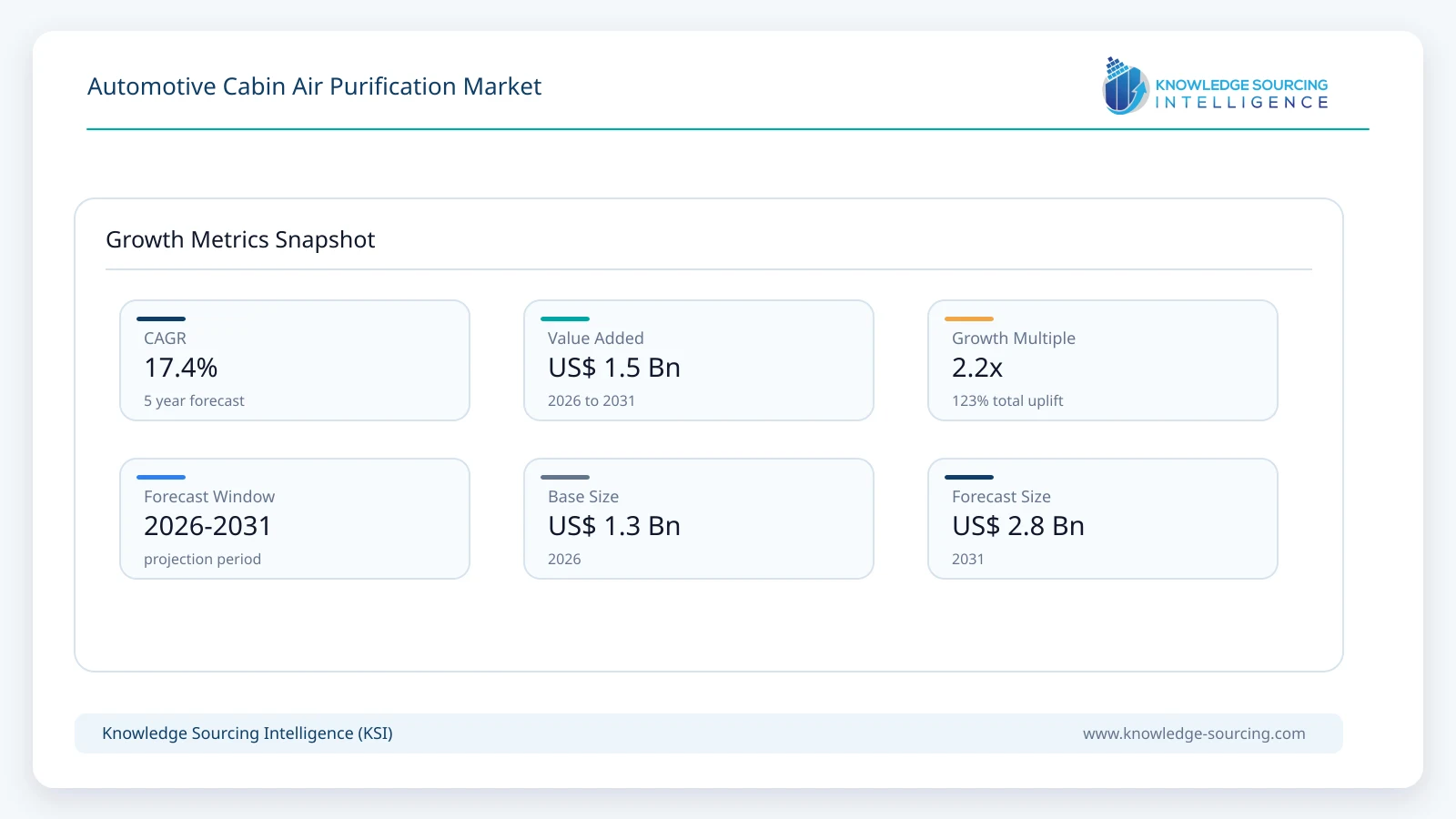
The automotive cabin air purification market is forecast to grow at a CAGR of 17.4%, reaching approximately USD 2.79 billion by 2031 from USD 1.25 billion in 2026.
Highlights:
- 1Ionization, plasma and hydroxyl-radical purification technologies account for approximately 37% of global market value in 2026 because they can actively treat airborne and surface-adhered contaminants while requiring relatively compact hardware.
- 2Multi-contaminant purification functions represent approximately 45% of market value in 2026 as premium systems increasingly target odours, allergens, volatile organic compounds, bacteria, viruses and fine particles through combined treatment mechanisms.
- 3Integrated HVAC purification architectures account for approximately 61% of 2026 market value because OEMs prefer purification technologies embedded within the climate system rather than standalone portable devices.
- 4Passenger cars represent approximately 87% of global market value in 2026, supported by premium-vehicle adoption, rising smart-cabin content and the growing use of air-quality features in EVs and hybrid passenger cars.
- 5Battery electric vehicles account for approximately 35% of market value in 2026 because EV manufacturers increasingly position clean-air functions as part of a premium digital-cabin experience and can integrate purification through centralized electrical architectures.
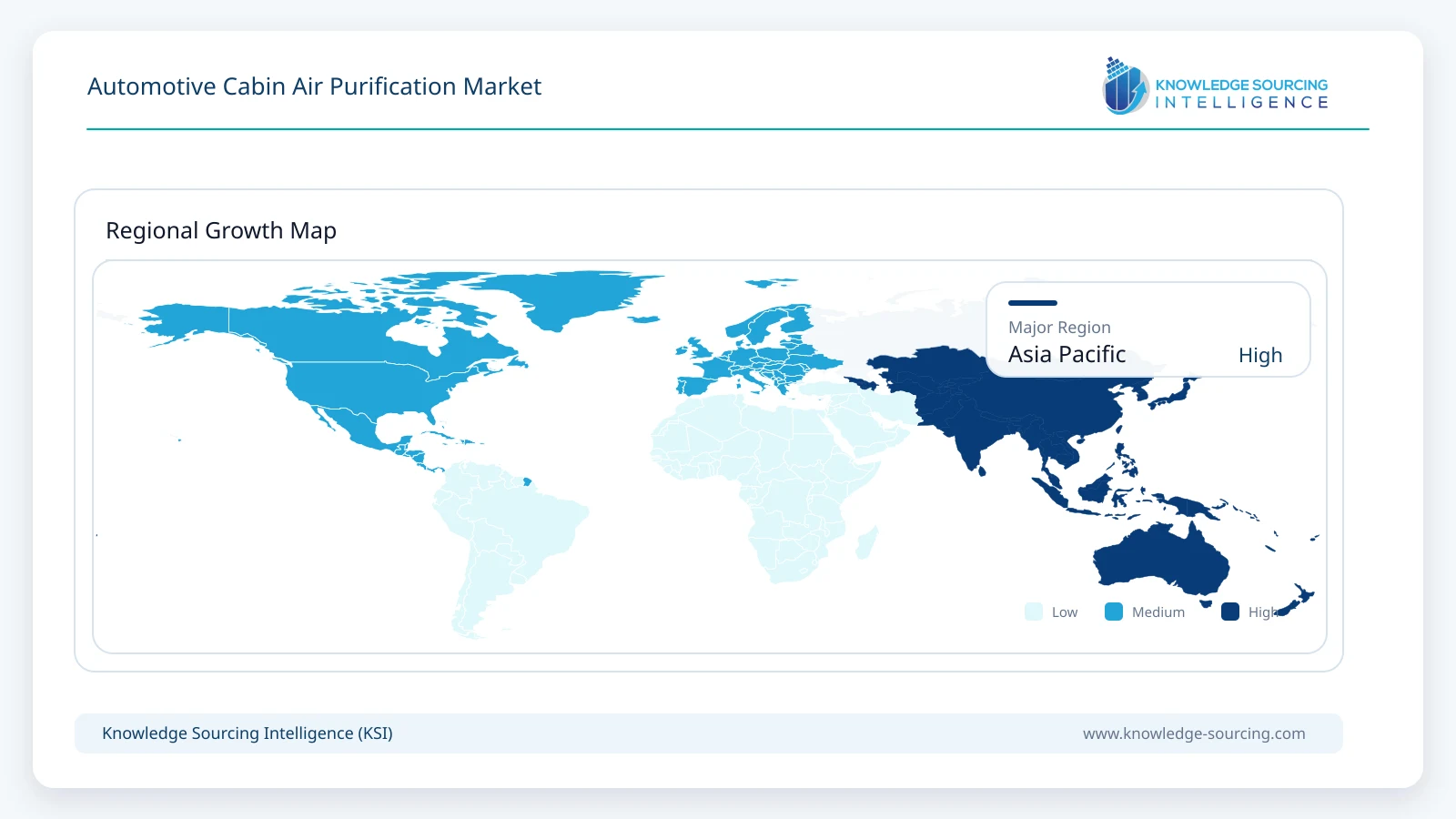
- 6Asia Pacific represents approximately 45% of global market value in 2026, supported by high vehicle production, severe urban pollution exposure in major markets and strong air-purification technology development in Japan, China and South Korea.
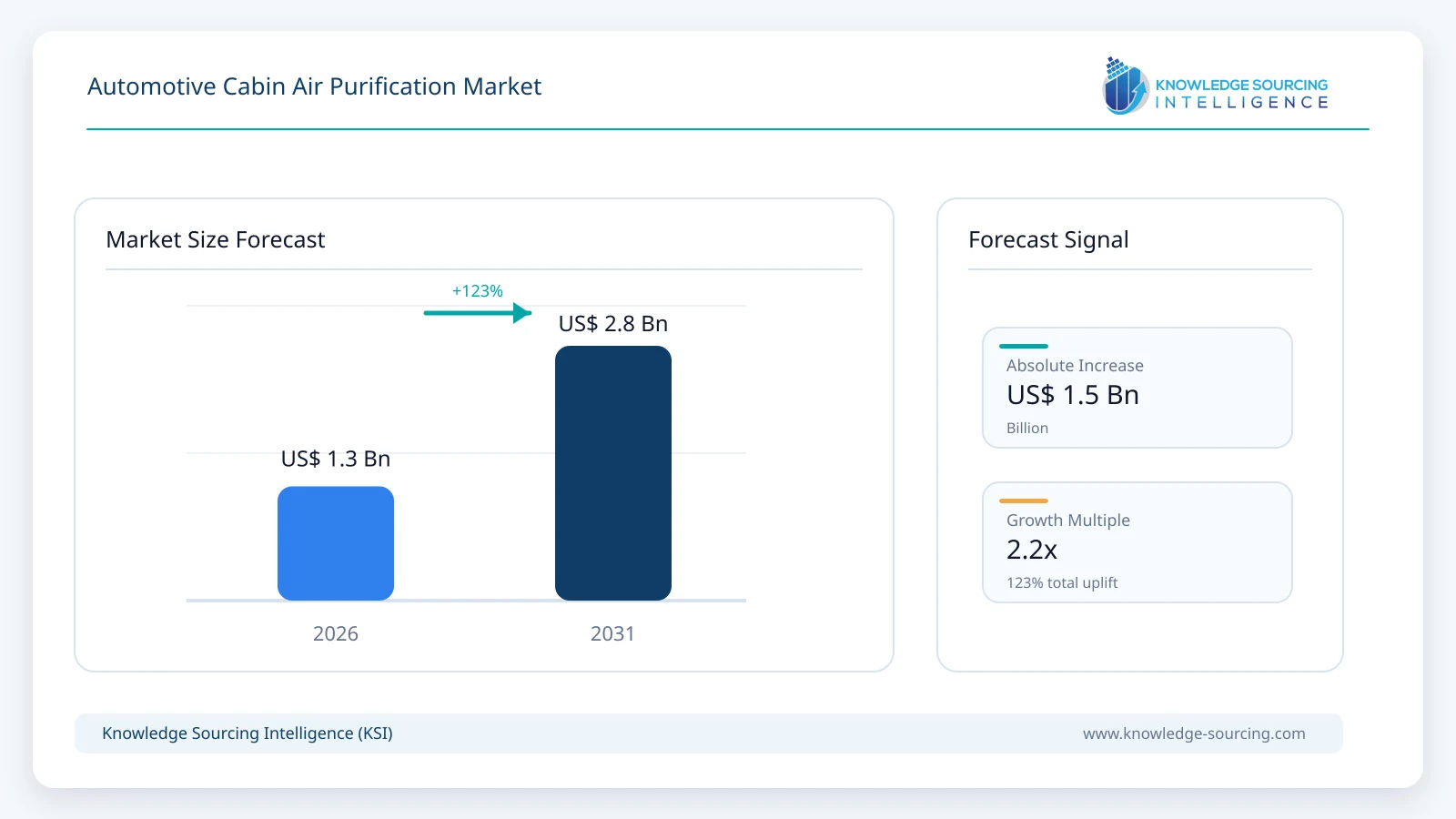
The market is expanding as automakers add active treatment technologies that work alongside conventional filters to neutralize pollutants, improve odour control and maintain cleaner air during recirculation.
Commercial development spans several technology paths. Panasonic nanoe X generates hydroxyl radicals contained in water and has been adopted across numerous vehicle models, including Jaguar Land Rover and Toyota applications. Sharp's Plasmacluster technology uses positive and negative ions and is deployed through automotive systems and DENSO vehicle ion generators. MAHLE has developed a production-ready Active Air Purifier that ionizes particles before an electrically activated filter, while Valeo offers integrated air-quality sensing and purification architectures and MANN+HUMMEL supplies smart multi-stage systems with sensors and HEPA filtration.
The value proposition is increasingly system-level. Sensors can detect deteriorating outside or cabin air quality, trigger recirculation, activate higher purification intensity and display air-quality status to occupants. This integration allows purification to operate only when required, reducing unnecessary energy use and extending filter or purifier service life.
Market Overview
Cabin air purification differs from passive filtration because it actively changes, charges, decomposes or neutralizes contaminants rather than simply trapping them in a filter medium. The principal technologies include ion and plasma generation, hydroxyl-radical systems, electrically activated filtration, photocatalytic treatment and other hybrid approaches integrated with vehicle HVAC.
Panasonic nanoe X is one of the most established automotive examples. The system generates nano-sized water particles containing hydroxyl radicals that can deodorize and inhibit selected allergens, bacteria, viruses and mould. Panasonic states that nanoe and nanoe X have been adopted across more than one hundred vehicle models, demonstrating that active purification is moving well beyond concept-stage deployment.
Sharp and DENSO provide another pathway through Plasmacluster ion technology. Positive and negative ions are released into the cabin and form hydroxyl radicals when interacting with airborne contaminants. DENSO offers Plasmacluster ion generators for passenger and commercial vehicle applications, while Sharp continues to expand research and development around in-vehicle use.
MAHLE is developing a hybrid active-filtration architecture in which particles are electrically charged before capture. The Active Air Purifier can work with conventional hybrid filters and electrically activate the filter to maintain high efficiency over its service life, providing a pathway to active purification without requiring a completely separate filtration system.
The longer-term market direction is toward adaptive purification. Air-quality sensors inside and outside the vehicle can determine when purification is necessary, while software coordinates intake air, recirculation, purification intensity and filter loading. This reduces unnecessary energy use and enables purification to become part of the broader software-defined cabin environment.
Market Trends
Active Particle and Hydroxyl-Radical Systems Are Moving into Mainstream Vehicle Platforms
Technologies that generate reactive ions or hydroxyl radicals are increasingly being integrated directly into vehicle HVAC systems rather than sold only as portable accessories. Panasonic's nanoe family is already used by multiple global automakers and continues to evolve toward higher radical-generation output.
The shift toward embedded systems improves distribution through the full cabin and allows purification to operate automatically whenever climate control is active.
Hybrid Purification Is Combining Active Treatment with High-Efficiency Filtration
Active purification and filtration are increasingly complementary rather than competing technologies. Electrically charging particles can improve their capture in filters, while HEPA and activated-carbon stages remove contaminants that active treatment alone may not address effectively.
MAHLE's Active Air Purifier and MANN+HUMMEL smart multi-stage concepts illustrate the move toward hybrid architectures that combine sensing, active treatment and physical filtration.
Smart Air-Quality Sensing Is Automating Purification Intensity
Modern systems increasingly measure outside and cabin air conditions and use the results to decide when to recirculate air, activate purification or increase treatment intensity. Valeo and MANN+HUMMEL both position sensing as part of their broader cabin-air-quality architectures.
Closed-loop control improves efficiency because the purifier does not need to run at maximum output continuously and can prioritize periods of high pollution or high cabin contamination.
Odour and VOC Reduction Are Becoming Important Premium Differentiators
Consumers notice odours and stale air immediately, making deodorization one of the most visible benefits of active purification. Hydroxyl-radical systems, activated surfaces and hybrid filtration architectures are increasingly designed to reduce odours and selected volatile organic compounds.
This creates a strong premium positioning opportunity because the perceived benefit is easy to demonstrate during vehicle use even when particulate pollution is not visible.
Purification Is Expanding from Air Cleaning toward Occupant Experience
Air purification is increasingly presented as part of a wider cabin wellbeing proposition. Toyota, Jaguar Land Rover and other manufacturers integrate nanoe or nanoe X technologies alongside climate, filtration and comfort functions, while Sharp has examined potential links between Plasmacluster exposure and driver concentration.
The market is therefore moving beyond a technical air-cleaning function toward a branded experience that supports comfort, perceived freshness and confidence in the vehicle interior.
Segment Analysis
By Purification Technology: Ionization, Plasma and Hydroxyl-Radical Systems
Ionization, plasma and hydroxyl-radical systems are projected to generate approximately USD 1.00 billion of market value by 2031. Growth will be driven by wider OEM integration of nanoe, Plasmacluster and related active-particle technologies in passenger vehicles and premium smart-cabin platforms.
The segment will remain the largest because these technologies can operate continuously with limited packaging space and can complement existing filters without requiring a complete HVAC redesign.
By Purification Function: Multi-Contaminant Purification
Multi-contaminant purification is projected to generate approximately USD 1.35 billion of market value by 2031. These systems combine odour reduction, allergen control, VOC reduction, biological-contaminant treatment and fine-particle management through multiple mechanisms.
The category is expected to gain share as automakers market cabin air quality as a broader wellbeing feature rather than as simple particulate removal.
By System Architecture: Integrated HVAC Purification
Integrated HVAC purification is projected to generate approximately USD 1.85 billion of market value by 2031. Embedding purification directly into the climate system improves air distribution, allows automatic control and avoids the packaging and user-maintenance limitations of standalone portable devices.
OEM integration also enables purifier operation to be linked with air-quality sensors, recirculation logic, filter monitoring and vehicle software.
By Vehicle Type: Passenger Cars
Passenger cars are projected to generate approximately USD 2.40 billion of market value by 2031. Premium sedans, SUVs and electric vehicles will remain the primary early adopters, but lower-cost ionization and active-particle technologies are expected to broaden adoption over the forecast period.
Commercial vehicles and buses also provide relevant use cases because of high occupant turnover and long operating hours, but their smaller unit volumes keep passenger cars dominant.
By Propulsion: Battery Electric Vehicles
Battery electric vehicles are projected to generate approximately USD 1.15 billion of market value by 2031. EVs commonly combine centralized electronics, advanced HVAC, smart-cabin interfaces and premium air-quality features, providing a strong technical platform for integrated purification.
Low-energy purification and intelligent recirculation also fit the EV requirement to manage cabin comfort and air quality without materially increasing battery consumption.
Market Drivers
Rising Urban Air Pollution and Concern over In-Vehicle Exposure
Drivers and passengers are regularly exposed to traffic-related particulate matter, exhaust gases, odours and other contaminants. Active purification provides an additional treatment layer when outside-air pollution is high or when contaminated air has already entered the cabin.
Growing public awareness of PM2.5, volatile organic compounds and allergens is increasing willingness to pay for visible air-quality features.
Vehicle Premiumization and Smart-Cabin Differentiation
Automakers increasingly use cabin air quality as part of a premium interior experience. Branded purification modes, air-quality displays and automatic clean-air functions provide a visible feature that can be marketed alongside advanced climate, lighting and wellness systems.
The trend is especially strong in premium EVs and high-content SUVs where buyers expect the cabin to feel like a protected personal environment.
Expansion of Electrified and Software-Defined Vehicle Architectures
Centralized electronics make it easier to integrate purifier generators, sensors, HVAC controls and user interfaces through common software. This supports automatic purification modes, connected diagnostics and over-the-air calibration.
Electric vehicles also tend to use recirculation strategically for energy efficiency, increasing the value of technologies that keep recirculated cabin air fresh and clean.
Advances in Compact Ionization and Active-Particle Technologies
Modern purifier generators can deliver high active-particle output from compact devices with relatively low power consumption. Panasonic's latest nanoe X generation increases hydroxyl-radical output substantially while maintaining a small device architecture.
Improved output and packaging make active purification easier to integrate across different vehicle classes and HVAC designs.
Growing Integration of Air-Quality Sensors and Automatic Recirculation
Cabin and outside-air sensors allow the vehicle to identify deteriorating conditions and adjust intake-air source or purification intensity automatically. This increases system effectiveness while reducing unnecessary operation.
Sensor-led control also creates an opportunity to show occupants real-time air-quality status, strengthening perceived value and trust in the purification function.
Market Restraints
Difficulty Comparing Purification Performance across Technologies
Ionization, hydroxyl-radical, photocatalytic and electrically enhanced systems use different test methods and performance metrics. This makes direct comparison difficult and can create uncertainty for OEMs and consumers.
Broader adoption will require clearer standardized testing under realistic cabin volumes, airflow rates and contaminant conditions.
Potential Ozone and By-Product Concerns
Some ionization and plasma technologies can generate unwanted ozone or reaction by-products if not carefully controlled. Automotive systems therefore require strict engineering limits, materials validation and long-term monitoring.
Suppliers must demonstrate that active purification improves air quality without introducing secondary contaminants.
Incremental Cost and Packaging versus Passive Filtration
Active purification adds generators, power electronics, sensors or control software beyond the conventional cabin filter. Lower-cost vehicles may therefore rely on upgraded filtration alone unless the active system provides clear additional value.
Cost reduction and integration into existing HVAC modules will be important for expansion beyond premium vehicle segments.
Performance Depends on Airflow and Cabin Operating Conditions
Purification effectiveness can vary with fan speed, cabin volume, air exchange rate, temperature, humidity and contaminant loading. A technology that performs strongly in a controlled chamber may deliver different results in real driving.
OEM validation therefore needs to account for vehicle-specific airflow patterns and passenger occupancy rather than relying only on laboratory generator output.
Consumer Understanding and Maintenance Can Be Inconsistent
Drivers may not clearly understand the difference between filtration, purification, ionization and air-quality sensing. Standalone purifier devices can also be ignored or switched off if their benefit is not obvious.
Automatic operation, simple air-quality displays and integration with the standard climate interface are therefore important for long-term user acceptance.
Regional Outlook
Asia Pacific
Asia Pacific is the largest regional market and is expected to remain the principal growth centre through 2031. Japan is a major technology base through Panasonic nanoe X, Sharp Plasmacluster and DENSO automotive ion-generation systems, while China is rapidly expanding premium smart-cabin and clean-air features across electric vehicles.
Panasonic reports broad automotive adoption of nanoe technologies, and Sharp continues to develop Plasmacluster for automotive and mobility applications. High urban pollution exposure and strong consumer familiarity with air-purification products provide favourable conditions for active cabin-purification adoption.
Growth will be supported by high vehicle production, rising EV penetration and strong demand for differentiated cabin experiences. Technologies that combine active purification with low power consumption and simple HVAC integration are positioned to gain share.
Europe
Europe is a major high-value market because premium OEMs and Tier 1 suppliers increasingly combine filtration, air-quality sensing and active purification. Jaguar Land Rover has integrated Panasonic nanoe X into its Cabin Air Purification Pro architecture, while MAHLE is developing a production-ready Active Air Purifier and Valeo offers integrated air-quality and purifier systems.
European adoption is also supported by strong consumer awareness of urban air quality and a mature premium-vehicle market. The region is likely to favour integrated systems with clear validation, low ozone emissions and measurable energy efficiency.
Growth through 2031 will depend on standardized performance claims, integration with advanced HVAC and sensor systems and the ability to demonstrate purification benefits under real driving conditions.
Competitive Landscape
The automotive cabin air purification market includes active-particle technology developers, thermal-management suppliers, filtration specialists and integrated cabin-system providers. Panasonic, MAHLE, Sharp, DENSO, Valeo and MANN+HUMMEL are directly relevant through hydroxyl-radical generation, ionization, electrically enhanced purification, smart filtration and integrated air-quality architectures.
Panasonic is differentiated by nanoe and nanoe X technology with broad automotive adoption. Sharp and DENSO provide Plasmacluster-based ion-generation solutions, while MAHLE is developing a hybrid Active Air Purifier that combines particle ionization with an electrically activated filter.
Valeo integrates sensors, filters and purifier functions into broader cabin-air-quality systems, while MANN+HUMMEL supplies smart HEPA architectures with sensor-based control. Competition is increasingly shifting toward systems that combine purification effectiveness, low energy demand, low secondary emissions and software-driven automation.
Recent Developments
• 28 September 2026: Panasonic announced a new nanoe X generating device producing 72 trillion hydroxyl radicals per second and reducing mould-inhibition time by half compared with the previous generation, with Panasonic identifying mobility as one of the target application environments.
• 1 September 2026: MAHLE presented CareMetix Natural at Automechanika Frankfurt 2026, extending its cabin-air-quality portfolio with VOC-reduction capability and sustainable filter media alongside its broader active-purification technology roadmap.
• 21 July 2026: MAHLE announced its new workshop ecosystem and highlighted CareMetix Natural as a new vehicle cabin-air-quality product, strengthening its combined filtration and purification offering.
• 27 February 2026: Sharp's latest Plasmacluster air purifiers received 2026 iF Design Awards, demonstrating continued development of the ion-generation platform used across mobility and automotive applications.
• 15 December 2025: Panasonic reported the first verification of improved driver concentration during simulated driving using nanoe technology, expanding the in-vehicle value proposition beyond conventional deodorization and pollutant inhibition.
• 2 December 2025: Toyota detailed the new bZ4X for Europe with nanoe-E air-quality technology available as part of the upgraded cabin specification for the 2026 model rollout.
• 24 October 2025: Sharp unveiled the second-generation LDK+ EV concept for Japan Mobility Show 2025, combining Plasmacluster and photocatalyst technologies as part of its clean-air cabin concept.
• 8 September 2025: MAHLE presented its production-ready Active Air Purifier at IAA Mobility 2025, using particle ionization and an electrically activated filter to maintain high filtration efficiency over the filter service life.
Market Outlook
The automotive cabin air purification market is expected to expand rapidly through 2031 as active-particle technologies and smart purification move from premium options into broader vehicle platforms. Ionization, plasma and hydroxyl-radical systems will remain the largest technology category, while hybrid active-filtration architectures are expected to gain share.
The market will increasingly move toward closed-loop purification. Vehicles will monitor outside and cabin air quality, select recirculation strategy, activate purification only when required and coordinate treatment with filter condition and HVAC energy demand.
Asia Pacific is expected to retain the largest regional share, while Europe remains a major premium engineering and validation market. Competitive advantage will depend on proven real-world effectiveness, low ozone or by-product generation, compact packaging, low energy consumption and seamless integration with intelligent climate-control systems.
Automotive Cabin Air Purification Market Scope:
| Report Metric | Details |
|---|---|
| Total Market Size in 2026 | USD 1.25 billion |
| Total Market Size in 2031 | USD 2.79 billion |
| Forecast Unit | USD Billion |
| Growth Rate | 17.4% |
| Study Period | 2021 to 2031 |
| Historical Data | 2021 to 2024 |
| Base Year | 2025 |
| Forecast Period | 2026 – 2031 |
| Segmentation | Purification Technology, Purification Function, System Architecture, Vehicle Type, Propulsion, Geography |
| Companies |
|
Market Segmentation
By Purification Technology
Ionization, Plasma and Hydroxyl-Radical Systems
Electrically Enhanced Filtration Systems
Photocatalytic and UV-Based Purification
Hybrid Active and High-Efficiency Purification Systems
By Purification Function
Multi-Contaminant Purification
Odour and VOC Reduction
Allergen and Biological Contaminant Control
Particulate and Ultrafine Particle Management
By System Architecture
Integrated HVAC Purification
Dedicated Built-In Purifier Modules
Portable and Accessory Purifiers
By Vehicle Type
Passenger Cars
Light Commercial Vehicles
Medium and Heavy Commercial Vehicles
Buses and Shared Mobility Vehicles
By Propulsion
Battery Electric Vehicles
Hybrid and Plug-in Hybrid Electric Vehicles
Internal Combustion Engine Vehicles
Fuel Cell Electric Vehicles
By Geography
North America
United States
Canada
Mexico
South America
Brazil
Argentina
Others
Europe
Germany
United Kingdom
France
Italy
Spain
Others
Middle East and Africa
Saudi Arabia
UAE
South Africa
Others
Asia Pacific
China
Japan
South Korea
India
Singapore
Others
Table of Contents
1. INTRODUCTION
1.1. Market Overview
1.2. Market Definition
1.3. Scope of the Study
1.4. Market Segmentation
1.5. Currency
1.6. Assumptions
1.7. Base and Forecast Years
1.8. Key Benefits to Stakeholders
2. RESEARCH METHODOLOGY
2.1. Research Design
2.2. Secondary Research
2.3. Primary Research
2.4. Market Estimation
2.5. Segment Modelling
2.6. Data Triangulation and Validation
3. EXECUTIVE SUMMARY
3.1. Key Findings
3.2. Automotive Cabin Air Purification Market Size, 2026-2031
3.3. Purification Technology Outlook
3.4. Purification Function Outlook
3.5. System Architecture Outlook
3.6. Vehicle Type Outlook
3.7. Propulsion Outlook
3.8. Regional Opportunity Summary
4. MARKET DYNAMICS
4.1. Market Drivers
4.1.1. Rising Urban Air Pollution and Concern over In-Vehicle Exposure
4.1.2. Vehicle Premiumization and Smart-Cabin Differentiation
4.1.3. Expansion of Electrified and Software-Defined Vehicle Architectures
4.1.4. Advances in Compact Ionization and Active-Particle Technologies
4.1.5. Growing Integration of Air-Quality Sensors and Automatic Recirculation
4.2. Market Restraints
4.2.1. Difficulty Comparing Purification Performance across Technologies
4.2.2. Potential Ozone and By-Product Concerns
4.2.3. Incremental Cost and Packaging versus Passive Filtration
4.2.4. Performance Depends on Airflow and Cabin Operating Conditions
4.2.5. Consumer Understanding and Maintenance Can Be Inconsistent
4.3. Market Opportunities
4.4. Porter's Five Forces Analysis
4.5. Industry Value Chain Analysis
4.6. Cabin Air Purification System Economics
4.7. Air-Quality Validation, Ozone Limits and Safety Environment
5. TECHNOLOGY OUTLOOK
5.1. Ionization and Plasma-Based Purification
5.2. Hydroxyl-Radical and Active-Particle Systems
5.3. Electrically Enhanced and Electrostatic Filtration
5.4. Photocatalytic Oxidation
5.5. UV and UV-C Treatment Architectures
5.6. Hybrid HEPA and Active Purification Systems
5.7. VOC and Odour Reduction Technologies
5.8. Air-Quality Sensors and Automatic Recirculation
5.9. Purifier Controllers and HVAC Integration
5.10. Smart Purification Modes and Connected Air-Quality Displays
5.11. Ozone, By-Product and Real-World Performance Validation
6. AUTOMOTIVE CABIN AIR PURIFICATION MARKET BY PURIFICATION TECHNOLOGY
6.1. Introduction
6.2. Ionization, Plasma and Hydroxyl-Radical Systems
6.3. Electrically Enhanced Filtration Systems
6.4. Photocatalytic and UV-Based Purification
6.5. Hybrid Active and High-Efficiency Purification Systems
7. AUTOMOTIVE CABIN AIR PURIFICATION MARKET BY PURIFICATION FUNCTION
7.1. Introduction
7.2. Multi-Contaminant Purification
7.3. Odour and VOC Reduction
7.4. Allergen and Biological Contaminant Control
7.5. Particulate and Ultrafine Particle Management
8. AUTOMOTIVE CABIN AIR PURIFICATION MARKET BY SYSTEM ARCHITECTURE
8.1. Introduction
8.2. Integrated HVAC Purification
8.3. Dedicated Built-In Purifier Modules
8.4. Portable and Accessory Purifiers
9. AUTOMOTIVE CABIN AIR PURIFICATION MARKET BY VEHICLE TYPE
9.1. Introduction
9.2. Passenger Cars
9.3. Light Commercial Vehicles
9.4. Medium and Heavy Commercial Vehicles
9.5. Buses and Shared Mobility Vehicles
10. AUTOMOTIVE CABIN AIR PURIFICATION MARKET BY PROPULSION
10.1. Introduction
10.2. Battery Electric Vehicles
10.3. Hybrid and Plug-in Hybrid Electric Vehicles
10.4. Internal Combustion Engine Vehicles
10.5. Fuel Cell Electric Vehicles
11. AUTOMOTIVE CABIN AIR PURIFICATION MARKET BY GEOGRAPHY
11.1. North America
11.1.1. United States
11.1.2. Canada
11.1.3. Mexico
11.2. South America
11.2.1. Brazil
11.2.2. Argentina
11.2.3. Others
11.3. Europe
11.3.1. Germany
11.3.2. United Kingdom
11.3.3. France
11.3.4. Italy
11.3.5. Spain
11.3.6. Others
11.4. Middle East and Africa
11.4.1. Saudi Arabia
11.4.2. UAE
11.4.3. South Africa
11.4.4. Others
11.5. Asia Pacific
11.5.1. China
11.5.2. Japan
11.5.3. South Korea
11.5.4. India
11.5.5. Singapore
11.5.6. Others
12. COMPETITIVE ENVIRONMENT AND ANALYSIS
12.1. Major Players and Strategy Analysis
12.2. Market Share Analysis
12.3. Purification Technology Benchmarking
12.4. OEM Integration and Production Readiness
12.5. Air-Quality Performance and Validation Comparison
12.6. Competitive Dashboard
13. COMPANY PROFILES
13.1. Panasonic Corporation
13.2. MAHLE GmbH
13.3. Sharp Corporation
13.4. DENSO Corporation
13.5. Valeo
13.6. MANN+HUMMEL
14. APPENDIX
14.1. Currency
14.2. Assumptions
14.3. Base and Forecast Years Timeline
14.4. Key Benefits for Stakeholders
14.5. Research Methodology
14.6. Abbreviations
14.7. Data Sources
Navigate
Trusted by the world's leading organizations











