
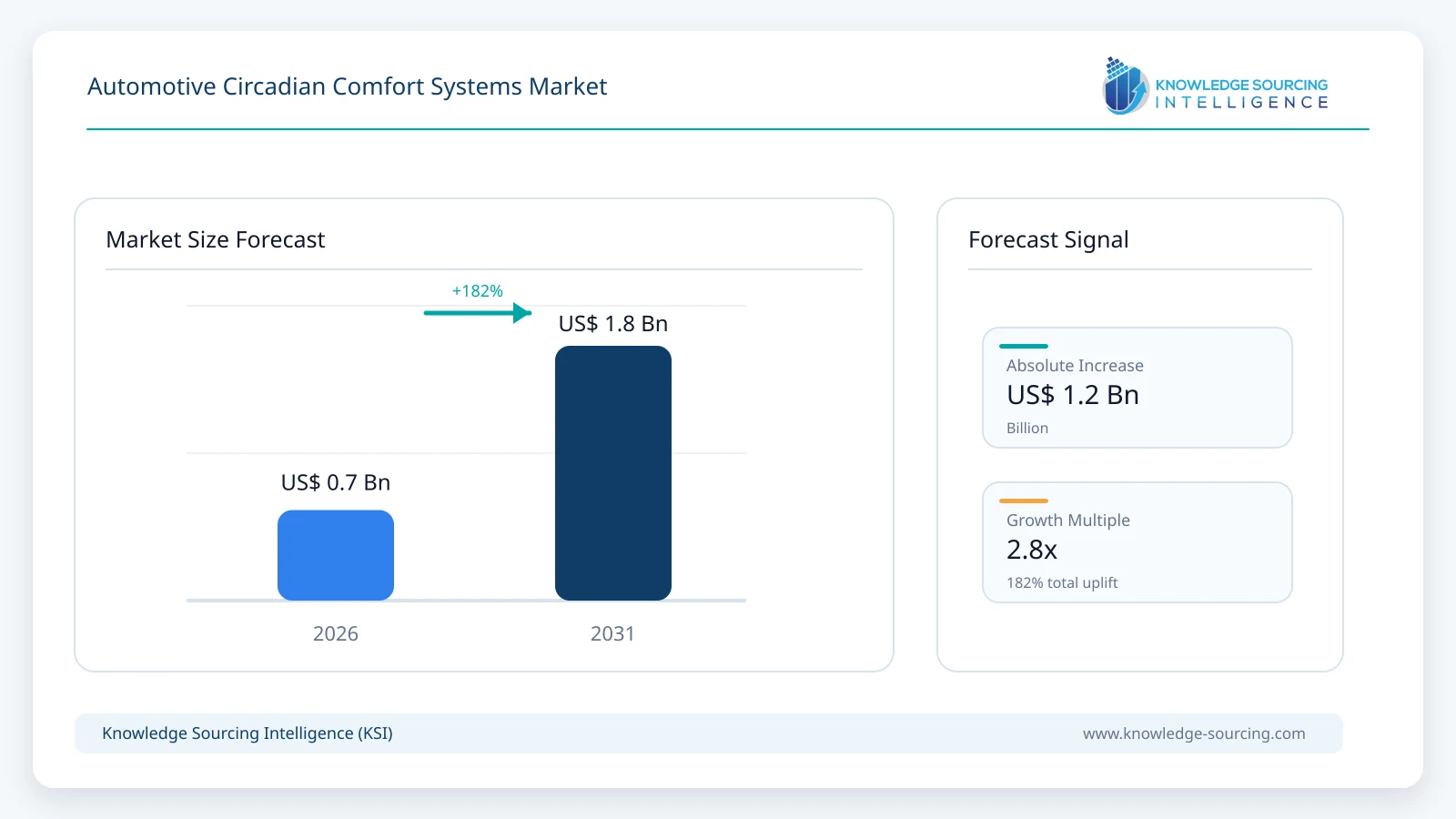
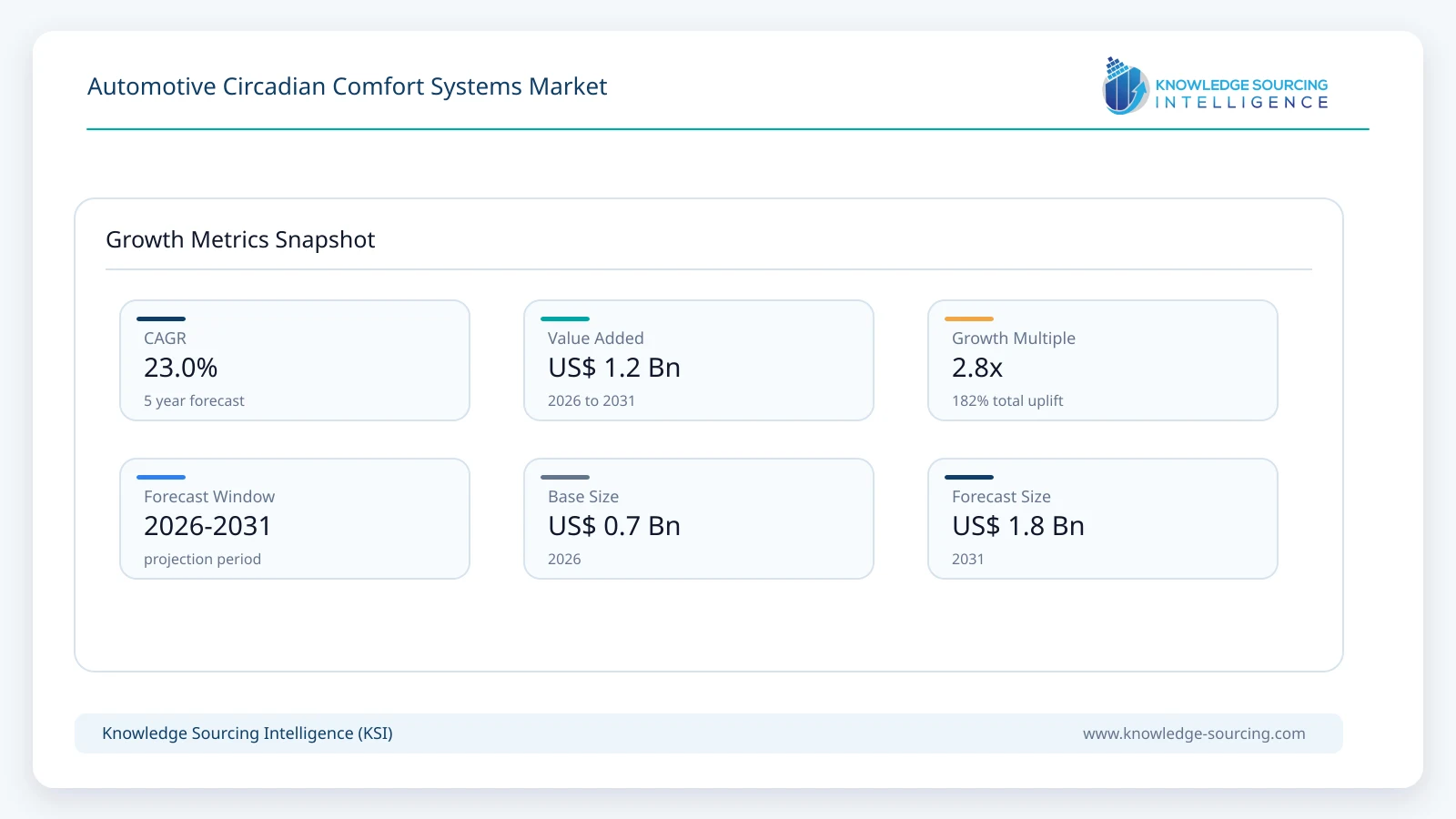
The automotive circadian comfort systems market is forecast to grow at a CAGR of 23.0%, reaching approximately USD 1.83 billion by 2031 from USD 0.65 billion in 2026.
Key Highlights
• Circadian-aware lighting hardware accounts for approximately 61% of global market value in 2026 because tunable-white LEDs, light guides, overhead modules and controllable luminous surfaces provide the primary physical pathway for delivering biologically relevant light inside the cabin.
• Alertness and activation functions represent approximately 43% of market value in 2026, supported by use cases that increase visual stimulation during morning travel, monotonous driving, fatigue events and post-nap wake-up phases.
• Sensor- and context-adaptive systems account for approximately 55% of 2026 market value as time, ambient light, vehicle state, eye behaviour, stress indicators and wearable data increasingly influence cabin-lighting and comfort decisions.
• Premium and luxury vehicles represent approximately 49% of global market value in 2026 because advanced tunable lighting, wellness software, biometric sensing and integrated comfort programmes remain concentrated in high-content interiors.
• Battery electric vehicles account for approximately 45% of market value in 2026 because EVs combine software-defined electrical architectures, premium cabin content and charging dwell periods that create natural use cases for relaxation and Power Nap programmes.
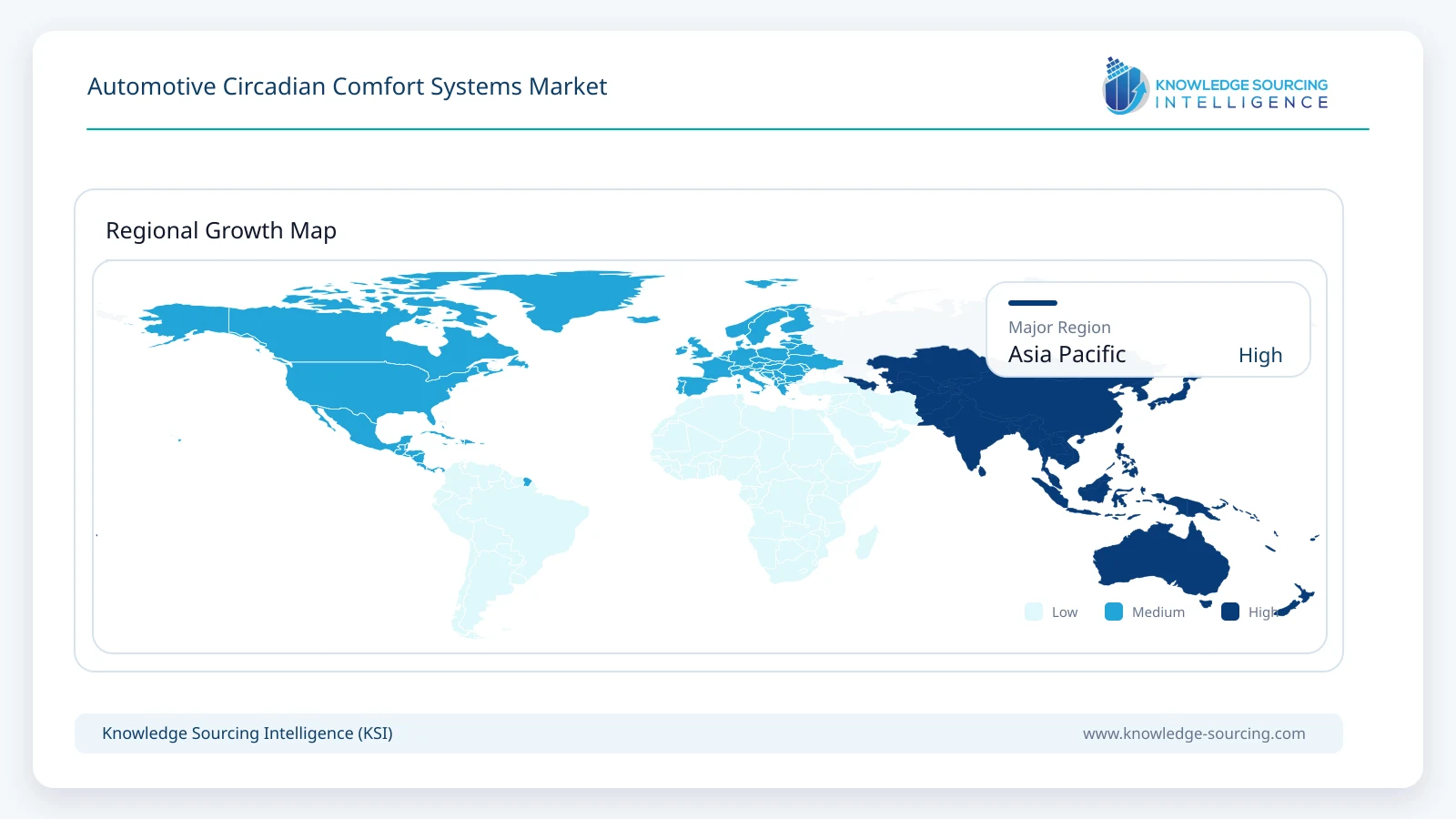
• Asia Pacific represents approximately 42% of global market value in 2026, supported by rapid smart-cabin innovation in China and direct human-centric lighting development in South Korea and Japan.
The market is moving beyond decorative ambient lighting toward biologically informed cabin systems that adjust colour temperature, intensity, spectral composition and supporting comfort functions according to time of day, ambient conditions and occupant state.
Commercial development is becoming more visible. Hyundai Mobis has developed Human-Centric Interior Lighting that uses cabin sensing and physiological inputs to adapt lighting across more than 32 scenarios. FORVIA HELLA offers adjustable-colour-temperature interior lighting and circadian-aligned Tunable White reading illumination. ams OSRAM provides automotive-qualified OSTUNE LEDs spanning warm to cool white, while Mercedes-Benz combines activating light, relaxation programmes and Power Nap conditioning through ENERGIZING COMFORT.
The market boundary is defined around systems with a specific alertness, sleep, biological-rhythm or time-of-day comfort objective. Decorative RGB mood lighting, conventional dome lamps, standard display dimming and generic ambient illumination are excluded unless they dynamically alter light exposure or other cabin conditions to support wakefulness, relaxation, circadian alignment or recovery.
Market Overview
Circadian comfort is emerging as a specialized layer within automotive wellness. Instead of using light only for visibility or styling, these systems manage colour temperature, intensity, timing and spatial distribution to influence perceived alertness, calmness and readiness for rest. The concept is especially relevant when occupants spend longer periods in vehicles, commute before sunrise or after sunset, work irregular schedules, or use electric-vehicle charging stops for recovery.
Lighting is the central technology because the human circadian system responds to light exposure through non-visual pathways as well as conventional vision. Peer-reviewed automotive research has shown that bright evening light can increase subjective alertness and reduce melatonin concentration compared with dim conditions. This creates a technical basis for automotive lighting systems that distinguish between stimulation, visual comfort and sleep-support objectives rather than applying one static lighting scene.
Supplier technology is advancing toward tunable and addressable architectures. Hyundai Mobis links lighting with biometric and environmental information, FORVIA HELLA offers circadian-aligned Tunable White reading illumination, and ams OSRAM supports warm-to-cool white tuning from 2700 K to 6500 K through automotive-qualified LED families. Valeo and Marelli add scalable dynamic-lighting and smart-surface architectures that can serve as delivery platforms for future circadian functions.
The strongest value shift is from scheduled lighting toward adaptive control. A time-of-day profile can provide a basic morning, daytime, evening and night sequence, but more advanced systems can combine local time, ambient daylight, trip duration, fatigue indicators, eye behaviour, user preference and sleep information. This allows the vehicle to avoid excessive stimulation when relaxation is desired and to provide targeted activation when alertness is more important.
Circadian comfort can also extend beyond lighting. Mercedes-Benz ENERGIZING COMFORT demonstrates how activating light, sound, massage, seat kinetics, climate and Power Nap routines can be coordinated through software. Over time, the market is expected to develop from lighting-led packages toward integrated circadian comfort controllers that orchestrate light, display brightness, temperature, airflow, audio and seating according to a common wake, relax or recover objective.
Market Trends
Tunable White Is Replacing Static Colour Selection for Wellness Functions
Static RGB ambient lighting can create mood, but circadian-oriented systems require more precise control of white-light colour temperature and intensity. Automotive lighting portfolios are therefore expanding toward warm-to-cool white tuning, high colour rendering and individually addressable zones.
The commercial advantage is that tunable-white hardware can serve multiple roles. The same module can provide comfortable reading light, a cool and stimulating morning scene, warmer evening illumination and reduced-intensity night lighting, allowing OEMs to add wellness functionality without creating a separate physical lighting architecture.
Biometric and Context Inputs Are Closing the Control Loop
Human-centric systems are beginning to use camera sensing, wearable data, brainwave information, stress indicators and ambient-light measurements to decide when and how the cabin should change. Hyundai Mobis has demonstrated lighting responses based on physical and mental state rather than relying only on manual colour selection.
This creates a pathway from generic circadian schedules toward individual adaptation. Chronotype, recent sleep, journey timing and current fatigue can differ widely between occupants, so closed-loop control is more commercially defensible than applying the same light sequence to every user.
Circadian Comfort Is Expanding Beyond Lighting into Multi-Sensory Programmes
OEM wellness programmes increasingly coordinate light with seat, climate, audio and display functions. Mercedes-Benz uses activating light in stimulation programmes and combines ambient conditions with a three-phase Power Nap experience that supports falling asleep, sleeping and waking.
This multi-sensory approach can reduce the need to drive the biological response through very high cabin illuminance alone. Light can provide the primary timing cue while thermal, acoustic and seating systems reinforce activation or relaxation with lower visual load.
Power Nap and Charging-Dwell Use Cases Are Creating a Clear Commercial Application
Electric vehicles create predictable stationary periods in which occupants can rest while charging. Power Nap routines can lower lighting intensity and colour temperature during sleep preparation, coordinate shade and seat position, and then use brighter light, ventilation, sound or massage to support waking.
Higher levels of driving automation could broaden this opportunity by allowing passengers to enter rest-oriented modes during travel, although driver-facing stimulation and relaxation functions must remain constrained by the active driving task and applicable safety requirements.
Software-Defined Lighting Enables Personal Profiles and Over-the-Air Evolution
Centralized vehicle electronics make interior lighting increasingly programmable. Scene logic can therefore evolve after vehicle sale, allowing OEMs to refine time-of-day programmes, add regional content, connect wearables and personalize schedules without redesigning the lighting hardware.
The longer-term opportunity is a persistent circadian profile that moves across vehicles and learns the user's preferred wake, work, relaxation and sleep routines. This shifts value from one-time lighting hardware toward algorithms, software content and integrated cabin control.
Segment Analysis
By System Component: Tunable White and Spectrum-Controlled Lighting Hardware
Tunable white and spectrum-controlled lighting hardware represents the largest component segment, accounting for approximately 61% of global market value in 2026. The category includes automotive-qualified LEDs, overhead and reading modules, light guides, smart surfaces and other emitters capable of changing colour temperature, intensity or spectral balance.
The segment is expected to remain the largest through 2031 because light is the direct actuator for circadian stimulation, while the same hardware can also serve ambient, reading and functional illumination. Growth will increasingly favour addressable architectures that can create separate driver and passenger zones.
By Comfort Function: Alertness and Activation
Alertness and activation account for approximately 43% of global market value in 2026. The function uses higher colour temperatures, greater brightness and coordinated stimulation to support morning travel, prolonged driving, monotonous conditions or the wake-up phase after a stationary rest period.
This function leads because fatigue and low alertness are immediate safety and comfort concerns with a clearer use case than longer-term biological-rhythm adjustment. It also integrates naturally with driver-monitoring systems that already detect drowsiness and attention state.
By Control Architecture: Sensor- and Context-Adaptive Systems
Sensor- and context-adaptive systems account for approximately 55% of market value in 2026. These architectures combine cabin cameras, ambient-light sensors, time and location data, driver-state signals, wearables or vehicle context with software that automatically changes lighting and supporting comfort functions.
Adaptive control is gaining value because optimal light exposure depends on more than clock time. Ambient daylight, journey purpose, fatigue, individual preference and whether the occupant intends to drive, work, rest or sleep all influence the appropriate cabin response.
By Vehicle Class: Premium and Luxury Vehicles
Premium and luxury vehicles represent approximately 49% of global market value in 2026. High-end models provide the strongest early platform for tunable lighting, dense ambient-light networks, wellness software, biometric sensing, premium seating and advanced cabin controllers.
Premium OEMs also use comfort and wellbeing as brand differentiators, making them more willing to integrate light with massage, climate, sound and digital content. Modularization is expected to move simpler circadian-aware functions into upper-mid and mass-market vehicles over the forecast period.
By Propulsion: Battery Electric Vehicles
Battery electric vehicles account for approximately 45% of global circadian comfort systems market value in 2026. EVs frequently combine digital cockpits, high-content interiors, centralized electronics and advanced ambient lighting, creating a favourable technical base for circadian functions.
Charging stops also create a distinctive use case for relaxation and Power Nap modes. As fast-charging networks expand and vehicle software coordinates charging, climate and cabin systems, the vehicle can automatically prepare occupants for rest and then support a controlled wake-up sequence before departure.
Market Drivers
Growing Focus on Driver Alertness, Fatigue and Cognitive Comfort
Fatigue remains one of the strongest reasons to move interior lighting beyond decorative use. Circadian and alertness-oriented lighting can complement drowsiness monitoring by providing a non-contact intervention when the driver is tired, travelling at biologically adverse times or emerging from a rest period.
The opportunity is strongest where lighting is connected with driver-state sensing, because intervention can be targeted rather than continuously applying stimulating light. This can improve acceptance and reduce unnecessary exposure.
Vehicle Premiumization and Competition around Wellness-Oriented Interiors
Premium vehicles increasingly differentiate through cabin experience rather than mechanical features alone. Human-centric lighting, personalized wellness programmes and smart surfaces create visible technology content that can be demonstrated during a test drive and monetized through higher trim levels or option packages.
As premium Chinese EV brands and established European OEMs compete on digital-cabin sophistication, suppliers are being pushed to combine lighting hardware with sensing, software and interior integration.
Growth of Software-Defined Vehicle Architectures
Centralized compute and zonal electrical architectures allow interior lighting, displays, climate and seating to share context and software control. This makes it easier to implement coordinated time-of-day programmes and to update control logic over the vehicle lifecycle.
Software-defined architecture also supports persistent user profiles, cloud-linked schedules and integration with wearables, creating a scalable foundation for individualized circadian comfort without adding a separate controller for every function.
Electrification, Autonomous Mobility and Longer In-Cabin Dwell Time
Electric charging stops, autonomous passenger use cases and increasingly multifunctional cabins create more time in which occupants may work, read, relax or sleep. These activities require different lighting conditions and increase the value of dynamic rather than fixed illumination.
The transition toward lounge-like vehicle interiors therefore expands the addressable market from driver alertness to passenger relaxation, power-nap conditioning and activity-specific light environments.
Advances in Tunable LEDs, Optical Sensors and Human-Centric Lighting Science
Automotive-qualified white LEDs now cover wide colour-temperature ranges with high colour rendering, while ambient-light sensors and in-cabin sensing can provide richer control inputs. At the same time, automotive research is improving understanding of non-visual light effects on alertness, melatonin and visual comfort.
These developments lower the technical barrier to implementing circadian functions and give OEMs a stronger basis for defining lighting scenes around measurable physiological and perceptual outcomes.
Market Restraints
Limited Standardization of Automotive Circadian Performance Metrics
There is no widely adopted automotive standard that defines how much circadian-effective light a vehicle should deliver, for how long, or under which driving conditions. Supplier claims can therefore be difficult to compare and may rely on different measures of colour temperature, illuminance or biological effectiveness.
The lack of common validation protocols can slow OEM adoption because engineering teams must balance comfort science with distraction, glare, power, packaging and safety constraints.
Risk of Glare, Distraction and Excessive Night-Time Stimulation
Light that increases alertness can also become visually intrusive, particularly at night. High brightness, poorly shielded sources or overly dynamic scenes can distract the driver, impair dark adaptation or create reflections on glazing and displays.
Circadian functions therefore require precise luminance control, spatial zoning and conservative driver-facing behaviour. Safety considerations may limit the intensity or duration of biologically stimulating light during active night driving.
Individual Differences in Chronotype, Sleep History and Light Sensitivity
A fixed schedule does not suit every occupant. Morning and evening chronotypes, recent sleep, age, shift work, travel across time zones and personal sensitivity can change how a user responds to the same light scene.
Useful personalization may require profile data, wearables or physiological sensing, adding complexity and creating privacy considerations around sleep and behavioural information.
Restricted Cabin Geometry and Energy-Exposure Trade-Offs
Vehicle cabins provide limited distance and luminous surface area compared with rooms designed for human-centric lighting. Delivering sufficient corneal light without glare can therefore be challenging, especially when the occupant changes posture or looks away from the primary source.
Suppliers must improve optical efficiency, use larger indirect luminous surfaces or combine multiple emitters so circadian benefit does not depend on a harsh point source or excessive power consumption.
High Cost and Early Concentration in Premium Platforms
Advanced circadian comfort can require tunable-white hardware, dense LED networks, sensors, controllers, cabin software and validation. The incremental cost remains difficult to justify in value segments where ordinary ambient lighting already satisfies styling requirements.
Scaling will depend on shared hardware that serves decorative, functional and circadian purposes, allowing OEMs to add biological-rhythm features mainly through software and calibration rather than separate premium components.
Regional Outlook
Asia Pacific
Asia Pacific is the largest regional market and is expected to remain the principal growth centre through 2031. China is rapidly expanding smart-cabin and premium EV content, while South Korea is a direct innovation hub through Hyundai Mobis Human-Centric Interior Lighting and Japan contributes established automotive lighting, electronics and interior-system capabilities.
Hyundai Mobis has demonstrated one of the clearest commercial pathways by linking lighting to stress, physical and mental state, environmental conditions and more than 32 predefined scenarios, with related technologies targeted for production from 2027. Regional EV competition is also accelerating adoption of programmable ambient lighting and centralized cabin software.
The regional opportunity is strongest in premium EVs and technology-led domestic brands, but falling LED and controller costs are expected to move time-of-day and human-centric lighting functions into upper-mid vehicle classes during the forecast period.
Europe
Europe is a major high-value market because it combines premium OEM demand with a dense supplier ecosystem in lighting, interior electronics and wellness software. Mercedes-Benz has commercialized integrated wellness programmes using activating light and Power Nap logic, while FORVIA HELLA, Valeo, ams OSRAM and Continental provide relevant lighting hardware, smart surfaces and control technologies.
FORVIA HELLA's current interior-lighting portfolio includes adjustable colour temperature and circadian-aligned Tunable White reading light, while ams OSRAM provides automotive-qualified warm-to-cool white LED technology. Valeo is industrializing integrated interior lighting and electronics at high volume, expanding the hardware base on which circadian software can be deployed.
Growth through 2031 will depend on proving benefits without creating glare or distraction, integrating functions into existing interior-lighting architectures and using software to differentiate circadian comfort from ordinary ambient-light packages.
Competitive Landscape
The automotive circadian comfort systems market includes interior-lighting suppliers, semiconductor companies, smart-surface specialists, cabin-system integrators and OEM software platforms. Hyundai Mobis, FORVIA HELLA, Valeo, ams OSRAM, Continental, Marelli and Mercedes-Benz are directly relevant through human-centric lighting, tunable illumination, circadian-aware surfaces, adaptive cabin control or integrated wake and relaxation programmes.
Hyundai Mobis is differentiated by sensor-linked human-centric lighting and explicit biological-rhythm use cases. FORVIA HELLA combines automotive lighting modules with adjustable colour temperature and circadian-aligned reading light, while ams OSRAM supplies the tunable high-CRI white LEDs that enable warm-to-cool interior illumination.
Valeo and Marelli provide scalable dynamic-lighting, smart-surface and software-defined interior architectures. Continental established an early circadian-aware surface-lighting concept, while Mercedes-Benz demonstrates the OEM integration layer by coordinating activating light with massage, audio, climate and Power Nap sequences.
Recent Developments
• 3 September 2026: FORVIA HELLA presented an adaptive RGB interior-lighting concept at IAA Transportation 2026, combining comfort, dynamic visual communication and software-controlled lighting scenarios within scalable cabin surfaces.
• 20 April 2026: Mercedes-Benz introduced the all-new electric C-Class with updated ENERGIZING COMFORT programmes using activating light, massage, sound and a 15-minute Power Nap mode, extending software-coordinated wellness into a high-volume vehicle line.
• 9 April 2026: Marelli announced its Auto China 2026 in-cabin demonstrators with customizable ambient lighting that adapts to user preferences and driving conditions as part of a software-defined cockpit and interior architecture.
• 20 January 2026: Valeo announced a major premium-automaker programme for high-volume interior lighting using in-mould structural electronics, expanding its order intake for interior lighting to close to EUR 1 billion since 2024.
• 21 February 2025: Hyundai Motor Group detailed Hyundai Mobis Human-Centric Lighting, describing lighting patterns that change colour, brightness and behaviour according to passenger state and environmental context, including biological-rhythm support.
• 24 January 2025: Hyundai Mobis highlighted its Human-Centric Interior Lighting system with in-cabin camera and brainwave inputs, more than 32 lighting scenarios and a stated path toward mass production as early as 2027.
• 12 December 2024: Hyundai Mobis announced CES 2025 demonstrations of Human-Centric Interior Lighting designed to support stress reduction, motion-sickness mitigation, environmental adaptation and occupant wellbeing.
• 12 November 2024: ams OSRAM's updated automotive OSTUNE E3030 specification maintained a 2700 K to 6500 K colour-temperature range and high colour-rendering performance, supporting tunable white interior-lighting architectures.
Market Outlook
The automotive circadian comfort systems market is expected to expand rapidly through 2031 as human-centric lighting moves from concept demonstrations toward software-controlled production features. Tunable-white lighting will remain the largest value pool, but faster growth is expected in sensing, personalization algorithms, power-nap programmes and multi-domain integration.
The market will increasingly shift from preconfigured day and night scenes toward context-aware circadian assistance. Vehicles will combine time, location, daylight, trip length, fatigue state, sleep information and personal preference to decide whether to stimulate, maintain neutral visual comfort or prepare occupants for rest.
Asia Pacific is expected to retain the largest regional share, while Europe remains a major premium engineering and commercialization market. Competitive advantage will depend on automotive-grade tunable-light hardware, validated human-factors science, glare-free optical design, sensor integration, privacy-preserving personalization and the ability to coordinate light with other cabin systems through software.
Automotive Circadian Comfort Systems Market Scope:
| Report Metric | Details |
|---|---|
| Total Market Size in 2026 | USD 0.65 billion |
| Total Market Size in 2031 | USD 1.83 billion |
| Forecast Unit | USD Billion |
| Growth Rate | 23.0% |
| Study Period | 2021 to 2031 |
| Historical Data | 2021 to 2024 |
| Base Year | 2025 |
| Forecast Period | 2026 – 2031 |
| Segmentation | System Component, Comfort Function, Control Architecture, Control Architecture, Propulsion, Geography |
| Companies |
|
Market Segmentation
By System Component
Tunable White and Spectrum-Controlled Lighting Hardware
Sensors and Context Inputs
Lighting and Comfort Controllers
Circadian Software and Algorithms
Integrated Cabin Interfaces and Smart Surfaces
By Comfort Function
Alertness and Activation
Relaxation and Sleep Readiness
Day and Night Visual Comfort
Stress and Mood Regulation
Shift-Work and Time-Zone Adaptation
By Control Architecture
Sensor- and Context-Adaptive Systems
Scheduled and Time-Aware Systems
User-Selected Preset Systems
By Vehicle Class
Premium and Luxury Vehicles
Mid-Range Vehicles
Mass-Market and Economy Vehicles
By Propulsion
Battery Electric Vehicles
Hybrid and Plug-in Hybrid Electric Vehicles
Internal Combustion Engine Vehicles
Fuel Cell Electric Vehicles
By Geography
North America
United States
Canada
Mexico
South America
Brazil
Argentina
Others
Europe
Germany
United Kingdom
France
Italy
Spain
Others
Middle East and Africa
Saudi Arabia
UAE
South Africa
Others
Asia Pacific
China
Japan
South Korea
India
Singapore
Others
Table of Contents
1. INTRODUCTION
1.1. Market Overview
1.2. Market Definition
1.3. Scope of the Study
1.4. Market Segmentation
1.5. Currency
1.6. Assumptions
1.7. Base and Forecast Years
1.8. Key Benefits to Stakeholders
2. RESEARCH METHODOLOGY
2.1. Research Design
2.2. Secondary Research
2.3. Primary Research
2.4. Market Estimation
2.5. Segment Modelling
2.6. Data Triangulation and Validation
3. EXECUTIVE SUMMARY
3.1. Key Findings
3.2. Automotive Circadian Comfort Systems Market Size, 2026-2031
3.3. System Component Outlook
3.4. Comfort Function Outlook
3.5. Control Architecture Outlook
3.6. Vehicle Class Outlook
3.7. Propulsion Outlook
3.8. Regional Opportunity Summary
4. MARKET DYNAMICS
4.1. Market Drivers
4.1.1. Growing Focus on Driver Alertness, Fatigue and Cognitive Comfort
4.1.2. Vehicle Premiumization and Competition around Wellness-Oriented Interiors
4.1.3. Growth of Software-Defined Vehicle Architectures
4.1.4. Electrification, Autonomous Mobility and Longer In-Cabin Dwell Time
4.1.5. Advances in Tunable LEDs, Optical Sensors and Human-Centric Lighting Science
4.2. Market Restraints
4.2.1. Limited Standardization of Automotive Circadian Performance Metrics
4.2.2. Risk of Glare, Distraction and Excessive Night-Time Stimulation
4.2.3. Individual Differences in Chronotype, Sleep History and Light Sensitivity
4.2.4. Restricted Cabin Geometry and Energy-Exposure Trade-Offs
4.2.5. High Cost and Early Concentration in Premium Platforms
4.3. Market Opportunities
4.4. Porter's Five Forces Analysis
4.5. Industry Value Chain Analysis
4.6. Circadian Comfort System Economics
4.7. Human-Factors, Safety and Wellness-Claim Environment
5. TECHNOLOGY OUTLOOK
5.1. Tunable White and Full-Spectrum Automotive Lighting
5.2. Melanopic and Non-Visual Light Optimization
5.3. Dynamic Colour Temperature and Intensity Control
5.4. Ambient-Light, Time and Location Sensing
5.5. Biometric, Eye-Behaviour and Driver-State Inputs
5.6. Circadian-Aware Reading and Task Lighting
5.7. Display Backlight and Ambient-Light Synchronization
5.8. Alertness, Wake-Up and Fatigue-Mitigation Lighting
5.9. Relaxation, Sleep-Readiness and Power-Nap Conditioning
5.10. Multi-Zone Driver and Passenger Circadian Control
5.11. AI-Based Circadian Personalization and OTA Calibration
6. AUTOMOTIVE CIRCADIAN COMFORT SYSTEMS MARKET BY SYSTEM COMPONENT
6.1. Introduction
6.2. Tunable White and Spectrum-Controlled Lighting Hardware
6.3. Sensors and Context Inputs
6.4. Lighting and Comfort Controllers
6.5. Circadian Software and Algorithms
6.6. Integrated Cabin Interfaces and Smart Surfaces
7. AUTOMOTIVE CIRCADIAN COMFORT SYSTEMS MARKET BY COMFORT FUNCTION
7.1. Introduction
7.2. Alertness and Activation
7.3. Relaxation and Sleep Readiness
7.4. Day and Night Visual Comfort
7.5. Stress and Mood Regulation
7.6. Shift-Work and Time-Zone Adaptation
8. AUTOMOTIVE CIRCADIAN COMFORT SYSTEMS MARKET BY CONTROL ARCHITECTURE
8.1. Introduction
8.2. Sensor- and Context-Adaptive Systems
8.3. Scheduled and Time-Aware Systems
8.4. User-Selected Preset Systems
9. AUTOMOTIVE CIRCADIAN COMFORT SYSTEMS MARKET BY VEHICLE CLASS
9.1. Introduction
9.2. Premium and Luxury Vehicles
9.3. Mid-Range Vehicles
9.4. Mass-Market and Economy Vehicles
10. AUTOMOTIVE CIRCADIAN COMFORT SYSTEMS MARKET BY PROPULSION
10.1. Introduction
10.2. Battery Electric Vehicles
10.3. Hybrid and Plug-in Hybrid Electric Vehicles
10.4. Internal Combustion Engine Vehicles
10.5. Fuel Cell Electric Vehicles
11. AUTOMOTIVE CIRCADIAN COMFORT SYSTEMS MARKET BY GEOGRAPHY
11.1. North America
11.1.1. United States
11.1.2. Canada
11.1.3. Mexico
11.2. South America
11.2.1. Brazil
11.2.2. Argentina
11.2.3. Others
11.3. Europe
11.3.1. Germany
11.3.2. United Kingdom
11.3.3. France
11.3.4. Italy
11.3.5. Spain
11.3.6. Others
11.4. Middle East and Africa
11.4.1. Saudi Arabia
11.4.2. UAE
11.4.3. South Africa
11.4.4. Others
11.5. Asia Pacific
11.5.1. China
11.5.2. Japan
11.5.3. South Korea
11.5.4. India
11.5.5. Singapore
11.5.6. Others
12. COMPETITIVE ENVIRONMENT AND ANALYSIS
12.1. Major Players and Strategy Analysis
12.2. Market Share Analysis
12.3. Circadian Comfort Technology Benchmarking
12.4. Product Launches and Development Activity
12.5. Competitive Dashboard
13. COMPANY PROFILES
13.1. Hyundai Mobis
13.2. FORVIA HELLA
13.3. Valeo
13.4. ams OSRAM
13.5. Continental AG
13.6. Marelli
14. APPENDIX
14.1. Currency
14.2. Assumptions
14.3. Base and Forecast Years Timeline
14.4. Key Benefits for Stakeholders
14.5. Research Methodology
14.6. Abbreviations
14.7. Data Sources
Navigate
Trusted by the world's leading organizations











