
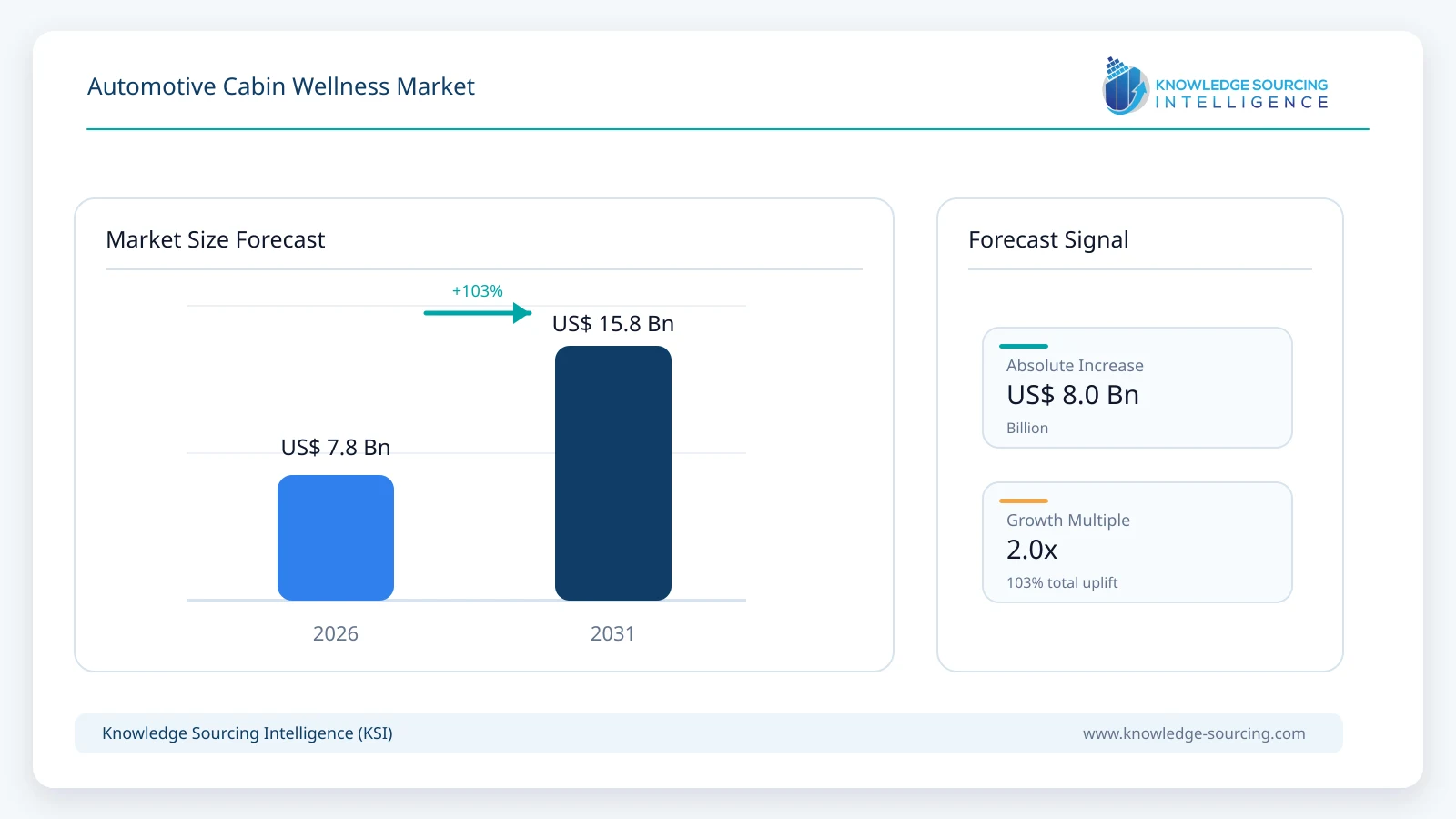
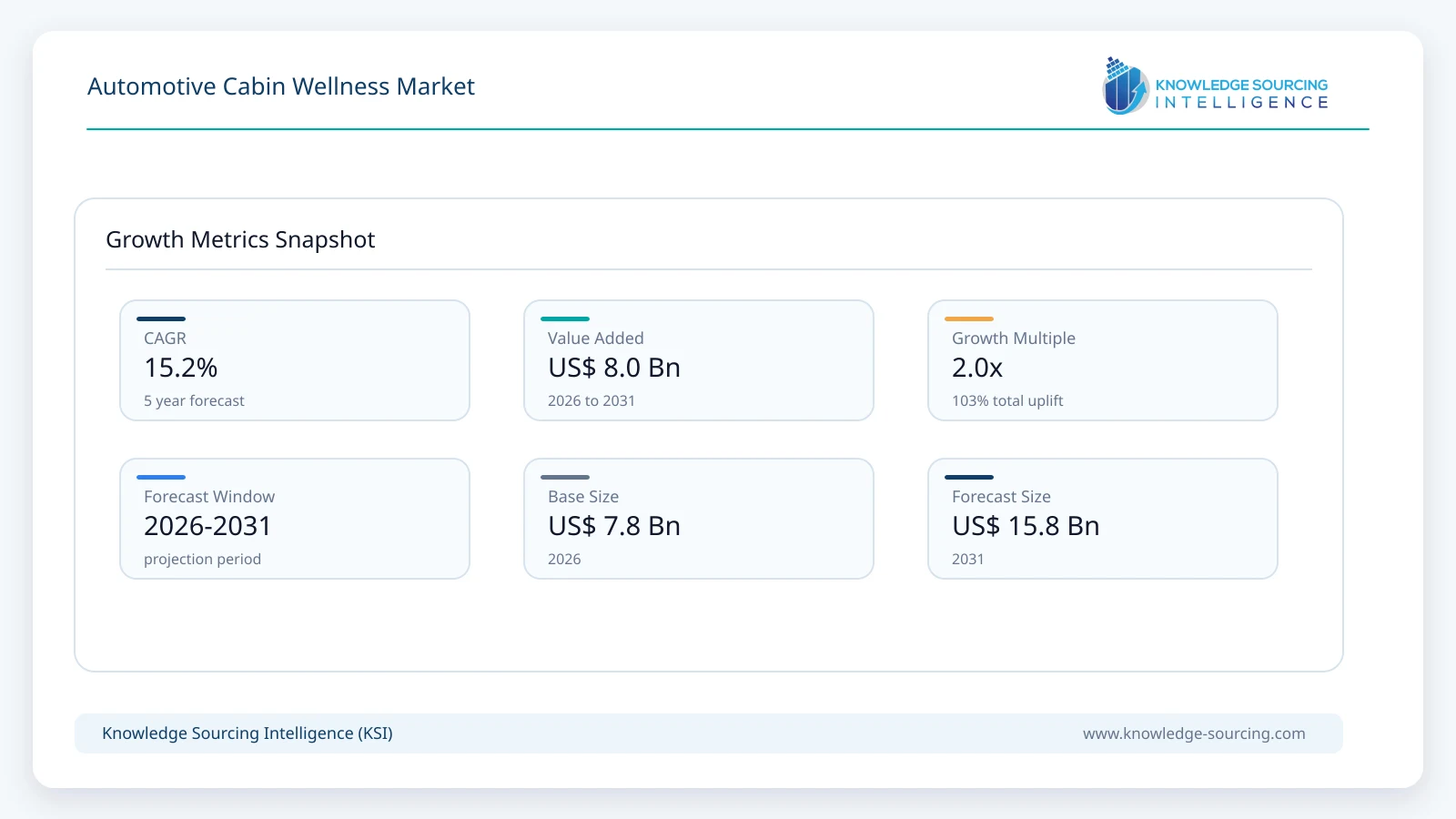
The automotive cabin wellness market is forecast to grow at a CAGR of 15.2%, reaching approximately USD 15.8 billion by 2031 from USD 7.80 billion in 2026.
Highlights:
- 1Personalized thermal and microclimate systems account for approximately 35% of global market value in 2026 because seat heating and ventilation, radiant heating, localized airflow and software-based thermal balancing provide the most mature scalable wellness proposition.
- 2Thermal comfort and relaxation functions represent approximately 41% of market value in 2026, supported by growing use of localized heating and cooling, massage, zero-pressure comfort modes and automated posture adjustment.
- 3Integrated multi-modal wellness architectures account for approximately 58% of 2026 market value as OEMs increasingly coordinate seating, climate, lighting, audio and sensing rather than offering independent single-function features.
- 4Premium and luxury vehicles represent approximately 46% of global market value in 2026 because higher price points support massage, advanced thermal comfort, air-quality systems, biometric sensing and personalized cabin modes.
- 5Battery electric vehicles account for approximately 42% of market value in 2026 because EV platforms place a premium on energy-efficient microclimate comfort and are frequently positioned with high-content software-defined interiors.
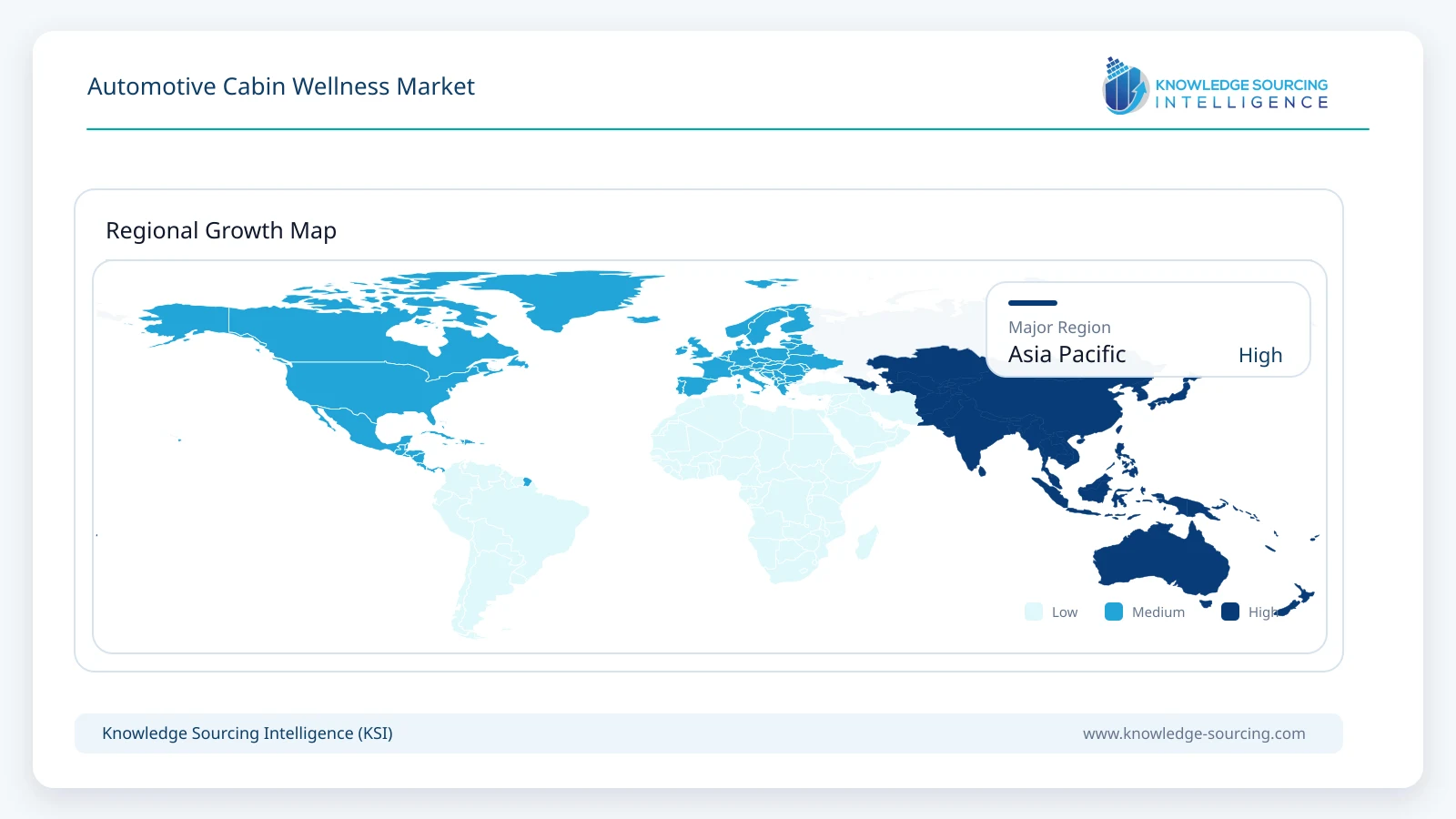
- 6Asia Pacific represents approximately 43% of global market value in 2026, supported by rapid smart-cabin development in China and established seating, thermal and interior-system capabilities in Japan and South Korea.
The market is moving beyond isolated comfort features toward coordinated wellness experiences in which seats, thermal effectors, lighting, air management, audio and occupant sensing work through a shared software layer.
Commercial deployment is already broadening. Lear is scaling modular thermal comfort systems including ComfortFlex, ComfortMax and INTU across multiple 2026 vehicle launches; Gentherm continues to expand ClimateSense, pneumatic comfort and Puls.A massage technologies; Yanfeng's XiM27 combines adaptive seating, individualized climate, responsive lighting and blood-oxygen monitoring; Toyota Boshoku's LOUNZE+ coordinates seating and interior functions around relaxation; and HARMAN Ready Care links vital-sign and fatigue sensing with temperature, lighting, audio and seat-massage responses.
The market boundary is defined around dedicated wellbeing value rather than conventional baseline equipment. Standard HVAC, ordinary manual seat adjustment and decorative ambient lighting are excluded unless they provide personalized thermal comfort, active posture support, stress or fatigue mitigation, air-quality improvement, physiological sensing or other measurable wellness functionality. This keeps the market focused on incremental systems and software that improve occupant physical or emotional state.
Market Overview
Cabin wellness is becoming a deliberate vehicle-design layer rather than a collection of optional comfort features. Automakers increasingly treat the interior as a controlled environment that can reduce thermal discomfort, physical fatigue, stress, poor posture and sensory overload while helping occupants remain alert or relax according to journey context.
Thermal comfort remains the largest commercial foundation. Gentherm's ClimateSense coordinates localized conductive, convective and radiant heating and cooling with central HVAC using thermophysiology-based software. Lear is expanding integrated thermal comfort through ComfortFlex and ComfortMax, while seat suppliers increasingly combine heating, ventilation, massage and occupant sensing within a common seat architecture.
Wellness is also becoming more responsive to occupant state. HARMAN Ready Care uses contactless vital-sign sensing and driver-state analysis to trigger personalized cabin responses. Lear INTU links seat sensing with comfort and wellness functions, while Yanfeng XiM27 uses AI-learned preferences and emotion recognition to adjust seating, temperature, lighting and audio. These systems shift the value proposition from user-selected comfort toward automated intervention.
Air and sensory quality are developing in parallel. Advanced filtration, purification, ionization, fragrance, UVC-capable lighting and noise-management technologies are being used to create cleaner and calmer cabins. Human-centric lighting can alter intensity, color or directional cues according to stress, fatigue, motion-sickness risk or time of day, while personalized audio and headrest sound can create individual relaxation zones.
The strongest long-term opportunity is the convergence of these domains. A future wellness controller can interpret occupant identity, posture, skin or cabin temperature, fatigue, breathing and journey context, then coordinate seat support, airflow, heat, massage, lighting, audio and air quality automatically. This increases software content and creates recurring opportunities for personalization and feature upgrades.
Market Trends
Microclimate Comfort Is Replacing One-Temperature-Fits-All HVAC
Localized thermal management is gaining importance because occupants experience comfort differently by body region, clothing, seat position and personal preference. Microclimate systems can heat or cool the occupant directly rather than conditioning the entire cabin to the same set point.
This is especially important in electric vehicles, where localized heating and cooling can reduce dependence on energy-intensive central HVAC while improving perceived comfort. The result is a direct link between cabin wellness and vehicle efficiency.
Seats Are Becoming Active Wellness Platforms
Seats increasingly combine heating, ventilation, massage, pneumatic adjustment, posture support and sensing within a single mechatronic system. Lear, Gentherm and other suppliers are pushing wellness content deeper into trim, foam, pneumatic and electronic architectures to reduce complexity while expanding functionality.
Massage and dynamic support are moving beyond luxury-only novelty toward fatigue mitigation and physical recovery. Software can vary intensity and pattern by occupant preference, journey duration or detected discomfort, creating a more personalized experience.
Cabins Are Beginning to Respond to Physiological and Emotional State
Non-contact camera and radar sensing can estimate heart rate, breathing, fatigue and stress indicators, while seat and interior sensors provide posture and pressure information. These inputs allow the cabin to respond automatically rather than relying on manual user selection.
HARMAN Ready Care demonstrates this direction by connecting vital-sign and driver-state sensing with interventions such as temperature change or seat massage. Yanfeng similarly positions emotion recognition and blood-oxygen monitoring as inputs to adaptive cabin behavior.
Human-Centric Lighting and Sensory Design Are Expanding the Wellness Stack
Ambient lighting is evolving from decorative color selection toward functional wellness. Hyundai Mobis has demonstrated human-centric lighting scenarios for stress reduction, motion-sickness mitigation and UVC sterilization, while other suppliers are coordinating light with music, displays and occupant state.
Acoustic zoning, headrest audio, fragrance and active noise management can create more private or calming personal environments. These functions are increasingly valuable in premium vehicles, shared mobility and long-distance travel.
Wellness Features Are Moving Down from Luxury Vehicles through Modular Architectures
Supplier modularity is lowering the cost of introducing wellness functions across more vehicle classes. Lear's modular thermal comfort systems, Gentherm's scalable microclimate effectors and software-controlled interior platforms allow OEMs to select different content levels without redesigning the complete cabin.
This creates a path from premium full-system deployments toward mid-range vehicles that may combine fewer functions but still offer meaningful wellness benefits such as localized heating, ventilation, basic massage, improved air quality or adaptive lighting.
Segment Analysis
By Wellness System: Personalized Thermal and Microclimate Systems
Personalized thermal and microclimate systems represent the largest wellness-system segment, accounting for approximately 35% of global market value in 2026. The category includes seat heating and ventilation, localized cooling, radiant heating, neck or surface warmers, zonal airflow, thermal sensing and software that coordinates these effectors with central HVAC.
The segment is expected to remain the largest through 2031 because thermal discomfort is universal, the technology can scale across vehicle classes and EV manufacturers have a direct incentive to improve comfort with lower energy use. Software-based personalization also allows the same hardware to deliver differentiated modes and over-the-air feature improvements.
By Wellness Function: Thermal Comfort and Relaxation
Thermal comfort and relaxation account for approximately 41% of global market value in 2026. The function combines temperature regulation with massage, posture support, recline and sensory cues that help occupants remain comfortable during commuting, long-distance travel or extended stationary use.
This function leads because it has immediate consumer value, mature supplier technology and clear integration pathways with seating and HVAC. Growth is increasingly driven by coordinated modes in which seat position, surface temperature, ventilation and massage operate together instead of as independent controls.
By Integration Architecture: Integrated Multi-Modal Wellness Systems
Integrated multi-modal systems account for approximately 58% of market value in 2026. These architectures connect two or more wellness domains, such as seat comfort, climate, lighting, audio, air quality or biosensing, through a shared controller or software layer.
Integration is becoming more important as OEMs seek coherent cabin experiences rather than feature overload. A common wellness layer can prioritize occupant needs, avoid conflicting commands and reduce the number of separate user interactions required to achieve comfort or alertness.
By Vehicle Class: Premium and Luxury Vehicles
Premium and luxury vehicles represent approximately 46% of global market value in 2026 despite a much smaller share of unit sales. High-content vehicles provide the strongest commercial environment for multi-zone thermal comfort, advanced massage, personalized lighting, fragrance, headrest audio, air purification and physiological monitoring.
Premium OEMs also use wellness as a differentiation tool in electric and software-defined vehicles where traditional performance attributes are becoming less distinctive. As supplier architectures become more modular, selected wellness functions are expected to diffuse into upper-mid and mass-market models.
By Propulsion: Battery Electric Vehicles
Battery electric vehicles account for approximately 42% of global cabin wellness market value in 2026. EV platforms often combine high interior electronics content with premium positioning, while localized microclimate technologies can improve perceived comfort with less central HVAC energy demand.
Battery-electric cabins are also well suited to preconditioning, software-controlled comfort modes and personalized thermal zones. These advantages are expected to keep BEVs overrepresented in wellness value even as hybrid and internal-combustion vehicles continue to contribute substantial unit volumes.
Market Drivers
Vehicle Premiumization and Competition around In-Cabin Experience
As powertrains become more electrified and digital, OEM differentiation is shifting toward the cabin. Wellness features create visible and experiential value through massage, thermal comfort, clean air, adaptive lighting and personalized responses.
Chinese EV brands, premium European automakers and technology-focused global OEMs are increasing the pace of interior innovation, pushing suppliers to deliver production-ready wellness features at shorter development cycles.
Energy-Efficient Thermal Comfort in Electric Vehicles
Electric vehicles create a strong economic case for localized thermal comfort because heating and cooling the occupant directly can reduce reliance on central HVAC. Microclimate systems can improve comfort while helping preserve driving range in extreme temperatures.
This connects a consumer benefit with an efficiency benefit, making personalized thermal management one of the most commercially durable wellness categories.
Rising Demand to Reduce Stress, Fatigue and Physical Discomfort
Long commutes, traffic congestion, extended screen use and sedentary travel increase the value of systems that support posture, reduce muscle fatigue and create a calmer environment. Massage, dynamic lumbar support, anti-fatigue lighting and adaptive climate can address discomfort before it becomes severe.
The opportunity extends beyond drivers to passengers as vehicles become more connected and higher automation allows occupants to spend more time working, reading, watching content or resting in the automotive Cabin.
Growth of Biosensing and Occupant-Aware Software
In-cabin cameras, radar, seat sensors and pressure sensing are expanding the amount of context available to the vehicle. Once the system understands occupant identity, posture, fatigue, breathing or stress indicators, it can adjust comfort functions more intelligently.
This sensor-to-action loop increases the value of software-defined wellness because the vehicle can intervene proactively rather than requiring repeated manual input.
Greater Consumer and OEM Attention to Air Quality and Healthy Interior Environments
Urban pollution, allergens, odor control and shared-cabin hygiene are increasing interest in advanced filtration, purification and air-treatment technologies. Premium vehicle buyers increasingly expect cabin air quality to be measured, displayed and managed rather than treated as an invisible HVAC function.
The trend supports integration of fine-particle sensing, high-efficiency filtration, purification, ionization, fragrance and other air-management functions into broader wellness packages.
Market Restraints
High Cost and Concentration in Premium Vehicle Segments
Multi-function wellness systems add sensors, actuators, pneumatic components, thermal effectors, control electronics and software. The incremental bill of materials can be significant, especially when massage, advanced air purification and biometric sensing are combined.
This keeps full-system adoption concentrated in premium models and requires suppliers to modularize hardware if wellness is to scale into high-volume vehicle classes.
Difficulty Validating Wellness Benefits without Making Medical Claims
automotive wellness features can improve comfort, alertness or perceived wellbeing, but claims around health outcomes require careful evidence and regulatory positioning. OEMs must distinguish comfort-oriented functionality from medical diagnosis or treatment.
This can slow commercialization of advanced physiological monitoring or therapeutic-style features because software logic, user messaging and validation must remain within appropriate automotive boundaries.
Data Privacy and Consent for Physiological and Behavioral Monitoring
Wellness systems may process heart rate, breathing, fatigue, emotion, identity, posture and other sensitive occupant information. Consumers and regulators increasingly expect transparent consent, secure processing and limits on data retention or external sharing.
Privacy-preserving edge processing can reduce risk, but it adds compute and software requirements and may complicate integration across multiple cabin domains.
Energy, Packaging and Weight Trade-Offs
Heating, cooling, massage pumps, air-treatment devices, lighting and high-performance electronics consume power and occupy packaging space. The challenge is greatest when multiple wellness functions are installed in already dense seats, consoles or instrument panels.
Suppliers must therefore improve actuator efficiency, integrate functions and reduce component count so the comfort benefit does not undermine EV range, mass targets or cabin packaging.
Integration Complexity and Risk of Sensory Overload
A cabin that independently changes seat position, temperature, airflow, lighting, sound and fragrance can become distracting or uncomfortable if the functions are poorly coordinated. Different occupants may also have conflicting preferences.
Wellness platforms need clear prioritization, easy override and individual-zone control. Poor integration can turn premium content into feature clutter, increasing validation effort and reducing perceived value.
Regional Outlook
Asia Pacific
Asia Pacific is the largest regional market and is expected to remain the principal growth center through 2031. China is driving rapid commercialization of smart-cabin features, premium EV interiors and software-controlled comfort, while Japan and South Korea contribute deep expertise in seating, lighting, interior systems and electronics.
Yanfeng's XiM27 illustrates the region's shift toward holistic wellness through AI-adaptive seating, individualized climate, oxygen generation, blood-oxygen monitoring and responsive lighting. Toyota Boshoku is developing LOUNZE+ around relaxation and emotional ease, while Hyundai Mobis is advancing human-centric lighting for stress, motion-sickness mitigation and sterilization scenarios.
The regional opportunity is strongest in premium EVs and technology-led domestic brands, but modular thermal and seating systems are expected to widen adoption into upper-mid vehicle classes as scale improves.
Europe
Europe remains a major high-value cabin wellness market because premium OEMs, stringent vehicle safety expectations and a mature supplier base support advanced comfort and occupant-state technologies. German premium brands in particular have long commercialized seat massage, multi-zone climate and advanced ambient lighting, providing a strong platform for more integrated wellness modes.
FORVIA, Lear and Gentherm supply seating, thermal and comfort technologies to European vehicle programs, while HARMAN Ready Care aligns with growing use of driver and occupant monitoring. The region is also important for data privacy, human-factors validation and the integration of wellness functions with evolving safety-assessment requirements.
Growth through 2031 will depend on moving beyond high-end option packages toward scalable systems that can meet energy-efficiency, sustainability and cost targets across a broader range of electric and hybrid vehicles.
Competitive Landscape
The automotive cabin wellness market includes thermal-comfort specialists, seating suppliers, interior-system integrators and in-cabin software providers. Competitive advantage depends increasingly on the ability to connect physical effectors with sensing and software rather than simply supplying a single comfort component.
Gentherm is differentiated by thermal-management science, ClimateSense microclimate control, pneumatic comfort and Puls.A massage. Lear combines complete seating, thermal comfort, massage, sensing and INTU software, while Yanfeng integrates seating, climate, lighting and wellbeing into full-cabin concepts. FORVIA and Toyota Boshoku bring complete seating and interior-system capabilities with strong comfort and relaxation positioning.
Hyundai Mobis adds human-centric lighting and neuro/driver-state technologies, while HARMAN connects physiological monitoring with cabin responses. Over time, competition is expected to shift toward platform-level integration, software personalization, low-energy effectors, privacy-preserving sensing and measurable improvements in occupant comfort.
Recent Developments
23 July 2026: Gentherm reported USD 690 million of new automotive business awards in the second quarter and 14.1% year-over-year growth in Automotive Climate and Comfort Solutions revenue, indicating continued OEM demand for thermal and pneumatic comfort technologies.
10 July 2026: Yanfeng announced that XiM27 received the 2026 Red Dot Design Concept Award. The platform combines individualized climate, adaptive lighting, spatial audio, AI-based emotion recognition and intelligent seating around passenger comfort and wellbeing.
29 June 2026: Yanfeng unveiled XiM27, a production-ready smart-cabin platform with AI-adaptive seating, natural wave-like ventilation, an active oxygen generator, blood-oxygen monitoring and centralized control across climate, lighting and seating.
23 April 2026: Toyota Boshoku presented LOUNZE+ at Auto China 2026, coordinating seats, door trims and console functions to create a living-room-like mobility space focused on relaxation, reassurance and individualized comfort.
4 February 2026: Lear reported continued expansion of its Thermal Comfort Systems business, including 2026 launches for ComfortFlex and ComfortMax across multiple global vehicle programs and new thermal-comfort awards with Chinese and global automakers.
13 January 2026: HARMAN introduced new Ready Care capabilities that combine occupant monitoring and vital-sign sensing with personalized mitigation responses including temperature, lighting, audio and seat-massage adjustments.
5 February 2025: Lear announced engineering integration of ComfortMax Seat with General Motors, embedding heating, ventilation and other thermal comfort functions directly into seat trim covers to improve occupant comfort and manufacturing efficiency.
12 December 2024: Hyundai Mobis announced CES 2025 demonstrations of Human-Centric Interior Lighting, using in-cabin sensing and up to 32 lighting scenarios for stress reduction, motion-sickness mitigation, safety support and UVC sterilization.
Market Outlook
The automotive cabin wellness market is expected to expand steadily through 2031 as comfort functions become more personalized, more software-controlled and more deeply connected with occupant sensing. Thermal microclimate will remain the largest value pool, but faster growth is expected in integrated massage and posture systems, human-centric lighting, biosensing and multi-modal wellness software.
The market will increasingly move from user-selected features toward adaptive experiences. Vehicles will learn individual preferences, interpret occupant state and coordinate thermal effectors, seat support, airflow, light, sound and other functions automatically. The most successful systems will be those that improve comfort without creating intrusive interaction or excessive energy consumption.
Asia Pacific is expected to retain the largest regional share, while Europe remains a major premium engineering and validation market. Competitive advantage will depend on scalable hardware, low-energy operation, proven comfort science, privacy-preserving sensing, software integration and the ability to translate subjective wellbeing into consistent, measurable cabin performance.
Automotive Cabin Wellness Market Scope:
| Report Metric | Details |
|---|---|
| Total Market Size in 2026 | USD 7.80 billion |
| Total Market Size in 2031 | USD 15.8 billion |
| Forecast Unit | USD Billion |
| Growth Rate | 15.2% |
| Study Period | 2021 to 2031 |
| Historical Data | 2021 to 2024 |
| Base Year | 2025 |
| Forecast Period | 2026 – 2031 |
| Segmentation | Wellness System, Wellness Function, Integration Architecture, Vehicle Class, Propulsion, Geography |
| Companies |
|
Market Segmentation
By Wellness System
Personalized Thermal and Microclimate Systems
Seating Massage, Posture and Pneumatic Comfort Systems
Air Quality, Filtration and Purification Systems
Human-Centric Lighting, Acoustic and Sensory Systems
Biosensing and Adaptive Wellness Software
By Wellness Function
Thermal Comfort and Relaxation
Stress and Fatigue Mitigation
Air Quality and Respiratory Comfort
Posture and Physical Recovery
Sensory and Emotional Wellbeing
By Integration Architecture
Integrated Multi-Modal Wellness Systems
Standalone and Single-Function Wellness Systems
By Vehicle Class
Premium and Luxury Vehicles
Mid-Range Vehicles
Mass-Market and Economy Vehicles
By Propulsion
Battery Electric Vehicles
Hybrid and Plug-in Hybrid Electric Vehicles
Internal Combustion Engine Vehicles
Fuel Cell Electric Vehicles
By Geography
North America
United States
Canada
Mexico
South America
Brazil
Argentina
Others
Europe
Germany
United Kingdom
France
Italy
Spain
Others
Middle East and Africa
Saudi Arabia
UAE
South Africa
Others
Asia Pacific
China
Japan
South Korea
India
Singapore
Others
Table of Contents
1. INTRODUCTION
1.1. Market Overview
1.2. Market Definition
1.3. Scope of the Study
1.4. Market Segmentation
1.5. Currency
1.6. Assumptions
1.7. Base and Forecast Years
1.8. Key Benefits to Stakeholders
2. RESEARCH METHODOLOGY
2.1. Research Design
2.2. Secondary Research
2.3. Primary Research
2.4. Market Estimation
2.5. Segment Modelling
2.6. Data Triangulation and Validation
3. EXECUTIVE SUMMARY
3.1. Key Findings
3.2. Automotive Cabin Wellness Market Size, 2026-2031
3.3. Wellness System Outlook
3.4. Wellness Function Outlook
3.5. Integration Architecture Outlook
3.6. Vehicle Class Outlook
3.7. Propulsion Outlook
3.8. Regional Opportunity Summary
4. MARKET DYNAMICS
4.1. Market Drivers
4.1.1. Vehicle Premiumization and Competition around In-Cabin Experience
4.1.2. Energy-Efficient Thermal Comfort in Electric Vehicles
4.1.3. Rising Demand to Reduce Stress, Fatigue and Physical Discomfort
4.1.4. Growth of Biosensing and Occupant-Aware Software
4.1.5. Greater Consumer and OEM Attention to Air Quality and Healthy Interior Environments
4.2. Market Restraints
4.2.1. High Cost and Concentration in Premium Vehicle Segments
4.2.2. Difficulty Validating Wellness Benefits without Making Medical Claims
4.2.3. Data Privacy and Consent for Physiological and Behavioral Monitoring
4.2.4. Energy, Packaging and Weight Trade-Offs
4.2.5. Integration Complexity and Risk of Sensory Overload
4.3. Market Opportunities
4.4. Porter's Five Forces Analysis
4.5. Industry Value Chain Analysis
4.6. Cabin Wellness System Economics
4.7. Health Claims, Data Privacy and Human-Factors Environment
5. TECHNOLOGY OUTLOOK
5.1. Personalized Thermal Microclimate and Zonal Comfort
5.2. Seat Heating, Ventilation and Surface Conditioning
5.3. Massage, Pneumatic Support and Dynamic Posture Control
5.4. Cabin Air Filtration, Purification and Air-Quality Sensing
5.5. Human-Centric and Circadian-Aware Lighting
5.6. Acoustic Zoning, Active Noise Management and Personal Audio
5.7. Fragrance, Oxygenation and Sensory Environment Control
5.8. Vital-Sign, Fatigue and Stress Sensing
5.9. AI-Based Wellness Personalization and Adaptive Cabin Modes
5.10. Wellness Controllers and Cross-Domain Integration
5.11. Energy-Efficient Wellness Systems for Electric Vehicles
6. AUTOMOTIVE CABIN WELLNESS MARKET BY WELLNESS SYSTEM
6.1. Introduction
6.2. Personalized Thermal and Microclimate Systems
6.3. Seating Massage, Posture and Pneumatic Comfort Systems
6.4. Air Quality, Filtration and Purification Systems
6.5. Human-Centric Lighting, Acoustic and Sensory Systems
6.6. Biosensing and Adaptive Wellness Software
7. AUTOMOTIVE CABIN WELLNESS MARKET BY WELLNESS FUNCTION
7.1. Introduction
7.2. Thermal Comfort and Relaxation
7.3. Stress and Fatigue Mitigation
7.4. Air Quality and Respiratory Comfort
7.5. Posture and Physical Recovery
7.6. Sensory and Emotional Wellbeing
8. AUTOMOTIVE CABIN WELLNESS MARKET BY INTEGRATION ARCHITECTURE
8.1. Introduction
8.2. Integrated Multi-Modal Wellness Systems
8.3. Standalone and Single-Function Wellness Systems
9. AUTOMOTIVE CABIN WELLNESS MARKET BY VEHICLE CLASS
9.1. Introduction
9.2. Premium and Luxury Vehicles
9.3. Mid-Range Vehicles
9.4. Mass-Market and Economy Vehicles
10. AUTOMOTIVE CABIN WELLNESS MARKET BY PROPULSION
10.1. Introduction
10.2. Battery Electric Vehicles
10.3. Hybrid and Plug-in Hybrid Electric Vehicles
10.4. Internal Combustion Engine Vehicles
10.5. Fuel Cell Electric Vehicles
11. AUTOMOTIVE CABIN WELLNESS MARKET BY GEOGRAPHY
11.1. North America
11.1.1. United States
11.1.2. Canada
11.1.3. Mexico
11.2. South America
11.2.1. Brazil
11.2.2. Argentina
11.2.3. Others
11.3. Europe
11.3.1. Germany
11.3.2. United Kingdom
11.3.3. France
11.3.4. Italy
11.3.5. Spain
11.3.6. Others
11.4. Middle East and Africa
11.4.1. Saudi Arabia
11.4.2. UAE
11.4.3. South Africa
11.4.4. Others
11.5. Asia Pacific
11.5.1. China
11.5.2. Japan
11.5.3. South Korea
11.5.4. India
11.5.5. Singapore
11.5.6. Others
12. COMPETITIVE ENVIRONMENT AND ANALYSIS
12.1. Major Players and Strategy Analysis
12.2. Market Share Analysis
12.3. Cabin Wellness Technology Benchmarking
12.4. Product Launches and Development Activity
12.5. Competitive Dashboard
13. COMPANY PROFILES
13.1. Gentherm Incorporated
13.2. Lear Corporation
13.3. Yanfeng
13.4. FORVIA
13.5. Toyota Boshoku Corporation
13.6. Hyundai Mobis
13.7. HARMAN International
14. APPENDIX
14.1. Currency
14.2. Assumptions
14.3. Base and Forecast Years Timeline
14.4. Key Benefits for Stakeholders
14.5. Research Methodology
14.6. Abbreviations
14.7. Data Sources
Navigate
Trusted by the world's leading organizations











