
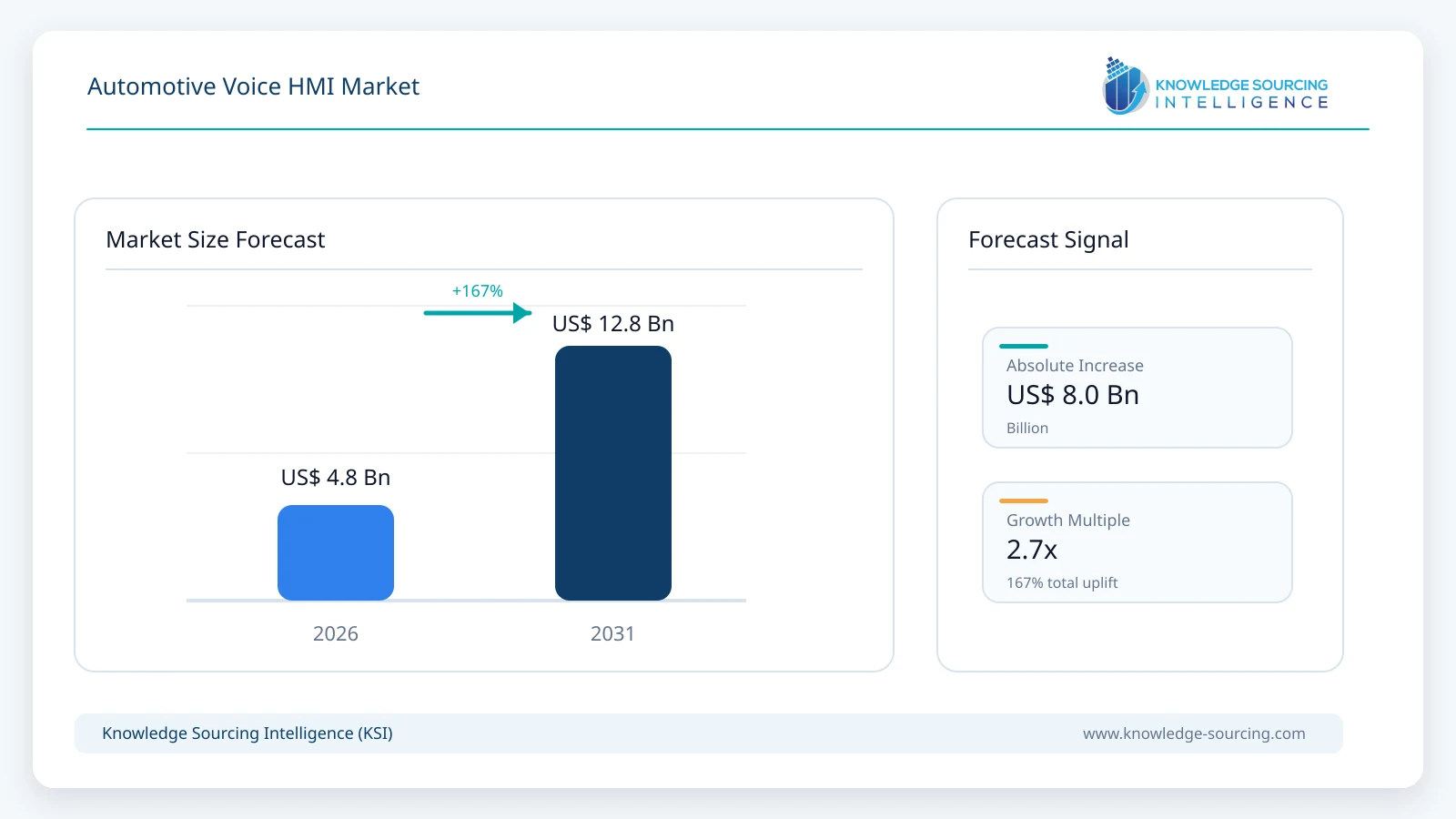
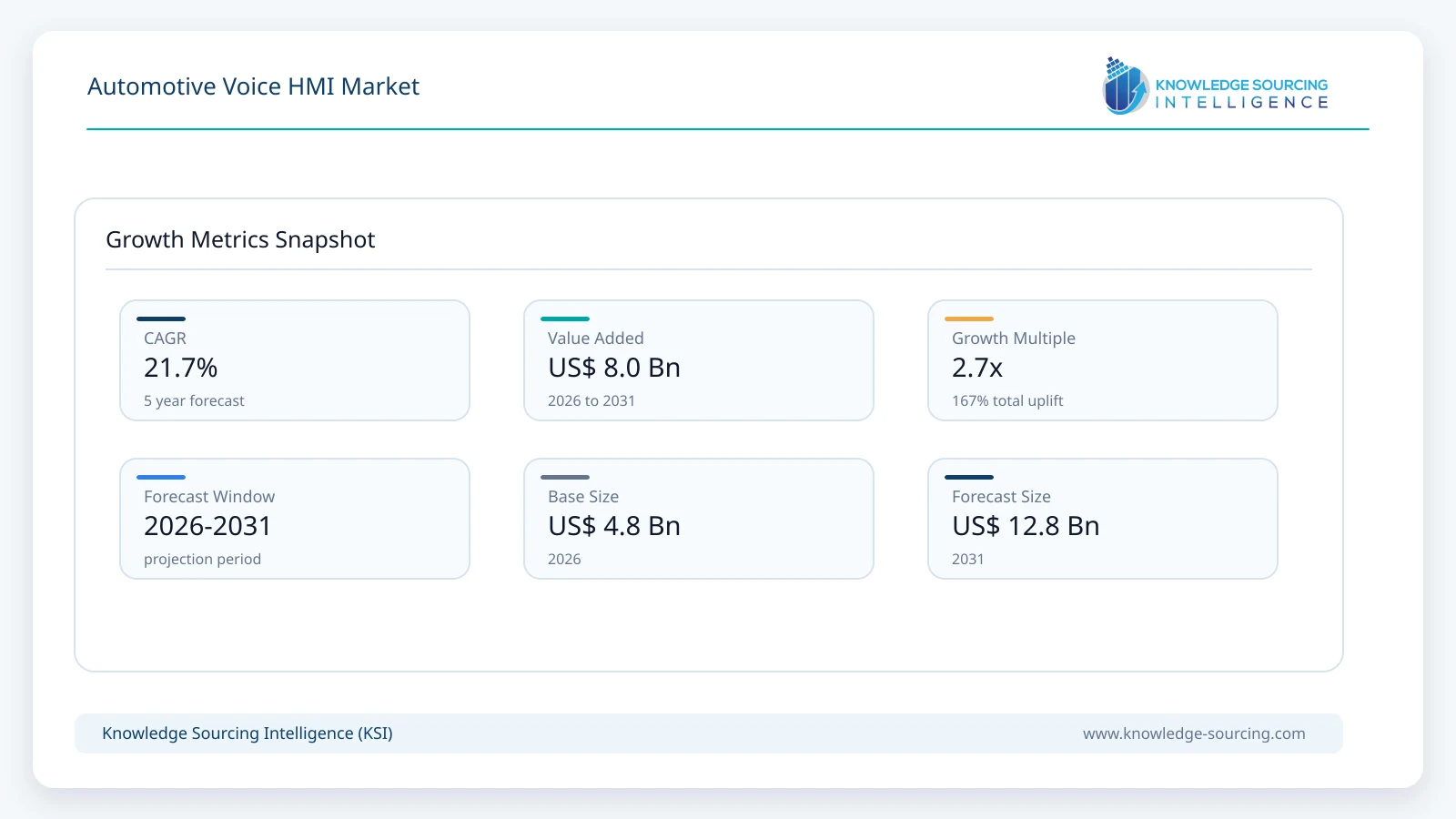
The automotive voice HMI market is forecast to grow at a CAGR of 21.7%, reaching USD 12.8 billion in 2031 from USD 4.8 billion in 2026.
Highlights:
- 1Conversational and generative voice AI accounts for approximately 36% of global market value in 2026 because OEMs are expanding voice assistants beyond fixed commands into multi-turn dialogue, open-ended vehicle knowledge and LLM-powered interaction.
- 2Hybrid edge-cloud voice architecture represents approximately 58% of 2026 market value because core vehicle commands require low-latency embedded processing while connected knowledge, larger language models and live services benefit from cloud execution.
- 3Infotainment, navigation and vehicle-control interaction accounts for approximately 47% of market value in 2026, reflecting the commercial maturity of voice-led media, destination search, climate and vehicle-setting functions.
- 4Driver-centric voice interaction represents approximately 72% of 2026 market value, although multi-seat and all-cabin voice recognition are gaining share as assistants distinguish speakers, seating zones and passenger-specific requests.
- 5Passenger vehicles account for approximately 92% of global market value in 2026 because voice assistants, connected infotainment and digital cockpit software are most widely deployed in passenger cars, SUVs and MPVs.
- 6Asia Pacific represents approximately 40% of global market value in 2026, supported by rapid smart-cockpit adoption in China and strong electronics, infotainment and speech-localization ecosystems across China, Japan and South Korea.
Voice interaction is moving from fixed command grammars and menu shortcuts toward natural, multi-turn and increasingly agentic dialogue that can understand ambiguous requests, maintain conversational context and connect spoken intent directly with navigation, media, climate, communication and other vehicle domains. This transition expands the addressable value from speech recognition alone into audio front-end processing, automotive language models, edge inference, cloud orchestration, text-to-speech, multi-seat interaction and lifecycle software updates.
Commercial deployment is accelerating across OEM and supplier ecosystems as voice assistants become more deeply integrated with vehicle software. Cerence xUI is entering production programs with Geely and BYD through a hybrid agentic architecture, BMW is rolling out an Alexa+-based Intelligent Personal Assistant that supports natural dialogue and vehicle-function control, and HARMAN Ready Engage combines context, intent and branded digital interaction across cabin domains. The competitive focus is therefore shifting toward low-latency speech performance in noisy cabins, multilingual accuracy, offline capability, brand customization, secure action execution and the ability to blend embedded speech services with rapidly evolving cloud and generative-AI models.
Market Overview
Voice HMI provides the spoken interaction layer between occupants and the vehicle, allowing users to access functions without navigating dense touchscreen menus or learning exact control paths. Earlier systems depended on predefined command phrases and narrow domain grammars, whereas current architectures increasingly accept natural language, infer intent from incomplete requests and retain context across follow-up questions, making voice useful for both direct control and more open-ended assistance.
The voice stack extends well beyond speech recognition because reliable in-vehicle interaction begins with microphone capture, echo cancellation, beamforming, noise suppression, and speaker-zone detection before language processing occurs. Cerence Audio AI and similar automotive speech front ends address overlapping passengers, road noise, entertainment audio, and emergency sounds, while multi-zone processing helps the assistant determine which occupant is speaking and whether a request should affect the driver, passenger, or a specific seat.
Hybrid embedded and cloud processing is becoming the dominant architecture because high-frequency vehicle commands need deterministic local response while generative knowledge, web-connected services and larger models continue to evolve rapidly in the cloud. Cerence xUI combines CaLLM Edge with cloud orchestration, while BMW's Alexa+-based assistant links natural dialogue with vehicle functions and broader knowledge. The hybrid model reduces connectivity dependence without forcing the embedded head unit to host every language model or external service locally.
Voice HMI is also moving toward agentic execution in which the assistant can coordinate multiple steps rather than answer one request at a time. Domain-specific agents can interpret a broad intent, access calendar or navigation context, adjust vehicle settings, and confirm actions through a single conversational thread. This increases the strategic value of permissions, guardrails, identity management and action orchestration because production systems must distinguish between harmless conversation and commands that affect the vehicle or user data.
Market Trends
Generative and Agentic AI Are Moving Voice HMI beyond Fixed Command Grammars
Automotive voice assistants are increasingly adopting large and small language models because natural dialogue can replace rigid intent lists and allow users to combine several requests in one sentence. BMW's 2026 Intelligent Personal Assistant with Alexa+ supports free-form dialogue and contextual follow-up requests, while Cerence xUI uses automotive-specific language models and domain agents to interpret multi-step tasks across vehicle and connected-service domains.
Generative voice HMI creates the greatest commercial value when natural language reduces interaction friction and translates directly into bounded automotive actions rather than simply expanding access to general knowledge. Production systems therefore need language models that preserve context across turns while handing commands to deterministic vehicle-control layers without allowing open-ended reasoning to bypass safety or permission rules.
Hybrid Edge-Cloud Voice Processing Is Becoming the Preferred Production Architecture
Automakers are balancing embedded reliability with cloud intelligence because voice HMI must continue to handle essential vehicle functions when connectivity is weak while still accessing live content and more capable generative models when a network is available. Cerence xUI and Cerence Assistant explicitly combine onboard speech and language processing with cloud services, and current cockpit platforms increasingly reserve NPU capacity for local language-model inference.
Hybrid execution also gives OEMs more control over latency, privacy, and cloud operating cost because frequent commands can remain inside the vehicle while less common or knowledge-heavy queries are escalated externally. The architecture requires disciplined workload routing and version management, so users receive consistent behavior even when different parts of the same conversation are processed on different compute environments.
Multi-Seat and Multi-Zone Voice Recognition Are Expanding Assistant Coverage beyond the Driver
Voice HMI is moving from a single driver microphone channel toward cabin-wide interaction in which several occupants can address the assistant from different seating positions. Cerence xUI supports multi-seat interaction and distinct acoustic zones, while advanced audio processing can prioritize speakers, suppress interfering conversations, and route responses to the appropriate occupant.
All-cabin voice interaction creates new passenger use cases for media, climate, and productivity but increases the need for speaker identification, seat association, and privacy controls. The system must understand not only what was said but who said it, whether that person has permission to execute the request and whether the response should be shared across the cabin or kept personal.
Speech Front-End Quality Is Becoming More Important as Voice Assistants Grow More Capable
More sophisticated language models do not solve poor acoustic input, making microphone-array design, echo cancellation, noise suppression and beamforming increasingly important to perceived assistant quality. Road noise, open windows, music playback, overlapping passengers and regional accents can degrade recognition before the request ever reaches the language model.
Automotive-grade voice suppliers therefore differentiate through the complete speech chain rather than through conversational AI alone. Reliable front-end processing lowers false activations, reduces repeated commands, and allows generative assistants to operate effectively in real driving conditions where consumer-device speech models may not perform consistently.
Voice Is Becoming a Control Layer for Productivity, Vehicle Knowledge and Connected Services
Automotive assistants are expanding beyond media and navigation into work, ownership support, vehicle explanation and third-party service orchestration. Cerence's Mobile Work Agent provides voice-first access to Microsoft 365 workflows, while ownership-focused agents can answer questions about vehicle features, warnings, and maintenance through the same conversational interface used for in-car control.
The expansion broadens monetization beyond the original infotainment use case because voice becomes a gateway to digital services throughout the ownership lifecycle. OEMs nevertheless need strong identity, data-sharing and distraction policies so productivity or commercial services do not overwhelm the driver or expose personal information in shared cabin environments.
Segment Analysis
By Voice Technology: Conversational and Generative Voice AI
Conversational and generative voice AI is projected to generate approximately USD 5.20 billion of market value by 2031 as OEMs replace rigid command-and-control systems with assistants that understand natural phrasing, context, multi-intent requests and follow-up questions. Automotive-specific language models and retrieval systems also improve the ability to explain vehicle functions and connect broad user requests with actionable domains.
Conversational and generative voice AI should gain value faster than conventional ASR and NLU because these capabilities increasingly sit above the entire voice stack as the visible user experience. Traditional speech recognition remains essential infrastructure, but differentiation is shifting toward context retention, agent orchestration, domain grounding, and controlled execution rather than transcription accuracy alone.
By Deployment Architecture: Hybrid Edge-Cloud Voice HMI
Hybrid edge-cloud voice HMI is projected to generate approximately USD 7.25 billion of market value by 2031 because it combines fast local execution for core vehicle functions with cloud access for broader knowledge, connected services and large language models. The architecture supports graceful degradation when connectivity is weak while preserving the ability to update cloud intelligence independently of the vehicle hardware lifecycle.
Embedded-only voice remains important for cost-sensitive or privacy-critical applications, while cloud-centric architectures retain value for service-rich assistants, but the hybrid model offers the strongest balance of resilience and capability. Commercial performance will depend on routing logic that decides which requests stay local, which require the cloud, and how conversational context is preserved across both environments.
By Interaction Scope: Driver-Centric Voice HMI
Driver-centric voice HMI is projected to generate approximately USD 8.55 billion of market value by 2031 because hands-free access to navigation, media, calls, climate and vehicle settings remains the primary production use case. The driver also receives the largest safety benefit from voice interaction when it reduces the need to search menus or reach for distant touch controls.
Multi-seat voice interaction should grow faster as passenger displays and personalized cabin zones become more common, but driver-centered assistants retain the largest absolute value because they are integrated into the core HMI of nearly every voice-enabled vehicle. Future systems will increasingly allow one assistant to shift between driver priority and passenger-specific interaction based on seating, identity and current driving context.
By Application: Infotainment, Navigation and Vehicle Control
Infotainment, navigation and vehicle-control functions are projected to generate approximately USD 5.95 billion of market value by 2031 because these domains combine high interaction frequency with clear hands-free benefits. Destination entry, media search, phone calls, climate adjustment and vehicle-settings access provide immediate user value and can be executed through bounded APIs with relatively clear confirmation logic.
Productivity, vehicle knowledge and broader connected services will expand the voice value pool, but core cockpit control remains the largest application because it is available across more vehicle classes and does not depend on premium subscriptions. Voice suppliers that integrate deeply with OEM domain APIs should therefore capture more value than assistants limited to general question answering.
By Vehicle Class: Premium and Upper-Mid-Range Vehicles
Premium and upper-mid-range vehicles are projected to generate approximately USD 6.05 billion of market value by 2031 because these platforms have the richest microphone arrays, cockpit compute, connected-service portfolios and willingness to deploy generative or branded assistants early. Premium OEMs also use voice quality, personality and multilingual capability as visible differentiation within the digital cockpit.
Mid-range adoption should broaden rapidly as embedded speech models become smaller and cloud services reduce the need for premium local compute, but premium vehicles will retain disproportionate value through multi-seat audio, advanced agents and broader service integration. The segment remains the primary launch environment for new voice capabilities before they migrate into higher-volume platforms.
By Vehicle Type: Passenger Vehicles
Passenger vehicles are projected to generate approximately USD 11.80 billion of market value by 2031 because connected infotainment, navigation and digital-assistant platforms are most widely deployed in passenger cars, SUVs and MPVs. Large production volumes also allow OEMs to amortize language localization and cloud-service development across several global nameplates.
Commercial vehicles will create meaningful use cases in navigation, fleet workflows, communication and driver productivity, but lower annual production keeps total value smaller. Shared and autonomous mobility can support richer passenger voice interaction, although broad market impact will depend on deployment scale and integration with passenger identity and service ecosystems.
Market Drivers
Touchscreen Complexity Is Increasing Demand for Natural Hands-Free Interaction
Digital cockpits now expose navigation, media, climate, communication and vehicle settings through increasingly dense software interfaces, making menu-based interaction harder to manage while driving. Voice provides a direct path from user intent to function without requiring the driver to understand where a control is located in the interface hierarchy.
The driver-distraction benefit is strongest when voice completes common tasks reliably in one or two turns rather than forcing repeated clarification. Automakers therefore have a commercial incentive to improve speech quality and domain integration as cockpit software grows more complex.
Automotive Large and Small Language Models Are Improving Conversational Capability
Automotive-specific language models can interpret implicit requests, retain dialogue context and translate ordinary speech into vehicle-relevant intents more effectively than legacy grammar systems. Cerence CaLLM and CaLLM Edge demonstrate how cloud and embedded models are being tuned around automotive data, while BMW's Alexa+-based assistant shows OEM adoption of LLM-driven natural dialogue in production vehicles.
Better language understanding expands voice usage because drivers no longer need to memorize exact commands or restart a request after minor wording changes. The commercial opportunity increases further when smaller models bring these capabilities to embedded hardware with lower latency and lower cloud cost.
Improved In-Cabin Audio Processing Is Raising Recognition Reliability
Modern vehicles increasingly use multi-microphone arrays, beamforming, speech enhancement and zone detection to isolate a speaker from road noise, music and other occupants. Cerence Audio AI highlights the importance of noise reduction and multi-speaker processing in next-generation voice assistants, particularly as rear-seat passengers gain their own interaction zones.
Higher acoustic reliability directly affects adoption because users quickly abandon voice systems that require repeated commands or fail under common driving conditions. Audio front-end investment therefore supports the market even when the visible assistant software is supplied by a separate vendor.
Software-Defined Vehicle Platforms Are Making Voice HMI Easier to Update and Extend
Software-defined cockpits expose vehicle functions through reusable APIs and support OTA updates, allowing voice assistants to add new domains, languages, and agents after the vehicle leaves the factory. Hybrid platforms can update cloud capabilities frequently while preserving stable embedded control layers for core functions.
Lifecycle software support expands revenue potential because OEMs can improve the assistant, add subscription features or localize services without replacing the head unit. The same architecture also reduces program-specific engineering when one voice platform can be reused across several vehicle lines.
Multilingual and Global Vehicle Programs Are Increasing Demand for Scalable Localization
Global OEMs need voice assistants that operate across languages, dialects, accents and regional service ecosystems without fragmenting into completely separate software stacks. Cerence emphasizes broad language coverage and Geely's xUI deployment specifically targets overseas localization requirements, demonstrating the commercial importance of global speech scalability.
Reusable language tooling lowers the cost of launching voice features in additional markets and helps OEMs maintain a consistent brand personality worldwide. Suppliers with strong acoustic data, local content integration and language-specific tuning are therefore better positioned for global platform awards than vendors focused on a small number of major languages.
Market Restraints
Recognition Errors in Real Driving Conditions Can Damage User Trust
Voice HMI must operate through road noise, music, open windows, overlapping speech and a wide range of accents, making real-world recognition more difficult than controlled consumer-device use. An assistant that repeatedly mishears destinations or vehicle commands can create more distraction than the touchscreen interaction it was intended to replace.
Automotive validation therefore requires extensive acoustic testing, confidence management and fallback behavior across vehicle variants and markets. Language-model improvements cannot fully compensate for weak microphone placement or speech front-end design, so system performance depends on coordinated hardware and software engineering.
Generative Responses and Agentic Actions Require Strong Automotive Guardrails
LLM-based assistants can produce incorrect information or interpret broad requests in unintended ways, which becomes materially more serious when the system is connected to navigation, climate, communications or other vehicle domains. Production voice HMI therefore needs deterministic action layers, bounded permissions and confirmation rules that separate conversational reasoning from execution.
The validation burden increases as assistants orchestrate more domains because the number of possible dialogue paths and action sequences expands rapidly. OEMs must test not only speech recognition but the complete chain from spoken intent through agent reasoning to final vehicle action and user confirmation.
Cloud Dependence Can Increase Latency, Operating Cost and Service Risk
Cloud voice processing provides access to larger models and live information but introduces connectivity dependence, recurring inference cost and exposure to external service changes. Weak network coverage can degrade responsiveness precisely when users expect the same basic vehicle functions to remain available.
Hybrid architecture mitigates the problem but requires duplicate capabilities, synchronization, and routing logic between embedded and cloud systems. OEMs also need long-term commercial arrangements that remain viable over vehicle lifecycles much longer than typical consumer cloud-service contracts.
Privacy and Identity Management Become More Complex with Personalized Voice Assistants
Voice assistants can process speech recordings, contacts, calendars, location history, account data and personal preferences, creating privacy risk if information is stored or transmitted without clear consent. Multi-seat interaction adds another layer because the system must determine which speaker is authorized to access personal services or execute specific vehicle functions.
Local wake-word and command processing, explicit account controls, and data minimization can reduce exposure, but premium agentic features still require careful identity and permission management. Shared, rented and family vehicles make these controls especially important because several users may interact with the same assistant over the vehicle lifecycle.
Language Localization and Long-Term Model Maintenance Remain Costly
Automotive voice systems must support regional accents, place names, media services, vehicle terminology and changing language usage across many markets, while vehicles remain in service for a decade or more. Generative models and cloud APIs evolve much faster than automotive software certification cycles, creating ongoing maintenance requirements.
OEMs therefore face continuous cost for language updates, model validation, service compatibility and cybersecurity rather than a one-time speech-integration expense. Platforms with modular language packs and hardware-independent speech services can reduce this burden, but global voice deployment remains more complex than launching a visual interface that relies less on linguistic localization.
Regional Outlook
Asia Pacific
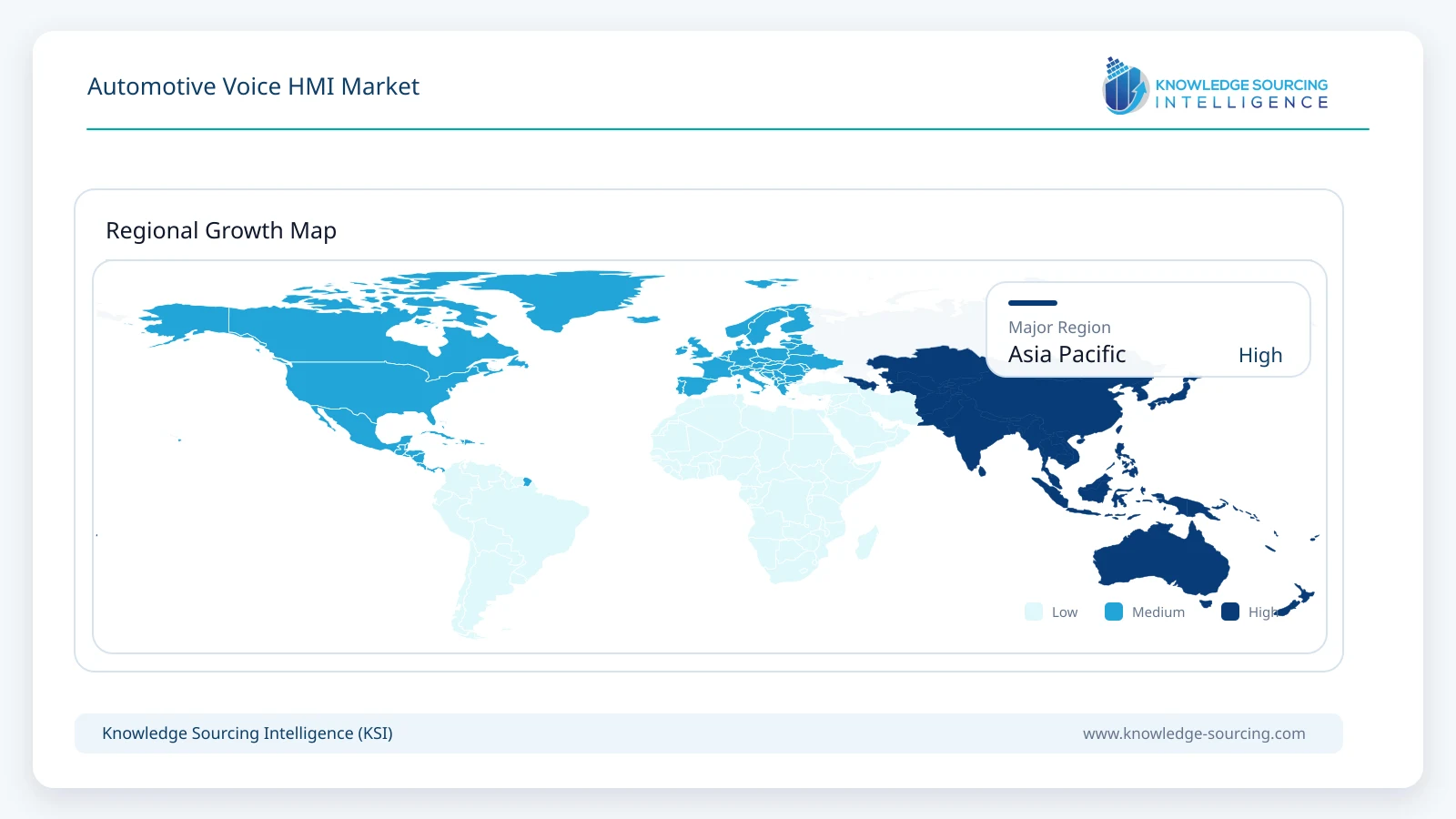
Asia Pacific is estimated to be the largest regional automotive voice HMI market in 2026 because China combines high connected-vehicle penetration with rapid adoption of smart-cockpit assistants, LLM-powered interfaces, and local digital-service ecosystems. Japan and South Korea add strong automotive electronics and infotainment capabilities, while regional OEMs are increasingly treating natural-language interaction as a standard smart-cabin feature rather than a premium-only option.
Cerence's 2026 xUI programs with Geely and BYD demonstrate the importance of scalable multilingual voice platforms for Chinese OEMs expanding internationally. The region also benefits from high vehicle volumes and frequent software refresh cycles, which allow voice assistants to evolve through OTA updates and spread quickly across several brands and price points once a common platform is established.
Asia Pacific growth through 2031 should be strongest where OEMs combine localized speech data, embedded processing and domestic digital services instead of relying entirely on global cloud platforms. Suppliers able to support Chinese-language ecosystems, multi-seat interaction and rapid localization across export markets are positioned to capture a disproportionate share of incremental volume.
Europe
Europe represents the second major high-value voice HMI market because premium OEMs have long integrated branded voice assistants and are now moving aggressively toward generative dialogue and software-defined cockpit architectures. BMW's Alexa+-based Intelligent Personal Assistant, Mercedes-Benz's generative-AI MBUX Virtual Assistant and Cerence's long-standing relationships with major European OEMs provide a strong commercialization base for advanced voice interaction.
European programs place particular emphasis on multilingual accuracy, privacy, brand control and low-distraction access to vehicle functions. BMW's 2026 rollout links natural dialogue directly with navigation and vehicle control, while next-generation Mercedes-Benz MBUX uses generative AI to maintain conversational context and provide personalized recommendations.
Regional growth will depend on whether voice suppliers can combine consumer-grade conversational quality with automotive privacy, cybersecurity and validation requirements. Premium models should remain the launch point for advanced agentic functions, while scalable embedded models and hybrid cloud architectures gradually move richer voice interaction into higher-volume segments.
Competitive Landscape
The automotive voice HMI market combines specialist conversational-AI suppliers, consumer voice-platform providers, cockpit integrators and OEM-developed assistant stacks. Cerence AI, Amazon, HARMAN International, SoundHound AI, Google, Mercedes-Benz and BMW are directly relevant through automotive speech recognition, embedded and cloud voice engines, large-language-model integration, branded assistants and vehicle-domain orchestration.
Cerence AI competes through a broad automotive speech stack spanning wake word, speech signal enhancement, embedded and cloud ASR, TTS, multi-zone audio, CaLLM language models and xUI agent orchestration. Amazon supplies Alexa Custom Assistant and Alexa+ technology to BMW, while HARMAN integrates voice-led context and intent through Ready Engage as part of a wider production-ready cabin platform.
SoundHound AI competes through automotive conversational AI and voice-commerce capabilities across several global vehicle brands, while Google provides Android Automotive and generative-AI services that can be integrated into OEM assistant strategies. Mercedes-Benz and BMW also illustrate the growing role of OEM-controlled assistant experiences in which external models are embedded behind a proprietary brand personality and vehicle-control framework.
Competitive advantage increasingly depends on end-to-end speech reliability, language coverage, low latency, edge-cloud orchestration, vehicle-domain integration and lifecycle support rather than on automatic speech recognition accuracy alone. Suppliers that preserve OEM brand control while allowing model substitution and third-party agent integration are better positioned as automakers seek to avoid long-term lock-in to a single AI or cloud provider.
Recent Developments
8 April 2026: Cerence AI expanded its longstanding partnership with BYD to deploy Cerence xUI as an LLM-powered conversational in-car assistant across new BYD vehicles for global customers.
5 January 2026: BMW announced that its next-generation Intelligent Personal Assistant will integrate Amazon Alexa+ technology, enabling natural multi-turn dialogue and direct links between spoken requests, general knowledge and vehicle functions beginning with the BMW iX3.
5 January 2026: Geely Auto selected Cerence xUI to upgrade overseas in-vehicle voice interaction with multi-intent recognition, Say What You See control and natural-language understanding, with deployment beginning in the Geely Galaxy M9 in April 2026.
5 January 2026: Cerence AI announced production adoption of Cerence xUI optimized with NVIDIA AI Enterprise on Microsoft Azure, with multiple global automakers preparing 2026 vehicle launches using hybrid agentic voice and AI capabilities.
13 January 2026: HARMAN introduced major updates across its road-ready in-cabin portfolio, reinforcing context-aware AI orchestration and integrated communication experiences designed for production deployment.
18 December 2025: Cerence AI announced CES 2026 updates to xUI, including enhanced multimodal CaLLM Edge, new automotive AI agents and expanded Audio AI capabilities for multi-speaker and multi-zone voice interaction.
Market Outlook
The automotive voice HMI market is expanding as natural-language assistants replace fixed command systems and become a primary interaction layer for increasingly software-defined cockpits. Conversational and generative voice AI is capturing rapid value growth, while speech recognition, audio enhancement, and text-to-speech remain foundational technologies required for reliable production performance.
Hybrid edge-cloud architecture is expected to remain the dominant deployment model because OEMs need local response for core vehicle functions and cloud access for live information, larger language models and rapidly evolving agents. Multi-seat interaction, voice biometrics and speaker-zone detection should gain importance as assistants expand from driver-only control toward personalized all-cabin services.
Asia Pacific is expected to retain the largest regional value pool, while Europe remains a major premium engineering and commercialization market. Competitive performance will depend on real-world acoustic robustness, multilingual scale, low latency, model efficiency, privacy-preserving processing, safe vehicle-domain execution, and the ability to update conversational intelligence over vehicle lifecycles without destabilizing core embedded functions.
Automotive Voice HMI Market Scope:
| Report Metric | Details |
|---|---|
| Total Market Size in 2026 | USD 4.8 billion |
| Total Market Size in 2031 | USD 12.8 billion |
| Forecast Unit | USD Billion |
| Growth Rate | 21.7% |
| Study Period | 2021 to 2031 |
| Historical Data | 2021 to 2024 |
| Base Year | 2025 |
| Forecast Period | 2026 – 2031 |
| Segmentation | Voice Technology, Deployment Architecture, Interaction Scope, Application |
| Companies |
|
Market Segmentation
By Voice Technology
Conversational and Generative Voice AI
ASR, NLU and Command Recognition
Audio AI and Speech Signal Enhancement
Text-to-Speech and Voice Synthesis
Speaker Recognition and Voice Biometrics
By Deployment Architecture
Hybrid Edge-Cloud Voice HMI
Embedded and On-Device Voice HMI
Cloud-Centric Voice HMI
By Interaction Scope
Driver-Centric Voice HMI
Multi-Seat and All-Cabin Voice HMI
Personalized and Identity-Aware Voice HMI
By Application
Infotainment, Navigation and Vehicle Control
Communication and Messaging
Productivity and Connected Work
Vehicle Knowledge, Ownership and Service Assistance
Comfort, Personalization and Cabin Orchestration
Commerce and Third-Party Connected Services
By Vehicle Class
Premium and Upper-Mid-Range Vehicles
Mid-Range Vehicles
Mass-Market and Economy Vehicles
By Vehicle Type
Passenger Vehicles
Light Commercial Vehicles
Medium and Heavy Commercial Vehicles
Shared and Autonomous Mobility Vehicles
By Geography
North America
United States
Canada
Mexico
South America
Brazil
Argentina
Others
Europe
Germany
United Kingdom
France
Italy
Spain
Others
Middle East And Africa
Saudi Arabia
UAE
South Africa
Others
Asia Pacific
China
Japan
South Korea
India
Singapore
Others
Table of Contents
1. INTRODUCTION
1.1. Market Overview
1.2. Market Definition
1.3. Scope of the Study
1.4. Market Segmentation
1.5. Currency
1.6. Assumptions
1.7. Base and Forecast Years
1.8. Key Benefits to Stakeholders
2. RESEARCH METHODOLOGY
2.1. Research Design
2.2. Secondary Research
2.3. Primary Research
2.4. Market Estimation
2.5. Segment Modelling
2.6. Data Triangulation and Validation
3. EXECUTIVE SUMMARY
3.1. Key Findings
3.2. Automotive Voice HMI Market Size, 2026-2031
3.3. Voice Technology Outlook
3.4. Deployment Architecture Outlook
3.5. Interaction Scope Outlook
3.6. Application Outlook
3.7. Vehicle Class Outlook
3.8. Vehicle Type Outlook
3.9. Regional Opportunity Summary
4. MARKET DYNAMICS
4.1. Market Drivers
4.1.1. Touchscreen Complexity Is Increasing Demand for Natural Hands-Free Interaction
4.1.2. Automotive Large and Small Language Models Are Improving Conversational Capability
4.1.3. Improved In-Cabin Audio Processing Is Raising Recognition Reliability
4.1.4. Software-Defined Vehicle Platforms Are Making Voice HMI Easier to Update and Extend
4.1.5. Multilingual and Global Vehicle Programs Are Increasing Demand for Scalable Localization
4.2. Market Restraints
4.2.1. Recognition Errors in Real Driving Conditions Can Damage User Trust
4.2.2. Generative Responses and Agentic Actions Require Strong Automotive Guardrails
4.2.3. Cloud Dependence Can Increase Latency, Operating Cost and Service Risk
4.2.4. Privacy and Identity Management Become More Complex with Personalized Voice Assistants
4.2.5. Language Localization and Long-Term Model Maintenance Remain Costly
4.3. Market Opportunities
4.4. Porter's Five Forces Analysis
4.5. Industry Value Chain Analysis
4.6. Voice Software, Cloud and Audio-Front-End Economics
4.7. Voice Privacy, Cybersecurity and Driver-Distraction Environment
5. TECHNOLOGY OUTLOOK
5.1. Microphone Arrays, Beamforming and Acoustic Front-End Processing
5.2. Wake-Word and Voice-Activation Engines
5.3. Embedded Automatic Speech Recognition
5.4. Cloud Automatic Speech Recognition
5.5. Natural-Language Understanding and Intent Classification
5.6. Automotive Large and Small Language Models
5.7. Conversational and Generative Voice Assistants
5.8. Text-to-Speech and Neural Voice Generation
5.9. Speaker Recognition and Voice Biometrics
5.10. Multi-Seat, Multi-Zone and Full-Duplex Voice Interaction
5.11. Hybrid Edge-Cloud Voice Orchestration
5.12. Automotive AI Agents and Voice-Led Task Execution
5.13. Guardrails, Permissions and Deterministic Vehicle Control
5.14. OTA Model Updates, Observability and Voice Lifecycle Management
6. AUTOMOTIVE VOICE HMI MARKET BY VOICE TECHNOLOGY
6.1. Introduction
6.2. Conversational and Generative Voice AI
6.3. ASR, NLU and Command Recognition
6.4. Audio AI and Speech Signal Enhancement
6.5. Text-to-Speech and Voice Synthesis
6.6. Speaker Recognition and Voice Biometrics
7. AUTOMOTIVE VOICE HMI MARKET BY DEPLOYMENT ARCHITECTURE
7.1. Introduction
7.2. Hybrid Edge-Cloud Voice HMI
7.3. Embedded and On-Device Voice HMI
7.4. Cloud-Centric Voice HMI
8. AUTOMOTIVE VOICE HMI MARKET BY INTERACTION SCOPE
8.1. Introduction
8.2. Driver-Centric Voice HMI
8.3. Multi-Seat and All-Cabin Voice HMI
8.4. Personalized and Identity-Aware Voice HMI
9. AUTOMOTIVE VOICE HMI MARKET BY APPLICATION
9.1. Introduction
9.2. Infotainment, Navigation and Vehicle Control
9.3. Communication and Messaging
9.4. Productivity and Connected Work
9.5. Vehicle Knowledge, Ownership and Service Assistance
9.6. Comfort, Personalization and Cabin Orchestration
9.7. Commerce and Third-Party Connected Services
10. AUTOMOTIVE VOICE HMI MARKET BY VEHICLE CLASS
10.1. Introduction
10.2. Premium and Upper-Mid-Range Vehicles
10.3. Mid-Range Vehicles
10.4. Mass-Market and Economy Vehicles
11. AUTOMOTIVE VOICE HMI MARKET BY VEHICLE TYPE
11.1. Introduction
11.2. Passenger Vehicles
11.3. Light Commercial Vehicles
11.4. Medium and Heavy Commercial Vehicles
11.5. Shared and Autonomous Mobility Vehicles
12. AUTOMOTIVE VOICE HMI MARKET BY GEOGRAPHY
12.1. North America
12.1.1. United States
12.1.2. Canada
12.1.3. Mexico
12.2. South America
12.2.1. Brazil
12.2.2. Argentina
12.2.3. Others
12.3. Europe
12.3.1. Germany
12.3.2. United Kingdom
12.3.3. France
12.3.4. Italy
12.3.5. Spain
12.3.6. Others
12.4. Middle East and Africa
12.4.1. Saudi Arabia
12.4.2. UAE
12.4.3. South Africa
12.4.4. Others
12.5. Asia Pacific
12.5.1. China
12.5.2. Japan
12.5.3. South Korea
12.5.4. India
12.5.5. Singapore
12.5.6. Others
13. COMPETITIVE ENVIRONMENT AND ANALYSIS
13.1. Major Players and Strategy Analysis
13.2. Market Share Analysis
13.3. Voice HMI Technology Benchmarking
13.4. Embedded versus Hybrid versus Cloud Voice Architecture Comparison
13.5. ASR, NLU and Generative Voice Capability Benchmarking
13.6. Multi-Seat, Speaker Recognition and Audio Front-End Benchmarking
13.7. Language Coverage, Localization and Acoustic Performance Benchmarking
13.8. AI Guardrail and Vehicle-Domain Integration Benchmarking
13.9. OEM Programs and Production Readiness
13.10. Competitive Dashboard
14. COMPANY PROFILES
14.1. Cerence AI
14.2. Amazon
14.3. HARMAN International
14.4. SoundHound AI
14.5. Google
14.6. Mercedes-Benz Group AG
14.7. BMW Group
15. APPENDIX
15.1. Currency
15.2. Assumptions
15.3. Base and Forecast Years Timeline
15.4. Key Benefits for Stakeholders
15.5. Research Methodology
15.6. Abbreviations
15.7. Data Sources
Navigate
Trusted by the world's leading organizations











