
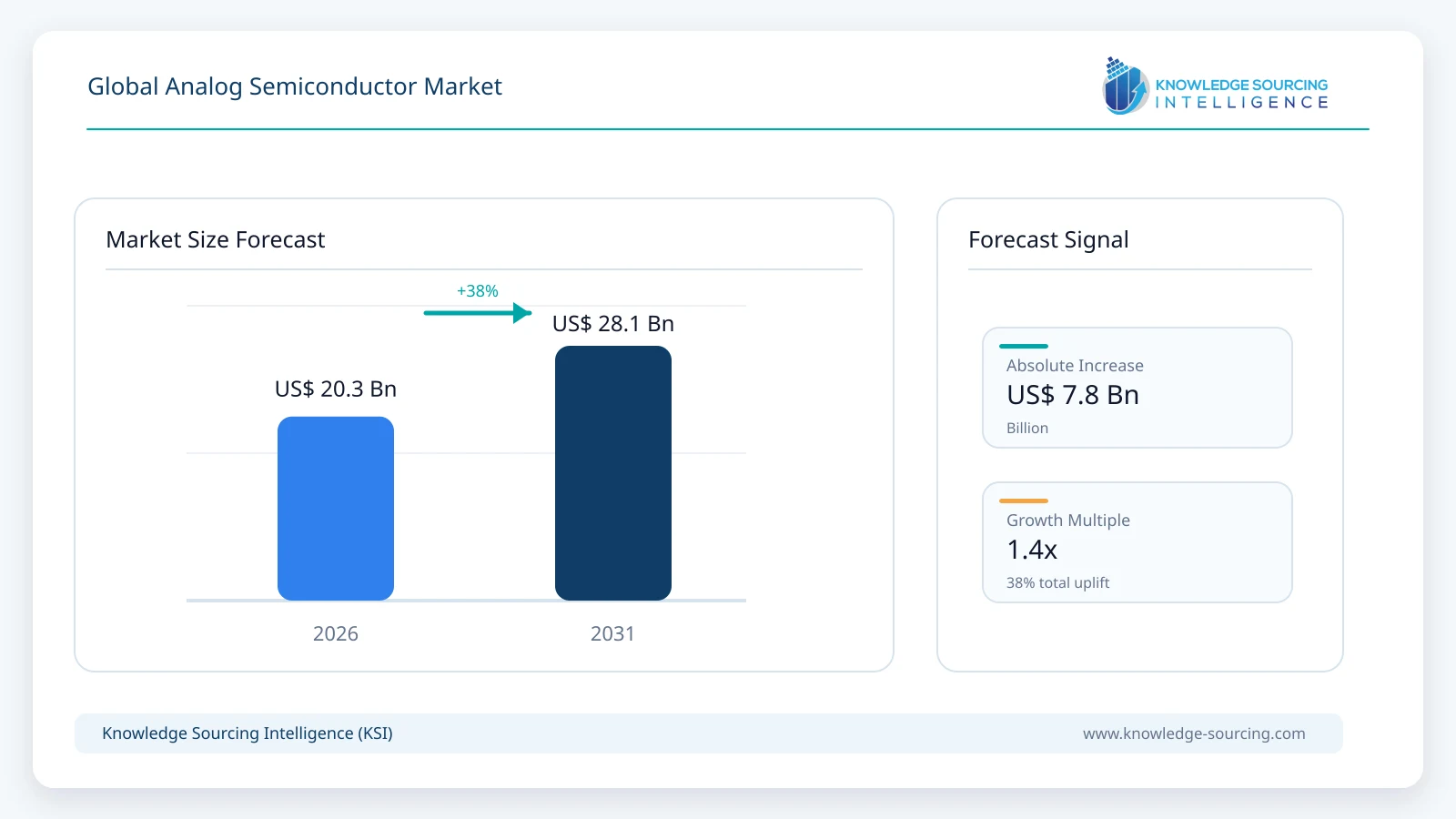
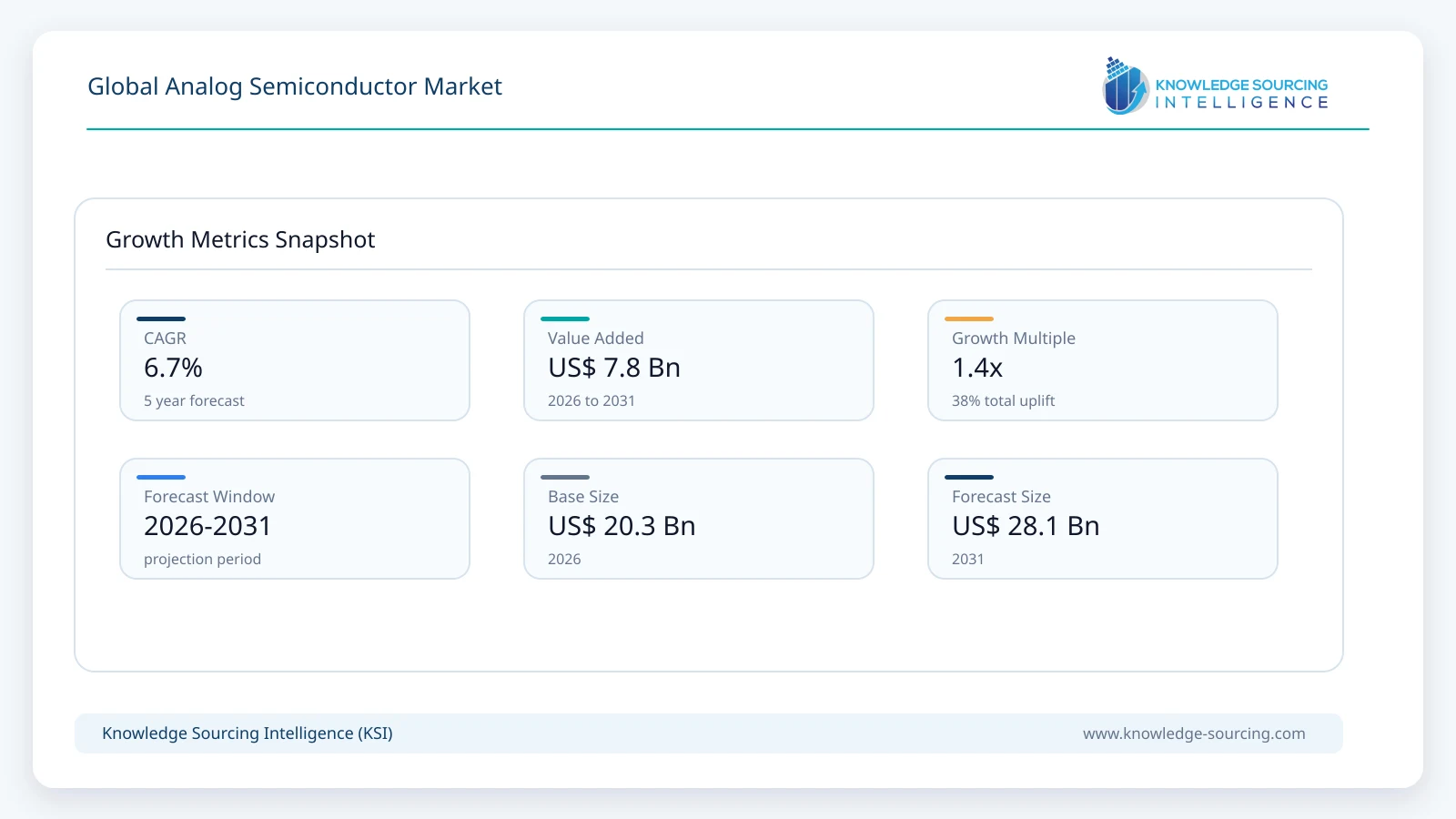
Global Analog Semiconductor Market for Consumer Electronics Industry is forecast to grow at a CAGR of 6.7%, reaching USD 28.1 billion in 2031 from USD 20.3 billion in 2026.
Highlights:
- 1Consumer electronics manufacturers increasingly prioritize analog ICs that improve battery efficiency, signal integrity, and device reliability.
- 2Power management ICs remain central to next-generation portable electronics, driven by higher power density requirements.
- 3Product differentiation increasingly depends on analog performance, packaging efficiency, and low-power operation rather than process-node scaling.
- 4Supply-chain resilience and long product lifecycles continue to influence sourcing strategies for analog semiconductor procurement.
- 5Asia Pacific remains the primary manufacturing hub, while North America and Europe retain leadership in analog design and high-value product development.
Unlike digital processors that execute computation, analog integrated circuits determine how efficiently devices consume energy, capture signals, manage thermal loads, and maintain operating stability. As smartphones, wearables, smart home products, gaming devices, and premium audio systems incorporate additional sensing, wireless communication, and artificial intelligence capabilities, the number and functional complexity of analog components per device continue to increase. Company disclosures from Analog Devices, Texas Instruments, and other suppliers consistently identify power management, signal conditioning, data conversion, and connectivity as long-term demand areas extending across consumer electronics.
Procurement decisions increasingly emphasize electrical performance, battery efficiency, integration density, product longevity, software compatibility, and assured component availability rather than simply unit price. Consumer electronics manufacturers seek suppliers capable of maintaining long product support cycles while delivering highly integrated analog solutions that reduce board space and simplify product design. The commercial value captured within the analog semiconductor market therefore depends not only on silicon manufacturing but also on application-specific design expertise, packaging technology, validation capability, and long-term customer support.
Investment patterns also reflect changing product architectures. High-resolution displays, multi-camera smartphones, wearable health monitoring devices, true wireless audio products, and intelligent home automation systems require multiple analog functions operating simultaneously under strict power budgets. Official company reports indicate continuing investment in power management technologies, mixed-signal integration, battery optimization, and precision signal processing to address these requirements while improving energy efficiency and user experience.
Key Market Indicators
Indicator | Latest Evidence | Commercial Meaning |
Consumer electronics applications | Smartphones, wearables, PCs, audio, displays and smart home devices | Broad application diversity reduces dependence on a single product category. |
Core analog functions | Power management, data conversion, amplifiers, RF and interface ICs | Product portfolios increasingly focus on integrated analog solutions. |
Manufacturing approach | Hybrid internal fabs and external foundries | Supply flexibility supports capacity management while reducing manufacturing risk. |
Product lifecycle | Long operational lifecycles compared with many digital ICs | Stable replacement demand supports recurring design wins and customer retention. |
Key Indicator: Consumer electronics increasingly require integrated power management, sensing, signal conversion, and connectivity within compact form factors.
Commercial meaning: Device manufacturers place greater value on analog integration that reduces power consumption, board space, and system complexity.
Market Drivers
Increasing integration of power management functions in portable consumer devices
Battery-powered consumer electronics continue to demand increasingly sophisticated power management integrated circuits (PMICs) that extend operating life while supporting higher processing loads and faster charging. Smartphones, tablets, wearable devices, and wireless audio products integrate multiple voltage domains, advanced battery monitoring, thermal protection, and dynamic power allocation, increasing analog semiconductor content per device. Analog Devices and Texas Instruments identify power management as a strategic product area because customers require greater efficiency, smaller footprints, and longer battery life across portable electronics. These requirements encourage continuous product redesigns, higher-value analog integration, and sustained investment in power management portfolios.
Higher sensor density expanding demand for precision signal chain components
Consumer electronics increasingly depend on multiple sensors that monitor motion, light, sound, environmental conditions, biometric signals, and user interaction. Every sensor requires amplification, filtering, signal conditioning, voltage reference, and analog-to-digital conversion before digital processing can occur. As wearable health devices, smart home products, advanced cameras, and augmented reality applications incorporate more sensing capability, manufacturers require precision analog front ends with low noise and high accuracy. Official company disclosures show sustained investment in amplifiers, data converters, signal chain products, and mixed-signal technologies to address expanding sensing requirements across consumer applications.
Demand for compact, feature-rich consumer devices increasing analog integration
Consumer device manufacturers continue to reduce product dimensions while adding higher-resolution displays, multiple cameras, wireless charging, AI-enabled processing, premium audio performance, and always-on connectivity. These design objectives increase demand for analog components that combine several functions within smaller packages while maintaining thermal efficiency and signal integrity. Company strategy documents indicate continued investment in highly integrated analog solutions for smartphones, wearables, home automation products, and portable computing devices, allowing manufacturers to reduce board space, simplify system architecture, and accelerate product development without compromising electrical performance.
Market Restraints and Challenges
Long qualification cycles and design-win dependence restrict supplier flexibility
Analog semiconductors for consumer electronics are typically selected early in the product development cycle because they directly influence power architecture, thermal performance, signal quality, battery life, and electromagnetic compatibility. Once qualified, replacing an analog component often requires redesign, validation, and compliance testing across the entire electronic system. This creates high switching costs for device manufacturers while extending the time required for new suppliers to secure design wins. Texas Instruments, Analog Devices, and Microchip Technology consistently identify design-win timing and customer product cycles as important factors affecting future revenue realization. For suppliers, missing a single flagship consumer device program can delay revenue opportunities for several years, making product planning and customer engagement critical to sustained market participation.
Supply-chain concentration and wafer capacity constraints continue to affect deliveries
Although supply conditions have improved since the semiconductor shortages experienced earlier in the decade, analog semiconductor manufacturing remains dependent on specialized fabrication processes, mature-node production capacity, advanced packaging facilities, and outsourced assembly and testing services. Unlike leading-edge digital processors, many analog products continue to rely on mature manufacturing technologies that compete for wafer capacity with automotive, industrial, and communications applications. Several semiconductor manufacturers have highlighted supply continuity, raw material availability, substrate sourcing, and geopolitical uncertainty as ongoing operational risks in their annual reports. Capacity bottlenecks can lengthen delivery schedules, increase inventory costs, and complicate procurement planning for consumer electronics manufacturers operating under compressed product launch timelines.
Pricing pressure from high-volume consumer electronics manufacturers
Consumer electronics remains one of the most cost-sensitive semiconductor markets because device manufacturers operate under continuous pressure to improve functionality while maintaining competitive retail prices. Original equipment manufacturers frequently negotiate long-term supply agreements, annual price adjustments, and multi-product sourcing arrangements to reduce component costs. This procurement environment places sustained pressure on analog semiconductor suppliers to improve manufacturing efficiency without compromising product reliability or electrical performance. Companies increasingly respond through higher product integration, manufacturing automation, optimized packaging technologies, and portfolio rationalization rather than competing solely on unit pricing. Suppliers with broad product portfolios and diversified customer bases are generally better positioned to absorb pricing pressure than firms dependent on a limited number of consumer electronics programs.
Increasing product complexity raises verification and development costs
Modern consumer devices combine multiple wireless standards, artificial intelligence processing, high-speed interfaces, advanced displays, image sensors, battery management systems, and precision analog circuits within compact designs. Each additional function increases the complexity of analog circuit design, electromagnetic compatibility testing, thermal management, and system-level validation. Company disclosures from leading analog suppliers indicate continued investment in research and development to address increasingly demanding performance, efficiency, and integration requirements. Smaller suppliers may face higher engineering costs and longer development timelines before achieving commercial qualification, particularly for products requiring stringent power efficiency, low-noise operation, and high reliability across multiple consumer electronics platforms.
Major Segment Analysis
Power Management ICs (PMICs)
Power Management ICs represent one of the most commercially important product categories within the analog semiconductor market because virtually every consumer electronic device depends on efficient power conversion, voltage regulation, battery charging, and thermal management. Smartphones, wearable devices, laptops, tablets, gaming systems, smart home products, and wireless audio equipment increasingly incorporate multiple PMICs to manage higher processing loads while maintaining battery life and compact product designs. Purchasing decisions in this segment extend beyond electrical performance to include energy efficiency, package size, heat dissipation, reliability, and compatibility with application processors and battery technologies.
Competition within the PMIC segment increasingly focuses on integration rather than discrete functionality. Suppliers seek to combine voltage regulation, battery charging, monitoring, sequencing, and protection into fewer integrated devices, allowing manufacturers to reduce printed circuit board area and simplify system architecture. Long qualification cycles and close collaboration with original equipment manufacturers create relatively high customer retention once a PMIC is incorporated into a device platform. At the same time, rapid innovation in fast charging, high-density batteries, AI-enabled portable devices, and ultra-low-power electronics continues to raise performance expectations, encouraging sustained investment in power management technologies across the analog semiconductor industry.
Regional Analysis
Region | Main Demand Signal | Principal Constraint |
Americas | Analog IC design leadership, consumer electronics innovation, semiconductor manufacturing investment | Limited consumer electronics assembly compared with Asia Pacific and continued dependence on global supply chains |
Europe, Middle East and Africa | Energy-efficient electronics regulations, analog technology expertise, expanding consumer device adoption | Uneven manufacturing capabilities and reliance on imported semiconductor components across many countries |
Asia Pacific | Concentration of electronics manufacturing, semiconductor fabrication, packaging, and consumer device production | Geopolitical risks, export controls, and supply-chain concentration |
Americas
The Americas remain an important region for analog semiconductor design, research, and high-value manufacturing. The United States accounts for the largest share of regional activity, supported by companies such as Texas Instruments, Analog Devices, onsemi, Microchip Technology, Skyworks Solutions, and Diodes Incorporated. Federal initiatives under the CHIPS and Science Act continue to encourage investments in semiconductor fabrication, packaging, and workforce development, strengthening domestic production capacity for foundational semiconductors, including analog integrated circuits. Canada contributes through semiconductor research and specialized technology development, while Brazil supports regional demand through a growing consumer electronics market and local electronics assembly. Although much of the world's consumer electronics manufacturing occurs outside the Americas, the region continues to generate substantial value through product design, intellectual property, engineering services, and long-term customer relationships with global device manufacturers.
Europe, Middle East and Africa
Europe remains a center for analog semiconductor innovation, supported by established manufacturers including Infineon Technologies, STMicroelectronics, and NXP Semiconductors. Regional demand is reinforced by stringent energy-efficiency standards, environmental regulations, and continued investment under the European Chips Act, which aims to strengthen semiconductor manufacturing and reduce supply-chain dependence. Germany, France, Italy, and the United Kingdom host important semiconductor research, manufacturing, and system integration activities that support both consumer electronics and adjacent industries. Across the Middle East and Africa, consumer electronics demand continues to expand alongside improving digital connectivity, smartphone adoption, and investments in telecommunications infrastructure. However, most countries remain dependent on imported semiconductor components, making supply availability and logistics costs important commercial considerations for electronics manufacturers and distributors.
Asia Pacific
Asia Pacific represents the largest manufacturing ecosystem for consumer electronics and remains central to global analog semiconductor demand. China serves as the world's largest electronics manufacturing base, supported by extensive production networks for smartphones, smart home devices, televisions, wearable electronics, and computing equipment. Taiwan maintains a critical role in semiconductor foundry services and advanced packaging, while Japan contributes through analog semiconductor design, semiconductor materials, and manufacturing equipment. India continues to expand its electronics manufacturing ecosystem through government incentive programs that encourage domestic production and semiconductor packaging investments. High production volumes, vertically integrated supply chains, and sustained investment in manufacturing capacity continue to support demand for power management ICs, signal chain devices, interface ICs, and other analog components. Nevertheless, geopolitical tensions, export-control measures, and supply-chain diversification initiatives are encouraging manufacturers to establish more geographically distributed production networks to reduce operational risk during the forecast period.
Competitive Landscape
The global analog semiconductor market for consumer electronics exhibits a moderately consolidated structure, with competition shaped by product breadth, engineering capability, manufacturing scale, long-term customer relationships, and application-specific expertise rather than process-node leadership alone. Texas Instruments, Analog Devices, STMicroelectronics, Infineon Technologies, NXP Semiconductors, Renesas Electronics, onsemi, Skyworks Solutions, Microchip Technology, ROHM, Diodes Incorporated, and Toshiba Electronic Devices & Storage compete across power management, signal chain products, interface ICs, mixed-signal devices, and sensor-supporting analog solutions.
Competitive differentiation increasingly depends on delivering highly integrated analog platforms that reduce power consumption, simplify system design, and shorten customer development cycles. Several suppliers continue expanding internal manufacturing capacity while maintaining strategic foundry partnerships to improve supply flexibility and reduce operational risk. Product longevity, application engineering support, reference designs, and software development tools have become increasingly important because consumer electronics manufacturers seek faster design integration and dependable long-term component availability. High qualification costs, extensive intellectual property portfolios, established customer relationships, and broad product ecosystems continue to create meaningful barriers for new entrants, while ongoing investment in research and development remains essential to maintaining competitiveness in rapidly evolving consumer electronics applications.
Recent Developments
July 2026: Analog Devices completed its Empower Semiconductor acquisition, adding integrated voltage regulator and silicon capacitor technologies that enhance high-efficiency analog power delivery for AI, computing, and advanced consumer electronics platforms.
July 2026: Infineon Technologies completed the acquisition of ams OSRAM's non-optical analog/mixed-signal sensor portfolio, expanding analog sensing capabilities applicable across consumer wearables, smart devices, industrial, and medical electronics.
July 2025: STMicroelectronics agreed to acquire part of NXP Semiconductors' MEMS sensor business for up to $950 million, strengthening its analog sensing portfolio for smartphones, wearables, automotive, and industrial electronics.
June 2025: Texas Instruments announced plans to invest more than USD 60 billion to expand semiconductor manufacturing across seven U.S. fabs. The investment is intended to increase long-term domestic production capacity for foundational semiconductors, including analog devices, improving supply resilience for electronics manufacturers.
Regulatory and Policy Environment
Government policy increasingly influences investment decisions, manufacturing strategies, and supply-chain planning across the analog semiconductor industry. While analog integrated circuits are generally subject to fewer technology-specific restrictions than certain advanced digital processors, manufacturers continue to operate within an expanding framework of industrial policies, export controls, environmental regulations, and supply-chain security initiatives. These measures affect production location decisions, sourcing strategies, customer qualification processes, and long-term capital investment.
In the United States, implementation of the CHIPS and Science Act continues to support domestic semiconductor manufacturing through financial incentives, research funding, and workforce development programs. Although the legislation covers the broader semiconductor industry, analog semiconductor manufacturers are among the companies expanding fabrication capacity and modernizing production facilities under this policy framework. Increased domestic manufacturing is intended to reduce dependence on geographically concentrated supply chains while strengthening resilience for strategically important electronic components.
The European Chips Act similarly encourages semiconductor manufacturing, research collaboration, and supply-chain diversification across European Union member states. Combined with regulations promoting energy efficiency, product safety, and environmental sustainability, these initiatives encourage manufacturers to develop analog components with lower power consumption, longer operational lifecycles, and improved recyclability. Compliance with the Restriction of Hazardous Substances (RoHS) Directive and Registration, Evaluation, Authorisation and Restriction of Chemicals (REACH) Regulation remains an established requirement for semiconductor suppliers serving consumer electronics manufacturers in European markets.
Across Asia Pacific, national semiconductor strategies in China, Japan, South Korea, India, and Taiwan continue to encourage investment in fabrication facilities, packaging technologies, research capability, and workforce development. Government-backed manufacturing incentives have strengthened regional production ecosystems while encouraging greater localization of semiconductor supply chains. At the same time, evolving export-control measures affecting semiconductor equipment and certain advanced technologies continue to influence procurement decisions, investment planning, and manufacturing diversification among multinational suppliers.
Outlook and Strategic Implications
Demand for analog semiconductors serving consumer electronics is expected to remain closely linked to increasing electronic content per device rather than growth in unit shipments alone. Smartphones, wearable electronics, smart home equipment, gaming systems, premium audio products, and portable computing devices continue to integrate additional sensing capability, artificial intelligence functions, higher-speed connectivity, advanced display technologies, and more sophisticated battery management systems. These product developments increase the number and complexity of analog components required within each device, supporting continued investment in power management, signal chain, interface, and mixed-signal technologies.
Manufacturing strategy will remain a defining competitive factor throughout the forecast period. Companies are expected to continue balancing internal wafer production with external foundry partnerships to improve supply flexibility while reducing exposure to regional disruptions. At the same time, customer procurement priorities increasingly emphasize long-term component availability, engineering support, product qualification, and lifecycle management alongside electrical performance and cost. Suppliers capable of delivering integrated analog platforms supported by strong application engineering and dependable manufacturing capacity are likely to strengthen their position within consumer electronics supply chains.
Strategic priorities across the value chain are expected to include:
Manufacturers: Expand integrated power management and mixed-signal portfolios while strengthening manufacturing resilience and packaging capabilities.
Consumer electronics OEMs: Prioritize suppliers offering long product support, secure supply arrangements, and application-specific engineering expertise.
Technology providers: Increase investment in ultra-low-power architectures, battery optimization, sensor interfaces, and advanced packaging technologies.
Investors: Monitor capital expenditure, capacity utilization, design-win pipelines, and customer diversification rather than short-term shipment fluctuations.
Policymakers: Continue supporting semiconductor manufacturing capacity, workforce development, and resilient supply chains while maintaining balanced trade and technology policies.
The market is expected to remain technology-driven and design-intensive throughout 2026–2031. Competitive advantage will increasingly depend on product integration, manufacturing reliability, application-specific expertise, and the ability to support increasingly complex consumer electronics platforms with highly efficient analog semiconductor solutions.
Market Scope:
| Report Metric | Details |
|---|---|
| Total Market Size in 2026 | USD 20.3 billion |
| Total Market Size in 2031 | USD 28.1 billion |
| Forecast Unit | Billion |
| Growth Rate | 6.7% |
| Study Period | 2021 to 2031 |
| Historical Data | 2021 to 2024 |
| Base Year | 2025 |
| Forecast Period | 2026 – 2031 |
| Segmentation | Product Type, Consumer Electronic Device, Application, Geography |
| Companies |
|
| Customization Scope | 15% Free Customization included with purchase — Request Custom Breakdown → |
| Sample & Data Access | PDF Sample, Excel Databook & Analyst Briefing — Download Free Sample → |
Market Segmentation
By Product Type
Power Management ICs (PMICs)
Signal Chain ICs
Operational Amplifiers (Op-Amps)
Data Converters (ADC/DAC)
Interface ICs
Comparators
Voltage Regulators and References
Others
By Consumer Electronic Device
Smartphones
Tablets
Laptops and PCs
Wearable Devices
Smart Home Devices
Smart TVs and Displays
Gaming Consoles
Audio Devices (Earbuds, Speakers, Headphones)
Digital Cameras
Others
By Application
Power Management
Signal Conditioning
Battery Management
Audio Processing
Display Management
Sensor Interfaces
Connectivity and RF Support
Lighting Control
By Geography
Americas
USA
Canada
Brazil
Others
Europe Middle East and Africa
Germany
France
United Kingdom
Italy
Others
Asia Pacific
China
Japan
India
Taiwan
Others
Table of Contents
1. INTRODUCTION
1.1. Market Overview
1.2. Market Definition
1.3. Scope of the Study
1.4. Currency
1.5. Assumptions
1.6. Base and Forecast Years Timeline
2. RESEARCH METHODOLOGY
2.1. Research Design
2.2. Secondary Sources
3. EXECUTIVE SUMMARY
4. MARKET DYNAMICS
4.1. Market Segmentation
4.2. Market Drivers
4.3. Market Restraints
4.4. Market Opportunities
4.5. Porter’s Five Force Analysis
4.5.1. Bargaining Power of Suppliers
4.5.2. Bargaining Power of Buyers
4.5.3. Threat of New Entrants
4.5.4. Threat of Substitutes
4.5.5. Competitive Rivalry in the Industry
4.6. Life Cycle Analysis - Regional Snapshot
4.7. Market Attractiveness
5. GLOBAL ANALOG SEMICONDUCTOR MARKET FOR CONSUMER ELECTRONICS INDUSTRY BY PRODUCT TYPE
5.1. Power Management ICs (PMICs)
5.2. Signal Chain ICs
5.3. Operational Amplifiers (Op-Amps)
5.4. Data Converters (ADC/DAC)
5.5. Interface ICs
5.6. Comparators
5.7. Voltage Regulators and References
5.8. Others
6. GLOBAL ANALOG SEMICONDUCTOR MARKET FOR CONSUMER ELECTRONICS INDUSTRY BY CONSUMER ELECTRONIC DEVICE
6.1. Smartphones
6.2. Tablets
6.3. Laptops and PCs
6.4. Wearable Devices
6.5. Smart Home Devices
6.6. Smart TVs and Displays
6.7. Gaming Consoles
6.8. Audio Devices (Earbuds, Speakers, Headphones)
6.9. Digital Cameras
6.10. Others
7. GLOBAL ANALOG SEMICONDUCTOR MARKET FOR CONSUMER ELECTRONICS INDUSTRY BY APPLICATION
7.1. Power Management
7.2. Signal Conditioning
7.3. Battery Management
7.4. Audio Processing
7.5. Display Management
7.6. Sensor Interfaces
7.7. Connectivity and RF Support
7.8. Lighting Control
8. GLOBAL ANALOG SEMICONDUCTOR MARKET FOR CONSUMER ELECTRONICS INDUSTRY BY GEOGRAPHY
8.1. Americas
8.1.1. USA
8.1.2. Canada
8.1.3. Brazil
8.1.4. Others
8.2. Europe Middle East and Africa
8.2.1. Germany
8.2.2. France
8.2.3. United Kingdom
8.2.4. Italy
8.2.5. Others
8.3. Asia Pacific
8.3.1. China
8.3.2. Japan
8.3.3. India
8.3.4. Taiwan
8.3.5. Others
9. COMPETITIVE INTELLIGENCE
9.1. Competitive Benchmarking and Analysis
9.2. Recent Investment and Deals
9.3. Strategies of Key Players
10. COMPANY PROFILES
10.1. Texas Instruments Incorporated
10.2. Analog Devices, Inc.
10.3. STMicroelectronics N.V.
10.4. Infineon Technologies AG
10.5. NXP Semiconductors N.V.
10.6. onsemi
10.7. Renesas Electronics Corporation
10.8. Skyworks Solutions, Inc.
10.9. Microchip Technology Incorporated
10.10. ROHM Co., Ltd.
10.11. Diodes Incorporated
10.12. Toshiba Electronic Devices & Storage Corporation





Frequently asked questions
What is the projected market size and growth rate for the Global Analog Semiconductor Market for Consumer Electronics Industry by 2031?
The Global Analog Semiconductor Market for Consumer Electronics Industry is forecast to reach USD 28.1 billion by 2031. This represents a significant growth from USD 20.3 billion in 2026, with a Compound Annual Growth Rate (CAGR) of 6.7% over the forecast period.
Which key consumer electronics applications are driving demand for analog semiconductors?
Key consumer electronics applications fueling demand for analog semiconductors include smartphones, wearables, smart home products, gaming devices, and premium audio systems. The increasing integration of sensing, wireless communication, and artificial intelligence capabilities in devices like high-resolution displays and multi-camera smartphones further drives this demand.
What strategic factors are influencing procurement decisions for analog semiconductors within the consumer electronics industry?
Procurement decisions are increasingly driven by electrical performance, battery efficiency, integration density, and product longevity. Consumer electronics manufacturers also prioritize software compatibility, assured component availability, and suppliers capable of maintaining long product support cycles while delivering highly integrated analog solutions that reduce board space.
What are the key regional contributions to the Global Analog Semiconductor Market for Consumer Electronics?
Asia Pacific remains the primary manufacturing hub for analog semiconductors used in consumer electronics. Conversely, North America and Europe retain leadership in analog design and high-value product development, indicating a geographical specialization in the market.
What specific analog functions are experiencing long-term demand growth in consumer electronics?
Company disclosures consistently identify power management, signal conditioning, data conversion, and connectivity as long-term demand areas extending across consumer electronics. These functions are critical for optimizing energy consumption, capturing signals, managing thermal loads, and maintaining operating stability in advanced devices.
What technological investments are shaping the future of analog semiconductors for consumer electronics?
Official company reports indicate continuing investment in power management technologies, mixed-signal integration, battery optimization, and precision signal processing. These investments aim to address the complex requirements of high-resolution displays, multi-camera smartphones, and wearable health monitoring devices, while improving energy efficiency and user experience.
Cite this report
Knowledge Sourcing Intelligence. (Sep 2026). Global Analog Semiconductor Market for Consumer Electronics Industry - Strategic Insights and Forecasts (2026-2031). https://www.knowledge-sourcing.com/report/global-analog-semiconductor-market-for-consumer-electronics-industry