
The Automotive Active Sound Management Market is forecast to grow at a CAGR of 18.1%, reaching USD 7.70 billion in 2031 from USD 3.35 billion in 2026.
Highlights:
- 1Active noise cancellation accounts for approximately 55% of global active sound management market value in 2026, equivalent to USD 1.85 billion and fully reconciled with the separately modelled Automotive Active Noise Cancellation Market.
- 2Active sound enhancement and synthesis represents approximately 33% of 2026 market value as OEMs use software-generated powertrain and driving sounds to restore feedback, differentiate brands and create configurable sound characters in electric and high-performance vehicles.
- 3Hardware and embedded electronics account for approximately 48% of 2026 market value, although software and acoustic algorithms are expected to overtake hardware as centralized audio processors and reusable software platforms scale across vehicle lines.
- 4Internal-combustion vehicles remain the largest propulsion category at approximately 42% of 2026 value, but battery-electric and fuel-cell vehicles are the fastest-growing segment because they require both stronger road-noise management and newly designed driving sound feedback.
- 5Passenger vehicles represent approximately 96% of global market value in 2026 because active acoustic functions are concentrated in passenger-car, SUV and premium EV programs with capable multi-speaker audio systems and high cabin-refinement expectations.
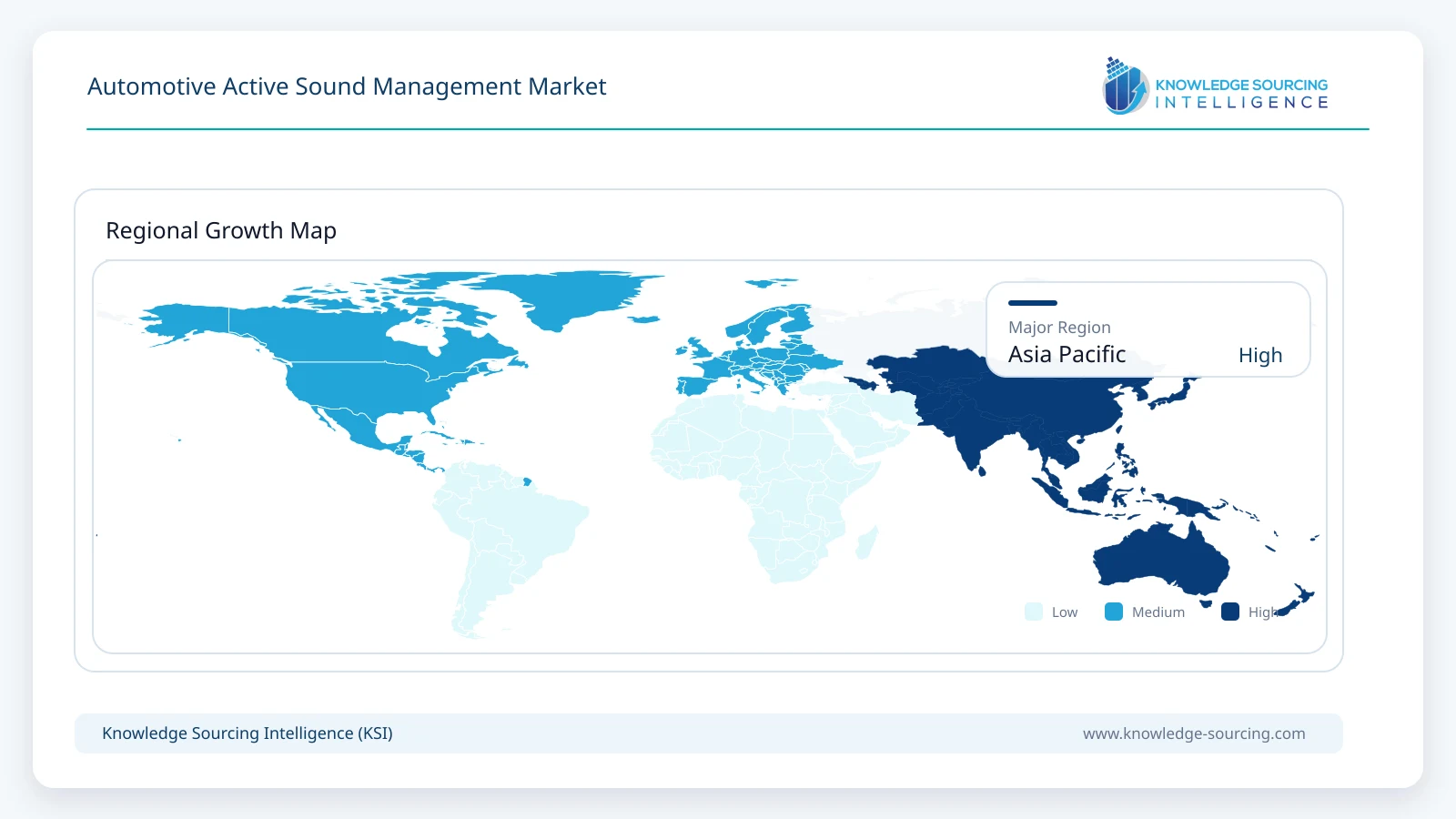
- 6Asia Pacific represents approximately 45% of global market value in 2026, supported by rapid smart-cabin development, high EV production and advanced active-acoustic deployment among Japanese, South Korean and Chinese vehicle manufacturers.
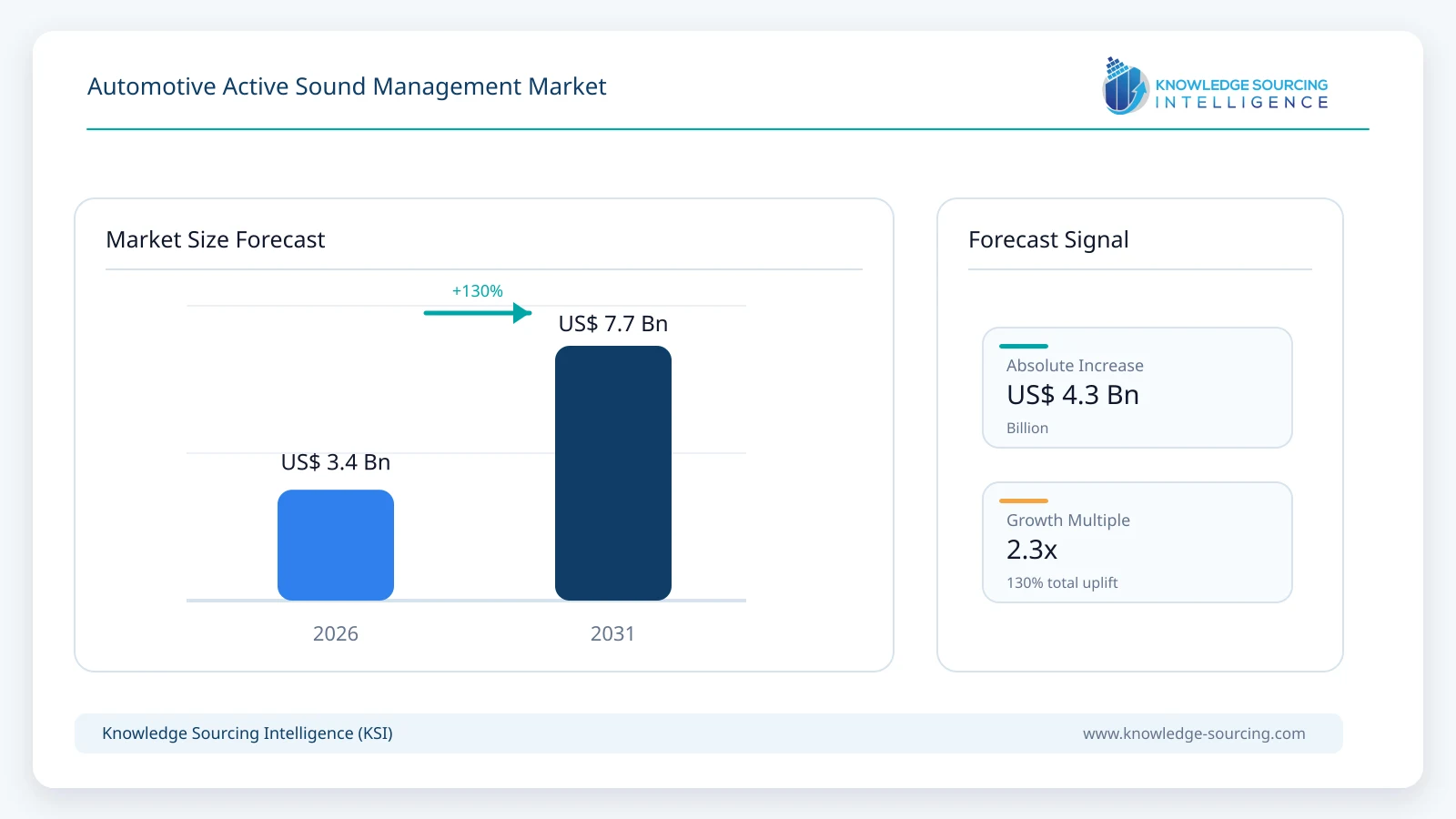
The market is broader than active noise cancellation alone because the same microphones, speakers, vehicle signals and signal-processing resources increasingly support both suppression of unwanted noise and deliberate creation or enhancement of desirable vehicle sound.
Active noise cancellation remains the largest value pool and is kept fully aligned with the separately modelled Automotive Active Noise Cancellation Market at USD 1.850 billion in 2026. The remaining market value comes from active sound enhancement and synthesis, targeted or zonal sound management, acoustic software orchestration and the calibration required to make these functions coexist with infotainment audio, speech, warning tones and vehicle-state feedback.
Commercial architectures are moving from isolated features toward integrated active-acoustic platforms. HARMAN combines noise cancellation, electronic sound synthesis and targeted sound through HALOsonic; Bose positions Road Noise Control, Engine Harmonic Cancellation, Engine Harmonic Enhancement and Electric Vehicle Sound Enhancement under Active Sound Management; and specialist suppliers such as Silentium, neosonic, Müller-BBM AST and SPB Audio Lab provide software-centric cancellation and sound-design capability that can run on shared automotive audio compute.
Market Overview
Active sound management changes cabin acoustics electronically. Cancellation functions detect road, tire, engine, driveline or HVAC disturbances and generate antiphase sound to reduce them, while enhancement and synthesis functions deliberately add or reshape sound using vehicle speed, torque, accelerator position, RPM, and drive-mode data. The same loudspeakers and audio processors can therefore make the cabin quieter in one operating condition and more expressive in another.
The technology is increasingly important in electrified vehicles. Removing combustion noise exposes road, tire, wind, motor and auxiliary sounds that were previously masked, while the absence of familiar engine feedback can make acceleration feel acoustically disconnected from vehicle response. Active sound management allows OEMs to suppress intrusive components without removing useful cues, then add controlled sound that communicates performance, brand character or driver-selected mood.
The market counts only the incremental hardware, software, algorithms and engineering attributable to active vehicle-sound management. Conventional premium audio reproduction, speakers and amplifiers are included only to the extent that additional specification or processing is required for active acoustic functions. Passive insulation, damping and acoustic trim are excluded, as are standalone external pedestrian-warning systems unless shared active-sound software or hardware also serves in-cabin management.
Market Trends
Cancellation and Sound Creation Are Converging into One Acoustic Layer
Vehicle programs are moving away from treating ANC and active sound design as unrelated functions. HARMAN HALOsonic combines road, engine and HVAC noise cancellation with electronic sound synthesis, while Bose Active Sound Management combines cancellation with engine harmonic and EV sound enhancement. The underlying architecture is similar: vehicle signals, microphones, DSP and the audio system are used to shape the sound field in real time.
This convergence improves hardware utilization and allows OEMs to tune a complete target sound rather than optimize quietness and character separately. It also increases the strategic value of software orchestration because cancellation filters, music playback, warning tones, and synthesized vehicle sounds must coexist without masking each other or creating artifacts.
Electric Vehicles Are Turning Sound into a Brand and Driving-Feedback Tool
EV sound design has moved beyond simply imitating an internal-combustion engine. Hyundai uses N Active Sound+ to create selectable performance-oriented sound identities, Mercedes-Benz offers active Sound Experience functions in electric models, and Kia provides configurable Active Sound Design on EV platforms. These systems use vehicle-state data to make sound responsive to acceleration and driving mode rather than play a static audio loop.
The commercial opportunity therefore extends from compliance or novelty into brand identity and perceived dynamics. OEMs can offer distinct sound themes by model, trim or software package, creating scope for feature differentiation and lifecycle updates without mechanical changes to intake, exhaust or drivetrain hardware.
Zonal and Occupant-Aware Control Is Replacing Uniform Cabin Tuning
Advanced systems increasingly manage sound by seat or zone instead of applying one acoustic target to the entire cabin. Nissan has described zone-based active noise control, while broader automotive audio architectures are adding headrest speakers, virtual microphones and occupant-position information. This allows quietness, alerts, and synthesized sounds to be delivered more selectively.
Targeted acoustic control is particularly relevant to multi-row and software-defined cabins because passengers may want entertainment isolation while the driver still needs vehicle feedback and safety cues. The technical challenge shifts toward accurate transfer-path modelling and low-latency coordination across many speakers and microphone positions.
Centralized Audio Compute Is Making Active Sound Software-Defined
Active sound management is migrating from dedicated control boxes into powerful audio amplifiers, cockpit domain controllers and centralized compute. Shared processors can run ANC, immersive audio, voice processing, communication enhancement and sound synthesis together, reducing duplicated electronics and giving OEMs a common platform across several models.
The shift favors portable algorithms, hardware abstraction, and over-the-air lifecycle tuning. Software can be recalibrated for new tires, cabin variants or drive modes and can support feature additions after launch, but only if processing latency, safety-relevant sound priority and resource allocation remain deterministic.
Sound Design Is Becoming More Natural, Adaptive and Physics-Informed
Synthetic driving sound is evolving from fixed samples toward hybrid and physics-informed models that react more continuously to torque, speed and driver input. Suppliers such as neosonic and Müller-BBM AST provide production-oriented active sound design environments, while engineering tools from Ansys and Siemens support sound creation, evaluation and in-vehicle tuning before final hardware is available.
More natural synthesis reduces the artificial or repetitive character that can limit consumer acceptance. It also enables a wider range of products, from subtle enhancement of real powertrain harmonics to completely new EV sound signatures, without forcing every brand toward the same simulated combustion-engine template.
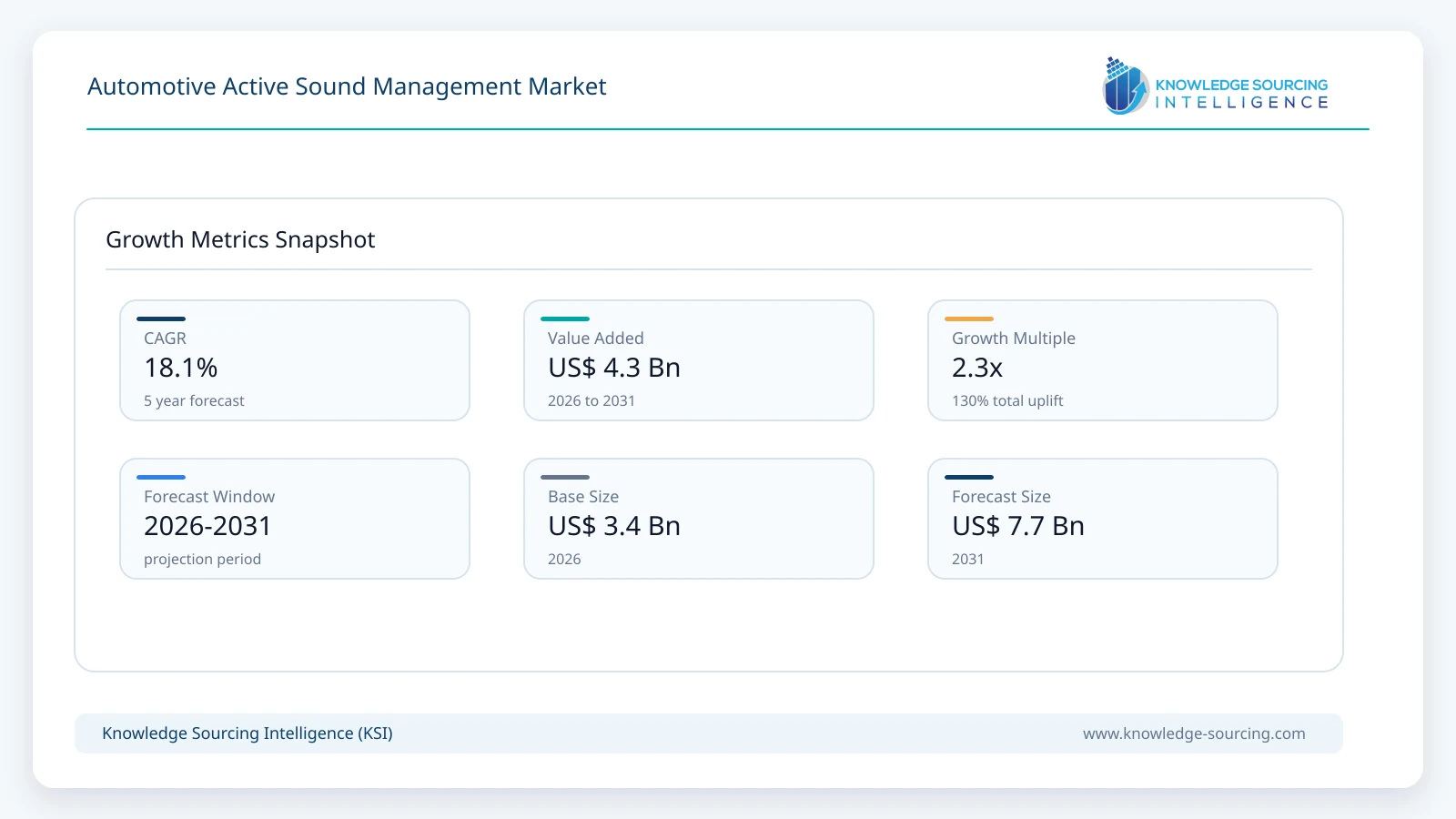
Segment Analysis
By Active Function: Active Noise Cancellation
Active noise cancellation is the largest functional segment because road, tire, engine, and auxiliary noise remain the most immediate acoustic problems that OEMs are willing to solve electronically. The segment benefits from mature engine-order cancellation and rapidly growing road-noise control, particularly in EVs where low-frequency tire and structure-borne noise is more exposed.
The segment is fixed at approximately USD 1.85 billion in 2026 and is projected to reach about USD 4.45 billion by 2031, matching the established Automotive Active Noise Cancellation Market model. Its share rises modestly as broadband road-noise control expands, even while active sound design and targeted sound functions also grow rapidly.
By Offering: Hardware and Embedded Electronics
Hardware remains the largest offering category because production systems rely on microphones, accelerometers or vehicle references, audio amplification, loudspeakers or headrest transducers, and DSP-capable processors. Many components are shared with the audio system, but higher microphone count, vibration sensing, low-latency compute, and additional output channels create incremental active-sound value.
Hardware and embedded electronics account for approximately USD 1.61 billion in 2026. Their share is expected to fall from about 48% to roughly 42% by 2031 as common compute becomes more capable and software licensing, acoustic algorithms and platform calibration capture a larger portion of system value.
By Propulsion: Internal-Combustion Engine Vehicles
Internal-combustion vehicles remain the largest propulsion category in 2026 because engine harmonic cancellation and enhancement have a long production history, and downsized engines, cylinder deactivation, and performance-oriented sound tuning create continuing demand. Active sound allows engineers to reduce undesirable boom while preserving or enhancing selected harmonics that communicate vehicle character.
ICE vehicles account for approximately USD 1.41 billion in 2026. Their absolute market value continues to increase through 2031, but share declines sharply as battery-electric and fuel-cell vehicles adopt both road-noise cancellation and active sound design at a faster rate.
By Vehicle Type: Passenger Vehicles
Passenger vehicles dominate because active sound management depends on a relatively sophisticated cabin-audio architecture and is closely tied to perceived refinement, premiumization and driver experience. Luxury vehicles, performance cars and increasingly higher-volume EVs provide the strongest economic case for additional microphones, DSP resources and acoustic calibration.
Passenger vehicles represent approximately USD 3.22 billion in 2026 and are expected to reach about USD 7.32 billion by 2031. Commercial vehicles remain smaller but can grow faster where fatigue reduction, cabin communication and software-defined noise control justify investment in long-duty-cycle applications.
By Geography: Asia Pacific
Asia Pacific leads the market because Japan and South Korea have long-running production experience in active noise control, while China is rapidly expanding software-defined cockpit and EV content. Regional OEMs increasingly combine quietness, premium audio and designed driving sound as part of a broader smart-cabin proposition.
The region accounts for approximately USD 1.51 billion in 2026 and is expected to exceed USD 3.6 billion by 2031. Growth is supported by high EV production, fast feature migration from premium to mid-range vehicles, and a supplier ecosystem spanning audio electronics, semiconductors, microphones, and embedded acoustic software.
Market Drivers
Electrification Is Reshaping What Occupants Need to Hear
Electric propulsion removes continuous combustion masking and exposes road, tire, aerodynamic, motor, and HVAC noise. At the same time, the quieter powertrain eliminates familiar auditory feedback about acceleration and load. This creates simultaneous demand for cancellation of undesirable sound and synthesis of intentional vehicle cues.
Active sound management solves both problems on the same digital architecture. OEMs can reduce road rumble, manage inverter or motor tonalities, and then add configurable driving sound without adding the mass and mechanical complexity associated with traditional acoustic countermeasures or tuned exhaust systems.
Cabin Refinement and Brand Differentiation Are Becoming Software Features
Vehicle interiors are becoming a larger source of differentiation as exterior performance and electrified powertrains converge. Quietness influences perceived quality, while the sound associated with acceleration or drive mode contributes to emotional connection. Active sound gives OEMs direct control over both dimensions.
Software-generated sound can also vary by trim, market, or customer preference. This creates scope for branded acoustic signatures and optional feature packages without requiring a different physical exhaust, intake or drivetrain configuration for each variant.
Lightweighting Increases the Value of Electronic Noise Control
Low-frequency noise is expensive to control with passive mass because thick barriers, damping layers and structural reinforcements add weight. The penalty is particularly important in EVs, where every kilogram affects range, and in combustion vehicles facing efficiency and emissions constraints.
ANC cannot replace all passive NVH treatment, but it can reduce the amount required for specific low-frequency problems. This allows engineers to use lighter passive packages while preserving cabin targets, improving the business case for microphones, DSP and software when total vehicle mass is considered.
Centralized Audio and Cockpit Compute Improve Feature Economics
Modern vehicles increasingly have multi-channel amplifiers, digital audio networks, cockpit processors and cabin microphones already installed for entertainment, voice and communication. Active sound management can reuse much of this infrastructure, lowering the incremental hardware cost compared with a dedicated system.
Shared compute also makes it practical to deploy several acoustic functions together. Road-noise cancellation, sound synthesis, targeted alerts and communication enhancement can use common sensing and output paths, raising software content per vehicle and improving the economics of broader platform deployment.
Performance EVs Are Creating Demand for Designed Driving Feedback
High-performance EVs can deliver strong acceleration with relatively little natural acoustic drama. Hyundai N and other performance brands are addressing this gap through synchronized sound, torque, and simulated shift experiences that make acceleration perceptible through multiple senses.
This expands active sound management beyond luxury quietness into driver engagement. As performance EVs move into more segments, acoustic feedback can become a tunable chassis-like attribute, encouraging investment in higher-quality synthesis, low-latency control and user-selectable sound profiles.
Market Restraints
Vehicle-Specific Acoustic Calibration Remains Expensive
The acoustic transfer path between speakers, cabin surfaces and occupants changes with body style, seat position, trim, tires and powertrain configuration. Cancellation and enhancement algorithms therefore require extensive tuning and validation for each vehicle program.
Platform reuse can reduce this burden, but calibration cannot be eliminated. Poor tuning may create unstable cancellation, unnatural synthesized sound, or audible transitions between operating states, which can undermine perceived quality quickly.
Latency and Shared-Audio Resource Conflicts Limit Performance
Active cancellation depends on very low and predictable sensing-to-output latency. Sound synthesis also needs tight synchronization with torque, accelerator position and drive-mode events. Shared processors and audio networks can introduce variable delays when many cockpit functions compete for resources.
OEMs therefore need deterministic scheduling, sufficient DSP headroom and clear prioritization between music, speech, warnings and active-sound functions. These requirements can limit deployment on low-cost audio architectures.
Consumer Acceptance of Artificial Sound Is Not Guaranteed
Designed sound can strengthen driver engagement, but overly artificial, repetitive, or loud profiles may be perceived as gimmicky. Preferences vary by market, vehicle type, and user, making a single fixed sound strategy risky for global programs.
OEMs increasingly respond with selectable sound modes, adjustable intensity, and the ability to switch features off. This improves acceptance but adds tuning complexity and increases the number of acoustic states that require validation.
Safety-Relevant Sounds Must Remain Clearly Audible
Active sound management operates through the same acoustic environment used for navigation, ADAS alerts, eCall communication, passenger speech and emergency warnings. Cancellation filters or added sound must not mask information needed for safe operation.
The system therefore requires frequency-aware prioritization, output limiting and robust degradation behavior. Integration becomes more difficult as sound zones and personalized experiences multiply across the cabin.
Incremental Hardware Cost Still Constrains Mass-Market Penetration
High-performance active sound can require additional microphones, vibration sensors, amplifier channels, speakers and processor capacity. Premium vehicles can absorb this cost more easily than entry-level models, especially when the audio system is already highly specified.
Lower-cost adoption depends on sensor reuse, virtual microphones, software portability and integration into existing cockpit or audio hardware. Suppliers that can deliver acceptable performance with fewer dedicated components will have a stronger route into high-volume segments.
Regional Outlook
Asia Pacific
Asia Pacific is the largest regional market, supported by strong production programs in Japan and South Korea and rapid EV and smart-cabin development in China. Hyundai Motor Group combines active road-noise control with designed EV sound on multiple platforms, while Nissan and Panasonic Automotive Systems continue to advance integrated active-noise technologies. Regional suppliers also benefit from dense semiconductor, microphone and audio-electronics ecosystems.
Growth through 2031 will increasingly come from software-defined sound design as Chinese and Korean OEMs compete on cabin experience and performance EV character. The ability to localize sound profiles, support fast vehicle-development cycles and run on regional SoCs will be important for suppliers seeking broader platform adoption.
Europe
Europe is a high-value active sound management market because premium brands have long used sound quality as a vehicle-character attribute and are rapidly electrifying their line-ups. Mercedes-Benz, Porsche and other European OEMs use designed sound to preserve emotional feedback in EVs, while strong passive-NVH expectations increase demand for complementary electronic control.
The region also has a deep specialist ecosystem in active sound design and acoustic engineering, including Müller-BBM AST and neosonic, alongside development-tool providers such as Siemens and Ansys. Growth will be driven by premium EVs, software-updatable sound profiles and the migration of active acoustic functions into shared cockpit and audio compute.
Competitive Landscape
The automotive active sound management market combines major automotive audio suppliers, active-acoustic software specialists, Tier 1 electronics companies and semiconductor providers. HARMAN and Bose have the broadest integrated portfolios because they address both suppression and enhancement: HALOsonic combines multiple ANC functions with Electronic Sound Synthesis and Sound2Target, while Bose Active Sound Management spans Road Noise Control, Engine Harmonic Cancellation, Engine Harmonic Enhancement and Electric Vehicle Sound Enhancement.
Panasonic Automotive Systems is strengthening its position through integrated road- and engine-noise cancellation, while Silentium focuses on software-centric active acoustic control. Specialist firms such as Müller-BBM AST, neosonic and SPB Audio Lab compete through production-oriented active sound design, noise cancellation and embedded acoustic software that can be ported to Tier 1 hardware. Hyundai Mobis adds system-level vehicle audio integration and active road-noise capability.
Competitive advantage is moving toward platforms that can manage the complete acoustic target on shared compute. Suppliers need broad algorithm coverage, fast vehicle calibration, low-latency implementation, compatibility with multiple SoCs and audio networks, and the ability to preserve speech, music and safety alerts while cancelling or adding sound. Production references and tuning workflow are therefore as important as individual algorithms.
Recent Developments
18 September 2026: Panasonic Automotive Systems announced an integrated Advanced Active Noise Control system for Nissan’s all-new Elgrand that simultaneously reduces road and engine noise in a series-hybrid vehicle through one broadband control architecture.
July 2026: Nissan detailed its Advanced Active Noise Control technology, including simultaneous road- and engine-noise reduction and Zone Control that can concentrate cancellation on selected seating areas.
25 March 2026: Genesis detailed the GV60 Magma NVH package with Active Noise Control-Road, using accelerometers, cabin microphones and the vehicle speaker system to manage road noise in a high-performance EV environment.
13 January 2026: HARMAN introduced new production-ready software-driven sound experiences, expanding HALOsonic Electronic Sound Synthesis with adaptive sound-design tools and driver-adjustable acoustic character for electric and combustion vehicles.
21 November 2025: Hyundai presented the IONIQ 6 N in North America with N Active Sound+, using a dedicated Acoustic Design Processor and selectable synthesized sound modes synchronized with high-performance EV driving behavior.
Market Outlook
The automotive active sound management market is driven by the growing integration of advanced acoustic technologies in modern vehicles. Active noise cancellation remains the largest function, supported by its established role in reducing unwanted cabin noise and improving passenger comfort. Active sound enhancement, sound synthesis, and targeted acoustic orchestration form increasingly important complementary applications. Demand is supported by the development of electric and hybrid vehicles, where quieter powertrains create new requirements for cabin acoustics and vehicle sound design. Automakers are also integrating sophisticated audio systems to improve driving experiences, manage road and motor noise, and deliver differentiated acoustic characteristics across vehicle models.
The largest structural change will be convergence. Instead of separate ECUs or isolated features for road-noise control, engine enhancement, and EV sound design, OEMs are moving toward shared software platforms running on audio amplifiers, cockpit controllers or central compute. This raises software value, supports OTA tuning and allows the same hardware to deliver quietness, driving feedback and personalized sound zones.
Asia Pacific is expected to remain the largest regional market, while Europe continues to generate high-value demand through premium EVs and brand-specific acoustic design. Supplier success will depend on production-proven algorithms, low-latency integration, fast calibration, hardware portability and the ability to shape a coherent cabin soundscape without compromising speech, entertainment or safety-relevant audio.
Automotive Active Sound Management Market Scope:
| Report Metric | Details |
|---|---|
| Total Market Size in 2026 | USD 3.35 billion |
| Total Market Size in 2031 | USD 7.70 billion |
| Forecast Unit | USD Billion |
| Growth Rate | 18.1% |
| Study Period | 2021 to 2031 |
| Historical Data | 2021 to 2024 |
| Base Year | 2025 |
| Forecast Period | 2026 – 2031 |
| Segmentation | Active Function, Offering, Propulsion, Vehicle Type |
| Companies |
|
| Customization Scope | 15% Free Customization included with purchase — Request Custom Breakdown → |
| Sample & Data Access | PDF Sample, Excel Databook & Analyst Briefing — Download Free Sample → |
Market Segmentation
By Active Function
Active Noise Cancellation
Active Sound Enhancement and Synthesis
Integrated and Targeted Sound Management
By Offering
Hardware and Embedded Electronics
Software and Acoustic Algorithms
Calibration, Integration and Engineering Services
By Propulsion
Internal-Combustion Engine Vehicles
Hybrid and Plug-In Hybrid Vehicles
Battery Electric and Fuel-Cell Electric Vehicles
By Vehicle Type
Passenger Vehicles
Light Commercial Vehicles
Medium and Heavy Commercial Vehicles and Buses
By Geography
North America
United States
Canada
Mexico
South America
Brazil
Argentina
Others
Europe
Germany
United Kingdom
France
Italy
Spain
Others
Middle East and Africa
Saudi Arabia
UAE
South Africa
Others
Asia Pacific
China
Japan
South Korea
India
Indonesia
Thailand
Others
Table of Contents
1. INTRODUCTION
1.1. Market Overview
1.2. Market Definition
1.3. Scope of the Study
1.4. Market Segmentation
1.5. Currency
1.6. Assumptions
1.7. Base and Forecast Years
1.8. Key Benefits to Stakeholders
2. RESEARCH METHODOLOGY
2.1. Research Design
2.2. Secondary Research
2.3. Primary Research
2.4. Market Estimation
2.5. Segment Modelling
2.6. Data Triangulation and Validation
3. EXECUTIVE SUMMARY
3.1. Key Findings
3.2. Automotive Active Sound Management Market Size, 2026-2031
3.3. Active Function Outlook
3.4. Offering Outlook
3.5. Propulsion Outlook
3.6. Vehicle Type Outlook
3.7. Regional Opportunity Summary
4. MARKET DYNAMICS
4.1. Market Drivers
4.1.1. Electrification Is Reshaping What Occupants Need to Hear
4.1.2. Cabin Refinement and Brand Differentiation Are Becoming Software Features
4.1.3. Lightweighting Increases the Value of Electronic Noise Control
4.1.4. Centralized Audio and Cockpit Compute Improve Feature Economics
4.1.5. Performance EVs Are Creating Demand for Designed Driving Feedback
4.2. Market Restraints
4.2.1. Vehicle-Specific Acoustic Calibration Remains Expensive
4.2.2. Latency and Shared-Audio Resource Conflicts Limit Performance
4.2.3. Consumer Acceptance of Artificial Sound Is Not Guaranteed
4.2.4. Safety-Relevant Sounds Must Remain Clearly Audible
4.2.5. Incremental Hardware Cost Still Constrains Mass-Market Penetration
4.3. Market Opportunities
4.4. Porter’s Five Forces Analysis
4.5. Industry Value Chain Analysis
4.6. Active Sound Hardware, Software and Calibration Economics
4.7. Acoustic Safety, Audio Integrity and Functional Validation
5. TECHNOLOGY OUTLOOK
5.1. Road and Tire Noise Cancellation
5.2. Engine Order and Harmonic Cancellation
5.3. Engine Harmonic Enhancement
5.4. Electric Vehicle Sound Enhancement and Synthesis
5.5. HVAC and Auxiliary Noise Cancellation
5.6. Targeted and Zone-Based Sound Management
5.7. Cabin Microphones and Error Sensing
5.8. Accelerometers and Vibration Reference Sensors
5.9. Low-Latency DSP and Automotive Audio Processing
5.10. Virtual Microphone and Occupant-Position Estimation
5.11. Physics-Based and Hybrid Sound Synthesis
5.12. Software-Defined Acoustic Orchestration and OTA Tuning
6. AUTOMOTIVE ACTIVE SOUND MANAGEMENT MARKET BY ACTIVE FUNCTION
6.1. Introduction
6.2. Active Noise Cancellation
6.3. Active Sound Enhancement and Synthesis
6.4. Integrated and Targeted Sound Management
7. AUTOMOTIVE ACTIVE SOUND MANAGEMENT MARKET BY OFFERING
7.1. Introduction
7.2. Hardware and Embedded Electronics
7.3. Software and Acoustic Algorithms
7.4. Calibration, Integration and Engineering Services
8. AUTOMOTIVE ACTIVE SOUND MANAGEMENT MARKET BY PROPULSION
8.1. Introduction
8.2. Internal-Combustion Engine Vehicles
8.3. Hybrid and Plug-In Hybrid Vehicles
8.4. Battery Electric and Fuel-Cell Electric Vehicles
9. AUTOMOTIVE ACTIVE SOUND MANAGEMENT MARKET BY VEHICLE TYPE
9.1. Introduction
9.2. Passenger Vehicles
9.3. Light Commercial Vehicles
9.4. Medium and Heavy Commercial Vehicles and Buses
10. AUTOMOTIVE ACTIVE SOUND MANAGEMENT MARKET BY GEOGRAPHY
10.1. North America
10.1.1. United States
10.1.2. Canada
10.1.3. Mexico
10.2. South America
10.2.1. Brazil
10.2.2. Argentina
10.2.3. Others
10.3. Europe
10.3.1. Germany
10.3.2. United Kingdom
10.3.3. France
10.3.4. Italy
10.3.5. Spain
10.3.6. Others
10.4. Middle East and Africa
10.4.1. Saudi Arabia
10.4.2. UAE
10.4.3. South Africa
10.4.4. Others
10.5. Asia Pacific
10.5.1. China
10.5.2. Japan
10.5.3. South Korea
10.5.4. India
10.5.5. Indonesia
10.5.6. Thailand
10.5.7. Others
11. COMPETITIVE ENVIRONMENT AND ANALYSIS
11.1. Major Players and Strategy Analysis
11.2. Market Share Analysis
11.3. Noise Cancellation versus Sound Enhancement Benchmarking
11.4. ICE versus EV Active Sound Architecture Comparison
11.5. Hardware versus Software Value Architecture Benchmarking
11.6. Sensor, DSP and Audio-Path Architecture Benchmarking
11.7. OEM Programs and Production Readiness
11.8. Competitive Dashboard
12. COMPANY PROFILES
12.1. HARMAN International
12.2. Bose Corporation
12.3. Panasonic Automotive Systems Co., Ltd.
12.4. Silentium Ltd.
12.5. Müller-BBM Active Sound Technology GmbH
12.6. neosonic automotive audio design
12.7. SPB Audio Lab
12.8. Hyundai Mobis Co., Ltd.
12.9. Analog Devices, Inc.
12.10. NXP Semiconductors N.V.
13. APPENDIX
13.1. Currency
13.2. Assumptions
13.3. Base and Forecast Years Timeline
13.4. Key Benefits for Stakeholders
13.5. Research Methodology
13.6. Abbreviations
13.7. Data Sources





Frequently asked questions
What is the projected growth rate and market size by 2031?
The Automotive Active Sound Management Market will reach USD 7.70 billion by 2031, growing at 18.1% CAGR.
Which segment holds the largest market share in 2026?
Active noise cancellation holds 55% of the market value in 2026.
Which vehicle propulsion segment is growing fastest?
Battery-electric and fuel-cell vehicles are the fastest-growing propulsion segment.
Which region leads the Automotive Active Sound Management Market?
Asia Pacific represents approximately 45% of the global market in 2026.
What drives active sound enhancement in vehicles?
Software-generated sounds differentiate brands and create configurable characters for OEMs.
Which vehicle type accounts for most market value?
Passenger vehicles represent approximately 96% of global market value in 2026.
Cite this report
Knowledge Sourcing Intelligence. (Oct 2026). Automotive Active Sound Management Market Size, Share & Growth Forecast (2026-2031). https://www.knowledge-sourcing.com/report/automotive-active-sound-management-market