
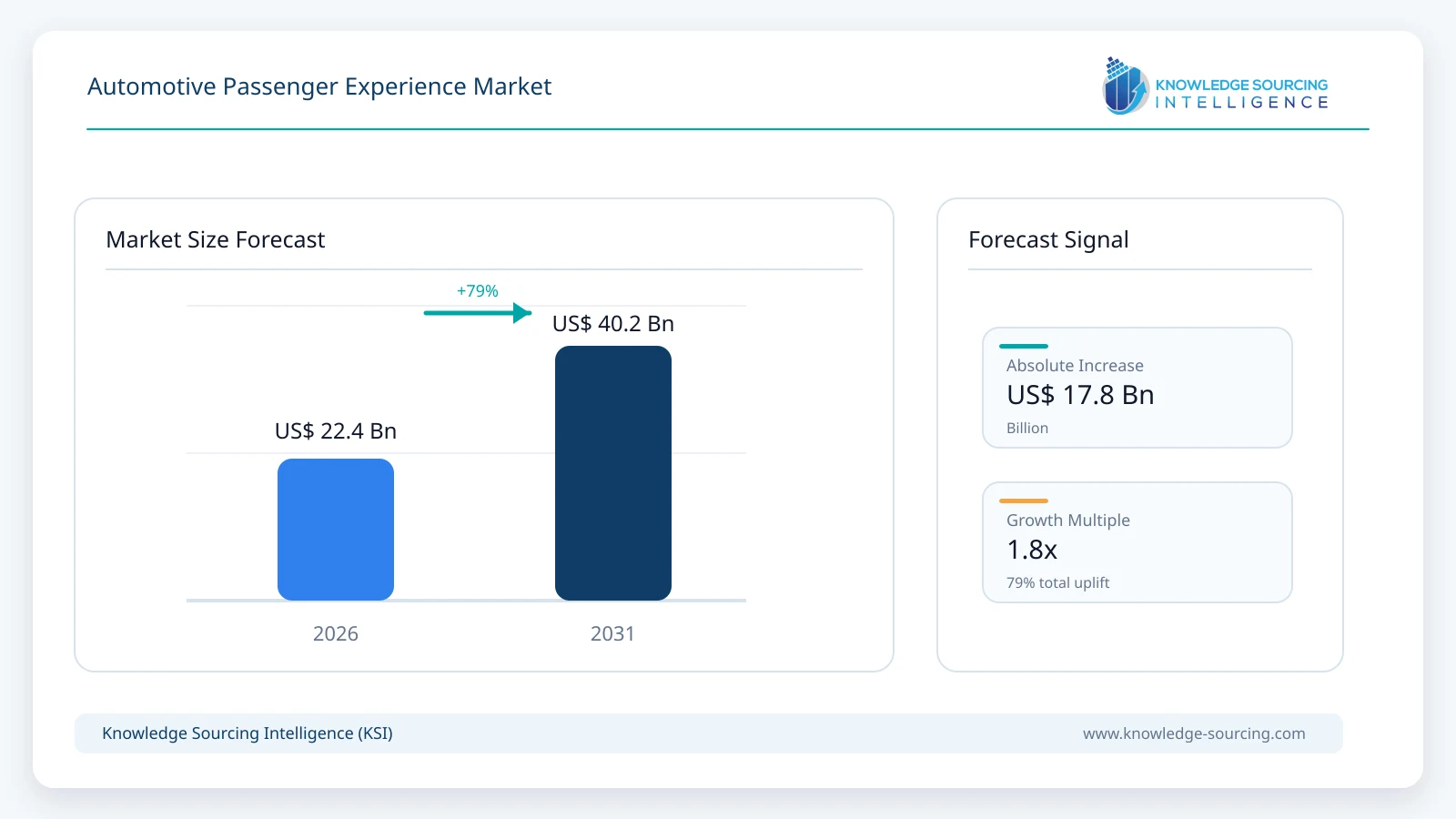
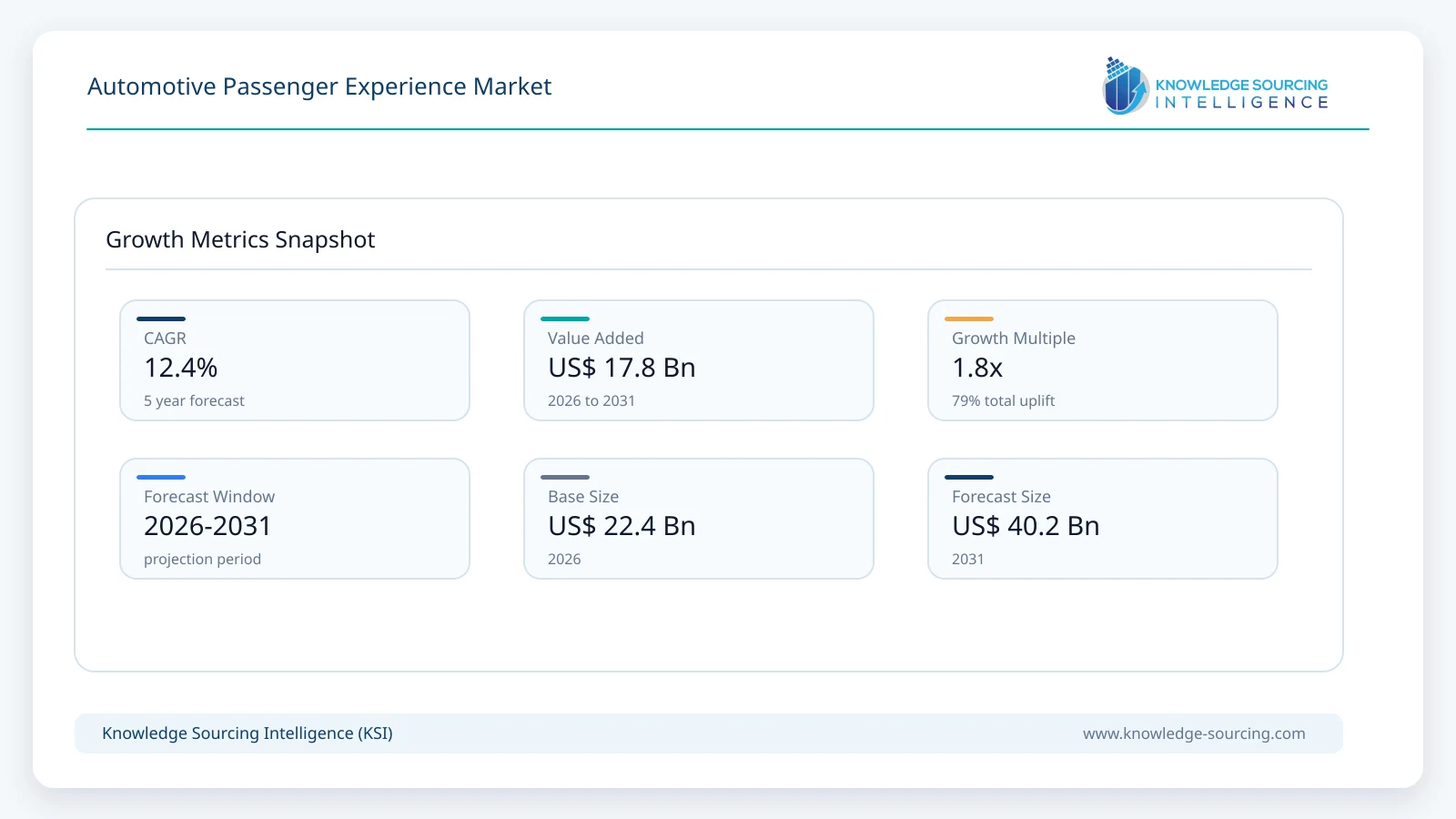
The Automotive Passenger Experience Market is projected to expand at a CAGR of 12.4%, increasing from USD 22.4 billion in 2026 to USD 40.2 billion by 2031.
Highlights:
- 1Passenger displays, entertainment and digital HMI account for an estimated 38% of market value in 2026, encompassing separate front-passenger and rear-entertainment content.
- 2Rear-passenger functionality represents approximately 44% of the 2026 market and is forecast to increase as large SUVs, MPVs and executive vehicles adopt more connected experiences.
- 3Integrated multi-domain platforms represent around 44% of market value in 2026 and gain share as cabin computing and software functions become more centralized.
- 4SUVs and crossovers represent approximately 42% of 2026 passenger-experience revenue, benefiting from volume scale and optional feature packages.
- 5Asia Pacific accounts for an estimated 46% of 2026 market value, supported by Chinese smart-cabin development and established electronics supply chains.
- 6Experience functions in autonomous passenger vehicles form an overlapping subset, not a separate revenue pool that can be added to this market.
The market measures supplier-level revenue attributable to passenger-facing entertainment, interaction, comfort, and assistance functions across front and rear cabin zones. Dedicated passenger display modules, rear entertainment, adjustable seating technologies, passenger-specific thermal systems, zoned audio and relevant software integration are included without valuing an entire seat or cockpit assembly.
Rising feature content, rather than vehicle production alone, underpins the forecast. Porsche provides privacy-filtered front-passenger displays, LG Electronics supplies automotive streaming and rear-cockpit technology, and Waymo offers passenger-controlled displays, climate and accessibility functions in its Ojai mobility platform. These examples span conventional, electrified, and autonomous vehicles, although their installed bases and commercialization stages differ substantially.
Market Overview
Passenger-facing vehicle technology is no longer confined to the rear entertainment screen. Front-passenger displays can support navigation input, media selection, and independent content, while rear-seat interfaces increasingly connect to climate, audio, seating and vehicle information. Porsche's privacy-filtered passenger displays illustrate how manufacturers separate passenger media activity from the driver's field of view while preserving access to shared vehicle services.
Experience value differs across vehicle categories. Family SUVs and MPVs emphasize rear entertainment, convenient charging and independent thermal controls, whereas executive sedans place greater weight on seat adjustment, noise management and high-resolution displays. Advanced ride-hailing platforms introduce another requirement: passengers may need straightforward controls, clear trip information and accessible entry without relying on a driver.
Automotive electronics suppliers are responding with integrated content ecosystems and distributed passenger control. LG Electronics announced a six-solution package for the Genesis GV90 in October 2026, including a rear-cockpit platform, console touchscreen and automotive content service. The development demonstrates a more coordinated supply model, but system packaging, regional service rights and integration economics still differ by automaker.
Market Trends
Passenger-Specific Screens Are Becoming Independent Interface Zones
Dedicated passenger displays allow front occupants to select media, adjust settings, and assist with navigation without taking over the main driver interface. Porsche offers an optional 14.9-inch passenger screen in the Cayenne Electric with app, streaming and vehicle-information functions. Privacy-oriented screen technologies limit the driver's view of moving content, making distraction control part of display qualification. The commercial value increasingly resides in display integration, graphics, controls and software rather than panel size alone.
Streaming and Connected Services Are Expanding Rear-Cabin Utility
LG Electronics' Automotive Content Platform brings television-style applications into the vehicle and was expanded through Prime Video integration announced in January 2026. The same platform has been specified for Kia models in Europe, illustrating the ability to deploy one service architecture across vehicle programs. Passenger entertainment suppliers must handle regional licensing, connectivity, software updates and user profiles, creating continuing integration work after hardware installation.
Comfort Technologies Are Becoming Passenger-Zoned
Localized heating, ventilation and ergonomic functions make cabin comfort more individual than a single HVAC setting. Smart seating and thermal suppliers such as Gentherm, Lear and FORVIA develop systems that adjust passenger support or thermal conditions by seating position and personal preference. Multi-zone control is particularly valuable in vehicles with several rear occupants, although packaging, energy consumption and validation constrain deployment in lower-cost models.
Accessible and Conversational Controls Are Receiving Greater Attention
Waymo's Ojai integrates passenger screens, accessible entry features and seat-aware controls within a purpose-designed autonomous vehicle. Waymo introduced a beta Gemini assistant in July 2026 to support climate changes, journey questions and selected rider requests. Passenger-centric conversational interfaces can reduce reliance on distant touchscreens, but privacy, speech accuracy and separation from safety-critical vehicle controls remain material design requirements.
Segment Analysis
By Experience System: Passenger Displays, Entertainment and Digital HMI
Passenger displays, entertainment and digital HMI represent approximately USD 8.51 billion in 2026, making the category the largest identifiable system group. Front-passenger screens and rear-seat entertainment have different physical installations, and their existing KSI estimates provide important lower-level benchmarks. Integrated content services, privacy technologies and passenger-oriented HMI add value beyond individual displays. The category is modeled at 40% of global value by 2031, allowing for continued development of digital content without mechanically summing adjacent report totals.
By Passenger Zone: Front-Passenger Experience
Front-passenger functions account for approximately 46% of the 2026 market because front seats receive comparatively high penetration of comfort controls, displays and shared infotainment access. Porsche's passenger display architecture shows how the front passenger can operate entertainment and navigation within an interface distinct from the driver's. Rear-passenger systems gain share through large SUVs, MPVs and luxury mobility programs, but front-passenger content remains a substantial recurring design requirement.
By Primary Experience Function: Entertainment and Media
Entertainment and media account for an estimated 35% of market value in 2026. Connected screens, audio interfaces, and application integration are increasingly supplied through common digital platforms rather than isolated rear entertainment hardware. LG's streaming partnerships show how vehicle entertainment offerings can change through software over time. The segment retains the largest functional share in 2031, while connected productivity and communications grow faster from a smaller base.
By Integration Architecture: Integrated Multi-Domain Platforms
Integrated multi-domain experience platforms represent approximately 44% of the 2026 market and are projected to capture 56% by 2031. Shared vehicle compute and software architecture can coordinate passenger media, local comfort, profiles, and cabin controls while reducing duplicated electronics. Centralization requires stronger partitioning, cybersecurity, and validation when passenger-facing applications share resources with other vehicle domains. Technology suppliers increasingly compete on software integration as much as standalone components.
By Vehicle Application: SUVs and Crossovers
SUVs and crossovers generate approximately 42% of 2026 revenue, supported by large global sales volumes and available packages combining rear-seat comfort, entertainment and connectivity. Three-row vehicles offer additional passenger zones, increasing the number of displays, control surfaces and charging points that can be specified. MPVs and passenger vans remain important for rear-cabin content, particularly in chauffeur-driven and family-oriented applications.
By Propulsion: Battery Electric Vehicles
Battery electric vehicles account for an estimated 30% of passenger-experience value in 2026 and are projected to reach 43% by 2031. Many EV programs launch with centralized electronics, large displays, and app-based interfaces, supporting higher passenger-facing content on selected models. Electric architectures do not automatically create more passenger value, however, and conventional vehicles continue to generate substantial revenue through their installed production base.
By Geography: Asia Pacific
Asia Pacific represents approximately 46% of the passenger-experience market in 2026. China's scale in smart-cabin vehicles, together with display, electronics and seating suppliers across Japan and South Korea, supports both volume and feature innovation. India and Southeast Asia provide longer-term adoption opportunities, although price-sensitive vehicle mixes limit high-value passenger packages on many models. Asia Pacific's modeled share reaches approximately 49% by 2031.
Market Drivers
Expansion of Passenger Displays and Rear Entertainment
Automakers increasingly specify dedicated passenger media functions alongside mainstream infotainment. Porsche's optional front-passenger screens and the expansion of factory rear entertainment systems demonstrate how additional cabin zones create incremental supplier content. Higher display resolution, passenger-specific controls, privacy features and connected applications increase value even where physical display counts change little.
Premium SUVs, MPVs and Executive Mobility
Passenger experience carries greater commercial weight in vehicles used for family travel and chauffeur-driven journeys. Large SUVs, executive sedans and MPVs offer the packaging space for rear displays, individual climate control and adjustable seating. Automakers can use these packages to differentiate trims, while specialist suppliers obtain higher integration content per vehicle.
Growth of Automotive Media and Application Ecosystems
Streaming, gaming and connected productivity change the commercial role of passenger interfaces. LG's Prime Video integration and European Kia platform expansion demonstrate how automotive software can carry familiar content services into multiple vehicle programs. Application certification, connectivity and lifecycle support give vehicle manufacturers reasons to maintain active software relationships after a model enters production.
Localized Passenger Thermal and Seating Comfort
Individual passenger comfort can improve perceived vehicle quality without requiring a complete cabin redesign. Seat ventilation, heating, massage and zoned airflow support different preferences across seating positions. Manufacturers of thermal and seating systems can supply upgradeable comfort functions while vehicle makers balance feature performance against electrical load, packaging and cost.
Passenger-Centered Design in Autonomous Mobility
Purpose-built autonomous vehicles place the passenger journey at the center of cabin development. Waymo's Ojai provides accessible entry, independent rider controls, and multiple information displays, while Gemini-based interaction extends rider access to selected cabin functions. Although autonomous fleets remain a small share of total automotive production, the design lessons can influence passenger interfaces in conventional premium vehicles.
Market Restraints
High Content Cost and Uneven Fitment
Independent displays, sophisticated seats, premium audio and multi-zone thermal systems increase supplier content and validation expense. Many features remain concentrated in higher-trim SUVs, MPVs and luxury vehicles where manufacturers can recover package costs. Expanding into mainstream models requires lower-cost component architectures and stronger evidence of consumer willingness to pay.
Distraction Management and Interface Qualification
Passenger-facing video functions need physical and software safeguards to prevent unwanted driver exposure while the vehicle is moving. Porsche's privacy-screen approach illustrates one solution, but viewing angle, lighting conditions and user interaction must still be validated. Integrating additional cabin controls also increases the importance of clear role separation between driver and passenger interfaces.
Fragmented Software and Content Rights
Entertainment applications may depend on regional streaming licenses, data connectivity, account management and security updates. OEMs and suppliers must maintain reliable services across markets with different commercial terms and telecommunications coverage. A feature that functions well at launch can create later customer dissatisfaction if application support or access changes.
Integration Burden across Cabin Domains
Seat controls, lighting, sound, climate and digital interfaces frequently originate from different supplier groups. Coordinated passenger experiences require stable software interfaces, consistent response times, and robust testing through model updates. Shared computing platforms may reduce duplicate hardware, but integration responsibility and cybersecurity exposure can become more complex.
Limited Scale of Passenger-First Autonomous Platforms
Dedicated autonomous mobility cabins provide useful demonstrations of accessibility and rider-centered HMI, but large-scale revenue depends on fleet rollout and operating geography. Waymo's Ojai illustrates commercial development rather than a universal adoption pattern. The broader market forecast therefore relies mainly on conventional and electrified passenger vehicles, with autonomous applications contributing a smaller differentiated portion.
Regional Outlook
Asia Pacific
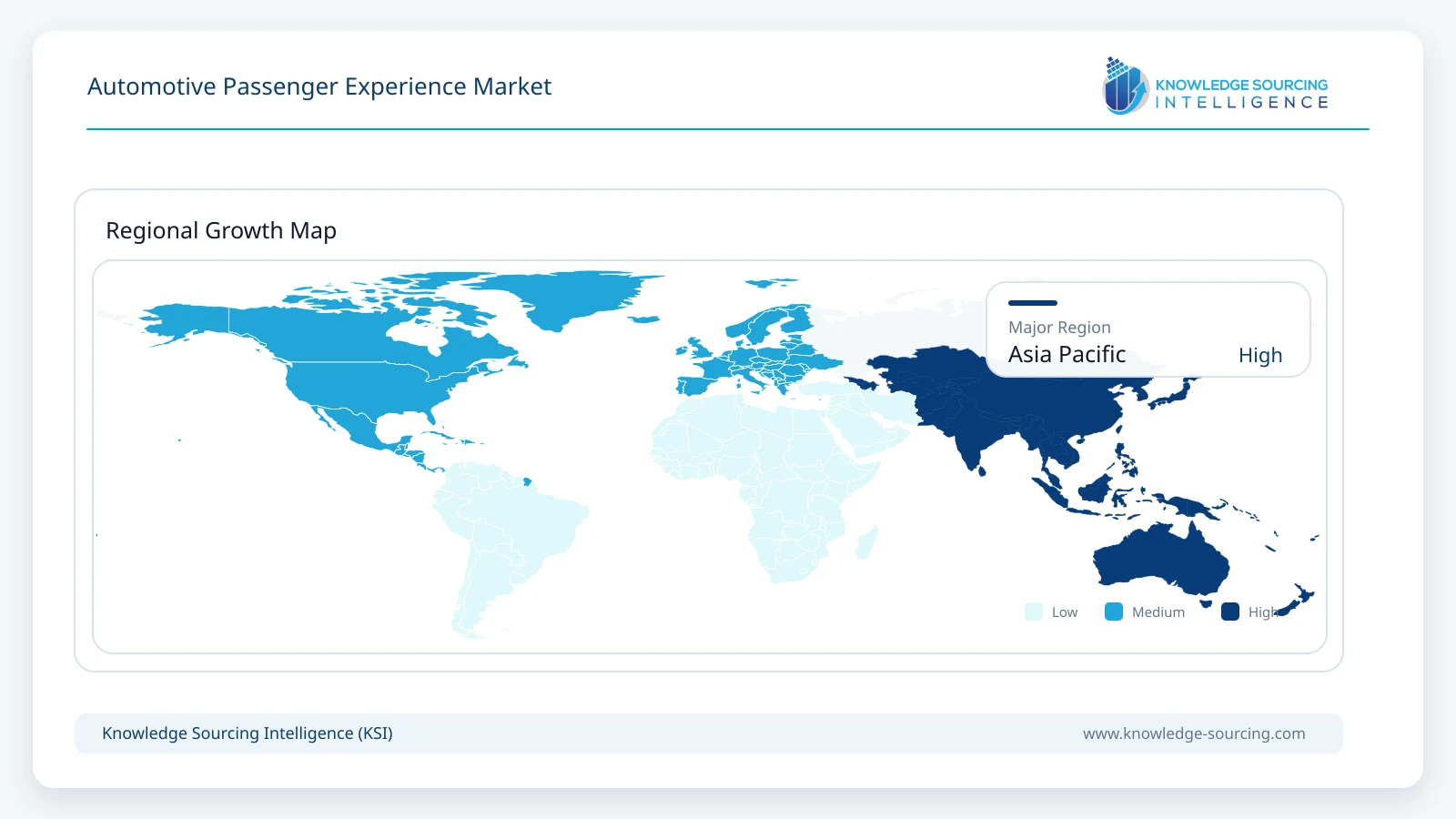
Asia Pacific leads passenger-experience revenue because China combines a large passenger-vehicle market with rapid development of connected, feature-rich cabins. Japanese and South Korean suppliers provide important expertise in screens, infotainment, electronics and seating systems, while Chinese OEMs increasingly emphasize rear passenger comfort and digital interaction. LG's Genesis GV90 program illustrates the breadth of experience technology assembled within a single high-content vehicle. The region is modeled at approximately USD 19.70 billion by 2031, with growth coming from richer digital platforms as well as broader adoption in SUVs and MPVs.
Adoption remains uneven across Asia Pacific. High-end Chinese EVs and executive MPVs can support multiple displays and complex comfort packages, while price-sensitive models in India and Southeast Asia generally deploy fewer passenger-specific features. Suppliers that offer scalable display, content and zonal control architectures are better positioned to expand beyond premium applications.
Europe
European passenger-experience demand is shaped by premium vehicle manufacturers and a strong focus on interface integration, cabin quality and distraction management. Porsche deploys privacy-filtered front-passenger screens and integrated streaming, while major European OEMs offer increasingly connected rear-seat options. Premium sedans and SUVs support higher average revenue per equipped vehicle than the regional production mix alone would suggest.
Europe represents approximately 25% of global value in 2026 and is projected to retain around 23% by 2031 as Asia Pacific expands more rapidly. Hardware qualification, privacy protection and software lifecycle support remain central purchasing criteria. Regional suppliers also benefit from cross-border development programs involving seating, cockpit electronics, infotainment and thermal systems.
Competitive Landscape
The supplier landscape spans digital platforms, displays, interior systems, seating and localized comfort. LG Electronics and HARMAN compete through media and connected-cabin technologies; Panasonic Automotive Systems, Visteon and Hyundai Mobis supply passenger interface and infotainment platforms; FORVIA, Yanfeng and Toyota Boshoku participate through cabin integration and seating architectures. Gentherm and Lear add specialist thermal and seating capabilities, while Magna and Alps Alpine contribute comfort, interface and electronics technologies.
Competitive differentiation depends on OEM program wins, experience integration, passenger-zone control, software reliability and manufacturing scalability. A broad concept demonstration is not equivalent to production revenue. Supplier rankings are therefore not inferred from total corporate sales, which frequently include substantial non-passenger and non-experience businesses.
Recent Developments
8 October 2026: LG Electronics detailed six display, infotainment and connectivity solutions for the Genesis GV90, including a rear-cockpit system, rear console touchscreen and Automotive Content Platform.
29 July 2026: Waymo introduced Gemini in Waymo and a redesigned Ojai rider interface, adding optional conversational access to cabin settings and journey information.
28 May 2026: Waymo described the Ojai rider-first platform, including three passenger screens, accessible entry and customized temperature and media settings.
24 April 2026: Porsche announced Disney+ availability for the Cayenne Electric and Macan Electric through Porsche App Center, with optional passenger-screen viewing.
6 January 2026: LG Electronics announced Prime Video integration into the Automotive Content Platform, expanding the in-vehicle entertainment application ecosystem.
16 July 2025: LG Electronics announced adoption of its webOS Automotive Content Platform on new Kia models in Europe, extending its automotive streaming footprint.
Market Outlook
The Automotive Passenger Experience Market is projected to reach USD 40.20 billion by 2031 as passenger-specific digital functions and individualized comfort gain value across more vehicle classes. Passenger display and entertainment systems remain the largest technology group, while integrated multi-domain architectures gain share through common computing and software platforms. The strongest opportunities lie in architectures that can be deployed across different trim levels without requiring costly redesigns.
Asia Pacific is expected to remain the largest region, followed by Europe and North America. Revenue growth is increasingly tied to passenger-zone usability, software lifecycle support, and effective coordination among seating, climate, content and HMI rather than independent hardware upgrades. Autonomous mobility provides a strategically important but smaller subset of the broader passenger-experience market.'
Automotive Passenger Experience Market Scope:
| Report Metric | Details |
|---|---|
| Total Market Size in 2026 | USD 22.4 billion |
| Total Market Size in 2031 | USD 40.2 billion |
| Forecast Unit | USD Billion |
| Growth Rate | 12.4% |
| Study Period | 2021 to 2031 |
| Historical Data | 2021 to 2024 |
| Base Year | 2025 |
| Forecast Period | 2026 – 2031 |
| Segmentation | Experience System, Passenger Zone, Primary Experience Function, Integration Architecture |
| Companies |
|
| Customization Scope | 15% Free Customization included with purchase — Request Custom Breakdown → |
| Sample & Data Access | PDF Sample, Excel Databook & Analyst Briefing — Download Free Sample → |
Market Segmentation
By Experience System
Passenger Displays, Entertainment and Digital HMI
Adaptive Seating and Ergonomic Comfort
Passenger Thermal and Wellness Systems
Personalized Audio and Ambient Environment
Connectivity, Digital Services and Accessibility
By Passenger Zone
Front-Passenger Experience
Rear-Passenger Experience
Shared and Multi-Zone Experience
By Primary Experience Function
Entertainment and Media
Comfort and Wellness
Productivity and Connected Services
Passenger Interaction and Convenience
Accessibility and Mobility Assistance
By Integration Architecture
Integrated Multi-Domain Experience Platforms
Dedicated Passenger-Facing Modules
Software-Led and Service-Based Experiences
By Vehicle Application
Passenger Cars and Executive Sedans
SUVs and Crossovers
MPVs and Passenger Vans
Shuttles and Other Passenger-Carrying Vehicles
By Propulsion
Battery Electric Vehicles
Hybrid and Plug-in Hybrid Vehicles
Internal Combustion Engine Vehicles
Other Propulsion
By Geography
North America
United States
Canada
Mexico
South America
Brazil
Argentina
Others
Europe
Germany
United Kingdom
France
Italy
Spain
Others
Middle East and Africa
Saudi Arabia
UAE
South Africa
Others
Asia Pacific
China
Japan
South Korea
India
Indonesia
Thailand
Others
Table of Contents
1. EXECUTIVE SUMMARY
2. MARKET SNAPSHOT
2.1. Market Overview
2.2. Market Definition
2.3. Scope of the Study
2.4. Market Segmentation
3. BUSINESS LANDSCAPE
3.1. Market Drivers
3.1.1. Expansion of Passenger Displays and Rear Entertainment
3.1.2. Premium SUVs, MPVs and Executive Mobility
3.1.3. Growth of Automotive Media and Application Ecosystems
3.1.4. Localized Passenger Thermal and Seating Comfort
3.1.5. Passenger-Centered Design in Autonomous Mobility
3.2. Market Restraints
3.2.1. High Content Cost and Uneven Fitment
3.2.2. Distraction Management and Interface Qualification
3.2.3. Fragmented Software and Content Rights
3.2.4. Integration Burden across Cabin Domains
3.2.5. Limited Scale of Passenger-First Autonomous Platforms
3.3. Market Opportunities
3.4. Porter’s Five Forces Analysis
3.5. Industry Value Chain Analysis
3.6. Policies and Regulations
3.7. Strategic Recommendations
4. TECHNOLOGICAL OUTLOOK
4.1. Passenger Display and Privacy Technologies
4.2. Integrated Rear-Cabin Infotainment
4.3. Passenger-Zoned Thermal and Seating Systems
4.4. Passenger Audio and Ambient Interaction
4.5. AI-Based Passenger Interfaces and Accessibility
5. AUTOMOTIVE PASSENGER EXPERIENCE MARKET BY EXPERIENCE SYSTEM
5.1. Introduction
5.2. Passenger Displays, Entertainment and Digital HMI
5.3. Adaptive Seating and Ergonomic Comfort
5.4. Passenger Thermal and Wellness Systems
5.5. Personalized Audio and Ambient Environment
5.6. Connectivity, Digital Services and Accessibility
6. AUTOMOTIVE PASSENGER EXPERIENCE MARKET BY PASSENGER ZONE
6.1. Introduction
6.2. Front-Passenger Experience
6.3. Rear-Passenger Experience
6.4. Shared and Multi-Zone Experience
7. AUTOMOTIVE PASSENGER EXPERIENCE MARKET BY PRIMARY EXPERIENCE FUNCTION
7.1. Introduction
7.2. Entertainment and Media
7.3. Comfort and Wellness
7.4. Productivity and Connected Services
7.5. Passenger Interaction and Convenience
7.6. Accessibility and Mobility Assistance
8. AUTOMOTIVE PASSENGER EXPERIENCE MARKET BY INTEGRATION ARCHITECTURE
8.1. Introduction
8.2. Integrated Multi-Domain Experience Platforms
8.3. Dedicated Passenger-Facing Modules
8.4. Software-Led and Service-Based Experiences
9. AUTOMOTIVE PASSENGER EXPERIENCE MARKET BY VEHICLE APPLICATION
9.1. Introduction
9.2. Passenger Cars and Executive Sedans
9.3. SUVs and Crossovers
9.4. MPVs and Passenger Vans
9.5. Shuttles and Other Passenger-Carrying Vehicles
10. AUTOMOTIVE PASSENGER EXPERIENCE MARKET BY PROPULSION
10.1. Introduction
10.2. Battery Electric Vehicles
10.3. Hybrid and Plug-in Hybrid Vehicles
10.4. Internal Combustion Engine Vehicles
10.5. Other Propulsion
11. AUTOMOTIVE PASSENGER EXPERIENCE MARKET BY GEOGRAPHY
11.1. North America
11.1.1. United States
11.1.2. Canada
11.1.3. Mexico
11.2. South America
11.2.1. Brazil
11.2.2. Argentina
11.2.3. Others
11.3. Europe
11.3.1. Germany
11.3.2. United Kingdom
11.3.3. France
11.3.4. Italy
11.3.5. Spain
11.3.6. Others
11.4. Middle East and Africa
11.4.1. Saudi Arabia
11.4.2. UAE
11.4.3. South Africa
11.4.4. Others
11.5. Asia Pacific
11.5.1. China
11.5.2. Japan
11.5.3. South Korea
11.5.4. India
11.5.5. Indonesia
11.5.6. Thailand
11.5.7. Others
12. COMPETITIVE ENVIRONMENT AND ANALYSIS
12.1. Major Players and Strategy Analysis
12.2. Market Share Analysis
12.3. Partnerships, Agreements and Collaborations
12.4. Passenger-Experience Technology Benchmarking
12.5. Competitive Dashboard
13. COMPANY PROFILES
13.1. LG Electronics Vehicle Solution Company
13.2. HARMAN International
13.3. Panasonic Automotive Systems Co., Ltd.
13.4. FORVIA SE
13.5. Yanfeng International Automotive Technology Co., Ltd.
13.6. Toyota Boshoku Corporation
13.7. Gentherm Incorporated
13.8. Visteon Corporation
13.9. Hyundai Mobis Co., Ltd.
13.10. Lear Corporation
13.11. Magna International Inc.
13.12. Alps Alpine Co., Ltd.
14. APPENDIX
14.1. Currency
14.2. Assumptions
14.3. Base and Forecast Years Timeline
14.4. Key Benefits for Stakeholders
14.5. Research Methodology
14.6. Abbreviations
14.7. Primary Sources





Frequently asked questions
What is the projected growth forecast for the Automotive Passenger Experience market?
The Automotive Passenger Experience Market will grow at a 12.4% CAGR, reaching USD 40.2 billion by 2031.
Which segments drive significant market value in 2026?
Passenger displays, entertainment, digital HMI, and multi-domain platforms contribute significantly.
Which region leads the market for automotive passenger experience?
Asia Pacific accounts for an estimated 46% of 2026 market value.
What vehicle types contribute most to passenger experience revenue?
SUVs and crossovers represent approximately 42% of 2026 market revenue.
What is the future outlook for rear-passenger functionality?
Rear-passenger functionality is forecast to increase, especially in larger vehicles.
What primarily underpins the market's growth forecast?
Rising feature content, rather than vehicle production alone, drives growth.
Cite this report
Knowledge Sourcing Intelligence. (Oct 2026). Automotive Passenger Experience Market Size, Share & Growth Forecast (2026-2031). https://www.knowledge-sourcing.com/report/automotive-passenger-experience-market