
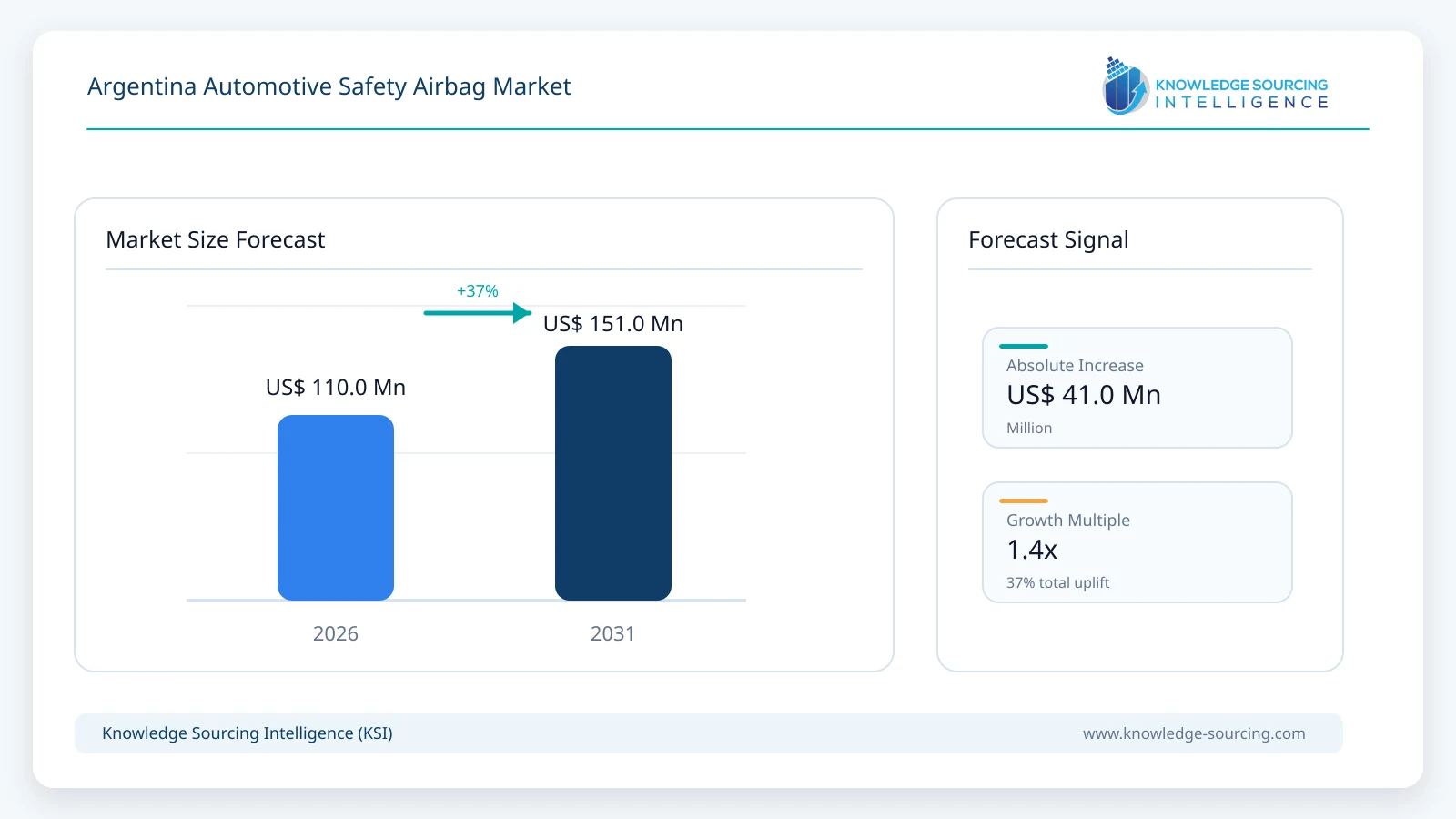
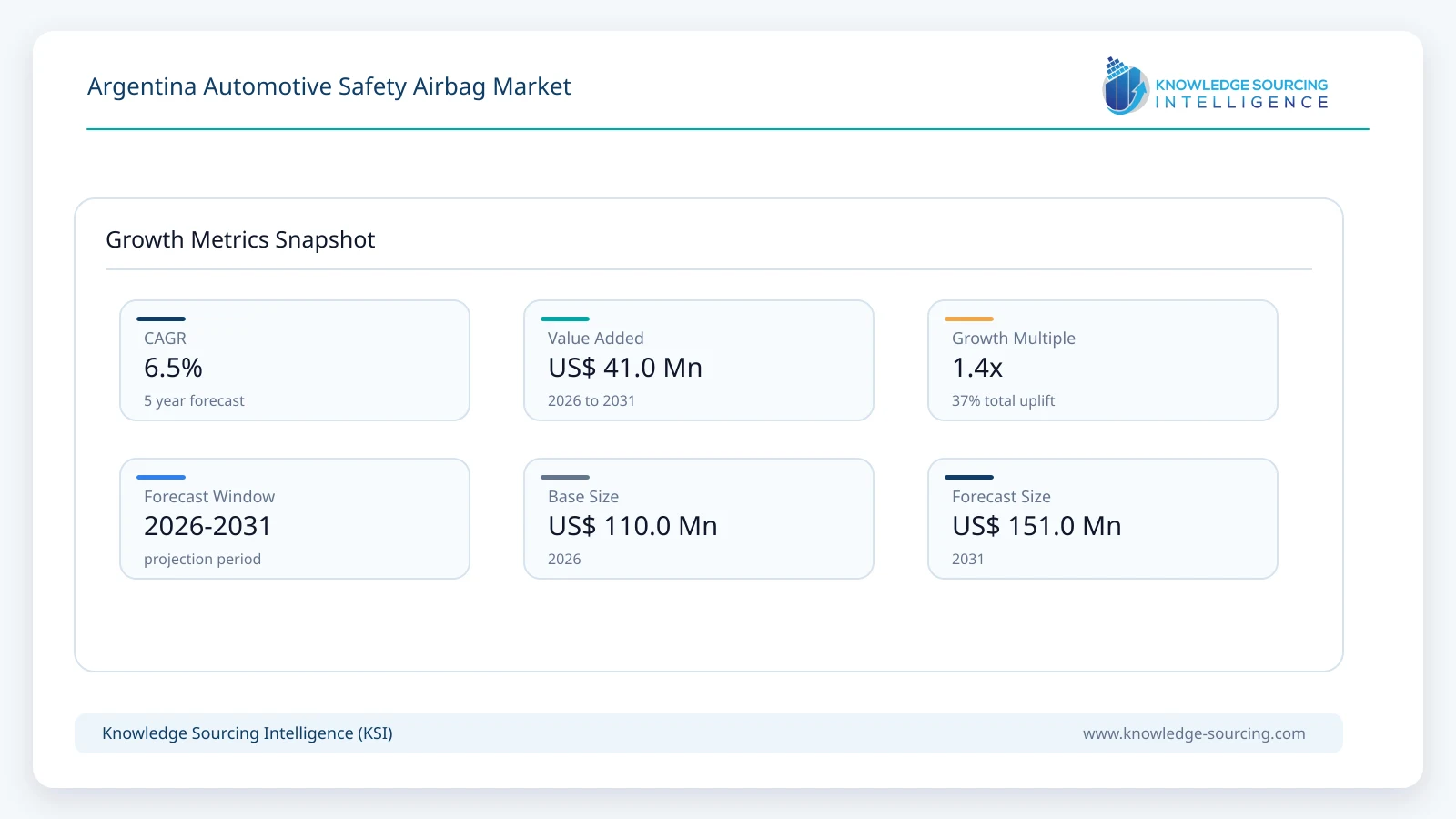
The Argentina Automotive Safety Airbag Market is projected to grow at a CAGR of 6.5%, reaching a market size of USD 151.0 million in 2031 from USD 110.0 million in 2026.
Highlights:
- 1Front airbags account for approximately 54% of 2026 market value, reflecting established driver and passenger protection.
- 2Passenger vehicles contribute an estimated 45% of spending, with richer restraint packages supporting further penetration.
- 3OEM supply represents roughly 94.5% of revenue as airbag modules are principally integrated during vehicle manufacture.
- 4Buenos Aires Province leads Argentine demand by production location, while Córdoba gains from diversified vehicle programs.
- 5Curtain and seat-mounted airbags are gaining importance in vehicle specifications beyond mandatory frontal protection.
Automotive safety airbags are engineered restraint modules containing folded cushions, inflators, housing assemblies and calibrated deployment hardware. In Argentina, demand is generated mainly by vehicle assembly programs, including cars and light commercial vehicles built for domestic sale and export. Front, side and specialist airbags are differentiated by occupant position and crash mode; replacement demand remains limited because deployed modules require controlled replacement and verification of the associated restraint system.
Argentina’s motor industry continues to rely on international supplier programs for critical restraint components. Autoliv, ZF LIFETEC, Joyson Safety Systems and Toyoda Gosei illustrate the global capabilities required to deliver validated airbag assemblies across vehicle platforms. Local manufacturers’ purchasing volumes fluctuate with model schedules, changes in passenger-car and pickup output, and the content specified for individual export destinations. Additional airbags can increase supplier revenue per vehicle without a matching rise in assembly volumes.
Market Overview
Vehicle production remains the main determinant of airbag procurement in Argentina. ADEFA recorded 314,975 vehicles manufactured during January–September 2026, 16.9% fewer than a year earlier, while exports reached 203,072 units. The difference between these two trends matters for restraint suppliers: passenger-car assembly can contract even as export-oriented pickup programs preserve scheduled deliveries of safety modules. Procurement volumes therefore follow the actual mix of platforms assembled rather than national new-car registrations alone.
Airbag specifications have also become more demanding than the original dual-front installation requirement. Argentina’s historical safety agreements established frontal airbags for applicable new vehicles, while updated homologation rules continue to link market access to demonstrated active and passive safety compliance. Manufacturers differentiate performance through inflator output, cushion shape, deployment timing, compatibility with seatbelts and control of occupant movement in side impacts. Global supplier examples provide a useful technology benchmark: Toyoda Gosei supplies compact curtain airbags, and ZF LIFETEC is integrating sensing information with adaptive restraint strategies. Neither example establishes automatic fitment on Argentine-assembled models.
The commercial market is concentrated at the interface between vehicle platforms and qualified safety-module suppliers. A module’s price depends on its crash-protection role, mounting location, calibration requirements and annual call-off volumes. Inflators, coated fabrics and control interfaces are already embedded within finished assemblies when bought on that basis; recognizing each component again would overstate supplier expenditure. The aftermarket mainly serves accident repairs or validated service campaigns, rather than normal wear replacement. Longer-term growth is consequently more sensitive to the number and complexity of locally manufactured vehicles than to broad expansion of aftermarket distribution.
Market Trends
Side-Impact Protection Is Expanding the Restraint Package
Airbags installed in seatbacks and roof rails complement frontal protection by managing contact with doors, glazing and adjacent occupants. Joyson Safety Systems offers side, head-side and far-side restraint architectures, while Toyoda Gosei’s new curtain-airbag deployments show ongoing effort to reduce packaging requirements. The ability to incorporate additional modules into compact cabins helps manufacturers extend protection without wholesale redesign of interior structures.
Argentine assembly programs generally adopt passive-safety specifications through international vehicle architectures. Side-impact coverage therefore expands unevenly: higher-specification passenger variants and models configured for export safety requirements may carry more modules than basic utility versions. Supplier value per assembled vehicle can rise even when production remains subdued.
Occupant-Specific Deployment Is Reshaping Module Design
ZF LIFETEC presented a production-ready approach in September 2026 that combines cameras and seat information with adaptive airbag and belt strategies. The direction is toward better control of restraint force for occupants of different sizes and seating positions, rather than adding cushions without regard to occupant movement.
The potential benefit depends on vehicle software integration, robust sensor information and a suitable test program. Adoption in Argentina would follow the sourcing decisions of individual OEM platforms; there is no evidence that all vehicles assembled locally have migrated to adaptive airbags. Validation costs can keep simpler proven architectures in high-volume, cost-sensitive models.
Virtual Testing Is Influencing Safety Development Economics
Autoliv introduced its Human Body Model Safety Suite in September 2026, supporting computer-based examination of occupant injury responses alongside conventional crash tests. Such methods can help teams evaluate occupant sizes and difficult crash conditions earlier in the design cycle and reduce late-stage module redesign.
Airbag programs for Argentine-built vehicles still require physical verification, production control and homologation. Virtual models are most commercially useful when they shorten engineering iterations for a platform used across multiple markets. The savings accrue primarily through development efficiency and do not constitute an additional airbag unit sold.
Pickup Platforms Are Changing the Local Vehicle Mix
Argentina’s light-commercial vehicle manufacturing base is structurally significant. Stellantis began Fiat Titano pickup production at its Córdoba operation in May 2025 and subsequently expanded that industrial program. Pickup development directs greater attention to front restraint robustness, side-impact requirements and the compatibility of modules with different seating and cab configurations.
Pickup manufacturing is not immune to cyclical adjustments. Supplier contracts are tied to platform schedules and model-level bill-of-material content; a capacity announcement or plant investment cannot be treated as an immediate increase in airbag shipments. The opportunity is strongest where a common restraint system can serve regional variants and export markets.
Safety Validation Is Becoming More Closely Linked to Homologation
Argentina’s 2025 and 2026 regulatory updates address procedures for recognizing and demonstrating vehicle safety compliance. Imported and locally manufactured vehicles must satisfy the applicable model-configuration approval framework, giving vehicle makers a continuing incentive to source reliable and traceable passive-safety assemblies.
Compliance expenditure falls across testing, documentation and qualification rather than necessarily generating additional airbag content on each vehicle. Suppliers with established validation data and repeatable manufacturing controls have an advantage when platforms change or components are re-sourced, especially where documentation must support several regional approval regimes.
Segment Analysis
By Product Type: Front Airbag
Front airbag modules remain the principal component of Argentina’s passive-restraint spending because driver and front-passenger coverage is built into the applicable vehicle safety framework. Steering-wheel and dashboard designs set the space available for cushions and inflators, while cabin geometry determines deployment volume. Supplier qualification is undertaken as part of vehicle development, leaving limited scope for one module to be substituted across unrelated models without fresh validation.
The front-airbag category is forecast to reach approximately USD 73.5 million by 2031. Its value grows more slowly than side- and specialty-restraint content as producers add protection for side-impact and out-of-position occupants. Toyoda Gosei’s June 2026 driver-airbag design demonstrates continued investment even in the established frontal category, where benefits increasingly come from controlled cushioning across occupant sizes rather than basic installation alone.
By Vehicle Type: Passenger Vehicle
Passenger-vehicle applications are expected to reach approximately USD 72.5 million in 2031, supported by the greater number of restraint positions fitted to selected car and crossover models. Cars configured for several sales markets can require airbags in the seat, roof rail and dashboard, making the value of the full restraint package more important than the number of units assembled. Argentina’s production base also includes pickup trucks whose installed safety content can be substantial but varies sharply by trim and destination.
The 2026 decline in national vehicle manufacturing constrains immediate demand; the forecast assumes only a measured volume recovery followed by increasing airbag content on newer platforms. Changes in passenger-car production at Buenos Aires and Córdoba sites, along with safety specification choices at model renewal, will determine whether this segment increases its contribution relative to light commercial vehicles.
By End-User: OEMs
Original-equipment manufacturers retain overwhelming purchasing influence because airbag modules are validated and installed during vehicle assembly. Tier-one producers work with automakers on crash-test targets, wiring and controller interfaces, packaging, deployment thresholds and reliable serial production. Replacement suppliers cannot reproduce these programs simply by offering an equivalent-looking cushion or inflator.
The OEM channel is projected to account for approximately USD 142.6 million in 2031. Service replacement after collisions remains a smaller, more specialized revenue category; airbags do not have a prescribed replacement interval comparable to brake pads or filters. Official service procedures, traceability and repair integrity are therefore central to legitimate aftermarket purchases.
Market Drivers
Established Front-Occupant Safety Requirements
Argentina’s staged vehicle-safety agreements embedded the expectation of frontal-airbag protection in applicable new vehicles. That baseline keeps driver and passenger restraint assemblies in recurring OEM procurement, even when discretionary equipment is reduced on entry-level variants. Suppliers must retain demonstrated compliance and production controls rather than treating airbags as optional cabin accessories.
Changes in model approval procedures introduced during 2025 and 2026 reinforce the importance of documented conformity. They do not, by themselves, mandate additional airbags on every locally manufactured vehicle; their commercial contribution is mainly the continuing necessity for verified passive-safety equipment.
Rising Airbag Content on Selected Passenger Platforms
Car and crossover programs increasingly combine front airbags with side, curtain and sometimes center or knee modules. Each added restraint location calls for its own cushion package, integration and crash-calibration work. Suppliers able to provide coordinated families of modules can capture a greater portion of a vehicle’s safety-content budget.
Toyoda Gosei’s 2026 product deployments and Joyson’s broad portfolio indicate the direction of available safety technology. Argentine adoption will be uneven because OEMs balance crash performance with packaging, homologation and cost targets. That uneven adoption is more credible than assuming identical content gains for every locally produced vehicle.
Platform Renewal and Regional Pickup Programs
Pickup manufacturing is an important source of industrial demand in Buenos Aires and Córdoba, supported by international platforms and export commitments. Stellantis’s Córdoba pickup expansion illustrates the ongoing role of product investment even when the national production cycle weakens. New platforms and revised cabins create opportunities for airbag module redesign and fresh supplier nominations.
Volume is the limiting condition. ADEFA’s 2026 production data show that a new program can coincide with an overall market contraction. Forecast gains therefore reflect a combination of selective platform replenishment, gradual output recovery and higher safety content rather than an uninterrupted manufacturing boom.
More Sophisticated Validation Across International Vehicle Programs
Global automakers face varied occupant-protection test methods and export-market expectations. Development teams increasingly use digital occupant models, sled testing and physical crash results to determine airbag firing strategies and minimize injury risk across diverse occupant sizes. These capabilities favor specialized manufacturers with extensive historical crash data.
Autoliv’s September 2026 virtual-testing announcement and ZF LIFETEC’s adaptive-restraint work show how engineering sophistication can become a purchasing differentiator. Local demand benefits through the adoption of globally validated modules, without requiring that Argentina itself host all of the underlying research facilities.
Higher Value of Integrated Safety-Supplier Relationships
Automakers generally buy passive-restraint hardware with tight service, warranty and launch obligations. Supplier selection incorporates production quality, inflator traceability, response to engineering changes and regional delivery performance. Reuse of a platform across markets rewards companies capable of coordinating design and capacity across several manufacturing locations.
Autoliv and other established airbag manufacturers maintain global development and production networks suited to this sourcing model. Their capacity to integrate front and side modules gives them a role in vehicle safety architecture, though the specific allocation of Argentina contracts is not publicly disclosed by all suppliers.
Market Restraints
Volatile Assembly Volumes and Export Exposure
Argentina’s vehicle production contracted sharply in the first nine months of 2026 compared with the preceding year, according to ADEFA. Airbag suppliers cannot readily offset lower OEM build schedules because most modules are vehicle-specific and delivered against agreed manufacturing calls. A single reduced production shift can affect several restraint suppliers simultaneously.
Pickup export demand may stabilize some programs, but reliance on regional destination markets introduces its own cyclical risk. Forecasts based only on announced vehicle investments would miss the possibility of underutilized assembly capacity and delayed component orders.
High Qualification Costs for Safety-Critical Modules
Airbag modules must operate within milliseconds after a collision and remain reliable for years across humidity, temperature and vibration conditions. Changes in bag material, inflator charge, mounting geometry or software thresholds can necessitate renewed design assurance and crash testing. Even improvements that reduce module size can require costly engineering sign-off.
Long validation cycles protect established suppliers but make new entrants less competitive. Local component substitution is consequently difficult unless an alternative can match the original vehicle’s certified safety performance and traceability requirements.
Imported-Component Supply and Currency Exposure
Argentine manufacturing programs often depend on regional or international sources for finished modules, inflators and dedicated restraint components. Currency movements, import administration, transit delays and supplier lead times can affect the landed cost and availability of these safety-critical assemblies. Vehicle manufacturers have fewer substitution options than for less regulated interior trim.
Airbag modules should not be treated as simple commodity imports: material and component changes may affect reliability and certification. Regional sourcing can mitigate freight exposure, but it does not eliminate dependence on highly specialized global suppliers.
Cost Pressure in Entry-Level Models
Buyers and manufacturers remain sensitive to vehicle prices, particularly where changes in import costs and financing conditions shift the product mix. Front airbags are established safety equipment, but the number and type of additional cushions fitted to each variant can differ. A premium safety package may not be specified across all trims when there is limited pricing headroom.
For suppliers, lower-priced vehicles place pressure on module design, standardization and manufacturing efficiency. Value growth from side- and specialty-airbag content therefore depends on real OEM fitment decisions, not simply the technical availability of new restraints.
Restricted and Specialized Aftermarket Demand
Deployed airbags must be replaced with correct assemblies and associated restraint-system checks after a collision. Unverified reused or counterfeit safety devices present serious risks and cannot be treated as an ordinary low-cost aftermarket channel. This limits the number of credible independent suppliers and the proportion of the installed vehicle fleet that generates recurring demand.
Airbags also do not wear out through predictable operating cycles. The aftermarket is consequently tied chiefly to crash repairs, service campaigns and legitimate parts distribution, preventing the recurring replacement patterns seen in tires or other maintenance components.
Regional Outlook
Buenos Aires Province
Buenos Aires Province is the principal Argentine manufacturing cluster for airbags procured into locally assembled vehicles. Major automotive assembly operations in Greater Buenos Aires and Zárate generate demand for safety modules across passenger models and pickups. The province is expected to retain the largest concentration of supplier-linked restraint value, reaching approximately USD 88.3 million in 2031, although its proportion of national production-linked demand edges lower as programs elsewhere diversify.
Regional demand depends on assembly allocation rather than where finished vehicles are registered. Export schedules, plant utilization and the installed airbag count on particular vehicles influence spending in Buenos Aires. Suppliers serving multi-market platforms must maintain consistent qualification and delivery performance, especially when engineering changes affect both domestic and export configurations.
Córdoba Province
Córdoba is the fastest-growing production cluster in the forecast, with modeled airbag value increasing at approximately 7.8% annually through 2031. Its base includes long-established passenger-car and light-commercial manufacturing, and Stellantis has added a pickup program to its Ferreyra operations. A broader mix of cars and pickups provides several routes to additional restraint content as new vehicle variants reach normal production levels.
The modeled gains are contingent on factory schedules and regional export orders; investment does not guarantee full utilization. Córdoba’s share is projected to rise as program diversity and vehicle safety specifications contribute to content value, while a shift toward locally assembled pickups may alter the distribution of front, side and other airbags purchased by the province’s plants.
Competitive Landscape
The market is supplied primarily through global passive-safety networks rather than a broad base of Argentine-owned airbag manufacturers. Autoliv, ZF LIFETEC, Joyson Safety Systems and Toyoda Gosei have established module-design and serial-production capabilities. Nihon Plast, Hyundai Mobis and Ashimori Industry also manufacture finished airbag assemblies, while Daicel specializes in the inflators that sit inside them. Supplier contracts and exact Argentine revenue shares are generally not publicly available, so global scale should not be mistaken for verified local leadership.
Module-level competition is based on crash-protection performance, the compatibility of inflators and cushions, launch readiness and product reliability. Joyson offers front, side, curtain, knee and far-side restraints; Toyoda Gosei combines multiple airbag positions with evolving occupant geometries; ZF LIFETEC links occupant sensing to adaptive restraint response. These capabilities can affect OEM purchasing when new models or safety specifications are introduced.
Component suppliers occupy a distinct part of the value chain. Daicel manufactures automotive inflators, but the inflator price cannot be added a second time when it is already included in a complete purchased module. The commercial outlook for direct airbag suppliers in Argentina is most closely linked to stable platform nominations, quality assurance and reliable deliveries across a periodically volatile manufacturing cycle.
Recent Developments
17 September 2026: ZF LIFETEC presented a production-ready integration of occupant detection and adaptive airbag/seatbelt protection, using camera and seat information to refine restraint decisions.
8 September 2026: Autoliv introduced its Human Body Model Safety Suite for more detailed virtual occupant-safety analysis; Toyota was identified as the first customer evaluating the platform.
11 June 2026: Toyoda Gosei announced a newly structured driver-side airbag adopted for the Lexus ES to accommodate a broader range of occupant physiques.
29 May 2026: Toyoda Gosei confirmed supply of a knee-airbag module for Mazda’s new CX-5, highlighting continued use of targeted lower-body restraints.
23 January 2026: Toyoda Gosei announced its compact curtain airbag for the IM Motors LS9, the company’s first airbag nomination by a Chinese automaker.
Market Outlook
Argentina’s airbag suppliers are likely to see more growth from the safety-content mix and an eventual improvement in local vehicle output than from the replacement market. Front protection retains the largest installed role, but further passenger-vehicle fitment of curtain, side and specialist airbags will increase average value per assembled unit. That shift depends on platform economics and homologation needs rather than uniform equipment additions across every variant.
The geography of supplier demand will continue to reflect automaker manufacturing allocations, with Buenos Aires providing scale and Córdoba benefiting from a more varied program mix. Supplier opportunities are concentrated in repeatable safety-module qualification, robust component traceability and integration with regional vehicle architectures. Import costs and cyclical production remain significant constraints on near-term orders.
Adaptive deployment, compact module packaging and improved occupant modeling should shape the next round of safety-system nominations. Producers with engineering resources and established serial-quality controls will be well placed to address these requirements, provided solutions remain affordable in locally assembled cars and pickups. Even with more advanced modules, airbag procurement in Argentina will remain closely tied to real assembly schedules.
Argentina Automotive Safety Airbag Market Scope
| Report Metric | Details |
|---|---|
| Total Market Size in 2026 | USD 110.0 million |
| Total Market Size in 2031 | USD 151.0 million |
| Forecast Unit | Million |
| Growth Rate | 6.5% |
| Study Period | 2021 to 2031 |
| Historical Data | 2021 to 2024 |
| Base Year | 2025 |
| Forecast Period | 2026 – 2031 |
| Segmentation | Product Type, Vehicle Type, End-User |
| Companies |
|
| Customization Scope | 15% Free Customization included with purchase — Request Custom Breakdown → |
| Sample & Data Access | PDF Sample, Excel Databook & Analyst Briefing — Download Free Sample → |
Market Segmentation
By Product Type
Front Airbag
Side Airbag
Others
By Vehicle Type
Passenger Vehicle
Light Commercial Vehicle
Heavy Commercial Vehicle
By End-User
OEMs
Aftermarket
Table of Contents
1. EXECUTIVE SUMMARY
1.1. Key Findings
1.2. Market Size and Growth, 2026–2031
1.3. Product, Vehicle and Channel Outlook
2. MARKET SNAPSHOT
2.1. Market Overview
2.2. Market Definition
2.3. Scope of the Study
2.4. Market Segmentation
3. BUSINESS LANDSCAPE
3.1. Market Drivers
3.1.1. Established Front-Occupant Safety Requirements
3.1.2. Rising Airbag Content on Selected Passenger Platforms
3.1.3. Platform Renewal and Regional Pickup Programs
3.1.4. More Sophisticated Validation Across International Vehicle Programs
3.1.5. Higher Value of Integrated Safety-Supplier Relationships
3.2. Market Restraints
3.2.1. Volatile Assembly Volumes and Export Exposure
3.2.2. High Qualification Costs for Safety-Critical Modules
3.2.3. Imported-Component Supply and Currency Exposure
3.2.4. Cost Pressure in Entry-Level Models
3.2.5. Restricted and Specialized Aftermarket Demand
3.3. Market Opportunities
3.4. Porter’s Five Forces Analysis
3.5. Industry Value Chain Analysis
3.6. Policies and Regulations
3.7. Strategic Recommendations
4. TECHNOLOGICAL OUTLOOK
4.1. Front and Side Restraint Architectures
4.2. Curtain and Center Airbags
4.3. Inflator and Cushion Integration
4.4. Virtual Testing and Adaptive Deployment
5. ARGENTINA AUTOMOTIVE SAFETY AIRBAG MARKET BY PRODUCT TYPE
5.1. Introduction
5.2. Front Airbag
5.3. Side Airbag
5.4. Others
6. ARGENTINA AUTOMOTIVE SAFETY AIRBAG MARKET BY VEHICLE TYPE
6.1. Introduction
6.2. Passenger Vehicle
6.3. Light Commercial Vehicle
6.4. Heavy Commercial Vehicle
7. ARGENTINA AUTOMOTIVE SAFETY AIRBAG MARKET BY END-USER
7.1. Introduction
7.2. OEMs
7.3. Aftermarket
8. ARGENTINA PRODUCTION-CLUSTER OUTLOOK
8.1. Buenos Aires Province
8.2. Córdoba Province
8.3. Santa Fe and Other Provinces
9. COMPETITIVE ENVIRONMENT AND ANALYSIS
9.1. Major Players and Strategy Analysis
9.2. Sourcing and Supplier Capabilities
9.3. Partnerships, Agreements and Collaborations
9.4. Competitive Dashboard
10. COMPANY PROFILES
10.1. Autoliv Inc.
10.2. ZF Friedrichshafen AG (ZF LIFETEC)
10.3. Joyson Safety Systems
10.4. Toyoda Gosei Co., Ltd.
10.5. Nihon Plast Co., Ltd.
10.6. Hyundai Mobis Co., Ltd.
10.7. Ashimori Industry Co., Ltd.
10.8. Daicel Corporation (airbag inflators)
11. APPENDIX
11.1. Currency
11.2. Assumptions
11.3. Base and Forecast Years Timeline
11.4. Key Benefits to Stakeholders
11.5. Research Methodology
11.6. Abbreviations





Frequently asked questions
What is the projected market size and growth rate for Argentina's airbag market?
Reaching USD 151.0 million by 2031, growing at a 6.5% CAGR.
Which airbag type dominates the market value in Argentina?
Front airbags account for approximately 54% of 2026 market value.
Which vehicle segment drives most of the spending?
Passenger vehicles contribute an estimated 45% of spending.
What is the primary revenue source for airbag suppliers in Argentina?
OEM supply represents roughly 94.5% of market revenue.
Which Argentine provinces lead airbag demand by production?
Buenos Aires Province leads, with Córdoba gaining importance.
What is the main determinant of airbag procurement in Argentina?
Vehicle production remains the main determinant of procurement.
Cite this report
Knowledge Sourcing Intelligence. (Oct 2026). Argentina Automotive Safety Airbag Market - Strategic Insights and Forecasts (2026-2031). https://www.knowledge-sourcing.com/report/argentina-automotive-safety-airbag-market