
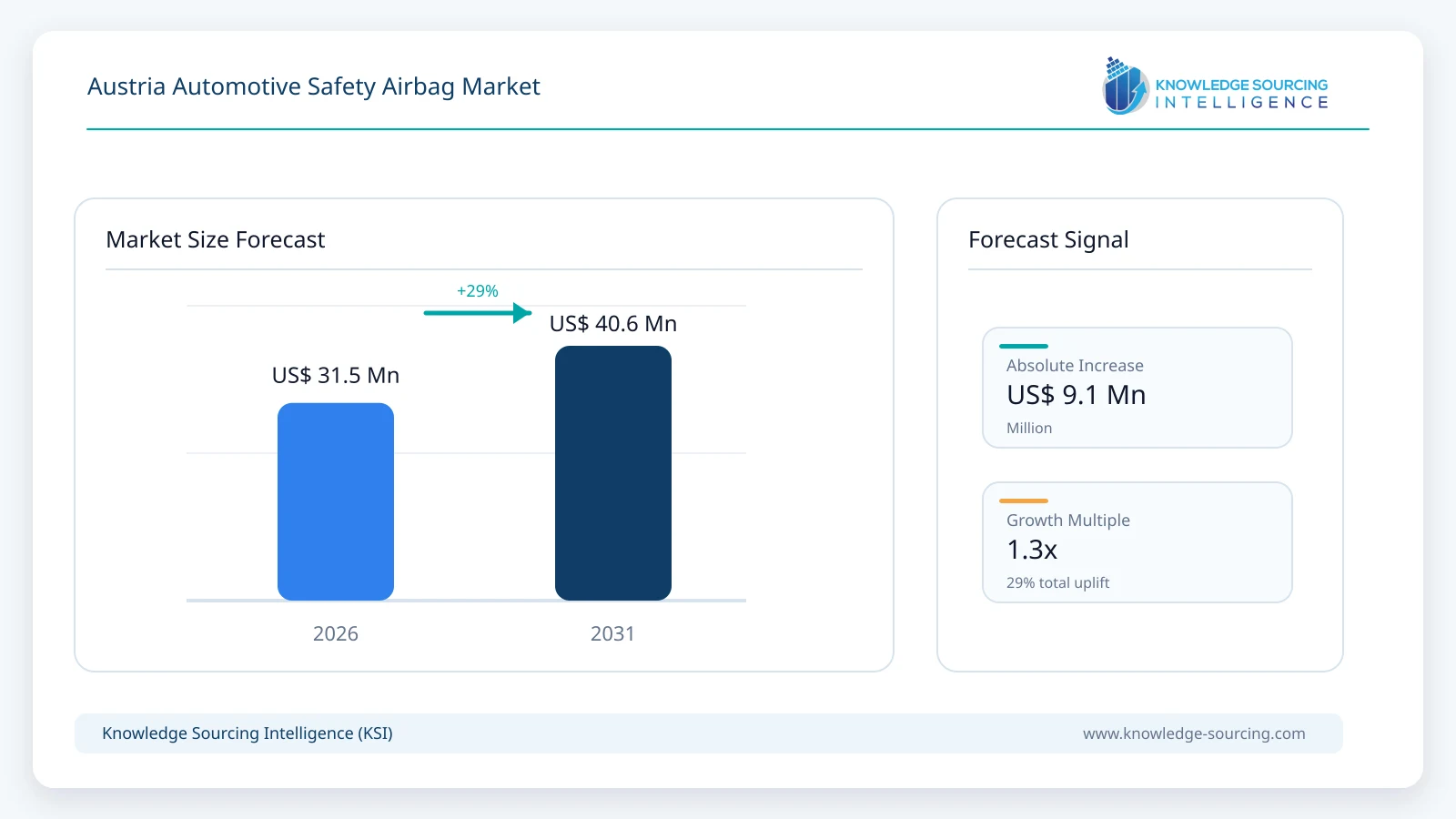
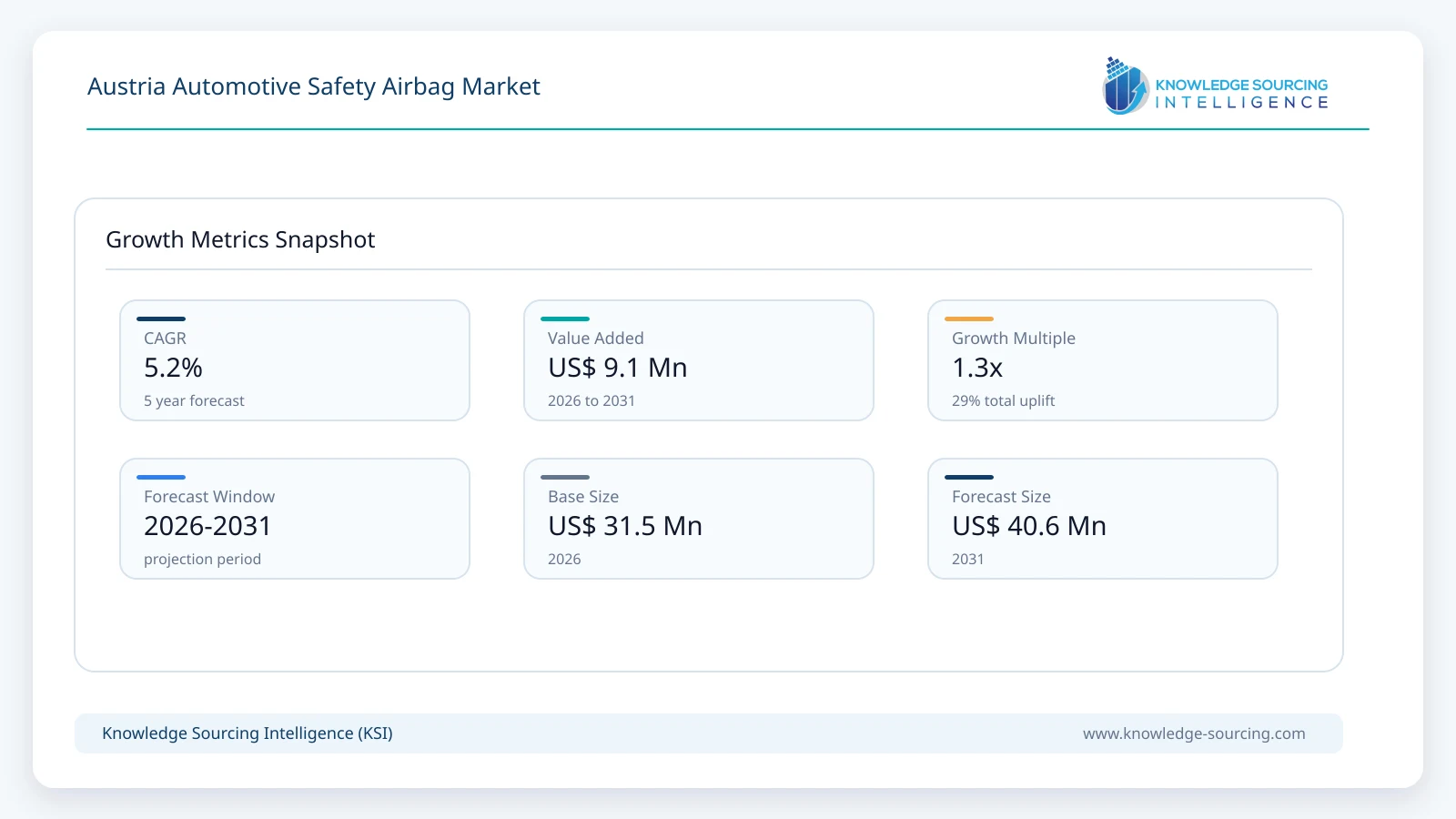
The Austria Automotive Safety Airbag Market is projected to grow at a CAGR of 5.21%, reaching USD 40.6 million in 2031 from USD 31.5 million in 2026.
Highlights:
- 1Front airbags account for an estimated 45% of 2026 product revenue.
- 2Passenger vehicles contribute approximately 89.1% of demand across the vehicle mix.
- 3OEM installations represent approximately 96% of sales, reflecting platform-level safety procurement.
- 4Far-side occupant assessment and adaptive deployment increase the complexity of restraint development.
- 5Vehicle replacement and richer side-protection content support Austrian demand over the forecast period.
The Austrian automotive safety airbag market comprises complete frontal, side and other inflatable occupant-restraint modules supplied as original equipment or authorised replacements for road vehicles entering the Austrian market. Airbag assemblies incorporate textile cushions, gas generators, housings and deployment interfaces; their value is linked to vehicle-platform safety specifications and the number and type of protected seating positions. Seatbelts, crash sensors, general electronic control units and complete vehicles are not counted as separate airbag sales.
Most demand is captured through OEM supply programmes associated with imported passenger cars, making Austria an end-market for systems manufactured across Europe and Asia. Domestic contract assembly creates a further engineering and integration connection but does not make every exported vehicle an additional Austrian end-market sale. Suppliers such as Autoliv, ZF LIFETEC, Toyoda Gosei and Joyson Safety Systems compete through validated restraint architectures and global OEM nomination processes.
Market Overview
The airbags fitted to new Austrian passenger cars are specified and validated at vehicle-platform level. A frontal module must work with the steering wheel or instrument panel, seatbelt pretensioner and crash pulse; side-curtain installations require compatible roof-rail packaging and carefully controlled deployment alongside the glazing. In newer cabins, centre airbags and additional rear-seat protection address collisions that standard frontal systems do not fully cover. The value of a restraint package therefore depends on engineering content and the vehicle’s occupant-protection target, not simply the number of visible airbag markings.
Austria registered 284,978 new passenger cars in 2025, according to Statistics Austria, and new registrations were 12.1% higher over January–September 2026 than in the comparable prior-year period. Rising deliveries increase the flow of vehicles carrying newly specified restraints. Yet the country’s 5.29 million-car installed base is relevant chiefly to replacement demand following collision damage or service interventions, not to routine periodic purchases of new airbag modules.
Global suppliers provide the manufacturing depth behind this market. Autoliv’s product portfolio combines inflatable restraints with steering-wheel and related safety technologies, while ZF LIFETEC manufactures frontal, curtain, side and centre-airbag systems. Toyoda Gosei’s recent passenger-vehicle programmes demonstrate continued refinement of driver, knee and rear-side protection. Austrian sourcing is consequently influenced by multinational automakers’ supplier nominations, local vehicle mix and the safety specifications of models sold in the country.
Market Trends
Far-side and centre protection are extending the occupant-protection brief
Euro NCAP’s 2026 framework places more weight on occupant protection across near-side and far-side impact conditions. This changes the design challenge for restraint suppliers: protecting the struck-side occupant is not sufficient when the opposite-side passenger can move toward the centre of the cabin. Centre airbags can restrain lateral movement, while conventional curtains and thorax bags remain essential for contact with intruding structures.
Toyoda Gosei’s self-supporting front centre-airbag development illustrates the packaging implications. Unlike designs that depend on a substantial centre console for support, the proposed construction allows flexibility for changing interior layouts. Adoption still depends on platform-specific testing, cost and customer requirements; a demonstrated design is not equivalent to deployment across all Austrian vehicle registrations.
Occupant-sensitive deployment is moving closer to production integration
Airbag deployment logic increasingly depends on occupant position, size and seating configuration alongside the measured severity and direction of impact. ZF LIFETEC presented an approach in September 2026 linking in-cabin sensing with restraint decisions so that the airbag and belt response can better match the detected occupant. The product proposition extends beyond a larger cushion to the behaviour of the entire restraint architecture.
Commercialisation requires the sensors, algorithm, inflatable structure and vehicle-specific crash calibration to perform together under repeatable validation procedures. The higher engineering burden can favour established Tier 1 suppliers with comprehensive testing facilities and long OEM relationships. Smaller vehicles remain price-sensitive, however, and manufacturers may select simpler validated configurations rather than the full set of adaptive functions.
Protection is becoming more tailored to the specific seating position
Knee airbags and rear-side modules are useful where the occupant’s likely injury mechanisms cannot be addressed through the front and side curtains alone. Toyoda Gosei’s selection for a knee airbag on the Mazda CX-5 and a redesigned driver airbag for the Lexus ES reflects the continuing differentiation of modules by seat position and occupant profile. Greater content can support supplier revenue even if vehicle volumes change only modestly.
The economic limit is the additional cost, mass and packaging demand of each device. OEMs weigh marginal crash-test benefits against restraint-system complexity, vehicle architecture and required certification work. Consequently, the strongest growth in added airbags is likely to occur on platforms where test performance or occupant-use cases clearly justify incremental hardware.
Flexible interiors are creating a longer-horizon safety-design challenge
More reclined seating and alternative interior arrangements alter how occupants move during a crash. ZF LIFETEC’s June 2026 concept combines multiple strategically positioned airbags to support occupants seated farther back, with the company describing the modules as intended for series readiness from 2028. The concept demonstrates a future design direction rather than a presently installed feature on the Austrian vehicle fleet.
For suppliers, the development challenge lies in retaining protection without relying on the geometric constraints of today’s upright seating positions. Such architectures require new deployment paths, restraint coordination and substantial validation. The relevance to Austrian demand will depend on which future vehicle models actually reach local showrooms and how their safety packages are priced.
Segment Analysis
By Product Type: Front Airbag
Front airbags remain the largest product group because the driver and front passenger positions require dependable protection against frontal crash loads in practically every modern passenger vehicle. They are mechanically integrated with steering-wheel assemblies and instrument panels, and OEM procurement decisions are made during vehicle-platform development. Suppliers must balance deployment speed and stability against contact loads for drivers and passengers of different sizes.
This category is projected to reach approximately USD 16.24 million by 2031. Its share is expected to ease as centre, rear-side and other protection devices capture additional equipment expenditure, although front modules continue to account for the largest single product allocation. Toyoda Gosei’s redesigned driver airbag for the Lexus ES indicates that even a mature airbag type still undergoes meaningful engineering development.
By Vehicle Type: Passenger Vehicle
Passenger vehicles are expected to generate approximately USD 36.54 million of airbag demand in 2031. The combination of relatively high annual registration volumes and increasingly comprehensive restraint fitment distinguishes passenger cars from small commercial-fleet categories. Euro NCAP testing, model-based equipment packages and customer expectations are important influences on whether a platform includes only basic frontal protection or several additional occupant-restraint modules.
Austrian vehicle registrations are concentrated in passenger cars, while light commercial vehicles represent a narrower safety-content pool and heavy commercial vehicles use different cab architectures. Premium and electrified models may support higher hardware content, but vehicle size, seat count and crash requirements matter more directly than propulsion alone. The passenger segment therefore retains a dominant position without requiring the same average airbag value for every registered car.
By End-User: OEMs
OEM installations account for the overwhelming majority of commercial demand because airbag systems are designed, calibrated and legally approved as part of a particular vehicle configuration. Replacement modules must match these specifications, and most deployed airbags are not acquired through the open accessory market. This structure concentrates supply negotiations within global vehicle programmes and gives established suppliers an advantage in testing, traceability and product-liability management.
The OEM channel is forecast at roughly USD 38.57 million by 2031. Authorised replacement demand will continue for accident repairs, but airbags are not typical consumables and cannot be assumed to generate recurring turnover merely because Austria has a large registered fleet. Genuine components, diagnostic procedures and repair restrictions constrain the aftermarket to a much smaller commercial role.
Market Drivers
Recovery in new passenger-car registrations
New passenger-car registrations in Austria rose to 284,978 in 2025, with further year-on-year growth during the first nine months of 2026. More newly registered vehicles increase the implied demand for original-equipment airbags installed on the cars sold through the Austrian market. The effect is especially relevant because airbags are fitted at initial vehicle assembly rather than purchased as discretionary accessories.
Volume growth does not translate one-for-one into airbag revenue. The country’s model and powertrain mix, number of seats and standard safety package determine the supplier value associated with each vehicle. A sustained improvement in registrations provides a firmer base for component demand, while a reversal in model sales could still reduce the market even if nominal safety content per car increases.
Broader side-impact and far-side occupant assessment
Euro NCAP’s updated assessment protocols expand attention to occupant movement and collision configurations beyond a conventional frontal crash. Such testing encourages vehicle manufacturers to consider centre airbags, side curtains and additional protection for vulnerable occupants. Better side-impact performance becomes relevant to vehicle ratings and brand positioning in European markets, including Austria.
The supplier opportunity arises when a vehicle platform adds a qualifying module or replaces a simpler device with a more capable system. This requires crash simulation, physical testing and package optimisation, limiting the ability of low-cost new entrants to substitute into existing nominations. The increase in safety content is likely to be uneven across vehicle classes because rating priorities and customer price tolerance vary.
Higher value in occupant-specific restraint design
Airbag engineers increasingly design for a range of occupant body sizes and seating positions rather than treating a single standard test dummy as representative of every customer. Toyoda Gosei’s new driver-airbag architecture and ZF LIFETEC’s occupant-sensitive restraint concept illustrate the additional design and controls work required for this direction of travel.
For automakers, the commercial case is a robust safety package that performs consistently across tests and foreseeable occupancy conditions. Supplier content can rise when enhanced airbags carry more demanding inflator, cushion and control-interface requirements. The benefit is constrained by programme economics, but the product-level changes can help lift value without a similar increase in the number of vehicles entering the market.
Continuing need for validated replacement components
Austria’s passenger-car stock exceeded five million at the end of 2025, supporting a continuing need for genuine replacement restraint components after accidents. Unlike tyres or brakes, airbags are generally replaced because they have deployed or because damage and authorised inspection procedures require specific intervention. This makes the aftermarket event-driven and comparatively small.
Older and imported vehicles also create parts-identification complexity: a front passenger or curtain module must be compatible with the exact model year, trim and safety-system configuration. Manufacturer-approved replacements and traceable service channels benefit from these constraints. The revenue opportunity is stable in character, though not a major source of the market’s growth.
Engineering depth within European vehicle programmes
Vehicles sold in Austria draw from multinational automaker platforms that commonly use standardised restraint architectures across several markets. A single successful supplier nomination can therefore cover a broad range of models and production facilities, lowering some programme-level engineering repetition. The country also participates in the European automotive supply chain through contract assembly and associated engineering activity.
Sourcing decisions remain centred on validated performance, reliable high-volume delivery and the ability to meet customer-specific qualification milestones. Suppliers with broad airbag and inflator portfolios can coordinate more of the required development work and help automakers integrate restraints into complex interiors. Austrian demand benefits from these programmes even when the physical modules are manufactured outside the country.
Market Restraints
Platform qualification and crash-validation expenditure
Airbags are safety-critical devices: changes in fabric geometry, gas generation, deployment timing or mounting can alter occupant loads in a crash. Each new configuration must be verified against a vehicle-specific programme of analysis and testing. An attractive standalone airbag design can therefore require extensive integration work before a carmaker will accept it.
This creates high fixed development expenditure and can delay commercial adoption of newer side and centre modules. Contract awards also tend to remain tied to platform lifecycles, making it difficult for an alternative supplier to win business midway through production. Smaller vehicle programmes may not justify additional restraint types when their incremental benefit is limited.
Pressure to reduce cost and package volume
Additional airbags compete for space with interior trim, displays, wiring, structural members and passenger accommodation. In smaller cars, even a modest module can complicate assembly and create new service requirements. A more comprehensive restraint package also raises the bill of materials, particularly when several pyrotechnic devices and custom housings are added.
Automakers must decide which devices materially improve tested safety outcomes at an acceptable cost. A strong market for lower-priced passenger cars can temper the rate at which more advanced airbags become standard, even where technically viable systems already exist. Suppliers face continual demands to reduce mass and simplify assembly without weakening protective performance.
Concentration of purchasing within global automakers
The Austrian market is supplied mainly through vehicles manufactured and certified under larger multinational programmes. Airbag manufacturers are therefore exposed to a small number of major purchasing groups rather than a dispersed customer base. Automotive buyers negotiate global platform contracts and can transfer pricing pressure down the supply chain.
This buying structure can limit achievable supplier margins even when sales volumes recover. Changes in a manufacturer’s product mix or a single platform’s production schedule can affect the local value associated with imported models. Suppliers need broad customer exposure and disciplined execution to balance the revenue benefits of large nominations against concentration risk.
Product-liability and replacement-traceability obligations
An airbag that does not deploy correctly, or deploys when it should not, can create substantial injury and legal exposure. Manufacturers manage this risk through production traceability, strict pyrotechnic handling and detailed verification of inflators, cushions, housings and control interfaces. Quality systems extend across the product’s design life and replacement supply.
These obligations constrain experimental component substitutions and raise the cost of both manufacturing and aftermarket distribution. Repairs involving deployed restraints require suitable parts and qualified service procedures rather than informal component interchangeability. The resulting barriers support incumbent suppliers but limit the number of commercially credible competitors.
Dependence on replacement cycles and economic conditions
Annual airbag demand follows vehicle deliveries and their equipment content, not the full size of the Austrian passenger-car fleet. A weaker economy, financing costs or delayed fleet renewal can reduce new-car registrations and thus the flow of original-equipment airbag value. The market’s modest size limits its ability to absorb a prolonged decline in vehicle sales.
A recovery in one year can also be partly caused by purchasing deferred from earlier periods. Forecasts therefore require conservative treatment of long-run vehicle volumes rather than extending a strong nine-month growth rate unchanged to 2031. Additional airbag content can support revenue, but cannot entirely offset a substantial contraction in new-vehicle demand.
Regional Outlook
Lower Austria
Lower Austria accounts for an estimated 22.5% of national airbag market value in 2026, making it the largest federal-state demand centre. Statistics Austria recorded approximately 1.16 million passenger cars in the province at the end of 2025, the largest car stock in the country. Substantial commuter and household vehicle ownership provides a broad base for new-car replacement and authorised repair demand. The province’s sizeable commercial-vehicle population adds a smaller, distinct safety-equipment component.
Local airbag sales are tied to vehicles newly registered in the province rather than to automotive manufacturing activity alone. The product mix will consequently follow model choices, fleet renewal and changes in standard side-protection equipment. Lower Austria should remain the dominant market through the forecast period, although its share can moderate as metropolitan fleet replacement elsewhere becomes more important.
Vienna
Vienna is the fastest-growing federal-state market in the model because a dense business and passenger-transport environment supports fleet turnover, while a high proportion of newer electrified cars increases exposure to current vehicle safety packages. The province had approximately 742,000 passenger cars at the end of 2025, materially fewer than Lower Austria despite its larger urban population. That distinction makes per-vehicle equipment content and renewal dynamics particularly important.
By 2031 Vienna is projected to represent 15.6% of Austria’s market value, up from 14.0% in 2026. This is a forecast of demand associated with new registrations and replacement activity, not a claim that airbags are manufactured locally. The pace of growth will depend on fleet investment and the mix of newly registered models carrying enhanced side, rear or centre-restraint systems.
Competitive Landscape
Competition is shaped by global manufacturers able to develop complete inflatable restraint modules and validate them for series vehicle programmes. Autoliv combines airbag systems with associated passive-safety capabilities across several automotive platforms. ZF LIFETEC competes through frontal, side, centre and curtain airbags, and has recently demonstrated integration of occupant sensing with adaptive restraint performance. Toyoda Gosei and its Ashimori subsidiary broaden the range of cushion, inflator and airbag designs available to OEM purchasers.
Joyson Safety Systems and Hyundai Mobis are further participants in the global market for occupant-restraint hardware, while specialist producers including Daicel and Nippon Kayaku focus on essential gas-generating devices used within airbag assemblies. Component suppliers are relevant to the value chain, but their sales must not be added again when already included in the finished-module price. Competitive positioning in Austria depends chiefly on the supplier selected for vehicles sold there, not on whether the supplier has an Austrian headquarters.
A manufacturer able to reduce module size, broaden occupant coverage and document stable deployment across a larger range of crash conditions may have a stronger position in forthcoming programmes. Price remains decisive for standard frontal modules, whereas additional rear-side, centre and adaptive products depend more heavily on a safety-performance case. Published global corporate revenues cannot be interpreted as Austrian market shares without country-level contract information.
Recent Developments
17 September 2026: ZF LIFETEC introduced an integrated occupant-monitoring and restraint approach linking occupant sensing with adaptive airbag and seatbelt strategies; the company planned a demonstration at InCabin Europe 2026.
25 June 2026: ZF LIFETEC presented a four-airbag concept for more reclined seating positions, describing the modules as intended to become series-ready from 2028 rather than already broadly deployed.
11 June 2026: Toyoda Gosei announced selection of a redesigned driver-side airbag for the new Lexus ES, targeting improved protection for occupants with different physiques.
29 May 2026: Toyoda Gosei confirmed that its knee airbag is used on the new Mazda CX-5, demonstrating continuing development of seat-position-specific occupant protection.
2 March 2026: Toyoda Gosei completed the acquisition of Ashimori Industry as a wholly owned subsidiary, strengthening its combined airbag and seatbelt systems capabilities.
23 January 2026: Toyoda Gosei announced that its compact curtain airbag had been adopted for IM Motors’ LS9, marking its first airbag application with a Chinese automaker.
Market Outlook
The Austrian airbag market is likely to grow through the combination of a normalising new-vehicle replacement cycle and gradually rising restraint content per passenger car. Front modules will remain indispensable, but the incremental value of newer programmes increasingly sits in side-curtain, rear-side, centre and occupant-sensitive designs. The shift is likely to be selective rather than uniform across entry-level and premium vehicles.
Supplier competition will be determined by test results, platform-engineering capacity and the ability to manufacture consistent components at automotive scale. Newer approaches to occupant sensing and non-traditional seating positions may influence later-generation platforms, though concept announcements should not be confused with widespread production fitment. The greatest near-term opportunities are likely to remain products already demonstrably selected for vehicle programmes.
Lower Austria will retain a large share of national demand through its extensive vehicle population, while Vienna offers a faster-growth scenario linked to fleet renewal and the content of newer registered models. Austrian safety-equipment demand will continue to draw on a wider European and international manufacturing network. The commercial outlook therefore rests on vehicle volumes, equipment specifications and verified supplier nominations rather than domestic factory output alone.
Austria Automotive Safety Airbag Market Scope:
| Report Metric | Details |
|---|---|
| Total Market Size in 2026 | USD 31.5 million |
| Total Market Size in 2031 | USD 40.6 million |
| Forecast Unit | Million |
| Growth Rate | 5.21% |
| Study Period | 2021 to 2031 |
| Historical Data | 2021 to 2024 |
| Base Year | 2025 |
| Forecast Period | 2026 – 2031 |
| Segmentation | Product Type, Vehicle Type, End-user, Geography |
| Companies |
|
| Customization Scope | 15% Free Customization included with purchase — Request Custom Breakdown → |
| Sample & Data Access | PDF Sample, Excel Databook & Analyst Briefing — Download Free Sample → |
Market Segmentation
By Product Type
Front Airbag
Side Airbag
Others
By Vehicle Type
Passenger Vehicle
Light Commercial Vehicle
Heavy Commercial Vehicle
By End-user
OEMs
Aftermarket
By Geography
Lower Austria
Upper Austria
Styria
Vienna
Tyrol
Carinthia
Salzburg
Vorarlberg
Burgenland
Table of Contents
1. EXECUTIVE SUMMARY
1.1. Key Findings
1.2. Austria Automotive Safety Airbag Market Outlook, 2026–2031
1.3. Leading Products and End Markets
2. MARKET SNAPSHOT
2.1. Market Overview
2.2. Market Definition
2.3. Scope of the Study
2.4. Market Segmentation
3. BUSINESS LANDSCAPE
3.1. Market Drivers
3.1.1. Recovery in New Passenger-Car Registrations
3.1.2. Broader Side-Impact and Far-Side Occupant Assessment
3.1.3. Higher Value in Occupant-Specific Restraint Design
3.1.4. Continuing Need for Validated Replacement Components
3.1.5. Engineering Depth within European Vehicle Programmes
3.2. Market Restraints
3.2.1. Platform Qualification and Crash-Validation Expenditure
3.2.2. Pressure to Reduce Cost and Package Volume
3.2.3. Concentration of Purchasing within Global Automakers
3.2.4. Product-Liability and Replacement-Traceability Obligations
3.2.5. Dependence on Replacement Cycles and Economic Conditions
3.3. Market Opportunities
3.4. Porter’s Five Forces Analysis
3.5. Industry Value Chain Analysis
3.6. Policies and Regulations
3.7. Strategic Recommendations
4. TECHNOLOGICAL OUTLOOK
4.1. Occupant-Sensitive Deployment
4.2. Centre and Far-Side Airbag Architecture
4.3. Rear-Seat and Knee Protection
4.4. Integrated Testing and Calibration
5. AUSTRIA AUTOMOTIVE SAFETY AIRBAG MARKET BY PRODUCT TYPE
5.1. Introduction
5.2. Front Airbag
5.3. Side Airbag
5.4. Others
6. AUSTRIA AUTOMOTIVE SAFETY AIRBAG MARKET BY VEHICLE TYPE
6.1. Introduction
6.2. Passenger Vehicle
6.3. Light Commercial Vehicle
6.4. Heavy Commercial Vehicle
7. AUSTRIA AUTOMOTIVE SAFETY AIRBAG MARKET BY END-USER
7.1. Introduction
7.2. OEMs
7.3. Aftermarket
8. AUSTRIA AUTOMOTIVE SAFETY AIRBAG MARKET BY GEOGRAPHY
8.1. Introduction
8.2. Lower Austria
8.3. Upper Austria
8.4. Styria
8.5. Vienna
8.6. Tyrol
8.7. Carinthia
8.8. Salzburg
8.9. Vorarlberg
8.10. Burgenland
9. COMPETITIVE ENVIRONMENT AND ANALYSIS
9.1. Major Players and Strategy Analysis
9.2. Market Share Analysis
9.3. Mergers, Acquisitions, Agreements and Collaborations
9.4. Competitive Dashboard
10. COMPANY PROFILES
10.1. Autoliv, Inc.
10.2. ZF LIFETEC
10.3. Joyson Safety Systems
10.4. Toyoda Gosei Co., Ltd.
10.5. Ashimori Industry Co., Ltd.
10.6. Hyundai Mobis Co., Ltd.
10.7. Daicel Corporation
10.8. Nippon Kayaku Co., Ltd.
10.9. Nihon Plast Co., Ltd.
11. APPENDIX
11.1. Currency
11.2. Assumptions
11.3. Base and Forecast Years Timeline
11.4. Key Benefits for Stakeholders
11.5. Research Methodology
11.6. Abbreviations





Frequently asked questions
What is the projected market size of the Austria Automotive Safety Airbag Market by 2031?
The Austria Automotive Safety Airbag Market is projected to reach USD 40.6 million by 2031.
What is the CAGR for the Austria Automotive Safety Airbag Market from 2026-2031?
The Austria Automotive Safety Airbag Market is projected to grow at a CAGR of 5.21%.
Which product segment accounts for the largest revenue share in 2026?
Front airbags account for an estimated 45% of 2026 product revenue.
Which vehicle type drives the most demand in the Austrian market?
Passenger vehicles contribute approximately 89.1% of demand.
What are key factors driving Austrian automotive safety airbag demand?
Vehicle replacement and richer side-protection content support Austrian demand.
Who are the key suppliers in the Austria Automotive Safety Airbag Market?
Autoliv, ZF LIFETEC, Toyoda Gosei, and Joyson Safety Systems are key suppliers.
Cite this report
Knowledge Sourcing Intelligence. (Oct 2026). Austria Automotive Safety Airbag Market - Strategic Insights and Forecasts (2026-2031). https://www.knowledge-sourcing.com/report/austria-automotive-safety-airbag-market