
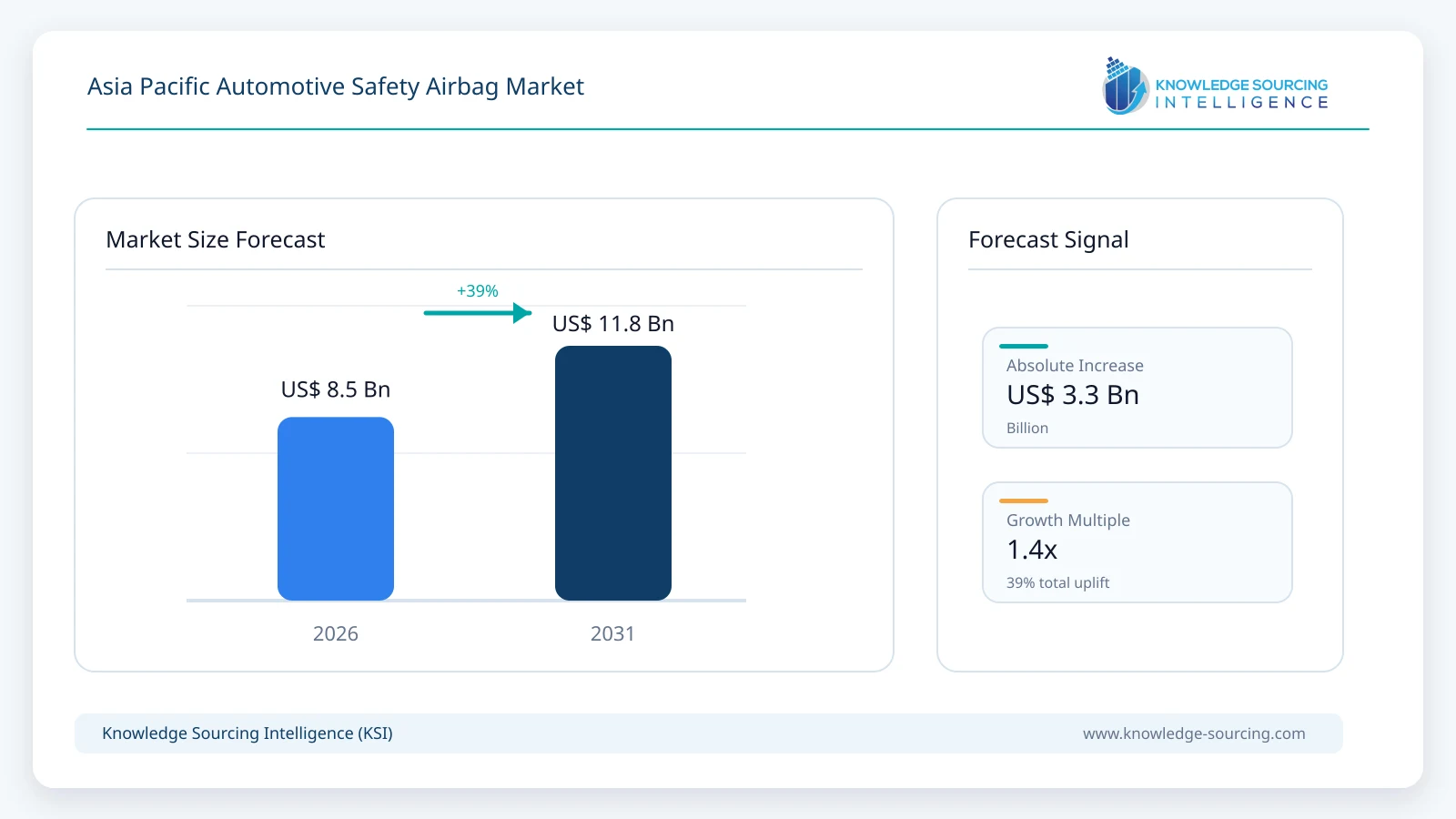
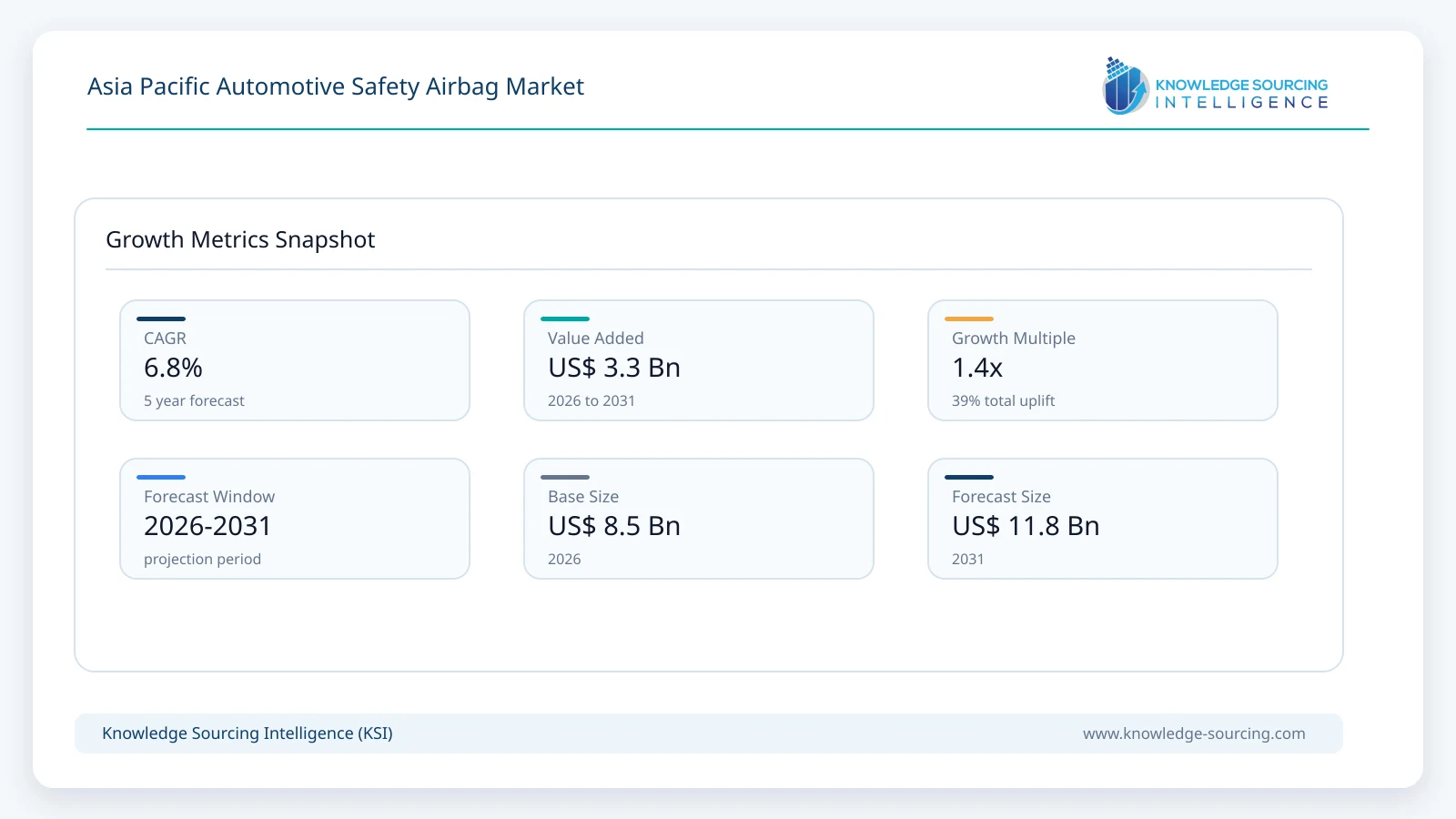
The Asia Pacific (APAC) Automotive Safety Airbag Market is projected to expand at a CAGR of 6.8%, reaching USD 11.8 billion in 2031 from USD 8.5 billion in 2026.
Highlights:
- 1Front airbags represent approximately 38% of 2026 regional revenue, supported by widespread standard fitment.
- 2Passenger vehicles account for about 86% of airbag-system value across the regional vehicle mix.
- 3Original-equipment channels dominate because restraint deployment characteristics are validated during vehicle development.
- 4Chinese automakers are widening sourcing opportunities for qualified domestic and international airbag suppliers.
- 5India records the strongest country-level growth outlook as vehicle output and safety content increase.
Automotive airbag systems sold across Asia Pacific comprise frontal, side-torso, curtain, knee and other approved occupant-restraint modules fitted to passenger and commercial vehicles. Module suppliers deliver validated assemblies for vehicle production, supported by authorized replacement parts for collision repair. Inflator manufacturers, textile specialists and module integrators operate at different stages of this tightly controlled supply chain.
Airbag sourcing is closely tied to vehicle-platform life cycles and the safety architecture specified by automakers. Suppliers qualify deployment behaviour for individual cabin structures, seating positions and collision pulses, making changes to propellant, fabric, folding geometry or inflator dimensions costly after production approval. Autoliv, Joyson Safety Systems, ZF LIFETEC, Toyoda Gosei and Japanese specialist manufacturers compete through these engineering capabilities, while regional production networks serve domestic vehicles and export programs.
Market Overview
The commercial value of an airbag program depends on the number of protective positions specified for a vehicle, module complexity and the negotiated price of a validated system. A front bag integrated into a steering wheel has a different bill of materials and qualification cycle from a roof-mounted curtain or center-side module. As vehicle makers introduce more seating configurations, electronic restraint controllers and crash-sensing strategies must be calibrated for a larger set of deployment conditions. Airbag-system suppliers consequently compete on application engineering and defect prevention as much as unit assembly cost.
Autoliv’s 2025 annual disclosures describe rapid growth with Chinese original-equipment manufacturers and rising safety content in India. In January 2026, Toyoda Gosei reported its first airbag installation by a Chinese automaker, supplying a compact curtain module to IM Motors’ LS9. This illustrates a broader shift toward cross-border sourcing in which Japanese and international producers seek vehicle programs outside their long-standing customer groups. Procurement decisions remain sensitive to local engineering support, traceable manufacturing and the ability to support model changes without restarting an entire crash-validation program.
The upstream production system combines precision-cut and folded woven cushions, inflators, housings, covers and electronic interfaces. Daicel and Nippon Kayaku develop automotive inflators, while Ashimori manufactures complete airbag assemblies and associated textiles. Their respective technologies influence finished-module performance, cost and the quality requirements imposed by automakers. Supplier exposure also differs across the region: Chinese EV platforms favor rapid model updates, Japanese programs generally involve long engineering relationships, and Indian small-car platforms require particular attention to affordability as protection specifications broaden.
Market Trends
Chinese EV Programs Are Broadening the Approved Supplier Base
Chinese manufacturers are developing a wider range of battery-electric vehicles with different dashboard volumes, seat layouts, and crash-load paths. That diversity changes demand for airbag cushion shapes and deployment strategies. Toyota Gosei’s January 2026 selection for an IM Motors curtain-airbag program is a tangible example of access beyond traditional Japanese customer relationships, while Autoliv’s July agreements with XPENG and Great Wall Motor extend safety-system collaboration with locally headquartered brands. The framework agreements do not by themselves establish delivery volumes or contract revenue.
Shorter program development intervals impose higher demands on prototype testing, digital crash simulation and application teams based close to the automaker. Suppliers without regional engineering capacity may find it difficult to convert a standard module catalogue into production contracts, even where they possess manufacturing scale. Continued expansion of Chinese platforms into export markets also increases the importance of meeting several test protocols with a common underlying restraint architecture.
Indian Vehicles Are Adding More Restraint Content
India combines rising passenger-vehicle assembly with an increase in equipment levels across several model classes. SIAM reported 4.64 million passenger-vehicle sales in fiscal 2025–26, while Autoliv reported strong growth in Indian safety content and continuing investment in inflator capacity. The market effect is not limited to additional cars: a move from basic frontal protection toward curtain and side systems increases revenue per equipped vehicle and changes the mix of cushion and inflator orders.
The regulatory distinction is important. Front driver and co-driver airbags are mandatory under applicable Indian requirements, whereas proposals for additional side and curtain airbags should not be presented as a universally implemented six-airbag mandate. Adoption of supplementary restraints therefore depends on model specifications, safety-rating ambitions and consumer preference as well as baseline regulatory compliance.
Side and Curtain Systems Are Becoming Platform-Level Design Decisions
Side impacts can expose occupants to door intrusion and contact with adjacent occupants, which frontal bags alone do not address. Far-side, curtain and center modules increasingly require coordination with seat structure, belt pretensioners and electronic sensing. Autoliv reported strong 2025 growth for side airbags and inflatable curtains, and ZF LIFETEC outlined an advanced set of airbag concepts for highly reclined seating positions in June 2026. The latter remains a future-oriented design, with series readiness indicated for 2028.
As the number of modules increases, the industry faces tighter installation spaces and more complex crash matrices. A high-specification module must still fold compactly, achieve deployment reliably after aging and meet production cost targets. These engineering requirements limit the speed at which concept demonstrations translate into installed revenue, even when their safety merits are clear.
Simulation and Component Traceability Are Changing Supplier Qualification
Autoliv introduced its Human Body Model Safety Suite in September 2026, with Toyota evaluating the virtual testing capabilities. Human-body simulation can improve analysis of occupant movement under collision conditions that are difficult to reproduce with conventional dummies, but it supplements rather than replaces physical crash testing. For airbag producers, the near-term value lies in earlier comparison of deployment geometries and fewer late-stage rework cycles.
Qualification also depends on reliable pyrotechnic and textile manufacturing. Inflator manufacturers including Daicel and Nippon Kayaku emphasize process control and repeatability, while complete-module suppliers must trace fabric, propellant and assembled products through their approved supply chains. Recalls and warranty exposure make these capabilities commercially significant even where the finished module contains relatively inexpensive materials.
Segment Analysis
By Product Type: Front Airbags
Frontal driver and passenger airbags account for the largest defined product category, equivalent to approximately USD 3.25 billion in 2026. Their installed position reflects baseline fitment in mass-market cars and the need for reliable protection during frontal crashes. Module design differs by steering-wheel packaging and dashboard architecture, while fold geometry, venting and inflator selection are adjusted to the vehicle’s restraint strategy. The mature segment provides an important base of repeat production for suppliers serving large vehicle platforms.
Growth is more moderate than for additional occupant-protection locations, so the front-airbag share gradually eases while side and specialist modules gain ground. Suppliers can defend front-module business through manufacturing quality, local delivery and integration with steering-wheel systems, although commoditization places pressure on prices. The strategic value of a frontal system nomination often comes from associated opportunities to supply a broader restraint package on the same vehicle platform.
By Vehicle Type: Passenger Vehicles
Passenger cars, SUVs and people movers drive the regional airbag market because their annual production volume and number of protected seating positions exceed those of commercial vehicles. Japanese and Korean manufacturers continue to specify established multi-airbag packages, while Chinese and Indian vehicle programs support changes in vehicle content. Commercial fleets require occupant restraint too, but payload design, cab structures and lower vehicle volumes produce a different safety-component mix.
The passenger-vehicle segment is expected to reach approximately USD 10.41 billion in 2031. Its position reflects both the expansion of equipped vehicle output and a gradual shift toward more side and curtain systems per vehicle. Suppliers therefore need capacity planning that accounts for module mix rather than forecasting airbag revenue solely from changes in passenger-car production.
By End-User: OEMs
Original-equipment manufacturers generate approximately 98% of 2026 regional airbag-system revenue. Airbag modules must meet individual vehicle crash-performance requirements, and the relevant electronic interfaces, mounting structures, and deployment parameters are normally settled before the start of production. This creates long nomination cycles and concentrates sales within automaker and tier-one supply relationships rather than open retail channels.
Authorized replacement sales form a limited market associated with collision repair and service parts. Uncertified or salvaged modules present safety and traceability concerns, while an OEM-approved replacement can command a different price from the original production module. Competitive advantage in the principal channel depends on engineering validation, supply consistency and customer program retention rather than standalone aftermarket distribution.
Market Drivers
Expansion of Vehicle Production in Key Asian Manufacturing Centers
China, India, Japan and South Korea constitute the principal regional vehicle production locations. Large platform volumes allow airbag suppliers to amortize dedicated assembly machinery and quality systems across multiple model years, while increasing assembly in India and selected Southeast Asian countries creates incremental opportunities for regional sourcing. OICA production records and SIAM manufacturing and sales statistics provide observable volume drivers. Production growth alone is insufficient to explain revenue; additional module locations and changing vehicle mix determine the value of content supplied per vehicle.
Higher Protection Content on New Passenger-Vehicle Platforms
More passenger vehicles are specified with side, curtain, or center restraint options, particularly when model developers target strong crash-assessment outcomes. Each additional module involves a cushion, inflator, and attachment architecture, with testing and calibration that add value beyond a basic frontal system. Vehicle makers can also standardize a richer safety package across trim levels, reducing specification complexity while lifting the average restraint bill. Adoption remains uneven across entry models, making platform-level evidence more useful than blanket fitment assumptions.
Indian Localisation of Inflator and Module Supply
Autoliv’s India manufacturing investments and Daicel’s regional inflator operations illustrate the supplier response to rising demand for vehicle safety content. Local production can reduce foreign-exchange exposure, shipping lead times and buffer stock requirements, although pyrotechnic facilities remain capital intensive and highly regulated. The business case is strongest for programs with predictable volume and stable customer nomination. Suppliers able to combine engineering support with local assembly can address requirements that imported finished modules may struggle to meet economically.
Cross-Border Qualification for Chinese Vehicle Programs
Chinese vehicle manufacturers are expanding both domestic model ranges and international sales, increasing the need for restraint systems capable of meeting several assessment standards. The Toyoda Gosei selection for IM Motors and Autoliv’s cooperation agreements with XPENG and Great Wall Motor show how safety suppliers are adapting to this procurement environment. New partnerships can improve commercial access and development coordination, but require subsequent vehicle nominations and production orders before they translate into measurable airbag revenue.
Technological Progress in Restraint Engineering
Improved deployment modeling, smaller cushion packages and more refined gas-generation technology allow airbags to be integrated into increasingly complex interiors. ZF LIFETEC’s advanced seating-position concept and Autoliv’s virtual human-body testing illustrate the direction of system development. Sophisticated methods may reduce engineering iterations and enhance occupant coverage, but meaningful market contribution requires OEM validation, competitive cost and serial-production approval. Their greatest commercial influence is likely to be on new platform specifications rather than the existing installed fleet.
Market Restraints
Vehicle-Specific Crash Validation and Long Development Cycles
An airbag cannot be transferred between vehicle models solely because its nominal cushion size and inflator output are similar. Deployment timing, cabin structures, occupant sizes and crash pulses must be evaluated together, often through extensive physical and virtual testing. These activities delay qualification and generate sunk engineering expenditure. For smaller vehicle programs, the cost of developing a distinct module can outweigh potential sales unless common hardware can be adapted without compromising validated performance.
Price Pressure in High-Volume Vehicle Programs
Asian automakers negotiate restraint-module costs under sustained pressure to maintain affordable vehicle prices. Suppliers must absorb costs for compliant fabrics, electronics, gas-generation components and traceable assembly while responding to scheduled price reductions. Shifting production closer to customers can improve delivery economics but adds fixed investment and exposure to uneven plant utilization. Cost competition is particularly consequential in entry-level cars, where additional restraint positions may compete for a limited bill-of-materials allowance.
Pyrotechnic Material and Supply-Chain Risk
Gas generators use tightly controlled chemical materials and precision components whose supply is subject to transport, storage and safety requirements. A quality deviation in an inflator or initiator can have broader effects because the affected part may appear in several module families. Suppliers require redundant tooling, lot traceability and disciplined change approval, which raise working-capital and operating costs. Sudden logistics disruptions can therefore affect output even when automakers continue to demand airbag systems.
Limited Revenue from the Replacement Channel
Most airbag value is committed during original vehicle assembly. After deployment, modules generally must be replaced with parts meeting manufacturer specifications, and incorrect repairs can create substantial safety risks. This makes the aftermarket far smaller than a normal consumable replacement category and limits entry for non-approved distributors. The regional forecast should not assume a conventional recurring-service business based on the number of vehicles already fitted with airbags.
Uneven Vehicle Safety Specifications Across Markets
Advanced restraint fitment varies with vehicle class, consumer willingness to pay and locally applicable regulation. Some passenger-vehicle models provide multiple curtain and side modules as standard equipment, while other vehicles prioritize the mandatory frontal package. Regulatory proposals can influence product planning without immediately changing delivered volumes. Suppliers must also tailor systems to country-specific crash-assessment practices, restricting the economies of scale possible from a single regional module configuration.
Regional Outlook
China
China contributes approximately 51.9% of the regional airbag market in 2026, reflecting its extensive production base and wide range of vehicle platforms. Large domestic electric-vehicle manufacturers maintain fast development schedules, while established foreign and Japanese producers continue to supply vehicles assembled for domestic and export markets. The sourcing environment rewards suppliers that can engineer compact side and curtain modules locally and support frequent changes to interior specifications. Toyoda Gosei’s curtain-airbag nomination for IM Motors and Autoliv’s new cooperation arrangements show that access to Chinese customers is expanding beyond traditional supplier relationships.
The country is expected to remain the regional revenue leader, with approximately USD 5.88 billion of airbag-system sales by 2031. Its relative share eases as faster-growing markets add safety content, but China’s scale continues to influence supplier tooling, research investment and regional component capacity. Competition among domestic and international restraint producers should remain intense, particularly where automakers compress vehicle-development cycles and negotiate price reductions between model updates.
India
Indian airbag-system value is forecast to grow at approximately 13.4% annually from 2026 to 2031, the fastest rate among the modeled national markets. The rise is supported by passenger-vehicle assembly, exports and a higher number of approved protection modules on mid-range and premium vehicles. The industry’s underlying production base is evident in SIAM’s FY2025–26 passenger-vehicle sales and the continuing local investments of international restraint suppliers. Compliance with mandatory frontal protection provides the foundation, while additional side and curtain equipment develops through model specification and crash-assessment competition.
Growth also encourages local inflator and cushion manufacturing to reduce import dependence and improve lead times. Indian vehicle producers are price sensitive, so equipment expansion must be accompanied by production efficiency and qualification discipline. Suppliers that can engineer systems for smaller passenger cabins, provide reliable gas-generation components and manage local sourcing are positioned to capture a rising share of the region’s incremental airbag demand.
Competitive Landscape
Autoliv, Joyson Safety Systems and ZF LIFETEC compete across broad passive-safety portfolios, combining airbag modules with related restraint and integration capabilities. Toyoda Gosei and NIHON PLAST have established Japanese airbag competencies, while Ashimori manufactures frontal, side, curtain and knee systems. Suppliers are differentiated by their access to platform programs, engineering proximity to automakers and capacity to deliver consistent module quality across several countries. Ranking producers by total automotive revenue would be misleading because those figures also include non-airbag products.
Daicel and Nippon Kayaku participate directly through inflators and ignition technology, supplying essential content to finished assemblies rather than necessarily selling full modules. Hyundai Mobis participates through automotive occupant-protection systems. These roles form an interconnected value chain in which component producers may sell to several module integrators. Competitive advantage increasingly depends on compact packaging, traceable pyrotechnic manufacture, physical validation and engineering responsiveness for new Chinese and Indian programs, while demand from mature Japanese platforms remains important for stable high-volume production.
Recent Developments
23 October 2026: Autoliv reported strong third-quarter performance with Indian and Chinese automaker customers and the opening of its second research and development center in China. The disclosure reflects ongoing safety-system engineering demand but does not identify separate airbag revenue for the new center.
8 September 2026: Autoliv introduced its Human Body Model Safety Suite for virtual crash analysis; Toyota began evaluating the platform. It strengthens early-stage restraint engineering rather than indicating a new airbag-production contract.
7 July 2026: Autoliv and XPENG signed a strategic framework agreement on vehicle safety development, localization and global cooperation. Specific module volumes and production nominations were not disclosed.
6 July 2026: Autoliv and Great Wall Motor expanded their global strategic cooperation framework to cover integrated safety systems and localized operations, supporting potential future platform opportunities.
25 June 2026: ZF LIFETEC unveiled a four-airbag concept for highly reclined seating, with the proposed modules planned to become series-ready in 2028; the announcement concerns development rather than current shipments.
23 January 2026: Toyoda Gosei confirmed its curtain airbag had been adopted on the IM Motors LS9, its first airbag selection by a Chinese automaker.
Market Outlook
Asia Pacific airbag demand through 2031 will be shaped by two related developments: continuing vehicle production in established hubs and a larger restraint package on selected new platforms. China will remain the center of scale competition, while Indian module and inflator programs are positioned to grow more quickly as safety specifications expand across vehicle classes. Side, curtain and center systems offer more scope for content gains than conventional frontal protection, although customer price pressure will remain material.
Supplier investment will concentrate on local validation, reliable pyrotechnic operations and design approaches that can be adapted across multiple vehicle architectures. Technology demonstrations for new seating positions and virtual crash testing will influence future nominations, but commercial benefits depend on cost-effective serial production. Companies with proven quality, regional engineering teams, and durable OEM relationships are likely to capture a disproportionate share of new vehicle program demand.
Asia Pacific Automotive Safety Airbag Market Scope:
| Report Metric | Details |
|---|---|
| Total Market Size in 2026 | USD 8.5 billion |
| Total Market Size in 2031 | USD 11.8 billion |
| Forecast Unit | Billion |
| Growth Rate | 6.8% |
| Study Period | 2021 to 2031 |
| Historical Data | 2021 to 2024 |
| Base Year | 2025 |
| Forecast Period | 2026 – 2031 |
| Segmentation | Product Type, Vehicle Type, End-user, Geography |
| Companies |
|
| Customization Scope | 15% Free Customization included with purchase — Request Custom Breakdown → |
| Sample & Data Access | PDF Sample, Excel Databook & Analyst Briefing — Download Free Sample → |
Market Segmentation
By Product Type
Front Airbag
Side Airbag
Others
By Vehicle Type
Passenger Vehicle
Light Commercial Vehicle
Heavy Commercial Vehicle
By End-user
OEMs
Aftermarket
By Geography
China
India
Japan
South Korea
Indonesia
Thailand
Taiwan
Others
Table of Contents
1. EXECUTIVE SUMMARY
2. MARKET SNAPSHOT
2.1. Market Overview
2.2. Market Definition
2.3. Scope of the Study
2.4. Market Segmentation
3. BUSINESS LANDSCAPE
3.1. Market Drivers
3.1.1. Expansion of Vehicle Production in Key Asian Manufacturing Centers
3.1.2. Higher Protection Content on New Passenger-Vehicle Platforms
3.1.3. Indian Localisation of Inflator and Module Supply
3.1.4. Cross-Border Qualification for Chinese Vehicle Programs
3.1.5. Technological Progress in Restraint Engineering
3.2. Market Restraints
3.2.1. Vehicle-Specific Crash Validation and Long Development Cycles
3.2.2. Price Pressure in High-Volume Vehicle Programs
3.2.3. Pyrotechnic Material and Supply-Chain Risk
3.2.4. Limited Revenue from the Replacement Channel
3.2.5. Uneven Vehicle Safety Specifications Across Markets
3.3. Market Opportunities
3.4. Porter’s Five Forces Analysis
3.5. Industry Value Chain Analysis
3.6. Policies and Regulations
3.7. Strategic Recommendations
4. TECHNOLOGICAL OUTLOOK
4.1. Frontal, Side and Curtain Restraint Architectures
4.2. Inflators, Fabrics and Module Integration
4.3. Crash Simulation, Qualification and Traceability
5. ASIA PACIFIC AUTOMOTIVE SAFETY AIRBAG MARKET BY PRODUCT TYPE
5.1. Introduction
5.2. Front Airbag
5.3. Side Airbag
5.4. Others
6. ASIA PACIFIC AUTOMOTIVE SAFETY AIRBAG MARKET BY VEHICLE TYPE
6.1. Introduction
6.2. Passenger Vehicle
6.3. Light Commercial Vehicle
6.4. Heavy Commercial Vehicle
7. ASIA PACIFIC AUTOMOTIVE SAFETY AIRBAG MARKET BY END-USER
7.1. Introduction
7.2. OEMs
7.3. Aftermarket
8. ASIA PACIFIC AUTOMOTIVE SAFETY AIRBAG MARKET BY GEOGRAPHY
8.1. Introduction
8.2. China
8.3. India
8.4. Japan
8.5. South Korea
8.6. Indonesia
8.7. Thailand
8.8. Taiwan
8.9. Others
9. COMPETITIVE ENVIRONMENT AND ANALYSIS
9.1. Major Players and Strategy Analysis
9.2. Market Share Analysis
9.3. Mergers, Acquisitions, Agreements and Collaborations
9.4. Competitive Dashboard
10. COMPANY PROFILES
10.1. Autoliv, Inc.
10.2. Joyson Safety Systems
10.3. ZF LIFETEC
10.4. Toyoda Gosei Co., Ltd.
10.5. NIHON PLAST CO., LTD.
10.6. Ashimori Industry Co., Ltd.
10.7. Hyundai Mobis Co., Ltd.
10.8. Daicel Corporation
10.9. Nippon Kayaku Co., Ltd.
11. APPENDIX
11.1. Currency
11.2. Assumptions
11.3. Base and Forecast Years Timeline
11.4. Key Benefits for Stakeholders
11.5. Research Methodology
11.6. Abbreviations





Frequently asked questions
What is the projected market size and growth rate for the APAC Automotive Safety Airbag Market?
The Asia Pacific Automotive Safety Airbag Market will reach USD 11.8 billion by 2031, growing at 6.8% CAGR.
Which airbag type contributes most to regional revenue?
Front airbags represent about 38% of 2026 regional revenue.
Which vehicle segment accounts for the most airbag system value in APAC?
Passenger vehicles account for about 86% of regional airbag-system value.
Which APAC country shows the strongest growth outlook for automotive airbags?
India records the strongest country-level growth outlook.
Who are the leading competitive suppliers in the APAC automotive airbag market?
Autoliv, Joyson Safety Systems, ZF LIFETEC, Toyoda Gosei are key competitors.
What is a significant trend regarding airbag sourcing by Chinese automakers?
Chinese automakers are widening sourcing opportunities for airbag suppliers.
Cite this report
Knowledge Sourcing Intelligence. (Oct 2026). Asia Pacific Automotive Safety Airbag Market - Strategic Insights and Forecasts (2026–2031). https://www.knowledge-sourcing.com/report/asia-pacific-automotive-safety-airbag-market